ChatGPT
 Perplexity AI
 Claude
While you might feel like writing a good security officer resume is hard, let us prove you wrong. When applying for jobs in this field, the key is to optimize your resume to showcase your greatest strengths and relevant experience, as well as key skills and educational credentials.
In this guide, we’ll take you through all the steps to optimize your security officer resume. Our professional examples, practical tips, useful samples, and customizable templates will help you land more job offers in no time.


 See more examples like these
Keep reading to learn how to:
- Dos and don’ts of resume writing from our security officer resume samples
- Select the correct resume format for your experience level
- Make your security officer resume ATS-friendly
- Pick between a resume summary and an objective
- Choose key security officer skills to highlight your diverse abilities
- Describe your work experience with specific and quantifiable details
- Give your security officer resume a boost with action verbs
- List your education as a security officer correctly
- Add optional resume sections (if appropriate)
- Avoid silly mistakes when writing your security officer CV
- Create a complementary cover letter for your resume
- Find the best resources for job-seeking security officers
- What to expect in terms of salary and job outlook as a security officer
Still seeking employment? Kickresume can help you find a job and tell you everything needed to get hired faster.
Security guard resume example


Why does this security officer cover letter example work?
- The education section actually supports the job: This is a good example of using education creatively. There’s no degree here, but that’s not a problem. The sports and fitness activities show stamina, discipline, and teamwork, all of which matter in security work. Instead of listing education just to fill space, the candidate uses it to back up physical readiness for the role. That’s smart.
- The experience clearly matches a real security role: The work experience stays focused on actual security duties. Patrols, inspections, access control, and client interaction are all relevant. Nothing feels out of place. You can tell the candidate understands what the job involves and hasn’t padded the resume with unrelated tasks.
- The skills section is easy to read: Breaking skills into languages and professional skills makes a real difference. It’s much easier to scan, especially for a recruiter who’s checking language ability quickly. This kind of structure shows thought and makes the resume feel clean instead of crowded.
What could be improved?
- It explains what was done, but not what changed because of it: Most bullets describe responsibilities, not outcomes. That’s the biggest missed opportunity here. Saying you conducted patrols is fine, but what did those patrols achieve? Fewer incidents? Safer sites? Happier clients? Without that, the experience feels flat.
- The profile sounds polished, but a bit generic: The profile reads well, but it leans heavily on broad phrases that could apply to almost anyone in security. It would be stronger with something concrete, like years of experience, type of sites worked on, or certifications held. One or two specifics would make it feel more real and more trustworthy.
Security guard professional resume sample

Why does this cover letter example work?
- The candidate’s niche is very clearly defined: This CV doesn’t try to appeal to every security role. It clearly positions the candidate as a close protection and VIP security professional. Terms like celebrity protection, counter-surveillance, and threat assessment immediately signal a specific niche. That focus is a strength because it attracts the right employers and filters out the wrong ones.
- The experience shows trust and autonomy: Several bullet points suggest a high level of independence and responsibility. Managing protection projects end to end, creating security plans, and coordinating with agencies all imply that this candidate was trusted to make decisions. That kind of implied responsibility is valuable, even before adding numbers or results.
What could be improved?
- The summary section is doing too much: The summary is packed with information, but it’s long and heavy. It tries to cover every skill, certification, and strength at once. This makes it harder to scan and easier to skip. Tightening it to four or five focused lines would make the strongest points stand out instead of getting buried.
- There are no numbers to show scale: This candidate clearly worked in high-stakes environments, but there’s nothing to show how big or demanding those roles were. Things like number of clients protected, length of assignments, size of teams, or types of events would help recruiters understand the level of responsibility. Without numbers, the impact feels smaller than it probably was.
Bouncer resume sample

Why does this cover letter example work?
- The Employee of the Month mention is a big plus: This is one of those details that immediately catches the eye. It tells the reader the candidate wasn’t just doing the bare minimum. Someone noticed their performance and rewarded it. Even on its own, that line adds credibility and makes the experience feel more meaningful.
- The volunteering section adds depth: Being president of a boxing club says a lot without trying too hard. It shows leadership, commitment, the ability to manage people, and, of course, a certain level of physical fitness. For bouncer or crowd control roles, that kind of background actually makes sense.
What could be improved?
- The profile talks more about looking for work than selling value: The opening sounds fine, but it spends too much time saying the candidate is looking for new opportunities. That space is better used to show why someone should want to hire them. A bit more focus on strengths and experience would make a better first impression.
- Some skills don’t really fit the target job: Programming languages and video editing tools feel out of place on a bouncer CV. They’re not wrong, but they don’t help here. A skills section works best when everything on it clearly supports the role you’re applying for.
1. Select the correct resume format for your experience level
Security companies and private clients often search for security officer professionals with a high level of experience. As such, you should select a resume format in which you can highlight your work history and relevant skills or accomplishments.
In this case, the best format for a security officer is the reverse-chronological format. This resume focuses almost entirely on work experience, making it the largest and most central section on the document.
However, for this format to be effective, an applicant needs at least 1 to 2 years of solid, recent experience within the security field. If you lack this level of experience, you should consider using one of the following alternative formats:
- The Functional Resume: The functional resume removes the focus from work experience and places it instead on education, certifications, skills, and unpaid experience. This format works well for students and recent graduates with limited formal work history.
- The Hybrid Resume: The hybrid resume combines elements from functional and reverse-chronological resumes, spreading the focus of the document out more evenly between all sections. This format is well-suited for applicants who are changing career paths with transferable skills and applicants working around large gaps in their employment history.
PRO TIP: If you’re applying for a job through an Applicant Tracking System (ATS), go with the reverse-chronological format whenever possible. Many ATS programs struggle with purely functional resumes, which can cause your application to get filtered out even before a human recruiter.
Choose your preferred template and make your resume shine.
Try our AI Resume Writer and have your resume ready in minutes!

2. Make your security officer resume ATS-friendly
A strong resume can still get rejected if the system can’t read it. Most security companies use Applicant Tracking Systems to screen resumes before a recruiter ever sees them.
That means clean formatting and clear wording matter just as much as your experience. If the ATS struggles to scan your resume, your application may never move forward.
Start with clean, readable formatting
ATS software works best with simple layouts:
- Use a one-column layout only: Don’t use columns, tables, text boxes, or sidebars. They often break ATS scanning and hide key information.
- Choose a standard font: Stick to fonts like Arial, Calibri, Helvetica, or Times New Roman. They’re easy to read and widely supported.
- Keep font sizes consistent: Use about 11–12 pt for body text and 14–16 pt for section headings.
- Use standard section headings: ATS systems recognize common titles like “Work Experience,” “Skills,” “Education,” or “Certifications.”
- Use bullet points instead of paragraphs: Bullet points help ATS software separate duties and achievements correctly.
- Save your resume as PDF or DOCX: These formats are the safest unless the job posting says otherwise.
Optimize your resume for ATS keyword scanning
Unfortunately, ATS can't judge the quality of your resume. It scans for keyword matches. So, if your resume doesn’t include the right terms, it can get filtered out even if you’re qualified.
Here's what you need to do:
- Mirror keywords from the job posting: If the ad mentions “access control,” “patrol reporting,” or “incident response,” use those exact phrases where they apply.
- Avoid icons, graphics, and skill bars: They may look modern, but many ATS systems can’t read them correctly.
- Don’t hide keywords: Tricks like white text, tiny fonts, or keyword stuffing can flag your resume and get you out of the race early.
- Always include a clear job title: ATS searches rely heavily on job titles. If yours was uncommon, add a clearer version in brackets. For example: Site Protection Officer (Security Officer)
Use ATS-friendly templates to save time
Formatting a resume manually can be frustrating, especially if you’re not sure how ATS software reads design elements. That’s why many job seekers use templates built with ATS in mind.
Kickresume’s resume templates are designed to stay clean, readable, and easy to scan. That way, your security officer resume gets past the software and still looks professional to hiring managers.
Find out your resume score!

3. Pick between a resume summary and an objective
This section sits at the very top of your resume, and it does more work than most people realize. It's often the first thing a recruiter reads, sometimes the only thing if they're scanning fast.
This CV section needs to be short and focused (3-5 sentences is usually all you have).
What this section should NOT include:
- Long backstories or personal details
- Empty phrases like “hardworking professional”
- Buzzwords with no proof
- Irrelevant experience
- Generic goals that could apply to anyone
Because this section is short, every word has to earn its place.
Resume summary
A resume summary focuses on what you’ve already done.
Pick a summary if you have prior security experience. This works best for licensed officers, guards with several years on the job, or anyone applying for a similar role they already held.
A strong summary should highlight:
- Your job title or specialization
- Years of experience
- Key skills or responsibilities
- Certifications or licenses
- One or two specific achievements
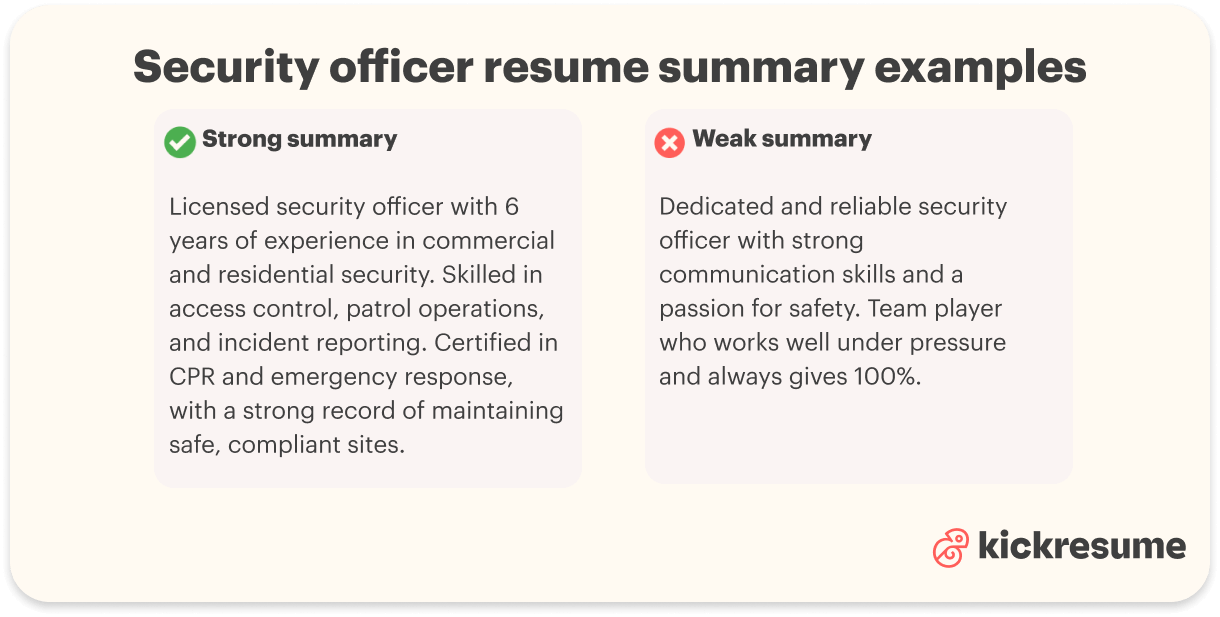
Bad security officer resume summary example
Dedicated and reliable security officer with strong communication skills and a passion for safety. Team player who works well under pressure and always gives 100%.
Why is this so blah? This example fails because it says nothing specific. There’s no experience level, no credentials, and no proof. Any applicant could copy and paste this, which makes it forgettable.
Good security officer resume summary example
Licensed security officer with 6 years of experience in commercial and residential security. Skilled in access control, patrol operations, and incident reporting. Certified in CPR and emergency response, with a strong record of maintaining safe, compliant sites.
Why is this one so much better? This example works because it’s clear and specific. You know the role, experience level, skills, and certifications right away. This resume summary gives the recruiter real reasons to keep reading.
Resume objective
A resume objective focuses on where you’re headed and why you’re a good fit, even if your experience is still limited.
Go with an objective if you’re new to security, changing careers, or applying for your first security job.
A strong objective should highlight:
- The job title you’re applying for
- Relevant training, licenses, or certifications
- Transferable skills (skills you picked up in a different job but can also be utilized in security)
- Your professional goal
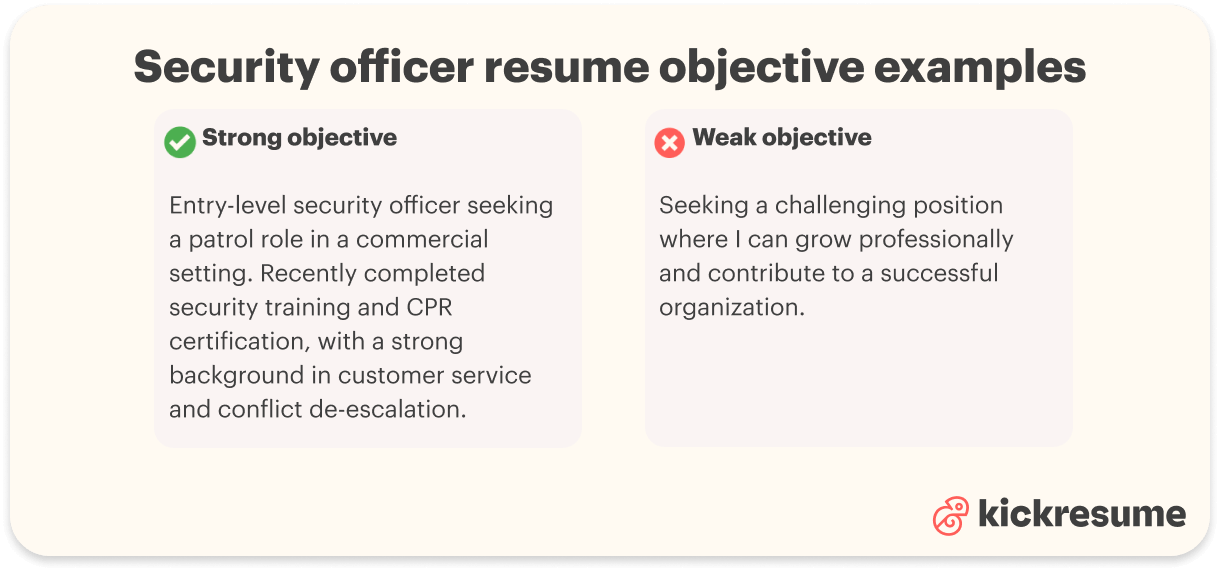
Bad security officer resume objective example
Seeking a challenging position where I can grow professionally and contribute to a successful organization.
Why doesn't this objective work? Because it’s vague and employer-focused in the wrong way. It only shows what the candidate wants from the employer, not how they can contribute. It doesn’t mention security, skills, or qualifications. It tells the recruiter nothing useful.
Good security officer resume objective example
Entry-level security officer seeking a patrol role in a commercial setting. Recently completed security training and CPR certification, with a strong background in customer service and conflict de-escalation.
What makes this one better? This example works because it’s specific and honest. It clearly states the role (and the level of experience the candidate has), shows relevant preparation, and connects past skills to security work.
Whichever option you choose, avoid empty buzzwords like “hard-working,” “motivated,” or “people person.” Let your results, skills, and examples say those things for you.
4. Choose key security officer skills to highlight your diverse abilities
Not all skills belong on your resume. That's why you can't just list everything you can do and hope for the best. You need to show you have exactly what this job needs.
Here’s a simple way to choose the right skills:
- Read the job posting again
- Highlight skills, tools, and duties they mention
- Check which ones you actually have
- Use those exact skills on your resume
If a skill shows up in the ad, and you genuinely have it, that’s a priority skill.
You can also include skills that aren’t listed directly, but ONLY IF they clearly support the role.
For example, crowd control makes sense for event security. It matters less for overnight site monitoring. Customer service fits front desk security, but it’s less relevant for remote patrol work.
If the connection feels forced, simply leave it out.
Hard skills vs soft skills in security
Security roles rely on both technical abilities and personal judgment. So naturally, employers look for a mix of both.
Hard skills are teachable, job-specific skills. They’re often tied to training, tools, procedures, or certifications.
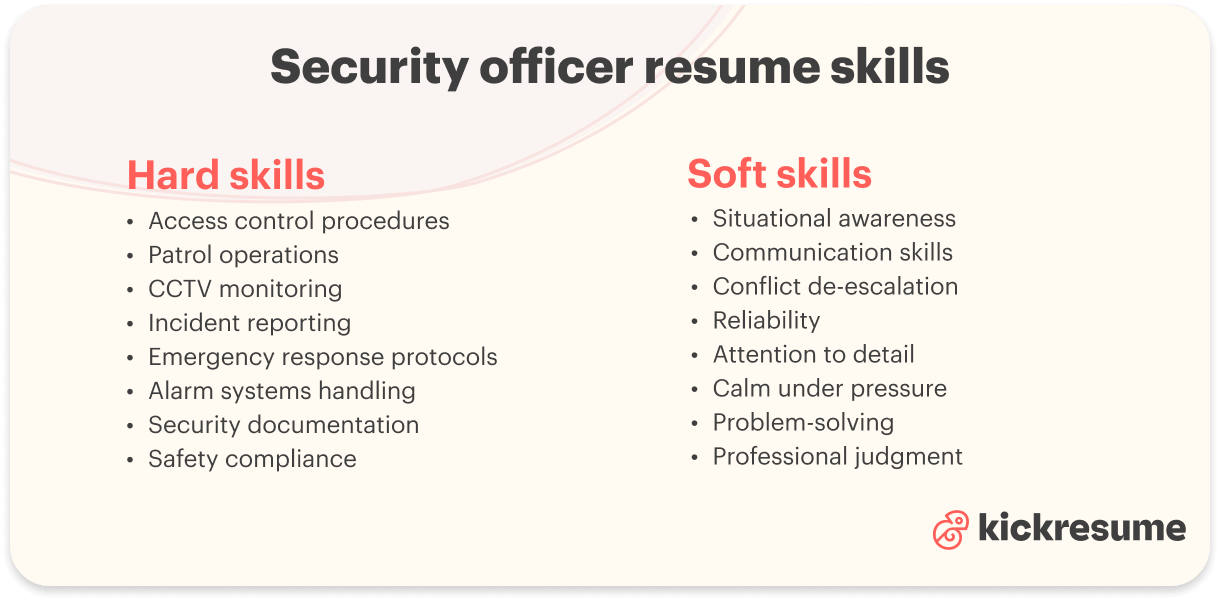
10 in-demand hard skills for security officers
- Access control procedures
- Patrol operations
- CCTV monitoring
- Incident reporting
- Emergency response protocols
- Alarm systems handling
- Security documentation
- Safety compliance
- Radio communication
- Physical security procedures
Soft skills are about how you work and how you handle people and situations.
10 in-demand soft skills for security officers
- Situational awareness
- Communication skills
- Conflict de-escalation
- Reliability
- Attention to detail
- Calm under pressure
- Problem-solving
- Professional judgment
- Customer service
- Teamwork
Where to place skills on your resume
You can list skills in a separate Skills section. This is especially useful for hard skills, certifications, and technical abilities that ATS systems scan for.
At the same time, your resume shouldn’t just list skills. It should show them in a specific professional context (in your work experience section).
Hard skills can live in both places. Soft skills work best inside your experience bullet points, where you can show how you used them in real situations instead of just naming them.
5. Describe your work experience with specific and quantifiable details
Skills alone don’t convince employers. Results do. Hiring managers want to see how you used those skills on the job and what impact you had. The work experience section turns empty claims into solid evidence.
What a strong work experience entry includes
A strong entry usually includes:
- Job title
- Employer name and location
- Dates of employment
- Core responsibilities
- Achievements or results
- Numbers or outcomes when possible
Bad security officer work experience example
Security Officer
ABC Security Services
- I was responsible for monitoring the premises.
- I was responsible for patrolling assigned areas.
- I was responsible for keeping people safe.
Why isn't this entry enough? This example won't impress recruiters because it’s vague and generic. There’s no detail, no scale, and no results. It could describe almost any security job, which makes the candidate blend in instead of stand out.
Good security officer work experience example
Security Officer
ABC Security Services | 2019–2024
- Conducted regular patrols across a 20,000 sq ft commercial property, reducing unauthorized access incidents by 30%.
- Monitored CCTV systems and access points for a multi-tenant office site with over 500 daily occupants.
- Responded to alarms and on-site incidents, completing accurate reports for all security events.
- Enforced access control procedures and verified credentials for staff, visitors, and contractors.
- Coordinated with local law enforcement during emergency situations to ensure rapid and safe resolution.
What works here? This example works because it’s specific and measurable. Each bullet starts with a clear action, shows responsibility, and adds context through numbers or outcomes.
What security officers can quantify on their resume
Many security officers think their work can’t be measured. That’s rarely true. You just have to look at your role through an employer’s eyes.
Here are common areas security officers can quantify, even if the job didn’t feel “data-driven” at the time.
Sites, people, and assets protected
These numbers show the size and importance of your assignment.
- Number of buildings, sites, or floors monitored
- Square footage of the property
- Average number of people on-site per shift
- Type and value of assets protected
Patrol and monitoring activity
These metrics highlight consistency and coverage.
- Number of patrols completed per shift
- Frequency of patrol rounds
- Number of cameras or access points monitored
- Length of assigned patrol routes
Incident response and reporting
This shows how often you handled real situations and how you responded.
- Number of incidents handled per month
- Types of incidents resolved
- Response times
- Number of reports written
Access control and compliance
These details show trust and responsibility.
- Number of employees, visitors, or contractors screened
- Volume of badge checks or credential verification
- Compliance rates or improvements
- Policy enforcement actions
Teamwork and leadership
Even if you weren’t a supervisor, you can still show leadership impact.
- Number of officers on a shift
- New hires trained
- Shifts or posts coordinated
- Coverage maintained during shortages
Safety improvements and outcomes
These numbers show results, not just activity.
- Reduction in incidents
- Improvements in response time
- Decrease in policy violations
- Positive audit or inspection results
How to structure your security officer experience section
A few simple rules make this section easier to read and more effective:
- Use 3–5 bullet points for recent roles
- Use fewer bullets for older positions
- Focus on the last 10–15 years of experience
- List jobs from most recent to oldest
- Prioritize relevance over completeness
Customization and specificity are what separate average resumes from strong ones. Choose experience that supports the job you’re applying for and describe it with real details. When your work history clearly backs up your skills, your resume becomes much harder to ignore.
6. Give your security officer resume a boost with action verbs
Action verbs place you in control of the task and help recruiters quickly understand your role. Plus, in a fast scan, they also make your bullet points easier to read and more convincing.
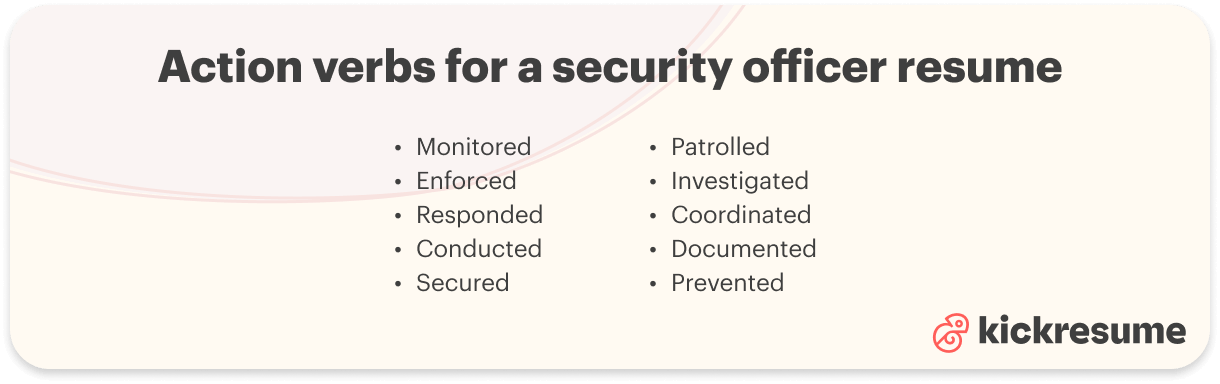
Best action verbs for security officer resume
- Monitored
- Enforced
- Responded
- Conducted
- Secured
- Patrolled
- Investigated
- Coordinated
- Documented
- Prevented
To give you a better idea of how exactly action verbs can help you sound more confident and proactive, we've prepared a few examples below.
Security officer resume without action verbs
Before:
- I was responsible for watching security cameras during my shift.
- I made sure site rules were followed by visitors and staff.
- I handled incidents when they happened.
- I helped keep the building safe.
- I looked into security issues when needed.
And this is how the same message can be delivered much more memorably:
Examples of action verbs on a security officer resume
After:
- Monitored CCTV systems covering multiple access points to detect and report suspicious activity.
- Enforced site security policies and access control procedures for staff and visitors.
- Responded to on-site incidents and alarms, following emergency protocols and reporting procedures.
- Secured a commercial property by monitoring entry points and verifying credentials.
- Investigated security incidents and documented findings in detailed reports.
Before you finalize your resume, scan your bullet points and replace weak phrases (“was in charge of,” “helped with,” “responsible for”) with stronger verbs.
7. List your education as a security officer correctly
In security, hands-on experience matters more than formal education. Most employers care far more about what you’ve done on the job than where you studied.
That said, the education section is still a non-negotiable part of any resume and leaving it out can raise questions.
The good news is you have more than one way to handle it. Depending on your path, you might have:
- Started working in security straight out of high school
- Completed formal security training or certification programs
- Earned a degree in criminal justice or a related field
- Taken short courses focused on safety, emergency response, or surveillance
No matter which route you took, your education section should be honest and relevant.
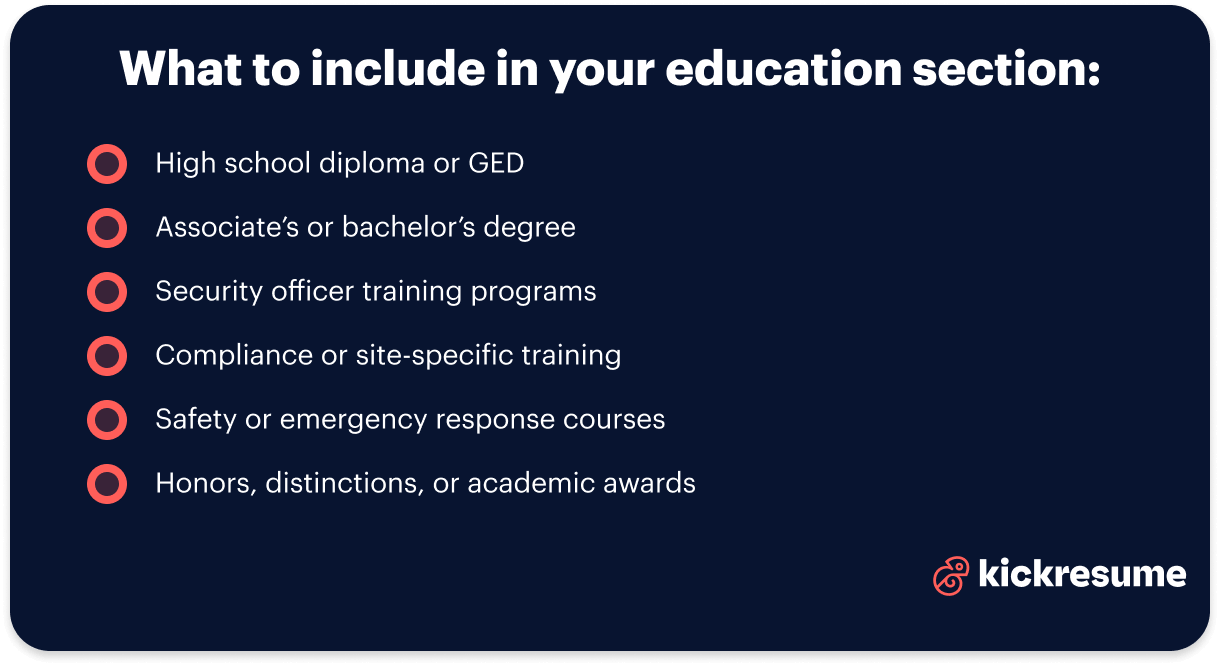
What to include in your education section
- High school diploma or GED: This is often the minimum requirement for security roles.
- Associate’s or bachelor’s degree: Common fields include Criminal Justice, Public Safety, Law Enforcement, or Homeland Security.
- Security training programs: Especially relevant for entry-level roles or career switchers.
- Relevant coursework: Useful if you lack experience or completed a related program.
Whichever of these fits your experience, make sure you structure your education entries like so:
Education section example for a security officer resume
Associate’s Degree in Criminal Justice
Phoenix College, Phoenix, AZ
2019 – 2021
- Relevant coursework: Criminal Law Basics, Public Safety Procedures, Emergency Response, Ethics in Security
High School Diploma
Central High School, Phoenix, AZ
Graduated 2019
If you don’t have a formal degree
That’s completely fine. Many successful security officers don’t and many employers don't ask for it either. If that's your case, shift the focus toward practical training and job-related learning.
Lean more heavily on:
- Security officer training programs
- On-the-job training
- Safety or emergency response courses
- Company certifications
- Compliance or site-specific training
Even short programs and internal training show that you take the role seriously and are committed to doing the job right.
8. Add optional resume sections (if appropriate)
Your resume summary, skills, and work experience form the core of your security officer resume. If those sections are strong and your resume already fills a full page, your CV is good to go.
But sometimes you have more to offer. Maybe you hold extra credentials. Maybe you’ve done specialized work that doesn’t fit neatly into your experience section.
That’s when you should consider including optional resume sections.
So, when should you add more?
YES: If you still have relevant details that would add value to your job application.
NO: If the extra sections don’t provide much additional value and would just serve to fill up space. Adding unnecessary or irrelevant info could easily backfire. It might make your resume look cluttered, and hiring managers may lose interest halfway through.
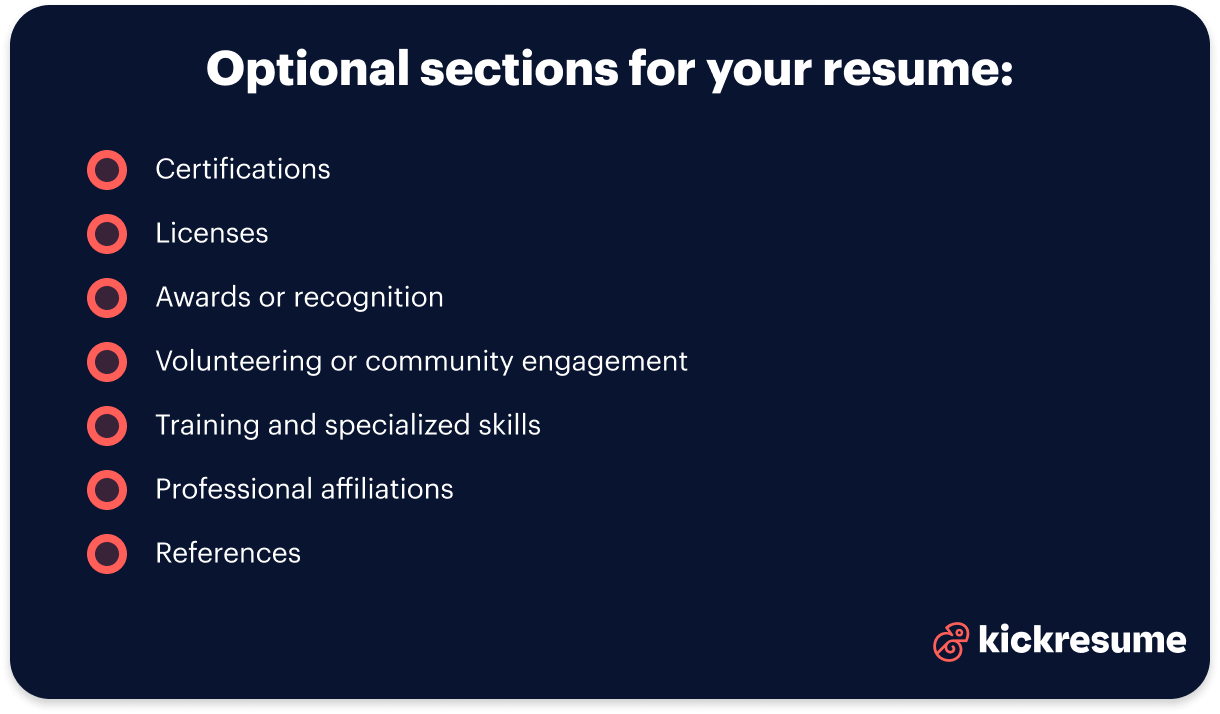
Optional sections that make sense for security officers
- Licenses: If you hold active security licenses, this section can be very effective because it shows that you meet legal and employer requirements.
- Certifications: They’re especially useful if the job involves safety, emergencies, or specialized environments (examples: CPR and First Aid, Fire safety certification, etc.)
- Training and specialized skills: This section works well if you’ve completed role-specific training that isn’t obvious from job titles alone.
- Awards and recognition: If you’ve been formally recognized, include it. This could be anything from Employee of the Month to Safety excellence awards.
- Professional affiliations: Membership in security or safety organizations shows commitment to the field.
- Volunteer security work: Volunteer roles still count if they’re relevant.
Example of optional sections on a security officer resume
Licenses
- Unarmed Security Officer License, State of Arizona, Valid through 2026
Certifications*
- CPR and First Aid Certification
- Emergency Response Training
Awards
- Employee of the Month, SecureGuard Services, March 2024
*If you’ve already listed licenses or certifications under education, don’t repeat them here. Duplication doesn’t add value and can clutter your resume.
Optional sections should support your candidacy, not distract from it. If they make your resume clearer, stronger, or more relevant, include them. If not, leave them out.
9. Avoid silly mistakes when writing your security officer CV
You can have solid experience and the right licenses, and still get rejected for small, avoidable resume mistakes.
Before you send your CV, take a few minutes to check for hiccups that can easily cost you interviews.
Here’s what to watch out for:
#1 Typos and spelling errors
Spelling mistakes can make you look careless, even if that’s not true. For example, writing “incident repport” or “surveilance” can raise doubts about your attention to details.
#2 Vague job descriptions
Generic phrases like “provided security services” don’t tell the employer much about what you're capable of.
#3 Overloading the CV with irrelevant experience
Unrelated roles, like listing a high school summer job with no connection to security, can water down your message and push relevant experience further down.
#4 Using the same CV for every job
Different security roles require different strengths. And one-size-fits-all CV won't get you far. You simply can't send the same CV to an event security role and a night patrol position and expect a positive outcome.
#5 Listing duties without results
Listing duties alone don’t show how well you performed them. And ultimately, that's precisely what employers care about.
#6 Ignoring soft skills
Sure, employers will hire you for your hard skills and practical experience. But you need to keep in mind that security officers deal with people every day.
#7 Poor formatting and layout
A cluttered CV is hard to read and easy to skip. Long paragraphs, mixed fonts, or inconsistent spacing are ideal for making recruiters fed up and annoyed with your CV.
#8 Skipping keywords from the job ad
Many employers use ATS software to filter CVs before a human sees them. So, if the job ad asks for “access control,” but your CV only says “checking IDs,” your resume might not make it through the ATS.
#9 Adding information that doesn’t matter
Extra details that don't add much value to your application can distract from what’s important. For example, listing hobbies like gaming or fishing does nothing to support your security skills.
Small mistakes can undo strong experience. Catching them before you apply can make a real difference in how your security officer CV is received.
10. Create a complementary cover letter for your resume
A resume shows what you’ve done, but it doesn’t explain why you want this job or why you care about the role. That's what a security officer cover letter is for.
How a resume and cover letter differ
Although these two documents are a part of the same application, they serve slightly different purposes, and that’s a good thing.
Your resume is factual and structured. It focuses on:
- Job titles and employers
- Dates of employment
- Skills and certifications
- Achievements and numbers
It’s designed for fast scanning and you don’t really get to speak directly to the recruiter.
Your cover letter is more flexible and personal. It gives you space to:
- Explain why you’re applying
- Show interest in the company or site
- Highlight motivation and work ethic
- Connect your experience to the role in plain language
How the two documents should work together
Your resume presents the facts and your cover letter adds meaning.
Your cover letter is the perfect place to:
- Add context to your experience
- Explain career changes or gaps
- Highlight why a specific role interests you
- Show how your skills fit the employer’s needs
For example, your resume may say you worked site security for five years. And your cover letter can explain why that environment suits you and what you learned from it.
How they should NOT interact
There aren't that many rules about cover letter writing. But there's one principle you always need to follow: Your cover letter shouldn't just repeat your resume word for word. That wastes space and attention.
Always avoid:
- Listing the same bullet points again
- Copying your resume summary into the letter
- Repeating job descriptions without added insight
If something is already clear from the resume, don’t restate it. Expand on it instead.
Make your resume and cover letter visually compatible
It's true that visual consistency isn't everything, but the way your application looks still matters more than most people think.
Keep your resume and cover letter visually aligned by:
- Using the same font in both documents
- Matching font sizes and spacing where possible
- Using the same color accents if you include any
- Aligning headers and section styling
An easy way to do this is by using matching templates. Kickresume’s cover letter templates often come paired with a matching resume design, so both documents look consistent without extra effort.
When your resume and cover letter support each other in content and design, your application feels complete. That extra level of care doesn’t go unnoticed.
Let your cover letter write itself — with AI!

11. Top resources for job-seeking security officers
While creating a great resume is ultimately the key to any successful job search, knowing where to look and where to send your polished resume is just as valuable.
- Industry-specific job boards: Websites like iHireSecurity and Guardpass specialize in connecting security professionals with employers. These platforms often feature roles not found on general job boards.
- Professional associations: Joining organizations such as the International Foundation for Protection Officers (IFPO) or ASIS International can provide networking opportunities, industry updates, and exclusive job listings.
- Continuous education and certifications: To stay competitive, consider taking on certifications like the Certified Protection Officer (CPO) or Certified Security Supervisor (CSS). These credentials not only boost your resume but also demonstrate your expertise and professionalism.
- Government and public sector portals: Many government agencies and municipalities post security officer jobs on their websites. Check sites like USAJobs for federal security roles or your local government’s career portal.
- Networking platforms: Sites like LinkedIn are a great way to start networking with other security professionals. Follow security-focused companies, and discover hidden job postings. Joining LinkedIn groups related to the security industry can also build your network and stay in touch with other professionals.
With resources like networking, joining professional associations, and access to the best job boards filled with thousands of job postings, you can unlock the full potential of your resume. And with a little patience, you'll land your desired job in no time.
Military / Law Enforcement Career Outlook in 2026
Law Enforcement roles (i.e. police and detectives) are projected to grow by 3% between now and 2034, which is as fast as the national average for all jobs. This means about 62,200 positions will open each year from both new jobs and workers retiring or changing careers. (Source: U.S. Bureau of Labor Statistics)
For military-specific roles, the U.S. Bureau of Labor Statistics doesn't provide employment projections, as these positions are not part of the civilian labor force data. That said, the armed forces will always need to hire and train new personnel to stay fully staffed.
Average US base salaries across popular Military / Law Enforcement roles:
- Guard: $63,678/year
- Law Enforcement Officer: $82,529/year
- Police Officer: $71,159/year
- Police Dispatcher: $60,799/year
- Security Officer: $66,918/year
Salary figures are based on Indeed's January 2026 data from anonymous submissions and job listings. What you actually earn will depend on location, company size, job type, and how much experience you have.
Security Officer Resume FAQ
What are common mistakes to avoid when writing a security officer resume?
One common mistake is using vague language—be specific to show you know what you’re doing. Another is neglecting keywords, which are crucial for ATS (Applicant Tracking Systems) and recruiters. Carefully read the job ad and include relevant terms like "surveillance," "patrol," or "incident reporting." Also, avoid bad formatting, grammar mistakes, and clutter. A clean, well-organized resume that’s easy to read will always make a better impression.
How should I effectively use keywords to improve my resume’s visibility?
Keywords are essential for passing ATS filters and catching the attention of hiring managers. To use them to your advantage, look for relevant terms directly from the job posting. Include job-specific terms like "security protocols," "access control," "fire prevention," or "emergency evacuation." The key is to naturally integrate these keywords into your skills, experience, and summary sections.
Should I include hobbies or interests on my security officer resume?
One of our most common tips is to include things in your resume only if they’re relevant to the role you’re applying for. With hobbies or interests, it’s no different. Include them only if they're relevant to the role. For instance, mentioning martial arts training or volunteer work in community safety can demonstrate your commitment to security and physical preparedness. Mentioning you can bake amazing cakes is really nice, but irrelevant, so we advise you to skip it.
What are the most important skills to highlight on a security officer resume?
Being a security officer requires a blend of both hard and soft skills, which is exactly what employers are typically looking for. So, when writing your resume don’t forget to mention both soft skills like: conflict resolution, interpersonal communication, or emergency response, but also hard skills like knowledge of security equipment and systems (e.g., CCTV, access control), surveillance, and monitoring techniques. Present these skills in specific examples and show how you’ve applied them to ensure security and safety in the past.
How can I make my security officer resume stand out from the competition?
There are a few things you can do to stand out. First, tailor the content of your resume to match the specific requirements of the job posting. Use action verbs and focus on your achievements rather than just listing your duties. Next, create a dedicated section in your resume for relevant credentials or certifications that might boost your chances like Certified Protection Officer (CPO) or CPR and First Aid certifications. Lastly, make sure it’s concise and easy to read.


![How to Write a Professional Resume Summary? [+Examples]](https://d2xe0iugdha6pz.cloudfront.net/article-small-images/How_to_Write_a_Professional_Resume_Summary_.png)
![How to List Your Education on a Resume? [+Examples]](https://d2xe0iugdha6pz.cloudfront.net/article-small-images/How_to_Put_Education_on_a_Resume_.png)
![How to Describe Your Work Experience on a Resume? [+Examples]](https://d2xe0iugdha6pz.cloudfront.net/article-small-images/How_to_Describe_Your_Work_Experience_on_a_Resume_.png)