ChatGPT
 Perplexity AI
 Claude
To become a part of a security personnel you might be asked to create a security officer cover letter. And if you feel like you don’t know where to start, this guide is for you. We’ll show you insightful examples, invaluable writing tips, modern templates, and practical samples tailored to your role. This guide will help you create the kind of cover letter that gets you the job you actually want.


 See more examples like these
Keep reading to learn:
- How to analyze real security officer cover letter samples and apply what works
- How to format and ATS-optimize a security officer cover letter to be easily readable and scannable
- How to write a professional cover letter header
- How to create a strong headline instantly captures attention
- How to choose the right greeting (even when no hiring manager is listed)
- How to introduce yourself without sounding generic or overly scripted
- Which skills to highlight first
- How to use action verbs to sound confident and proactive
- How to write a persuasive closing that encourages an interview
- Which mistakes to avoid when creating a cover letter
- Why your cover letter and resume should complement each other
- Where to find the best job-search resources for security officer roles
- What to expect in terms of salary and job outlook in security
Still looking for your next job? Our in-depth cover letter and resume guides, along with practical career tools, can help you turn applications into interviews and interviews into job offers.
Security guard cover letter sample


What works
- Clear evidence of responsibility and scope: The candidate describes specific duties such as patrolling residential and luxury areas, monitoring suspicious activity, and providing bodyguard services. This gives hiring managers a concrete sense of the level of trust and responsibility involved.
- Measurable impact on client satisfaction: Mentioning an increase in client satisfaction from 80% to 97% within a year adds strong credibility. Quantified results are especially valuable in security roles where performance is often tied to service quality and incident prevention.
- Relevant licensing and language skills included: Highlighting a valid SIA Security Guard Licence and multilingual abilities (French, English, basic Spanish) strengthens the application, particularly for roles involving diverse clients or international environments.
What could be improved
- Stronger opening with a clearer value proposition: The introduction is polite but generic. It could immediately position the candidate as an experienced, licensed security professional with a track record of improving safety and client satisfaction.
- More emphasis on risk prevention or incident handling: While responsibilities are described, adding a brief example of successfully preventing an incident, managing a security breach, or responding to an emergency would further demonstrate real-world effectiveness under pressure.
Bouncer cover letter sample

What works
- Strong alignment with role-specific demands: The candidate clearly emphasizes physical stamina, the ability to stay calm under pressure, and experience controlling IDs and maintaining a secure venue. These are directly relevant to bouncer and nightlife security roles.
- Use of structured bullet points for responsibilities: The short bullet list makes key duties easy to scan, such as resolving problematic situations, monitoring compliance with safety guidelines, and conducting patrols. This improves readability and helps hiring managers quickly assess fit.
- Additional certifications and language skills add value: Mentioning a Certified Bodyguard background and a First Aid License strengthens credibility. Multilingual skills (Portuguese, English, Spanish) are also an advantage in high-traffic, diverse environments like clubs.
What could be improved
- The greeting is too generic: The letter opens with “Dear Hiring Managers,” which feels broad and impersonal. Addressing a specific person, such as the venue manager or head of security, would demonstrate initiative, attention to detail, and genuine interest in this particular employer rather than sending a mass application.
- Limited demonstration of measurable impact: While responsibilities are listed, the letter could be more persuasive by including concrete examples, such as the number of guests handled per shift, incidents successfully de-escalated, or improvements in safety compliance.
Animal control officer cover letter sample

What works
- Clear specialization and sector focus: The candidate immediately establishes experience in local government and humane society settings, which positions them as someone familiar with public-sector procedures, regulations, and community-facing responsibilities.
- Well-defined scope of responsibilities: The letter outlines specific duties such as responding to abuse complaints, coordinating with law enforcement, handling emergency calls, and managing animal intake and adoptions. This gives the hiring manager a realistic picture of hands-on field experience.
- Clear and well-structured layout: The cover letter is organized into short, focused paragraphs that are easy to read and digest. The logical flow and concise structure make it simple for hiring managers to quickly understand the candidate’s experience and strengths without feeling overwhelmed by dense text.
What could be improved
- The closing statement is too brief and lacks direction: The conclusion is limited to a short, single sentence and doesn’t clearly encourage next steps. It would be stronger if it confidently invited an interview, reiterated key strengths, and included clear contact details or availability to make follow-up easier for the employer.
- Relocation explanation could be reframed: The mention of family relocation is understandable, but it would be more impactful to connect the move directly to enthusiasm for the specific organization or community, rather than focusing primarily on personal circumstances.
1. How to format and ATS-optimize a security officer cover letter to be easily readable and scannable
When applying for a security officer position, presentation matters just as much as experience.
Security roles are built on trust, discipline, and attention to detail. If your cover letter looks disorganized or difficult to read, hiring managers may question your professionalism before they even get to your qualifications.
Recruiters in security companies, corporate facilities, hospitals, or residential complexes often review applications quickly. A clean, structured layout ensures your key strengths are easy to spot.
Here’s how to format your security officer cover letter so it looks professional and reliable:
- Use a clear, professional font: Stick to dependable fonts such as Arial, Calibri, or Times New Roman. A font size between 10 and 12 points keeps your letter readable and formal.
- Keep paragraphs short and well-spaced: Avoid dense blocks of text. Brief, focused paragraphs with adequate white space make your letter easier to scan, especially when hiring managers are reviewing multiple candidates.
- Align text to the left: Left alignment is the most professional and readable option. Centered or overly stylized formatting can distract from your message.
- Follow a simple, structured layout: There’s no need for creative design in a security role. A straightforward format works best: Header -> Opening paragraph -> 1-2 body paragraphs -> Closing paragraph
- Limit it to one page: Security supervisors and hiring managers want clarity, not lengthy explanations. One concise page highlighting your experience, certifications, and reliability is ideal.
- Use bullet points carefully: If you want to emphasize measurable results, such as reduced incidents, improved response times, successful patrol coverage, or compliance with safety protocols, a short bullet list can help those achievements stand out.
- Keep the tone professional and steady: Security roles call for confidence, composure, and responsibility. Your tone should reflect reliability and sound judgment rather than overly aggressive or overly casual language.
Pro tip
If formatting is not your strength, using a professionally designed cover letter template can help you avoid layout mistakes and present yourself as organized and detail-oriented at first glance.
In security roles, first impressions are about trust. A clean, well-structured cover letter immediately signals that you take responsibility seriously.
Create your cover letter fast with artificial intelligence.

2. How to write a professional cover letter header
Let’s begin with the header. It may feel like a formality, but in security roles, structure and clarity are everything.
Before a hiring manager reads about your patrol experience or certifications, they see your header. A well-organized header immediately signals professionalism, reliability, and attention to detail, all essential qualities for a security officer.
Your objective is simple: make your contact information clear, complete, and easy to find.
What to include in your security officer cover letter header
Your contact details:
- Full name
- Professional title (optional, e.g., Security Officer or Licensed Security Guard)
- Phone number (with area code)
- Professional email address
- LinkedIn profile (if relevant and up to date)
- Personal website (optional)
The recipient’s details:
- Hiring manager’s name (if available)
- Their job title
- Company name
- Company address
Bad example of a security officer cover letter header
From: Mike R.
555-7788 | mike@email
To: Hiring Manager
Why this doesn’t work: The phone number is incomplete, the email looks informal, and the company name is missing. In a field that requires precision and accountability, this lack of detail can create doubts about professionalism.
Good example of a security officer cover letter header
From: Michael Roberts
(415) 555-7788
michael.roberts@email.com | linkedin.com/in/michaelroberts
To: Sarah Collins, Security Operations Manager
Guardian Protection Services
240 Market Street
San Francisco, CA 94105
Why this works: The information is complete, professional, and easy to read. The applicant addressed a specific person and company, which demonstrates initiative and seriousness about the role.
Key takeaway
In security positions, accuracy and structure reflect how you approach responsibility. A clean, complete header sets a professional tone before the first paragraph even begins.
With your header in place, you can move on to crafting a strong opening that highlights your reliability and experience.
.png)
3. How to create a strong headline that instantly captures attention
Why does your headline matter?
Because it’s the first signal of who you are as a security professional. Your headline needs to immediately communicate reliability, experience, and readiness.
A strong headline should quickly show:
- Your level of experience
- Any key certifications or licenses
- The type of environment you’ve worked in
- Your core strengths in safety and risk prevention
Let’s compare two examples.
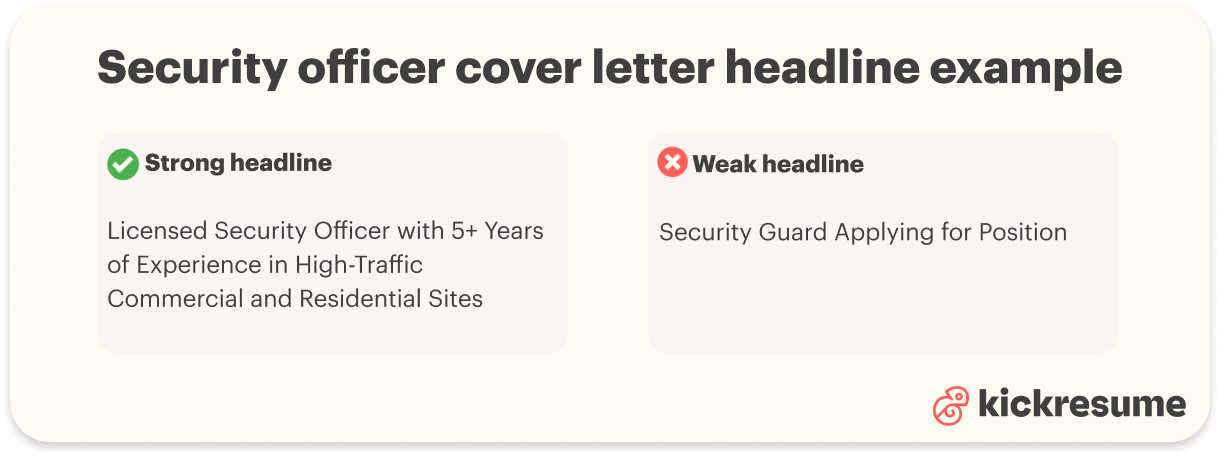
Bad example of a security officer cover letter headline
Security Guard Applying for Position
Why this doesn’t work: It simply repeats the job title and doesn’t communicate experience, licensing, or strengths. It doesn’t give the employer any reason to keep reading.
Good example of a security officer cover letter headline
Licensed Security Officer with 5+ Years of Experience in High-Traffic Commercial and Residential Sites
Why this works better:
- It highlights licensing, which is often mandatory.
- It mentions years of experience.
- It specifies the type of environment worked in.
- It immediately positions the candidate as qualified and job-ready.
If a security company is looking for someone dependable and already certified, this headline quickly checks those boxes.
Crafting a headline as an entry-level security officer
If you’re new to the field, have no previous security experience, or are transitioning from a related role (such as military service, law enforcement support, or customer-facing positions), focus on transferable strengths.
Instead of emphasizing years of experience, highlight:
- Relevant certifications (SIA, state license, First Aid, CPR)
- Conflict resolution skills
- Situational awareness
- Reliability and strong work ethic
- Experience in high-responsibility environments
Entry-level security officer headline example
Certified Security Officer with Strong Conflict Resolution Skills and First Aid Training
This works because it emphasizes qualifications and readiness, even without extensive on-site experience.
Key takeaway
Your headline is your professional positioning statement. Keep it specific, factual, and aligned with the role. In security work, clarity and credibility matter from the very first line.
4. How to choose the right greeting (even when no hiring manager is listed)
Starting your cover letter with something overly generic like “To Whom It May Concern” can make your application feel impersonal.
Security officers are expected to be observant and detail-oriented. Taking the time to address your letter to a specific person demonstrates both.
How to find the right contact name
Here are a few practical ways to identify the appropriate hiring contact:
- Review the job posting: Sometimes the site supervisor, operations manager, or HR contact is listed directly.
- Visit the company website: Look for sections such as “Leadership,” “Our Team,” or “Careers.”
- Search LinkedIn: Try titles like Security Manager, Operations Manager, Site Supervisor, or HR Manager.
- Call the company or site office: A brief, professional inquiry about who handles hiring can leave a strong first impression.
Once you have a name, use it in a professional format:
Examples of personalized greetings
- Dear Mr. Harris,
- Dear Ms. Thompson,
- Dear Ms. Laura Thompson,
Stick to formal titles unless you are certain the company culture is more informal. And always double-check spelling. In security roles, attention to detail matters.
What if you can’t find a name?
Sometimes the hiring contact simply isn’t publicly available, especially with large security firms or contract postings. If you’ve made a reasonable effort, these alternatives are perfectly acceptable:
Examples of greeting if you can't find a name
- Dear Hiring Manager,
- Dear Security Operations Team,
- Dear [Company Name] Recruitment Team,
These options remain professional and respectful without sounding outdated.
Personalizing your greeting shows initiative and professionalism. In the security field, small details reflect larger qualities like reliability and diligence. Starting your letter the right way helps establish trust before the first paragraph even begins.
.png)
5. How to introduce yourself without sounding generic or overly scripted
If you want your security officer cover letter to stand out, your opening paragraph needs to do more than simply state that you’re applying.
In security roles, employers are looking for reliability, vigilance, and sound judgment. Your introduction should quickly demonstrate that you understand what the job requires, such as protecting people and property, staying alert, following procedures, and responding calmly under pressure.
Keep it direct and avoid dramatic language. Clarity and credibility matter most.
Here’s what you can naturally include in your opening:
- A brief overview of your security or related experience
- Relevant certifications (e.g., security license, CPR/First Aid, firearms permit if applicable)
- Experience in specific environments (corporate buildings, retail, events, healthcare, residential, etc.)
- A measurable accomplishment (incident reduction, response times, compliance scores, etc.)
- A short reason why you’re interested in this company or site
- A referral, if you have one
If you’re transitioning from military, law enforcement, customer service, or another public-facing role, this is the right place to highlight transferable skills such as situational awareness, conflict resolution, reporting accuracy, and professionalism under stress.
Bad example of a security officer cover letter introduction
I am writing to apply for the security officer position at your company. I believe I would be a good fit and would like to learn more about the role.
Why this doesn’t work: It’s vague and forgettable. There’s no mention of security training, responsibilities, certifications, or specific strengths. It gives the employer no reason to keep reading.
Good example of a security officer cover letter introduction
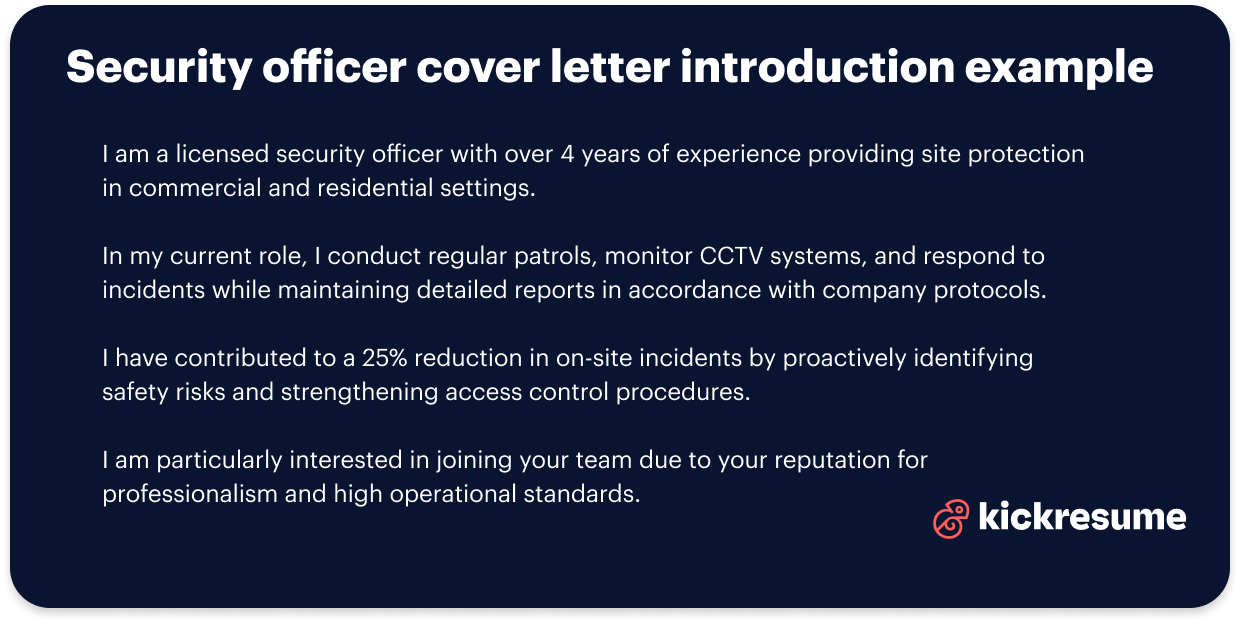
I am a licensed security officer with over 4 years of experience providing site protection in commercial and residential settings. In my current role, I conduct regular patrols, monitor CCTV systems, and respond to incidents while maintaining detailed reports in accordance with company protocols. I have contributed to a 25% reduction in on-site incidents by proactively identifying safety risks and strengthening access control procedures. I am particularly interested in joining your team due to your reputation for professionalism and high operational standards.
Why this works: This introduction establishes credentials, highlights relevant responsibilities, includes measurable results, and shows genuine interest in the employer. In just a few sentences, it communicates competence and reliability.
Tips for entry-level candidates
If you’re new to security work, focus on relevant strengths and certifications. Employers value professionalism, discipline, and responsibility.
You can highlight:
- Military or law enforcement background
- Customer service or front-desk experience
- Conflict resolution or de-escalation skills
- CPR/First Aid certification
- Strong report-writing and observation skills
- A clear motivation to work in protective services
Entry-level security officer introduction example
I am eager to apply for the security officer position at SafeGuard Services. With a background in customer service and recently completed security training, I have developed strong observation skills, clear communication habits, and the ability to remain calm in high-pressure situations. I am committed to maintaining a safe and secure environment and am ready to contribute with professionalism and attention to detail.
Why this works: Even without years of direct experience, the candidate emphasizes relevant traits and preparedness. The tone is confident and responsible, which aligns well with security roles.
A strong introduction shows that you understand security work is about prevention, awareness, and accountability. When your first paragraph communicates professionalism and trustworthiness, you immediately position yourself as a serious candidate.
6. Which skills to highlight first
The body of your cover letter is where you move from introduction to proof.
This is your chance to demonstrate how your presence and judgment contribute to a safer environment, reduced risk, and smooth daily operations.
Avoid repeating your resume word-for-word. Instead, add context. Explain your impact. Show responsibility in action.
How to structure the body
Keep it clear and disciplined:
- 2–4 short paragraphs
- Concrete examples, no unnecessary filler
- Easy to scan and focused on results
Each paragraph should answer one core question:
How do I improve safety, reduce risk, or support smooth operations at this site?
Key skills employers look for in security officers
If you’re unsure what to emphasize, these are some of the most valued skills in security roles:
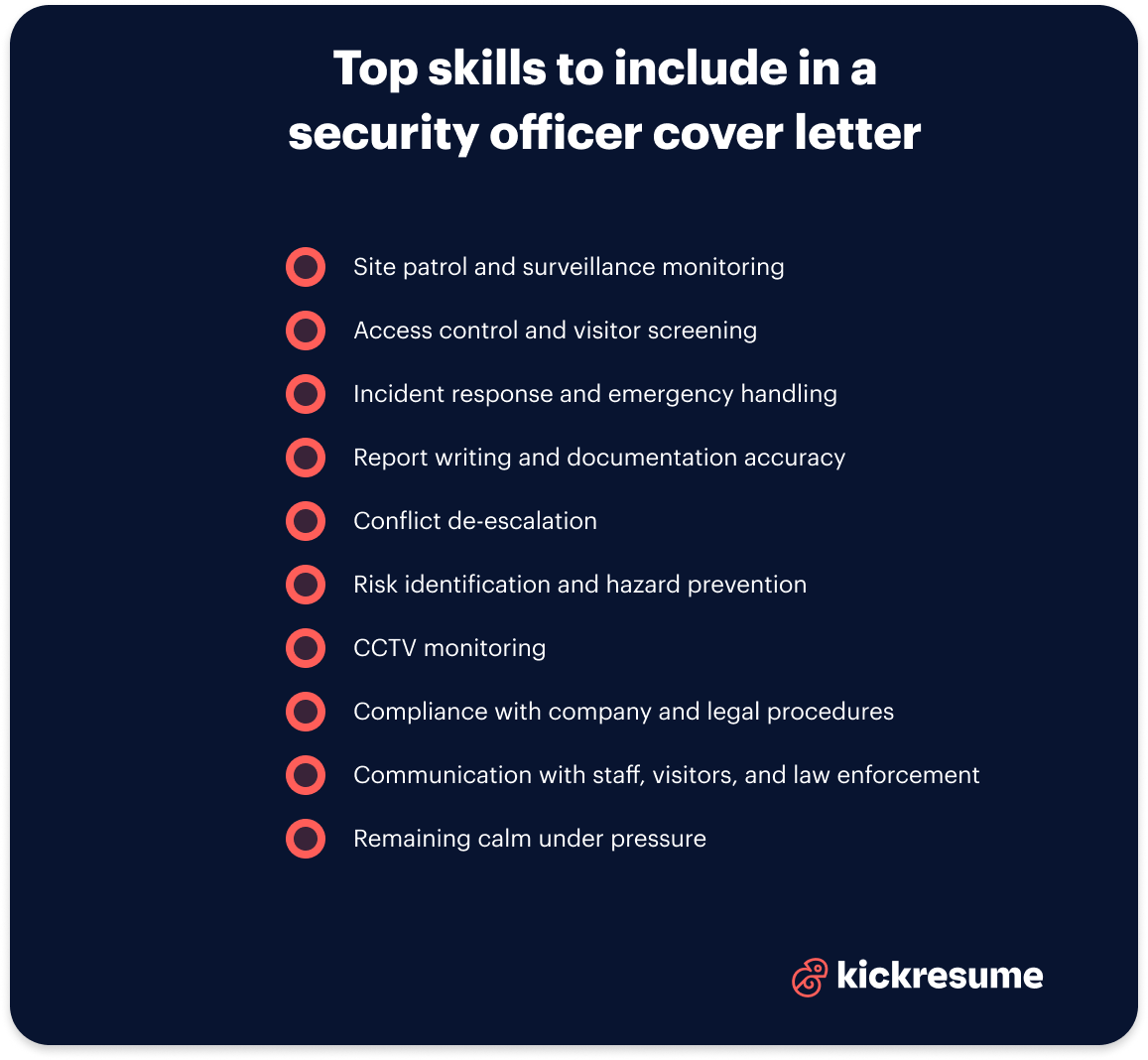
Top skills to highlight in your security officer cover letter
- Site patrol and surveillance monitoring
- Access control and visitor screening
- Incident response and emergency handling
- Report writing and documentation accuracy
- Conflict de-escalation
- Risk identification and hazard prevention
- CCTV monitoring
- Compliance with company and legal procedures
- Communication with staff, visitors, and law enforcement
- Remaining calm under pressure
How to show value, not just duties
The formula is simple:
Situation + action + result = credibility
Instead of listing what you were assigned to do, show what improved because of your actions.
Here’s how:
- Mention measurable improvements (incident reduction, faster response times, improved compliance)
- Reflect priorities from the job posting (if they stress access control, highlight your experience managing entry procedures)
- Use clear, outcome-driven examples
Examples for experienced security officers
- In my current role at a high-traffic commercial facility, I conduct routine patrols and monitor CCTV systems to identify potential risks before they escalate. By strengthening visitor verification procedures and coordinating closely with site management, I contributed to a 30% reduction in unauthorized access incidents over the past year.
- I take incident reporting seriously and ensure all documentation is accurate, detailed, and submitted on time. During a recent internal audit, my reports were used as a reference model for clarity and completeness.
- When responding to disturbances, I prioritize calm communication and de-escalation. In one instance involving an aggressive visitor, I successfully resolved the situation without injury or property damage by following protocol and maintaining composure.
- Working overnight shifts has strengthened my ability to stay alert, organized, and dependable even during long hours. I understand that consistency and vigilance are key to maintaining a secure environment.
Tips for entry-level candidates
If you’re new to security work, focus on transferable strengths:
- Military or law enforcement training
- Customer service or front-desk experience
- Strong observation skills
- Conflict management
- Responsibility in high-pressure situations
- CPR/First Aid or other certifications
Employers in security prioritize reliability, professionalism, and sound judgment just as much as years of experience.
Examples for entry-level or junior security officers
- In my previous customer service role, I regularly handled difficult situations involving frustrated customers, maintaining professionalism and resolving issues calmly. This experience strengthened my ability to stay composed under pressure and communicate clearly during conflicts.
- During volunteer event security support, I assisted with access control and monitored entry points, ensuring procedures were followed and safety guidelines were respected.
- Through security training and certification, I developed a strong understanding of patrol procedures, incident documentation, and emergency response protocols, and I am ready to apply these skills in a professional security environment.
Key takeaway
The body of your cover letter should make one thing clear: You don’t just observe. You prevent, respond, document, and protect.
When hiring managers can clearly see the safety impact you bring, it becomes much easier for them to picture you safeguarding their site.
7. How to use action verbs to sound confident and proactive
Once your structure is clear and your examples are solid, there’s one simple way to instantly elevate your cover letter: stronger verbs.
In security roles, wording matters. The verbs you choose should communicate control, awareness, and responsibility, not passive observation.
Compare these two versions:
Bad example without strong action verbs
I was responsible for monitoring the premises and reporting incidents.
Good example with strong action verbs
Monitored premises through routine patrols and CCTV surveillance, documented incidents accurately, and escalated security concerns according to protocol.
Same responsibility. Completely different level of authority.
The second version sounds decisive, professional, and accountable, which is exactly how a strong security officer should come across.
Action verbs that work well for security officer roles
Security employers look for signs of vigilance, control, and sound judgment. Your verbs should reflect that.
Effective action verbs for security officers
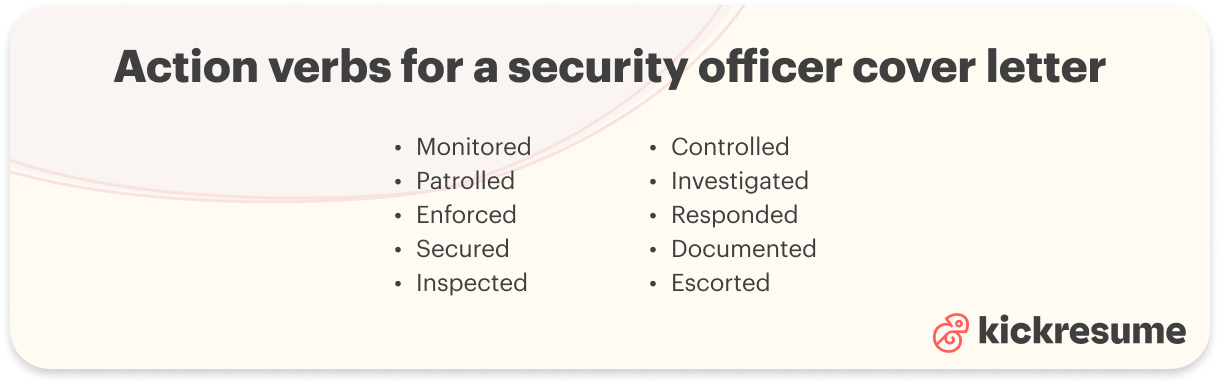
- Monitored
- Patrolled
- Enforced
- Secured
- Inspected
- Controlled
- Investigated
- Responded
- Documented
- Escorted
- Verified
- Coordinated
- De-escalated
- Reported
- Prevented
These verbs move you away from “assigned tasks” and toward demonstrated responsibility and action.
How to use action verbs effectively
The goal is not to sound dramatic. It’s to sound capable and reliable.
Here’s how to make them work:
- Start sentences or bullet-style examples with a clear verb
- Tie the action to an outcome whenever possible
- Avoid repeating the same verb multiple times
- Match the verb to your level of authority
Before including action verbs
- Checked visitor IDs.
- Helped resolve conflicts.
After including action verbs
- Verified visitor identification and enforced access control procedures to prevent unauthorized entry.
- De-escalated tense situations between individuals, preventing physical confrontation and maintaining a safe environment.
Action verbs and ATS: why they matter
Strong verbs don’t just improve tone. They also support ATS alignment.
Security job postings often include terms like:
- Monitored
- Responded
- Enforced
- Patrolled
- Investigated
- Documented
- Controlled access
Using this language naturally in your cover letter increases the likelihood that both automated systems and hiring managers recognize you as a strong match.
Key takeaway
Review the job posting carefully and mirror the terminology used. If they emphasize “incident response,” “access control,” or “surveillance monitoring,” reflect those priorities in your wording.
Strong action verbs make it clear that you don’t simply observe situations — you actively protect, prevent, and respond.
And that’s exactly what employers expect from a security officer.
8. How to write a persuasive closing that encourages an interview
Your closing paragraph may be short, but it plays an important role.
The closing should reinforce your qualities and clearly express your readiness to take the next step.
Think of it as your final demonstration of confidence and accountability.
A strong security officer cover letter closing should include:
- A professional thank-you for the reader’s time
- A brief reminder of your key strengths (vigilance, incident response, access control, conflict management)
- Genuine interest in the organization or facility
- A clear statement that you welcome an interview
- Your contact details and availability
- A polished, formal sign-off
Let’s start with what doesn’t work.
Bad example of a security officer cover letter conclusion
Thank you for reading my letter. I hope you consider me for the position and look forward to hearing from you.
Best,
John
Why this falls short:
It’s generic and doesn’t reinforce any strengths. There’s no reminder of experience, no expression of commitment to safety, and no confident invitation to move forward. For a role centered on responsibility and authority, this feels too passive.
Good example of a security officer cover letter conclusion
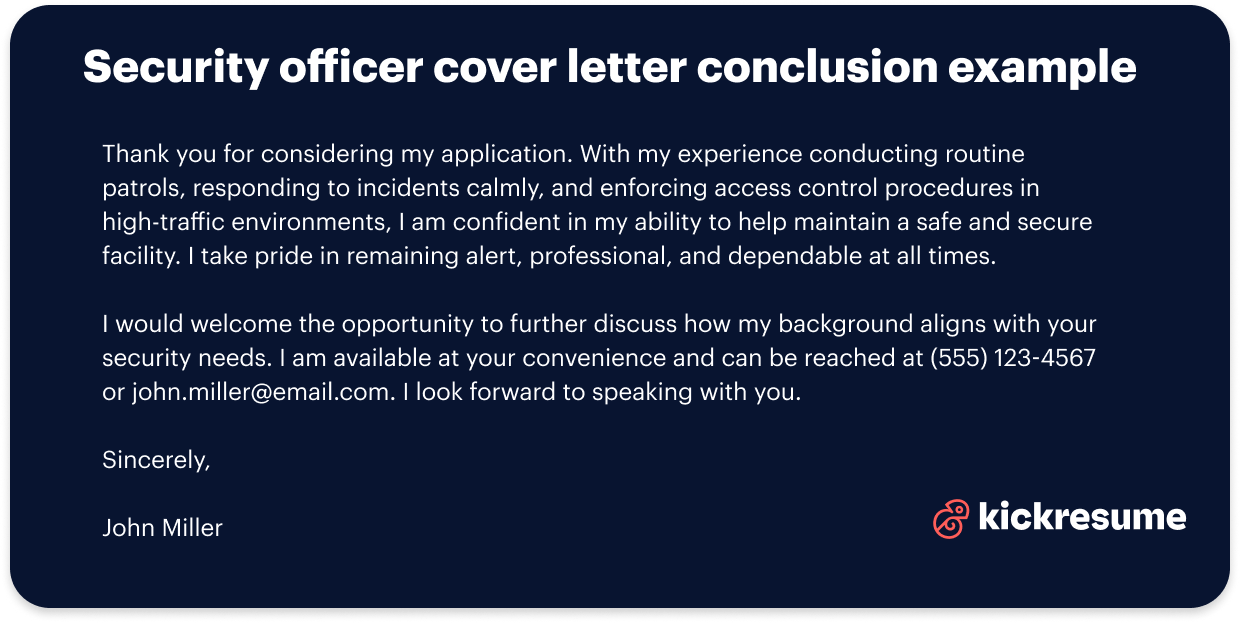
Thank you for considering my application. With my experience conducting routine patrols, responding to incidents calmly, and enforcing access control procedures in high-traffic environments, I am confident in my ability to help maintain a safe and secure facility. I take pride in remaining alert, professional, and dependable at all times.
I would welcome the opportunity to further discuss how my background aligns with your security needs. I am available at your convenience and can be reached at (555) 123-4567 or john.miller@email.com. I look forward to speaking with you.
Sincerely,
John Miller
Why this works:
It reinforces key security strengths such as vigilance and incident response. It sounds composed and professional without being overly aggressive. It clearly invites the next step while maintaining the tone expected in security roles.
Reaffirm your commitment to safety, express genuine interest in the role, and make it easy for the employer to contact you. A confident, professional ending leaves the impression that you are reliable, prepared, and ready to protect what matters most.
9. Which mistakes to avoid when creating a cover letter
Even a strong security officer cover letter can lose credibility if it includes preventable mistakes. And in security roles, where vigilance, precision, and professionalism are essential, small errors can raise serious concerns.
Here are the most common pitfalls security officer candidates face, and how to avoid them:
- Sending a generic letter to every employer: A shopping mall, corporate office, hospital, warehouse, and government facility all have different security priorities. Some focus on access control and surveillance, others on crowd management or asset protection. Tailor your letter to reflect the specific environment and risks of the facility you’re applying to protect.
- Being too vague about responsibilities: Statements like “I ensured safety” are too general. Security is results-driven. Mention specifics such as conducting perimeter patrols, monitoring CCTV systems, managing entry logs, responding to incidents, or coordinating with law enforcement when necessary.
- Focusing only on physical presence: Security work is not just about standing guard. Employers look for observation skills, report writing accuracy, de-escalation ability, and sound judgment under pressure. Highlight those qualities, not just your physical availability
- Repeating your resume word for word: Your resume lists your duties. Your cover letter should explain how you handled challenging situations, prevented incidents, remained calm during emergencies, or improved safety procedures. Add context and professionalism.
- Ignoring required certifications or licensing: Many security roles require specific licenses, background checks, CPR certification, first aid training, or firearms qualifications. If the job posting mentions these, address them clearly. Overlooking such details can make you appear unqualified.
- Using an overly aggressive tone: Security officers must be firm, but also professional and controlled. Avoid language that sounds confrontational or overly forceful. Employers want someone who can enforce rules respectfully and de-escalate conflict effectively.
- Careless formatting or typos: In a profession built on alertness and detail, mistakes in spelling, company names, or formatting can suggest a lack of attention. Proofread carefully and ensure your letter looks organized and professional.
- Forgetting the safety mindset: Security roles revolve around prevention and responsibility. If your letter focuses only on employment history without mentioning safety, risk management, or vigilance, it may feel incomplete.
Key takeaway
Avoiding these mistakes is not about being perfect. It is about demonstrating reliability and attention to detail. Taking the time to tailor and refine your cover letter shows that you approach your responsibilities seriously, which is exactly what employers expect from a security professional.
10. Why your cover letter and resume should complement each other
Before you submit your application, make sure your security officer cover letter is supported by a resume that reinforces the same message. These two documents should not feel separate. They should work together to present a consistent picture of your reliability, vigilance, and professionalism.
Even though they serve different purposes, they share one goal: showing the employer that you can protect people, property, and procedures with confidence.
Here’s how they complement each other:
- Your resume is structured and factual. It outlines your security experience, licenses, patrol duties, surveillance monitoring, incident response, certifications, and measurable achievements in a clear, scannable format.
- Your cover letter adds context and judgment. It explains how you handle high-pressure situations, approach conflict de-escalation, maintain situational awareness, and uphold safety standards in real-world environments.
Together, they demonstrate both capability and character, which are critical in security roles.
How to make your resume and cover letter feel cohesive
A professional security application should look organized and dependable at first glance.
To ensure both documents feel aligned:
- Use the same header format: Your name, phone number, email address, and any relevant certification details should appear consistently on both documents.
- Stick to one professional font: Choose clean, readable fonts such as Arial, Calibri, or Times New Roman. Maintain consistent font sizes and heading styles across both documents.
- Match margins and spacing: Uniform spacing creates a structured, disciplined appearance, which reflects well in a field that values order and precision.
- Keep the design simple and professional: Security roles prioritize clarity over creative layouts. Avoid flashy graphics or decorative elements. A clean and straightforward design communicates seriousness and reliability.
If formatting is not your strength, using matching resume and cover letter templates can help ensure a polished and professional presentation without extra effort.
When your resume and cover letter align in both content and appearance, your application feels deliberate, credible, and security-ready.
Try our AI Resume Writer and have your resume ready in minutes!

11. Top resources for job-seeking security officers
Okay, now you know how to write a great cover letter, but to land the job you want, you need one last boost — knowing the right resources. Well, look no further.
Here are the best resources for job-seeking security officers:
- Industry-specific job boards: You can start your job hunt by exploring platforms like iHireSecurity and Guardpass that specialize in offering job ads for security professionals, which you might not find on general job boards.
- General job boards: To broaden your possibilities, you should also consider exploring more general job platforms like Indeed, Monster, or ZipRecruiter. These platforms allow users to filter job ads based on specific needs such as location, job field, and salary.
- Professional associations: Organizations like International Foundation for Protection Officers (IFPO) or ASIS International provide valuable industry updates, networking opportunities, and exclusive job listings. This is another great way to access vital information from the field and connect with other professionals.
- Continuous education and certifications: Credentials and certifications like the Certified Protection Officer (CPO) or Certified Security Supervisor (CSS) can greatly boost your resume. It’s the perfect way to advance your career and stay relevant in any competitive field.
- Government and public sector portals: You might also want to check sites like USAJobs for federal security roles or your local government’s career portal.
With these resources, you'll have everything you need to take the right steps in your career, whether it's building your network, advancing your credentials, or joining professional associations.
Military / Law Enforcement Career Outlook in 2026
Law Enforcement roles (i.e. police and detectives) are projected to grow by 3% between now and 2034, which is as fast as the national average for all jobs. This means about 62,200 positions will open each year from both new jobs and workers retiring or changing careers. (Source: U.S. Bureau of Labor Statistics)
For military-specific roles, the U.S. Bureau of Labor Statistics doesn't provide employment projections, as these positions are not part of the civilian labor force data. That said, the armed forces will always need to hire and train new personnel to stay fully staffed.
Average US base salaries across popular Military / Law Enforcement roles:
- Guard: $63,678/year
- Law Enforcement Officer: $82,529/year
- Police Officer: $71,159/year
- Police Dispatcher: $60,799/year
- Security Officer: $66,918/year
Salary figures are based on Indeed's January 2026 data from anonymous submissions and job listings. What you actually earn will depend on location, company size, job type, and how much experience you have.
Security Officer Cover Letter FAQ
How can I make my cover letter stand out from the competition?
Firstly, research the company's values and mission and try to tailor your cover letter to their needs so that you seem like the perfect fit. Start with a compelling opening that grabs attention, such as a brief anecdote or a statistic about your success rate. Use a professional yet conversational tone to show your personality while staying focused on your qualifications. Conclude with a confident call to action, expressing your enthusiasm for an interview.
What are the most common mistakes to avoid in a security officer cover letter?
Avoid using generic cover letters that could apply to any job posting; you want to make sure it’s clear you’re interested in that specific position. Be cautious with buzzwords like "team player" and "hard worker." Instead, use relevant keywords from the job description. Lastly, keep it concise and easy to read—and always proofread for grammatical errors.
How can I effectively use keywords in my cover letter to increase my chances of getting noticed?
Review the job description and identify important keywords related to skills, certifications, and responsibilities (e.g., “CCTV monitoring,” “risk assessment,” “incident reporting”). Integrate these keywords naturally throughout your cover letter while providing context. For example, instead of listing "CCTV monitoring," write, "Monitored and analyzed CCTV footage to identify and address security risks in real-time." This not only improves readability but also demonstrates your qualifications in action.
How can I showcase experience if I’m just starting in the security field?
If you're new to the security industry, focus on transferable skills and experiences that have taught you skills applicable to a security officer role. This could include volunteer work or internships in safety or event management, as well as educational qualifications and certifications related to security. In your resume, highlight skills such as vigilance, quick decision-making, and strong communication. If it’s relevant to the job, you can also mention sports or physical training to demonstrate your physical abilities.
How do I address a lack of direct security experience if I’m applying for an entry-level position?
If you lack direct security experience, focus on transferable skills and relevant experiences. For instance, highlight roles where you demonstrated responsibility, problem-solving, or crisis management (e.g., managing crowds in a retail environment or handling emergencies as a volunteer). Mention any certifications (e.g., CPR, first aid, or security training) and your eagerness to learn. Use your cover letter to show your commitment to the role and your proactive attitude toward developing the necessary skills.