

 ChatGPT
 Perplexity AI
 Claude
Whether you’re a student, recent graduate, or an experienced worker, the right extracurricular activities on your resume can make all the difference—well, if you know how to pick them.
Let’s be honest: “binge-watching TV” isn’t exactly the extracurricular employers are looking for. But chances are, you have some much better experiences worth sharing—and we’ll help you spotlight them!
In this guide, we’ll break down which activities actually belong on your resume (spoiler: gaming trophies usually don’t make the cut) and show you how to feature them so you get noticed.
We’ll dive into:
- What are good extracurricular activities for a resume and why to include them
- How to list extracurriculars on your resume
- How to choose the right extracurricular activities for your desired position (+examples of extracurricular activities for different fields)
- Extracurricular activities for college applications
Use artificial intelligence to create your resume — FAST!

What counts as an extracurricular activity for your resume?
Not sure what actually qualifies as an extracurricular activity? Think of anything you do outside of your regular coursework or job—basically, what you choose to spend your time on (when no one’s forcing you).
It could be joining a club, volunteering, organizing events, playing on a sports team, or even starting a side project with friends.
Some examples of extracurricular activities to put on a resume include:
- School clubs (science club, debate team, drama society)
- Community service or volunteering
- Leadership roles (student council, team captain)
- Creative pursuits (music, art, writing for the school paper)
- Competitions and academic contests
- Sports (varsity or club teams)
- Starting your own club or project
If it taught you something, challenged you, or made you part of a team, there’s a good chance it counts. We’ll dive into why employers might want to see extracurriculars on your resume.
Why should you list extracurricular activities on your resume?
You might be wondering: do extracurriculars really make a difference on your resume? The answer is yes—especially if you’re early in your career and don’t have years of work experience yet.
Here’s why extracurricular activities deserve a spot on your resume:
- They show you have real-world skills: From teamwork and leadership to organization and communication, employers love to see evidence of these skills—even if they were built on the soccer field, in student government, or through volunteering.
- They set you apart from other candidates: When everyone has similar academic achievements, unique activities or leadership roles can simply make you more memorable.
- They prove your commitment and passion: Sticking with a club, starting your own project, or volunteering regularly tells employers you’re reliable, invested, and motivated.
- They help fill employment gaps: If you’re a student, recent grad, or career changer, activities can help fill in for limited work experience and show you’re ready to learn and grow.
- Spark a connection with your potential boss: You never know—your interest in rock climbing, coffee roasting, or volunteering at the animal shelter might be the icebreaker that helps you connect with your next manager or interviewer. From my own experience, it often feels like I end up surrounded by colleagues who just naturally get each other.
Bottom line: listing your extracurriculars can turn your resume from ordinary to outstanding. Well, in case you choose the ones that truly show off your strengths and potential. Now, let’s explore which ones to pick!
When is the right time to emphasise extracurricular activities?
Extracurricular activities can be a strong addition to your resume — but timing and relevance matter. Consider including them when:
- You’re early in your career or just graduated and lack extensive paid work experience.
- You’re changing fields and want to show transferable skills and initiative.
- You’ve held leadership roles, done significant volunteer work or achieved measurable outcomes through your activity.
If you already have 10+ years of job-relevant experience, an activity from high school may no longer add value. In such cases, either omit it or keep it very brief.
Which extracurricular activities look best on a resume?
So, which of your activities are actually resume-worthy? It’s all about choosing the ones that highlight your skills, show you take initiative, or reveal something memorable about you.
The right extracurriculars can do a lot more than just fill space. They can tell your story, spark conversation, and can be the little detail that gets your foot in the door.
Here are some types of extracurricular activities that always make a strong impression:
- Leadership roles: Did you lead a club, captain a sports team, or organize events? Leadership shows you can take responsibility and motivate others.
- Academic clubs and societies: Being involved in groups like debate team, Model UN, coding club, or student council shows you’re committed and have interests that go beyond the classroom.
- Volunteering and community service: Volunteering is a personal favorite for good reason—it shows you care about something bigger than yourself. Helping others highlights your empathy, teamwork, and dedication. No matter your career path, it’s always a plus on your resume.
- Creative or technical projects: Building an app, running a blog, taking part in a theater group, or producing a podcast? These things show resourcefulness, creativity, and real-world experience.
- Sports and fitness activities: Playing on a team or even solo pursuits like martial arts or marathon running point to discipline, perseverance, and goal-setting.
- Unique or standout activities: Examples might be launching a quirky online shop, publishing your own comic book, building a solar gadget from scratch, or turning a blank wall into a neighborhood mural. These kinds of projects show off your creativity and drive—just the thing employers remember.
Checklist: How to choose and list extracurriculars effectively
When selecting which extracurricular activities to highlight, run them through this quick checklist:
- Relevance: Does the activity demonstrate skills or values that match the job description (teamwork, leadership, initiative, discipline)?
- Significance: Did you hold a role or achieve something (e.g., club president, event organiser, fundraiser success)?
- Impact: Can you add a bullet point showing measurable result or concrete outcome (e.g., “raised $2,000”, “led 15-member team”)?
- Updatedness: If you graduated many years ago and have rich work history, avoid old minor activities that may look like filler.
- Placement: Decide where to list it — dedicated section, under “Education”, or as part of “Experience”, based on how strong it is.
By following this checklist, you ensure your extracurriculars aren’t just listed — they add real value to your resume.
Quick tip: Don’t just list the activity—mention your role, your achievements, or what you learned! For example:
- Led fundraising for the robotics club, raising $2,000 for new equipment.
- Volunteered weekly at the animal shelter, helping organize adoption events.
- Co-founded a student podcast, reaching over 500 listeners per episode.
Coming up next: How to choose which extracurriculars to include on your resume, and how to present them so they catch an employer’s eye.
How to choose the right extracurricular activities for your resume
With a whole menu of activities to pick from, how do you decide which ones actually make the cut?
Here are a few simple tips to help you choose the best fit for your resume and the job you’re targeting:
- Keep it relevant: Pick activities that relate to the skills or values your target employer mentions in their job description—or that are respected in your industry. For example, team sports for a sales job, or coding club if you’re applying for a tech internship.
- Highlight growth: Show activities where you took on new challenges, stepped into leadership roles, or achieved something concrete. Did you move from club member to president? Did you organize an event, or lead a project?
- Quality over quantity: You don’t need to list everything. It’s more impressive to go deeper on two or three meaningful roles than to quickly mention ten.
- Show your personality: Don’t be afraid to include an activity that reveals something unique or memorable about you—as long as it’s appropriate and genuine.
- Be prepared to talk about it: Choose experiences you’re comfortable discussing if someone brings them up in an interview. If an activity has a good story behind it, even better!
Want to see what this looks like in practice? Here’s how you can tailor your extracurricular activities for specific career paths:
Extracurricular activities examples for technology & engineering
- President, Coding Club: Led a team of 15 to develop a mobile app for local nonprofits.
- Participant, National Robotics Competition: Designed and programmed robots for team challenges.
- Member, Women in STEM Society: Attended monthly speaker events focused on diversity in tech.
Why this works: These activities show you’ve actually built and created things, worked with others, and stayed plugged in to what’s happening in tech.
Extracurricular activities examples for business & finance
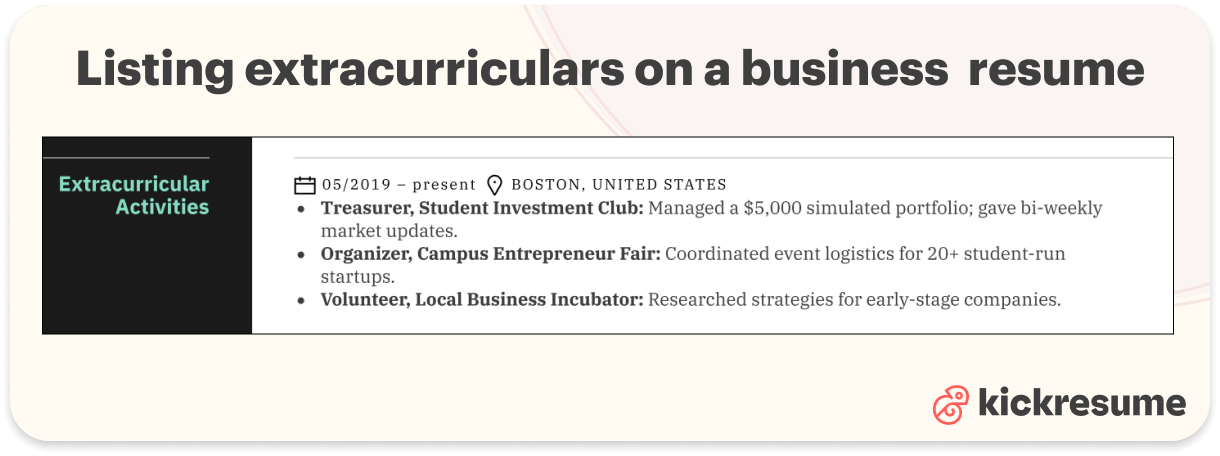
- Treasurer, Student Investment Club: Managed a $5,000 simulated portfolio; gave bi-weekly market updates.
- Organizer, Campus Entrepreneur Fair: Coordinated event logistics for 20+ student-run startups.
- Volunteer, Local Business Incubator: Researched strategies for early-stage companies.
Why this works: You’re taking on real responsibilities, handling money, organizing big events, and getting a taste of what business is all about.
Extracurricular activities examples for creative fields (art, communication, design)
- Editor, School Newspaper: Oversaw layout and managed a team of writers and photographers.
- Founder, Campus Film Festival: Organized film screenings and contributed a short film that won Best Animation.
- Member, Art Collective: Created digital illustrations for a group exhibition.
Why this works: You’re not just creative—you’re leading projects and making things happen, which looks awesome to creative recruiters.
Extracurricular activities examples for healthcare & life sciences
- Volunteer, Hospital Outreach Program: Assisted with patient activities and organized health awareness events.
- Secretary, Pre-Medical Society: Arranged guest lectures by physicians and ran campus blood drives.
- Participant, Science Olympiad: Competed in biology and chemistry events at the state level.
Why this works: These show you care about people, you’re curious about science, and you’re willing to step up and get involved.
Extracurricular activities examples for social impact & education
- Co-Leader, Peer Tutoring Program: Helped organize math and science tutoring for underclassmen.
- Event Organizer, Community Clean-Up Day: Led a team of 30+ students to improve local parks.
- Mentor, Big Brothers Big Sisters: Supported a middle school student with weekly tutoring and activities.
Why this works: They highlight your leadership and people skills—and that you genuinely want to make a difference for others.
Pro tip: Under each entry, mention your role, skills you used, and any specific accomplishments. This gives context and shows the real value of your experience.
Where to put extracurricular activities on your resume
So you’ve picked out your best extracurriculars—now, where do they actually go on your resume?
The answer depends a bit on your experience level and how much you want to highlight these activities.
- If you’re a student or recent grad: Make a dedicated section called “Extracurricular Activities,” “Leadership & Activities,” or “Campus Involvement.” Place it right after your education, since both are especially relevant when you don’t have much work experience yet.
- If you have more experience: Weave the most relevant activities into your “Experience” or “Additional Information” sections, or include them under education if they’re connected to your academic life. For leadership roles or major achievements, you might even mention them in your “Summary” or “Skills” section.
- For club or organization involvement: List your role, the name of the organization, dates involved, and a quick bullet about what you accomplished or contributed.
Example of listing extracurricular activities on a resume
- President, Coding Club, University of Citytown (2022–2023): Led weekly meetings, organized campus hackathon with 100+ participants.
- Volunteer, City Animal Shelter (2021–2023): Organized fundraisers raising over $3,000; trained new volunteers.
Tip: Focus on what you did, not just your title. Action verbs and real results make your activities extra impressive.
Find out your resume score!

Extracurricular activities for college applications
Sometimes, the line between resume-building and college applications can get a little blurry—especially if you’re a student or recent grad.
While our guide focuses on resumes, it’s worth mentioning how extracurriculars can also boost your college applications.
Colleges want more than good grades—they love seeing students who bring energy, interests, and a fresh perspective to campus. Strong extracurriculars can show you’re motivated, a leader, and have a life beyond the classroom.
A few quick tips for college applications:
- Quality beats quantity: Admissions officers would rather see deep involvement in a few activities than a long list of brief memberships.
- Highlight leadership and impact: Starting a club, earning an award, or making a difference in your community will stand out.
- Variety helps: Combining academics, sports, arts, and volunteering can show that you’re a well-rounded applicant.
Examples of extracurricular activities for college applications
Clubs and organizations
- Secretary, Environmental Club: Organized school recycling drives and led monthly nature hikes.
- Member, Science Club: Participated in hands-on experiments and presented at the regional science fair.
- Co-founder, Diversity Alliance: Planned cultural awareness events and peer discussions.
Leadership roles
- President, Debate Team: Organized weekly debates and led the team to regional championships.
- Captain, Varsity Soccer: Coordinated team practices and served as a role model for new players.
Academic competitions
- Participant, Math Olympiad: Placed in the top 10 at the state level.
- Science Fair Finalist: Conducted research on renewable energy sources.
Community service
- Volunteer, Local Food Bank: Helped organize food drives and distributed supplies to families in need.
- Founder, Neighborhood Cleanup Project: Recruited classmates and improved local parks.
Arts and creative projects
- Lead Actor, School Musical: Played the lead role and assisted in set design.
- Student Photographer: Managed the yearbook photo team.
Personal passion projects
- Started a YouTube channel teaching chemistry basics to middle schoolers.
- Founded a school gardening club that donated produce to the community kitchen.
Remember to focus on activities that show responsibility, initiative, and genuine passion—these help set you apart from other applicants.
The great news? Many of these examples will also look fantastic on your resume as you start your career!
Key takeaways
- Stand out with the right extracurriculars: Relevant activities make your resume more memorable—especially for students and recent grads.
- Show leadership and initiative: Leadership roles, club involvement, community service, and standout projects highlight skills colleges and employers value.
- Tailor to your field: Pick extracurriculars that match the job or industry you’re targeting to show you’re a great fit.
- Demonstrate impact: Don’t just name your activities—explain your role, responsibilities, and results.
- Build connections: Your extracurriculars can be a great way to connect personally with potential employers and colleagues.
- Focus on quality: A few meaningful activities are more impressive than a generic, lengthy list.
- Value clubs and organizations: Active participation or leadership in clubs shows teamwork, initiative, and a willingness to get involved.

![How to Write a Professional Resume Summary? [+Examples]](https://d2xe0iugdha6pz.cloudfront.net/article-small-images/How_to_Write_a_Professional_Resume_Summary_.png)
![How to List Your Education on a Resume? [+Examples]](https://d2xe0iugdha6pz.cloudfront.net/article-small-images/How_to_Put_Education_on_a_Resume_.png)
![How to Describe Your Work Experience on a Resume? [+Examples]](https://d2xe0iugdha6pz.cloudfront.net/article-small-images/How_to_Describe_Your_Work_Experience_on_a_Resume_.png)