


 ChatGPT
 Perplexity AI
 Claude
The amount of people who freeze when asked the job interview question "Why should we hire you?" is too damn high!
For no reason too.
Sure, the question is a bit tricky, but with the right approach, you should be able to breeze through it. All while impressing your recruiter.
Recruiters ask “Why should we hire you?” to understand whether you truly get what the job is about — and if you can clearly explain how your skills, experience, and personality will benefit their team. It’s less about bragging and more about showing alignment between what you offer and what they need.
In short, when an interviewer asks the question "Why should we hire you?", they want to know why you, of all the candidates, are the right fit for the job, their company, and their overall bottom line. In other words - are you the one?
We'll go over this question in detail and offer you tips and answer examples that will help you formulate the perfect response.
Try our AI Resume Writer and have your resume ready in minutes!

Best general answer to "Why should we hire you?"
So what makes a good answer to this question? Every good response to "Why should we hire you?" rests on three things: showing what you know about the company and the role, what you bring to the table in skills and experience, and what they get out of hiring you.
The interviewer wants to see that you understand their needs, that you can meet them, and that you've thought about the value you'll add once you're in the seat.
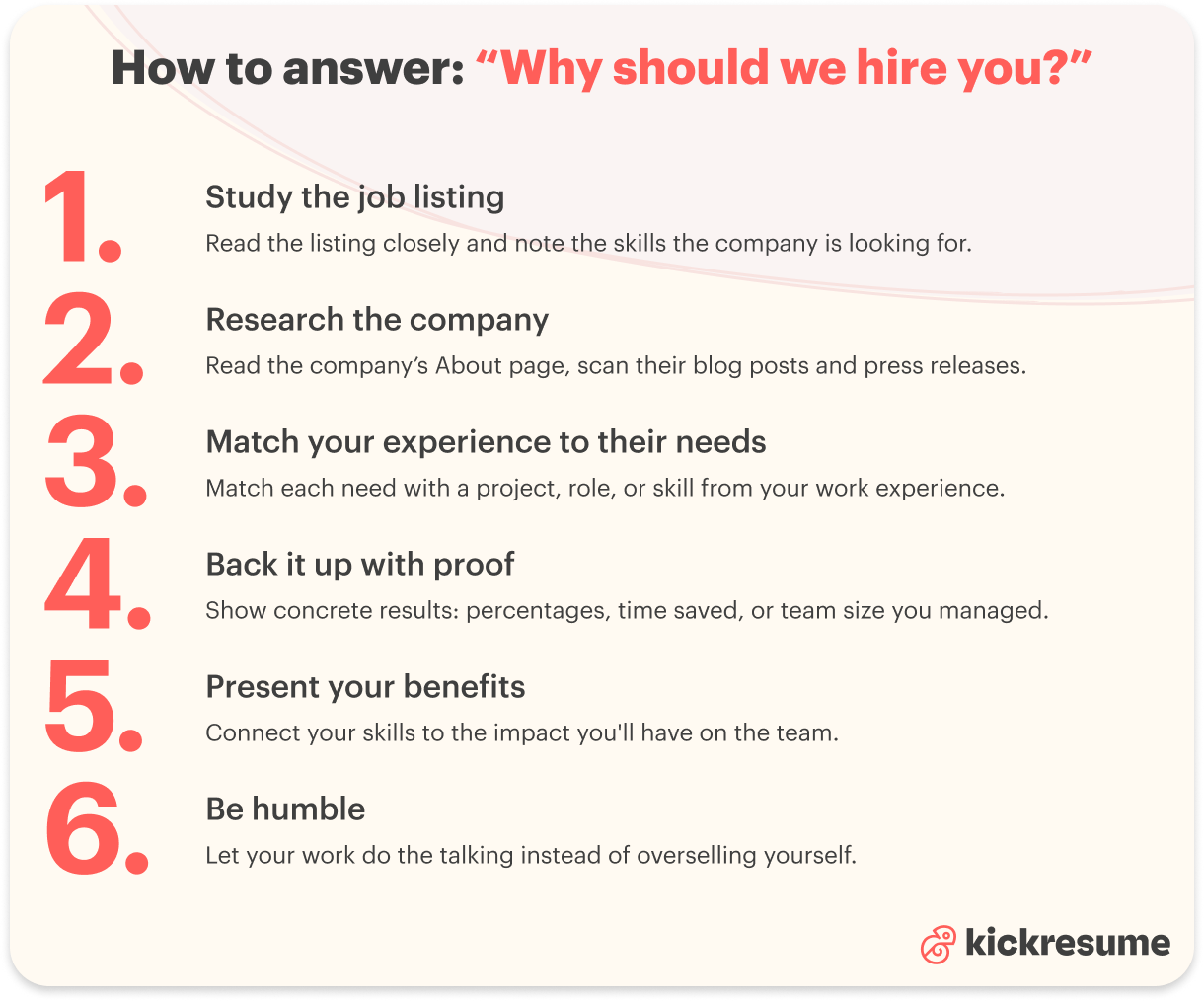
Here are 6 simple steps for putting it all into practice:
Step 1: Study the job listing. Understanding the ins and outs of the job at hand is a great way to put together a response that aligns with the company's demands.
Step 2: Research the company. Read the company's About page, scan their last two or three blog posts or press releases, and check the LinkedIn profiles of the team you'd join. Mentioning a product launch, a stated value, or a milestone tells the interviewer you didn't apply on autopilot.
Step 3: Match your experience to their needs. Now line up your background against what you found in steps 1 and 2. For each top need, pick one specific project, role, or skill from your work experience that addresses it directly.
Step 4: Back it up with proof. Wherever possible, attach a result to your evidence — what you achieved, percentages, time saved, team size you managed. Numbers show the employer you've done the work, not just described it.
Step 5: Present your benefits. Don't just state the skills you possess (features). Instead, talk about how your noteworthy skills, experience and personality traits can bring improvements into the job, team, or company (benefits).
Step 6: Be humble. Fight the need to over embellish your accomplishments. Sure, you might have the proper technical skills for the job, but you also need to show them your soft skills, for example, answering this answer with tact.
Most people struggle with "Why should we hire you?" because they're trying to think and speak at the same time. Doing the prep beforehand means you've already done the thinking, so in the room you just have to talk. The sample answers below show what that can look like across different roles and experience levels.
Common mistakes to avoid
- Giving a vague answer (“Because I’m a hard worker”).
- Focusing only on what you want, not what they need.
- Sounding rehearsed or robotic.
- Listing your entire resume again.
- Instead: Keep it specific, confident, and employer-focused.
Best general answer (example)
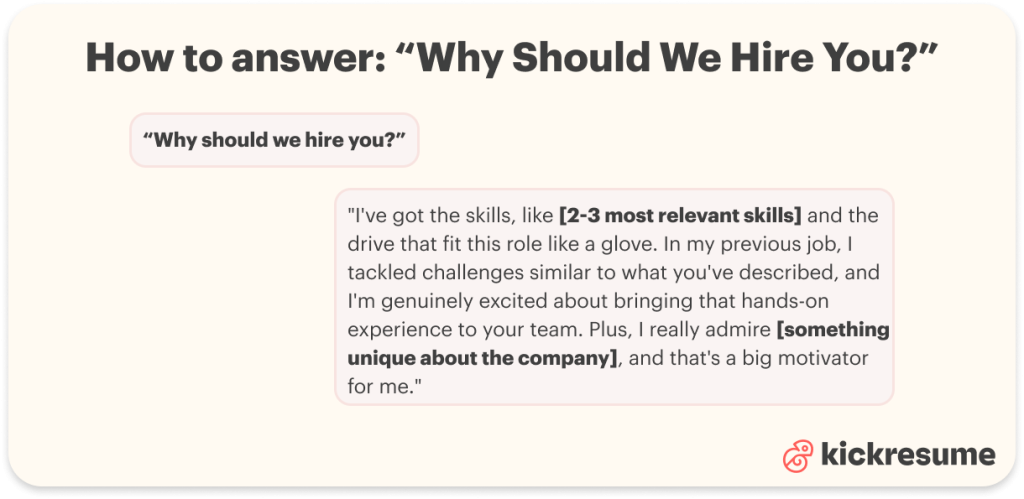
In the end, a general answer following the statement, experience, benefit formula should be something along these lines:
Or, another way to answer this question:
12 sample answers according to your job position/experience
A good general response can take you a long way.
However, when replying to any interview question it's always wise to tailor your response to the job at hand.
This is especially true if you're conducting your interview online, as recruiter's tend to have back-to-back interviews and therefore limited time. (Quick virtual interview tip: In order to avoid speaking over the recruiter due to internet delays, try to pause for a second or two when responding online).
Basically, the more you show you understand the job, the company, and its work culture. The higher the chances of you coming ahead of your competition.
Here are a few answer examples from different job positions and experience levels that can help you formulate an impressive response.
Best answer for a customer service job #1 (example)
Best answer for a customer service job #2 (example)
Best answer for a fresher #1 (example)
Best answer for a fresher #2 (example)
Best answer for a teacher #1 (example)
Best answer for a teacher #2 (example)
Best answer for a nursing job #1 (example)
Best answer for a nursing job #2 (example)
Best answer for a fresh graduate #1 (example)
Best answer for a fresh graduate #2 (example)
Best answer for accountant #1 (example)
Best answer for accountant #2 (example)
How to answer the question "Why shouldn't we hire you?"
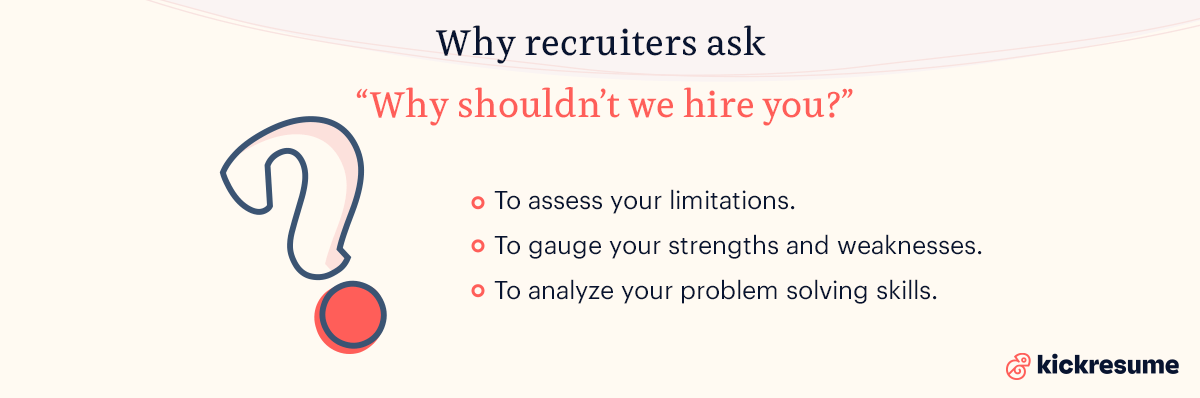
Sometimes recruiters like to throw oddball questions you don't find in your average job interview guide like, "Why shouldn't we hire you?" or "What is your biggest weakness?".
Usually, such questions are asked in order to gauge your limits, strengths and weaknesses, and to observe how you handle yourself in stressful situations.
Hence, why a good way to answer these question is to:
- Keep your cool.
- Collect your thoughts. Now's a good time to take a sip of water (Reason to always say yes when they offer you water).
- Reverse the question. Pull out your reverse UNO card and flip that weakness into a strength.
- Be honest. Even Superman has a weakness. If you're to show one, show a weakness you overcame.
- Don't be too negative. Negativity is not the best of traits and is definitely not good as a first impression.
With that said, here's an answer example if the company you're applying for values creativity and self guidance:
Find out your resume score!

Similar job interview questions
The question "Why should we hire you?" comes in many variations, but with similar intentions. Such as:
- Why do you want to work here?
- Why are you fit for the position?
- Why do you want to work for us?
- What will you bring to the position?
- Why are you the right candidate
- Why should we take the risk in hiring you?
"Because I'm the best!" probably won't cut it 😉 A better way would be to briefly reiterate why you're a great fit by summarizing what they're looking for vs. what you bring to the table: "As well as over a decade of experience as a fine dining chef, I believe my resume and our interview today demonstrate my passion for creating and serving incredible food, leading teams to success, and putting restaurants on the culinary map. As a customer, I've had excellent experiences in your restaurant and fully believe in what you do. I'd be thrilled to be part of your growth and continued success!".
–Christy Morgan, Resident HR Expert
Other common job interview questions
"Where do you see yourself in 5 years?"
"Where do you see yourself in 5 years?" is a question asked by recruiters in order to gauge if a potential employee has the ability to commit long-term, especially to a job, project, or company. A good general answer to this interview question is:
"Within 5 years, I see myself in a position that continues to challenge me and that provides me opportunities to grow my skill-set."
"What are you passionate about?"
When answering the question "What are you passionate about?" it's important to be as specific and honest as you can. Recruiters ask this question in order to see what you're truly into and how you think. Also, how you answer this question might also affect where you get placed in the company, so embellishing could backfire.
"Why did you leave your past job?"
In regards to the question "Why did you leave your past job?" What you don't say is just as important as what you do say. Here are do's and dont's:
Do:
- Answer truthfully
- Reframe question back to job prospect
- Show right amount of details
Dont's:
- Slander your past employer
- Overdo It with details
- Lie about why you left
If you really want to come prepared for the interview, here is an article that teaches you how to answer 100+ common job interview questions. Or simply watch the video guide below.
Quick expert tip:
"If you’re answering this question during a virtual interview, make eye contact with the camera and smile while you speak. Body language matters, even on video — and it helps make your answer sound more genuine." - Julia Belak
That's all, good luck in your interview!


