

 ChatGPT
 Perplexity AI
 Claude
Knowing how to prepare for a phone interview is the difference between coasting into the next round and getting sneakily filed under "no."
A phone screen feels low-stakes. It's only fifteen minutes, no one's even looking at you, so why bother? Well, those fifteen minutes decide whether you advance. However, a phone interview is also the most predictable stage of the whole hiring process. So once you know what's coming, it's surprisingly easy to walk in ready.
Keep reading and you'll find out:
- What a phone screen interview actually is (and what recruiters really want);
- How to prepare for a phone interview, step by step;
- The most common phone interview questions, with sample answers;
- Phone interview tips that genuinely make a difference;
- The mistakes that sink your chances.
Try our AI Resume Writer and have your resume ready in minutes!

What is a phone screen interview?
A phone screen interview is a short, early-stage call, usually 15 to 30 minutes, that employers use to narrow down their pool of applicants before inviting anyone for a longer interview.
It's kinda like a bouncer at the door. It's not the party itself, but you're not getting in without getting past it first.
Usually, it's a recruiter or someone from HR on the line, not your future boss. Their job isn't to dig deep into your technical skills. It's to confirm the basics: that you're real, you're interested, your experience roughly matches the job, and your salary expectations won't blow up the budget.
In other words, the phone screen exists to save everyone time. Including yours.
Phone screen vs. phone interview vs. video interview
These terms get tossed around interchangeably, so let's clear a few things up first:
- Phone screen interview. This is the short first call described above. It's usually fast and run by a recruiter. The goal is to filter potential candidates, not to evaluate you in depth.
- Phone interview. Sometimes the screen is the full interview, especially for the first round. It can run longer and dig a little deeper into your experience.
- Video interview. Same questions, different medium, plus the joy of worrying about your camera angle. We'll focus on the phone here, but most of this advice carries straight over.
The lines blur, and that's exactly why you should prepare as if every first call is the real thing. Because sometimes it is.
What recruiters are really trying to find out
So, if this is just an interview to determine whether you get to the actual interview, what is it good for? What do the recruiters want? This is what's actually going through the recruiter's mind during a phone screen interview:
- Are you genuinely interested? Or are you mass-applying and can't quite remember which company this even is?
- Do you meet the basic requirements? They ask you a few basic questions while ticking boxes against the job description they've been given.
- Can you communicate clearly? Since they can't see you, your voice carries the entire impression. No, really! Communication is one of the most underrated soft skills. And also one of the most appreciated by employers.
- Do your expectations match reality? What are your salary expectations? Are you willing to relocate? When would you be able to start? What work setup do you prefer? You know, the practical deal-breakers.
Notice that none of this requires a heroic performance. It just requires you to be prepared and easy to say yes to.
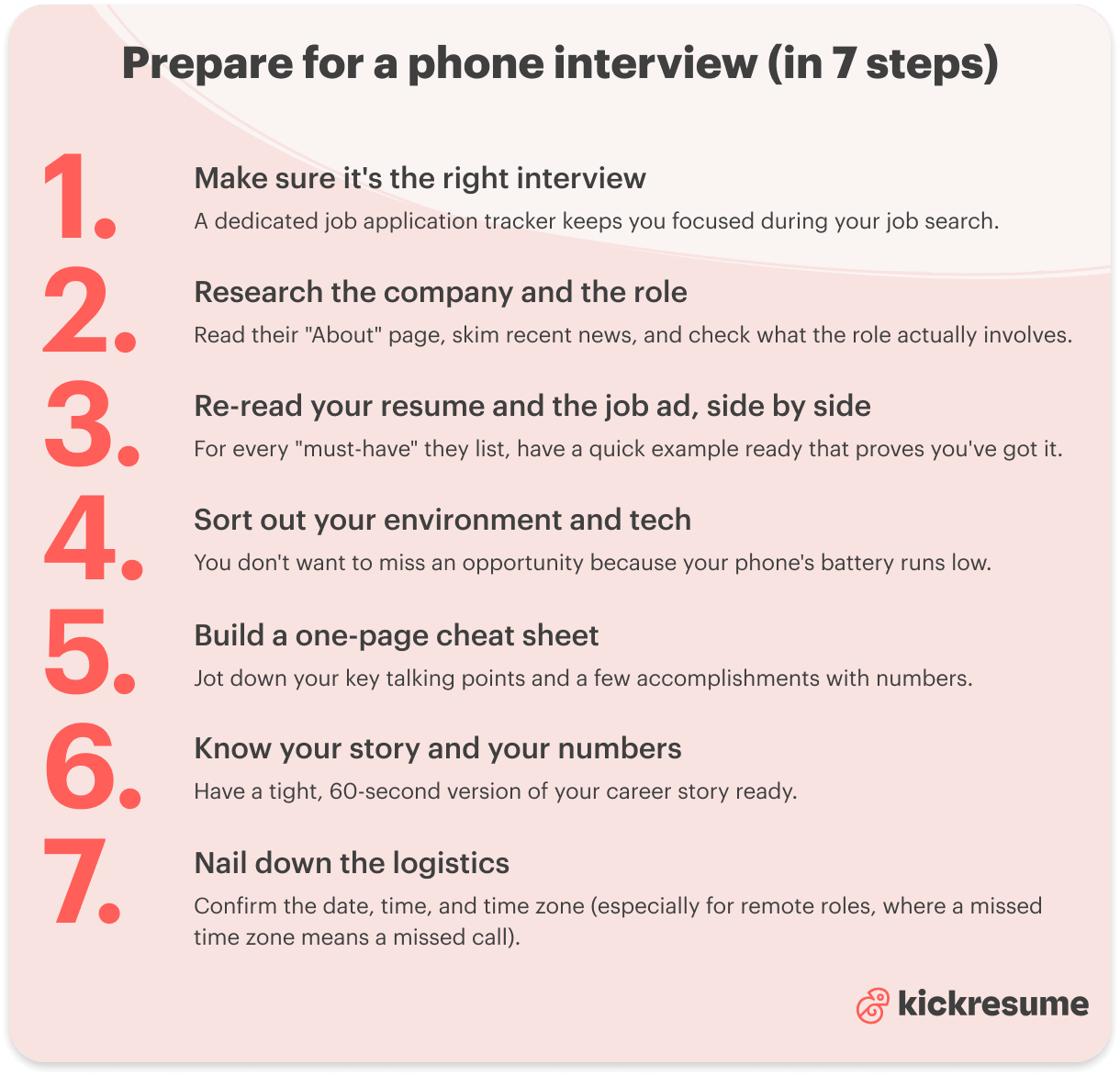
How to prepare for a phone interview (in 7 steps)
And now, the real reason you're here. And let me tell you … preparing for a phone interview takes more than five panicked minutes before the call. But it's not like you'll need to take a day off either. (This is NOT the phone screen interview we talked about earlier btw.)
Here's how to get ready:
#1 Make sure it's the right interview
Phone interviews are notoriously difficult to keep track of. You wouldn’t believe how many stories we've heard about job seekers who thought they were attending a completely different interview.
Moments like these are exactly where having your stuff in one place saves your life. If you've actually been keeping track of your job hunting process, you can pull up the role and see what requirements belong to their job ad.
This is exactly why you should be tracking your search, instead of letting it sprawl across three spreadsheets, your inbox, and your memory (which, let's be real, is the worst database ever). A job application tracker handles it all effortlessly.
#2 Research the company and the role
Before any phone interview, spend at least 20 minutes getting to know the company. Read their "About" page, skim recent news, check what the role actually involves, and get a feel for the language they use to describe themselves.
You don't need to write a dissertation about this. You just need to know enough to answer "Why do you want to work here?" without freezing, and to ask one or two intelligent questions of your own. A little research also calms the nerves, because walking in informed always feels better than walking in blind.
#3 Re-read your resume and the job ad, side by side
The recruiter is holding your resume and the job description. You should be too.
Go through the job ad and match your experience to each requirement. For every "must-have" they list, have a quick example ready that proves you've got it. This makes you sound effortlessly relevant on the call, instead of scrambling to connect the dots in real time.
#4 Sort out your environment and tech
If you have a cat, lock it in the other rooms. If you have a roommate who practices naked yoga, lock them in the other room. If you have a toddler who cries a lot … well.
But seriously now. You don't want to miss an opportunity because your phone's battery runs low. These are just some tips we earned from our own experience:
- Find a quiet space with no roommates, traffic, or barking dogs.
- Use headphones with a mic for cleaner sound.
- Charge your phone. Obvious, until it isn't.
- Silence notifications so you're not pinged mid-sentence.
#5 Build a one-page cheat sheet
The biggest advantage of a phone interview is that they can't see what's in front of you. So use it. Jot down your key talking points, a few accomplishments with numbers, your questions for the recruiter, and the answers to questions you find tricky. Keep it to one page and make it easy to read (use highlighters and different text structures so you won't get lost in it).
#6 Know your story and your numbers
You'll almost certainly be asked to "walk through your background." So get ahead of the curve and have a tight, 60-second version of your career story ready, and back up your achievements with real numbers wherever you can.
"I improved customer retention" is fine. But "I improved customer retention by 22% in a year" is the one they remember.
#7 Nail down the logistics
Confirm the date, time, and time zone (especially for remote roles, where a missed time zone means a missed call). Know who's calling whom. Is it you calling them or the other way around? And be ready ten minutes early so you're settled, not scrambling for a pen while the phone rings.
Having a glass of water near you is also a good idea. A sudden throat dryness caused by the inevitable stress of the situation isn't ideal in this scenario.
Your phone interview cheat sheet (what to actually put on it)
We've mentioned the cheat sheet twice now, so let's get specific. Because "make a cheat sheet" is useless advice if nobody tells you what goes on it..
So .. here we are, telling you what shouldn't be missing from yours:
- A one-line reminder of the role and company. The job title, the company name, and one sentence on what they do. This alone saves you from several potentially awkward situations.
- Three to five accomplishments, with numbers. Your proudest, most relevant wins, each boiled down to a single line. "Cut onboarding time by 30%." "Managed a 12-person team." Make sure you pick something that is relevant for this particular job and will impress the person on the other side.
- Your 60-second story. It doesn't have to be the full thing, just the bullet-point skeleton of your "tell me about yourself" answer so you don't ramble.
- Three things you genuinely like about the company. Pull this from your previous research. The question "Why do you want to work here?" is bound to pop up during your first call.
- Your salary range. Write it down so you say it calmly instead of inventing a number under pressure. You can also prepare a few points that support your range (like your accomplishments, years of experience, degrees, any extra courses and experiences you've gained).
- Your technical skills. This is probably second nature to you at this point, but it's always good to have it in front of your eyes in case you freeze. Forgetting a key tool you can use or a process you're comfortable with would be a shame.
- Two or three questions for the recruiter. Everybody loves a proactive listener. Asking questions makes you look engaged and really into the position on offer. So when they ask "any questions for me?", you're never caught empty handed (Empty headed? Empty mouthed?).
- A couple of tricky answers. Are there any questions that make you nervous? Like a career gap or why you're leaving your previous job. If you have something like this, jot down a quick reminder of how you want to frame it.
That's it. Resist the urge to write full paragraphs, the moment your cheat sheet becomes a screenplay, you'll start reading it aloud, and a recruiter can hear that from a mile away.
Common phone interview questions (with sample answers)
Remember how we said the phone screen is the most predictable stage? Here are the phone interview questions you're most likely to hear, what the recruiter is really asking, and a sample answer for each one that you can adapt to your own experience.
A quick note on the samples below: don't memorize them word for word. Read them, borrow the shape and the rhythm, then swap in your own story. You need to sound like you, not like us (although we do sound pretty good).
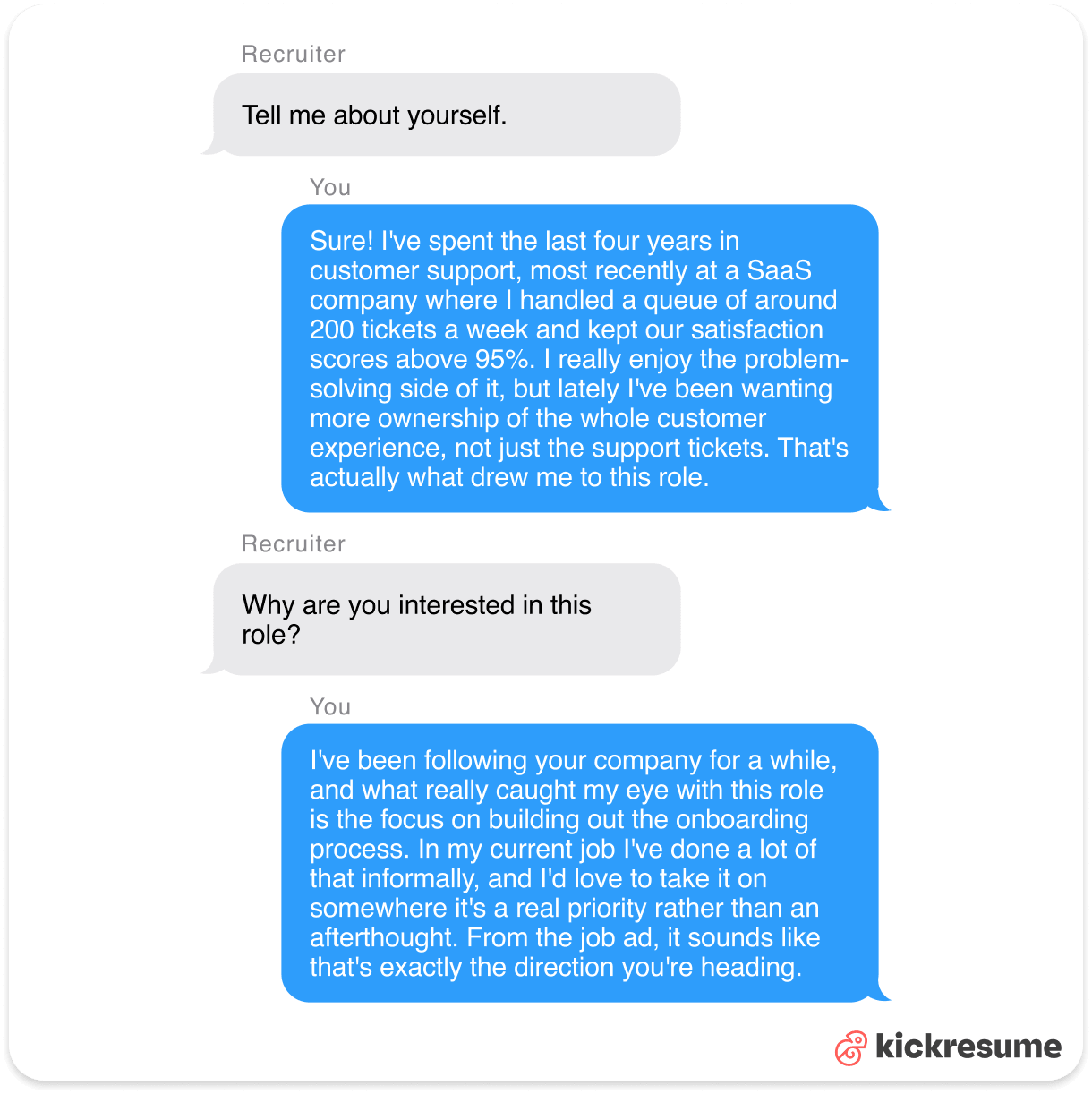
"Tell me about yourself."
What they're really asking: Can you summarize your relevance without rambling for ten minutes?
What you can answer:
"Sure! I've spent the last four years in customer support, most recently at a SaaS company where I handled a queue of around 200 tickets a week and kept our satisfaction scores above 95%. I really enjoy the problem-solving side of it, but lately I've been wanting more ownership of the whole customer experience, not just the support tickets. That's actually what drew me to this role."
"Why are you interested in this role?"
What they're really asking: Did you actually read the job ad, or are you applying to everything that moves?
What you can answer:
"I've been following your company for a while, and what really caught my eye with this role is the focus on building out the onboarding process. In my current job I've done a lot of that informally, and I'd love to take it on somewhere it's a real priority rather than an afterthought. From the job ad, it sounds like that's exactly the direction you're heading."
"Can you walk me through your resume?"
What they're really asking: Does your career story make sense, and can you tell it clearly?
What you can answer:
"Of course. I started out in retail management, which is where I learned to handle teams and pressure at the same time. After a couple of years I moved into operations at a logistics company, and that's where I really got into process improvement. Most recently, I've been leading a small team that streamlined our fulfillment workflow, and that's the kind of work I want to keep doing, which is why this role stood out to me."
Keep it chronological and land on why this job is the logical next step.
"What are your salary expectations?"
What they're really asking: Are we even in the same ballpark?
Do your research beforehand and offer a range based on the market and your experience.
What you can answer:
"Based on my experience and what I've seen for similar roles in this market, I'm looking at somewhere in the range of $60,000 to $70,000. That said, I'm flexible depending on the overall package and the scope of the role, so I'm happy to discuss it further."
"Why are you leaving your current job?"
What they're really asking: Are you going to badmouth us to the next recruiter, too?
What you can answer:
"I've genuinely learned a lot in my current role and I'm grateful for it. But I've grown about as much as I can there, and I'm ready for a position with more room to take on bigger projects. This role lines up really well with where I want to take my career next."
Keep it positive and forward-looking. Focus on what you're moving toward, not what you're escaping.
"What do you know about us?"
What they're really asking: Did you do your homework, or are you winging it?
What you can answer:
"From what I've read, you help small businesses manage their finances without needing a full accounting team, and I saw you recently launched a feature for automated invoicing. That stood out to me because it's solving a really practical problem. I'd actually love to hear more about how the team approaches new features from the inside."
Two or three specific sentences is plenty. You're proving you care, not delivering a TED talk.
"When could you start?"
What they're really asking: Are you available within our timeline?
What you can answer:
"I'm currently on a two-week notice period, and I'd want to wrap things up properly so I leave on good terms. So realistically I could start about two to three weeks after an offer. If you need a bit of flexibility either way, I'm happy to work something out."
"Are you interviewing with other companies?"
What they're really asking: How much time do we have, and how serious are you about us?
What you can answer:
"I am in conversations with a couple of other companies, yes. I'll be upfront, though: this role is the one I'm most excited about, mainly because of the product and the team I'd be working with. I just wanted to be transparent about my timeline so we can keep things moving on my end."
There's no need to bluff. A little honesty here actually builds trust.
"Tell me about a time you handled a difficult situation at work."
What they're really asking: Can you give me a real example, not just a buzzword?
What you can answer:
"In my last role, one of our biggest clients was threatening to leave after a delivery went badly wrong (Situation). I was asked to step in and save the relationship (Task). So I set up a weekly check-in with them, mapped out exactly what had gone wrong, and personally oversaw the next three deliveries to make sure nothing slipped (Action). Within two months, not only did they stay, they actually expanded their contract by about 15% (Result)."
This is a behavioral question, and it's the perfect moment for the STAR method, Situation, Task, Action, Result. It keeps you concise and stops you from trailing off into a story with no ending.
"Do you have any questions for me?"
What they're really asking: Are you actually engaged with this opportunity?
Always have two or three ready. "No, I think that's everything" is the fastest way to seem indifferent. Try a few of these:
- "What does success look like in this role in the first six months?"
- "How would you describe the team I'd be joining?"
- "What are the next steps in the process from here?"
Don't make impressing the recruiters your only focus (although that is your main goal). Ask questions that also tell you whether this job is actually worth your time.
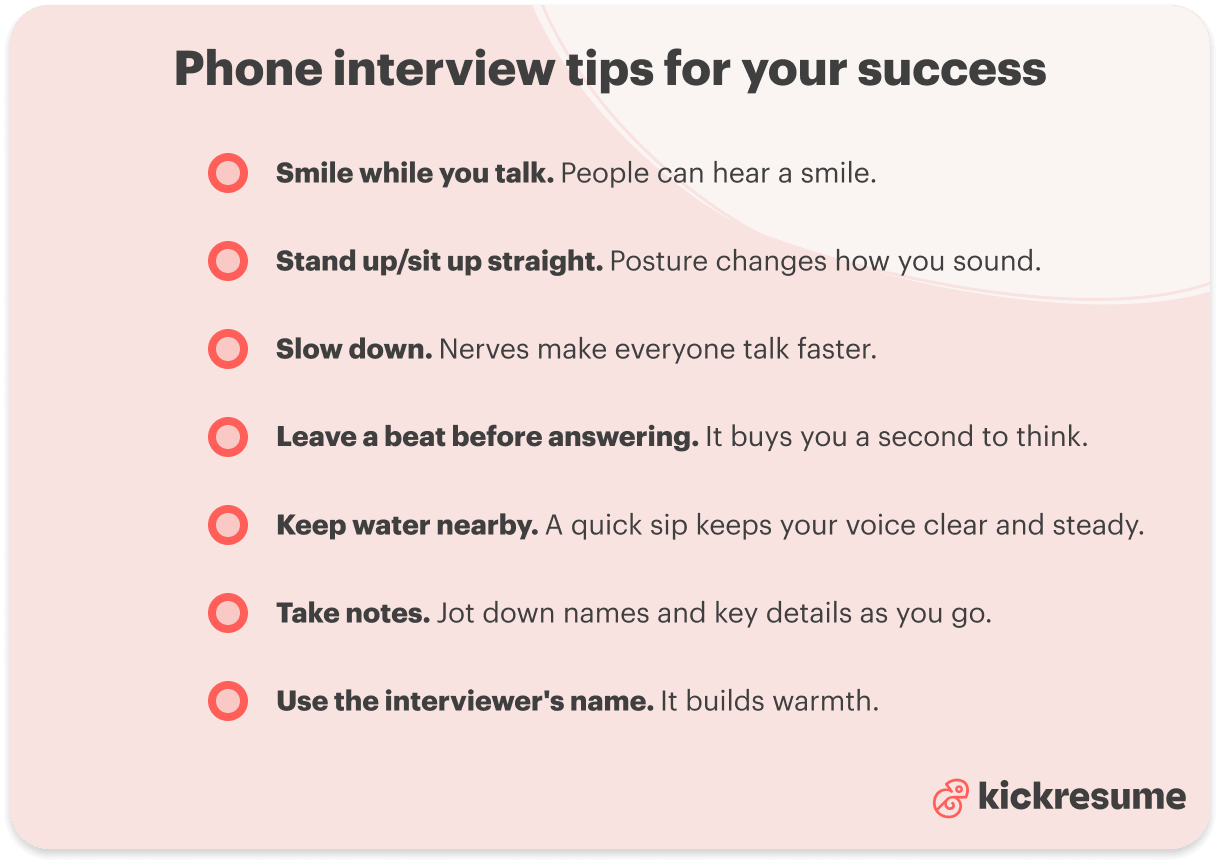
Phone interview tips for your success
You've prepped and you know the questions. Now here are the phone interview tips that separate a forgettable call from a memorable one:
- Smile while you talk. It sounds ridiculous, but people can hear a smile. It warms up your voice instantly.
- Stand up, or at least sit up straight. Posture changes how you sound. Standing tends to make you sound more energetic and confident.
- Slow down. Nerves make everyone talk faster. A deliberate pace makes you sound composed and easy to follow.
- Leave a beat before answering. A short pause avoids talking over the interviewer and buys you a second to think. Silence is fine, it reads as composure, not confusion.
- Keep water nearby. Dry mouth is real, and a quick sip keeps your voice clear and steady.
- Take notes. Jot down names and key details as you go. They're gold for your follow-up email and your next round.
- Use the interviewer's name. It's a small touch that builds warmth and shows you're present in the conversation.
None of these are revolutionary. Together, though, they make you sound like someone who's genuinely ready, which is the entire point of a phone screen.
Phone interview mistakes to avoid
- Answering unprepared. If a surprise call catches you off guard, ask to reschedule rather than fumbling through it.
- Not knowing which role it is. An instant credibility killer (and exactly the problem a tidy application tracker solves).
- Talking too much. Long, winding answers eat up the recruiter's checklist. Aim for a minute or less per answer.
- Badmouthing a current or former employer. It says far more about you than about them.
- Taking the call somewhere noisy. A café, a car with the windows down, a room with the TV on. All avoidable.
- Having no questions ready. It reads as disinterest, every single time.
- Forgetting to confirm next steps. Which brings us neatly to what happens after you hang up.
What to do if the call goes badly
Sometimes a phone interview just goes sideways. Your mind blanks. You stumble over a question you'd practiced ten times. It happens to everyone, and it's almost never as fatal as it feels in the moment.
So if things wobble, here's how to recover with your dignity intact:
- If you blank on a question, don't fill the silence with panic. Buy yourself a beat: "That's a great question, let me think for a second." A short, composed pause is better than a rushed, rambling answer.
- If you give an answer you regret, you're allowed to circle back. "Actually, could I add one thing to my earlier answer?" shows self-awareness, which recruiters genuinely respect.
- If the call drops or the line gets choppy, don't spiral. Call back or text right away: "Sorry about that, the line cut out, happy to pick up where we left off." Tech glitches are nobody's fault, and how you handle them is its own small test.
- If you realize halfway through that it's going poorly, reset rather than write it off. A strong, warm answer to the last question, and a thoughtful question of your own, can shift the whole impression. People remember how things end.
And if it truly was a write-off? Move on. One rough screen isn't your career. Note what tripped you up, tweak your cheat sheet, and bring it to the next one. Which is exactly why having a few applications in motion takes the sting out of any single call.
What to do after the phone interview
The call's over …but you're not quite done.
Before you hang up, ask about the next steps and the expected timeline. It shows interest and tells you when it's appropriate to follow up.
Within 24 hours, send a short thank-you email. Reiterate your interest, reference one specific thing from the conversation, and keep it brief. It keeps you top of mind while other candidates stay silent.
Then, log the outcome. Update the status of that application so you know exactly what you're waiting on and what to chase. (This is where keeping everything in one job tracker earns its keep again, no more wondering whether you ever heard back from that role three weeks ago.)
And then? On to the next one. Because the best way to take the pressure off any single phone interview is to have a few others in the pipeline.
Key takeaways: How to prepare for a phone interview
The phone screen interview isn't a hurdle to dread. It's the most predictable, most preparable stage of the whole process, and a genuine chance to make a strong first impression before anyone's even seen your face.
To prepare for a phone interview, remember to:
- Research the company and the role.
- Re-read your resume and the job ad side by side.
- Sort out a quiet space and working tech.
- Build a one-page cheat sheet.
- Know your story and your numbers.
- Confirm the logistics, and stay organized enough to handle a surprise call.
Prepare for the common questions, lean on the STAR method for examples, smile while you talk, and follow up within 24 hours. Do that, and those fifteen minutes will take you exactly where you want to go: the next round.
