


 ChatGPT
 Perplexity AI
 Claude
Figuring out how to get a job with no experience can feel like the most frustrating catch-22 in the working world: you can't get the job without experience, and you can't get the experience without the job.
And if you've been firing applications into the void and hearing nothing back, you're not the only one. Plenty of people chasing their first job are hitting the exact same wall right now.
But "no experience" is rarely the real reason you're not getting hired.
Far more often, it comes down to three things: how you frame what you already have, which jobs you actually aim at, and how you run your search. Fix those, and that wall starts to look a lot more like a door.
Keep reading and find out:
- Why the market really is tougher right now (with the data to prove it);
- What actually counts as experience (you have more than you think);
- Which jobs to target, including high-paying and remote ones;
- And how to run your whole search like a pro.
Let's get you hired.
Try our AI Resume Writer and have your resume ready in minutes!

First, the truth: it really is harder right now
Before the pep talk, we'll start with a bit of honesty. Because pretending the market is fine helps absolutely no one.
If you're a recent graduate, you're walking into one of the toughest entry-level markets in over a decade. According to the Federal Reserve Bank of New York, the unemployment rate for recent college graduates (ages 22–27) sat around 5.7% in early 2026. That is higher than the roughly 4.2% rate for the overall workforce.
The competition is brutal by the numbers, too:
- Career platform Handshake reported that new-grad job postings dropped about 15% year-over-year, while applications per role jumped 30%. More people, fewer openings.
- Oxford Economics has warned that rising youth unemployment may be an early sign of a slowing economy, with recent grads bearing the brunt.
And yes, AI gets a lot of the blame. Some big employers say they're replacing entry-level tasks with automation, though economists are still divided on how much of the slowdown is really AI versus remote work and a post-2021 hiring hangover. Either way, the entry-level rung of the ladder is the one that's wobbling.
Can you really get a job with no experience? (Yes, here's why)
The single biggest mistake we see inexperienced applicants make is self-rejecting.
They spot "2+ years required," decide they're not qualified, and close the tab. Please, you need to stop doing that.
Understand that most job descriptions are wish lists, not checklists. Hiring managers routinely interview, and hire, people who tick maybe 60% of the boxes, because the genuine must-haves are usually far fewer than the posting suggests.
So here's a rule of thumb worth tattooing somewhere visible: if you meet around 60% of the core requirements, apply anyway. The worst-case scenario is silence, which costs you nothing you didn't already have.
What counts as experience when you have none
"Experience" doesn't only mean paid work in the exact field. It means evidence. Proof that you can show up, solve problems, and get things done.
Start digging here, and you'll find plenty of raw material:
- School and coursework. You can lean into group projects, a capstone, a research paper, or that presentation you nailed.
- Clubs, sports, and volunteering. This is awesome for proving that you are comfortable with organizing, leading, fundraising, or just showing up consistently for years.
- Side hustles and personal projects. Experience gained through a Depop store, a gaming community you moderated, or freelance favors for family friends counts as well.
- Life responsibilities. Things like caregiving, managing a household budget and translating for relatives also show your capabilities and responsibility.
You just need to translate it well. Our favorite tip that we share with everyone who'd listen, is to focus more on the outcomes of your skills rather than just everyday duties.
"Treasurer of the film club" is much weaker than "Managed a $4,000 annual budget and cut event costs by 20% by renegotiating venue rates." Writing a resume for a first job is tricky, admittedly. But plenty of people that came before you managed. You will too. What else is there to do?
What jobs can you get with no experience?
Some roles are genuinely built for beginners. And yes, AI automatization threatens them the most. But acquiring AI skills is also an option! And in 2O26, it's more of a must than an option.
The best entry-level jobs with no experience
These roles hire first-timers all the time, and most will train you on the job:
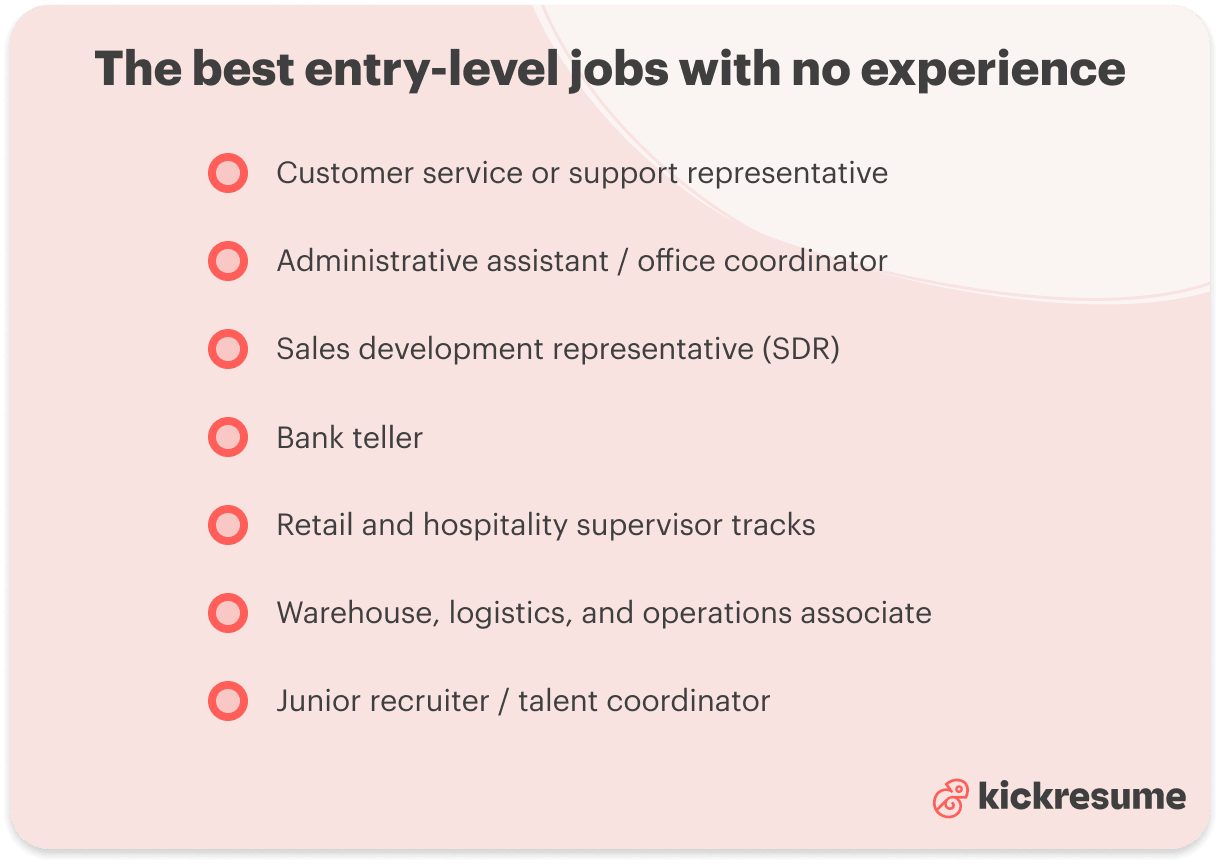
- Customer service or support representative
- Administrative assistant / office coordinator
- Sales development representative (SDR)
- Bank teller
- Retail and hospitality supervisor tracks
- Warehouse, logistics, and operations associate
- Junior recruiter / talent coordinator
Not the most glamorous list in the world, we know. But several of these are genuine launchpads. An SDR role, for example, is a well-worn path straight into higher-paying sales and tech careers.
High-paying entry-level jobs worth targeting
Having an "entry-level" job doesn't have to mean being "broke." Plenty of high-paying entry level jobs hire with little to no experience and reward you handsomely for good work.
Here are a few, with rough U.S. salary ranges (do double-check current figures):
- Sales development representative: ~$45k–$65k base, often more with commission
- Insurance claims adjuster: ~$50k–$70k
- Junior data or operations analyst: ~$55k–$70k
- Real estate agent: commission-based, with a high ceiling
- Technical / IT support specialist: ~$45k–$60k, and a classic on-ramp into tech
- Commercial driver or skilled-trade apprentice: ~$50k+ with paid training
Roles that pay for results (hello, commission) or that come with structured training tend to care far less about your past, and far more about your potential.
How to get a job fast(er): run your job search like a system
Most people job hunt the same way: spot a posting, fire off a generic resume, cross their fingers, repeat. Then a month of silence rolls by, and suddenly it starts to feel deeply personal.
But landing a first job is partly a numbers game. And you only win a numbers game if you stop treating it like a vibes-based emotional experiment.
You need a system. Here’s how to set up one that sticks:
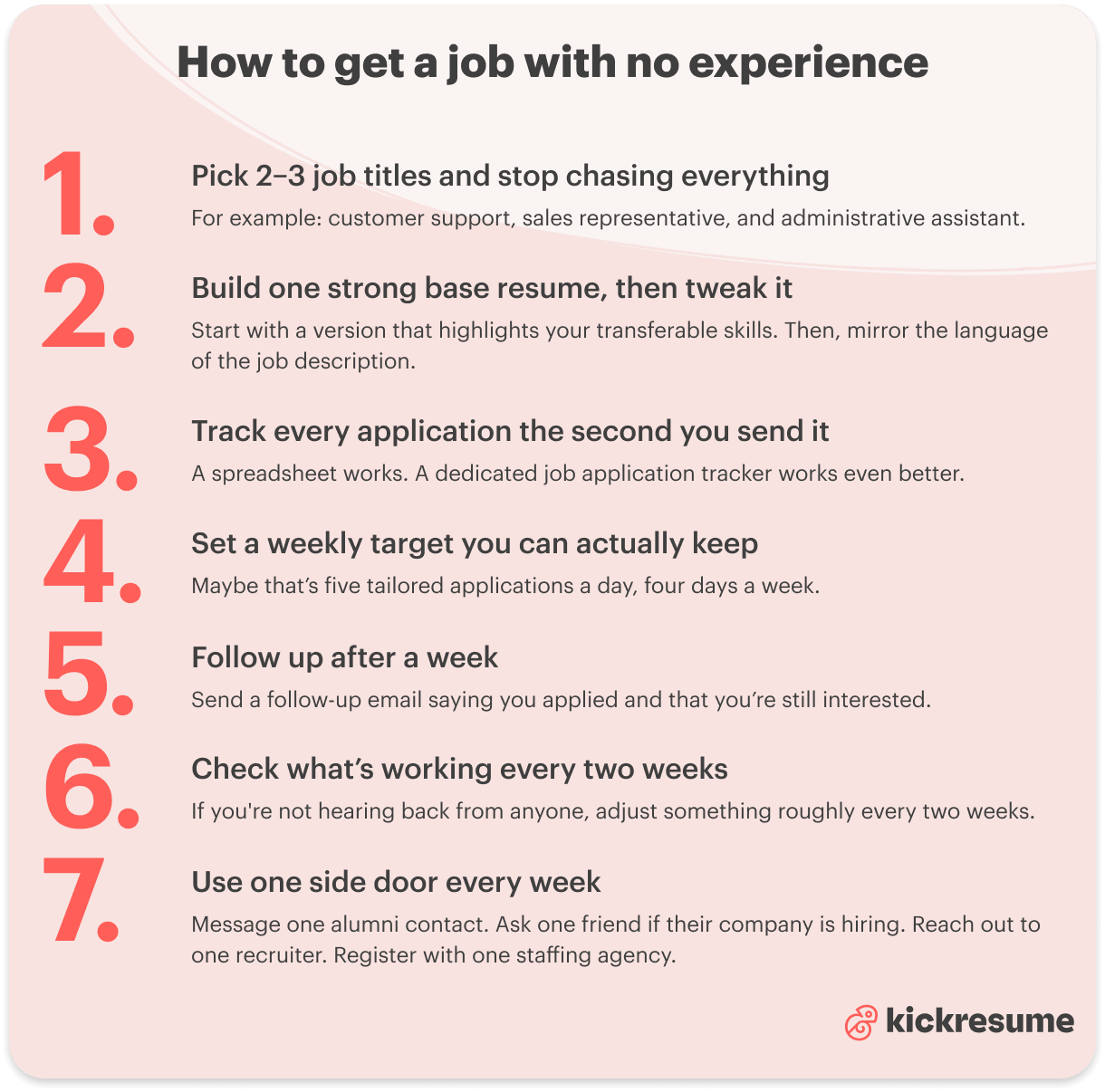
#1 Pick 2–3 job titles and stop chasing everything
When you have no experience, it’s tempting to apply for every job that looks vaguely survivable.
Customer support? Sure. Marketing assistant? Why not. Junior recruiter? Fine. Office coordinator? Sounds adult. Social media intern? You have posted before. Surely that counts.
The problem is that this makes your search messy fast. Every role wants slightly different skills, keywords, and examples. So instead of getting sharper, your applications get more generic.
What you need to do: Pick two or three realistic target roles and focus on those. For example: customer support, sales development representative, and administrative assistant. After a while, you’ll start seeing the same requirements again and again. That’s good. It means you can tailor faster, sound more relevant, and stop rewriting your entire personality for every job ad.
If you're not sure what job roles you should go for, our career map can show you all the directions your skills can take you.
#2 Build one strong base resume, then tweak it
Even though you absolutely need to tailor every single resume you send out, you don't need to create a brand-new resume for each time. That way lies madness, and probably a folder called “resume-final-FINAL-actuallyfinal-v7.pdf.”
What you need to do: Create one solid base resume that you tailor slightly for each role. Start with a version that highlights your transferable skills: communication, organization, customer service, problem-solving, teamwork, reliability, basic tech skills, whatever fits the jobs you’re targeting. Then, before you apply, mirror the language of the job description (this is the best way to create an ATS-friendly resume).
#3 Track every application the second you send it
When you're five applications in, you can probably keep everything in your head. When you're 40 applications deep, no you cannot. You'll lose track of which job posting you've already applied to, who ghosted you, and who invited you for an interview. COMPLETE. AND. UTTER. MESS!
What you need to do: Log every application the moment you hit submit: company, role, date, link to the posting, status, and next step. A spreadsheet works. A dedicated job application tracker works even better (especially when it's completely free). Job application tracker lets you keep your whole search in one place, so you can see what’s applied, what’s pending, what needs a follow-up, and what has sadly entered the little graveyard of rejected applications.
#4 Set a weekly target you can actually keep
Don't wake up on Monday and announce that you’re going to apply to 100 jobs this week. You may technically be able to do it. But by application 47, your resume will have lost all meaning, your cover letter will read like a hostage note, and you’ll start applying to jobs you don’t even want because the button is right there.
What you need to do: Instead, set a boring target you can actually repeat. Maybe that’s five tailored applications a day, four days a week. Maybe it’s 15 good applications a week. Pick a number that keeps you moving without turning your life into a punishment.
#5 Follow up after a week
Most first-time job seekers don’t follow up because they’re scared of being annoying.
Fair. Nobody wants to become the “just checking in” person. But one short, polite message after about a week is not annoying.
What you need to do: If you can find the recruiter or hiring manager, send a quick follow-up email saying you applied, mention the role, and say you’re still interested. And yes, this only works if you know when you applied and who to contact. Which brings us, once again, back to tracking. Funny how that keeps happening.
#6 Check what’s working every two weeks
If you send 30 applications and get nothing back, don’t just send 30 more of the exact same thing and hope the universe apologizes.
Take a good look at the pattern. Are you getting responses for one type of role but not another? Are you skipping the jobs where you actually meet most of the requirements? Did one version of your resume get interviews while another one went straight into the void?
What you need to do: If you're not hearing back from anyone, adjust something roughly every two weeks. Your target roles, your resume headline, your skills section, your keywords, your cover letter, your follow-up timing. Anything. Just don’t keep guessing forever when the data is sitting right there.
#7 Use one side door every week
Online applications are useful. They are also crowded and sometimes feel like feeding your resume into a shredder with branding.
What you need to do: Every week, do one thing that doesn't involve simply clicking “Apply.” Message one alumni contact. Ask one friend if their company is hiring. Reach out to one recruiter. Register with one staffing agency.
Hidden ways to get hired most people overlook
Everyone and their cousin is flooding the same online postings. So the people who actually get hired often sneak in through the side doors instead:
- Staffing and temp agencies. They place inexperienced workers constantly, and "temp-to-hire" is one of the most reliable on-ramps to a permanent gig.
- Apprenticeships and returnships. Earn-while-you-learn programs stretch way beyond the trades these days. Tech, finance, and healthcare all run them.
- Referrals. A referred candidate is more likely to land an interview. It is what it is! Most first jobs arrive through a loose connection, not a job board.
- Contract-to-hire roles. Lower commitment for the employer usually means a lower experience bar for you.
How to get a remote job with no experience (and dodge the scams)
Just like their on-site counterparts, beginner-friendly remote roles include customer support, virtual assistant, content moderation, data entry, social media coordination, and (again) SDR work.
Now, one serious warning: the remote entry-level space is absolutely crawling with scams.
And since you're new here, it's not uncommon to miss the red flags (even when they're the size of an ensign).
So memorize these three non-negotiable rules. A legitimate employer will never:
- Ask you to pay to work (or buy "starter equipment" through them);
- Send you a check and ask you to wire part of it back;
- Ask for your bank details, ID documents, or require you to install unfamiliar software before a formal offer and onboarding;
- Hire you over text within an hour, no real interview required.
Watch for additional red flags:
- interviews held only on Telegram or WhatsApp,
- vague job descriptions,
- pressure to “move fast,”
- or emails that don’t come from a real company domain.
If the pay looks wildly high for the skill involved, or something just feels off, trust that instinct and walk away! And always verify the company exists independently before you hand over a single personal detail.
How to find a job after college with no experience
If you're a fresh graduate, you've got specific advantages, so use them:
- Tap your career center (it's free, and often still available to you after graduation).
- Lean on your alumni network (alumni reply to fellow alumni far more readily than to total strangers).
- And hunt down internships, rotational and graduate programs, which are literally built to train people with zero experience.
Most importantly, don't forget that your first job out of college is a starting point, not a life sentence. Get your foot in somewhere, rack up a year of real experience, absorb as much as you can. Everything else will become much clearer after that. Promise!
How long does it take to get a job with no experience?
Again, we will be honest with you. It will probably be longer than you'd like, especially in today's market. Often a few months of steady, consistent effort.
And two things will keep you sane through it:
- Track your progress, not just your rejections. Watching your application count, interview rate, and follow-ups climb in one place turns a demoralizing slog into visible, motivating momentum.
- Protect your energy. Treat the search like a part-time job with set hours. Then clock off. Applying nonstop with little results is a sure way to burnout fast. The people who get hired are very often simply the ones who outlasted everyone who quit.
The market is hard. You can't change that. But you can be more targeted, more prepared, and more organized than the next applicant. And that's almost always enough to earn you one yes.
Key takeaways: How to get a job with no experience
Let's pull it all together. Here's your no-experience game plan in a nutshell:
- Don't self-reject. If you meet ~60% of the requirements, apply anyway.
- Reframe your experience. School, volunteering, side projects, and life skills all count (translate them into achievements with numbers).
- Build proof fast. Simulations, a small freelance gig, a portfolio project, or volunteering can manufacture real experience in 30 days.
- Target beginner-friendly roles, including high-paying and remote ones (but stay sharp about remote scams).
- Use the side doors: temp agencies, apprenticeships, referrals, and contract-to-hire roles.
- Run your search like a system. Apply, tailor, track, follow up, iterate, and let a job application tracker do the remembering for you.
- Pace yourself. It takes a while, especially right now. Consistency beats intensity.
You've got this. Now go get that first yes.
