


 ChatGPT
 Perplexity AI
 Claude
Oh mate, Australia is great. No wonder you're probably asking yourself "How do I find a job in Australia as a foreigner?"
Apart from having beautiful nature and vibrant cities, Australia also has one of the strongest economies in the world. Therefore, it comes as no surprise that it's a popular place for foreigners looking to work abroad.
Can foreigners work in Australia? Of course, it's just not always quick and easy to get a job. But it's not impossible.
Here we've compiled a complete guide on how to get a job in Australia as a foreigner. We also answered some of the FAQs concerning employment opportunities in Australia.
Is it easy to get a job in Australia?
Australian job market is very competitive. Not all jobs and skills are in equal demand, especially for foreigners. As a foreigner, the most in demand sectors are hospitality, construction, and education. But worry not, it doesn't mean you won't find a job in other sectors.
Generally, there are a few tips which will ease your job hunting process in Australia:
- Don't try to make a career change. It will be so much easier to find a job you already have plenty of experience with. It's important to look for industries that align with what you've been doing in the past.
- Look for a job that is high in demand. Have a look at the Skilled Occupation list. These include jobs in healthcare, education, or construction.
- Get your visa well in advance. Recruiters in Australia are very hesitant to hire people who do not have visas already. The so called "right to work". There are different types of visas you can get, which we'll discuss more in depth in a separate section.
- Don't get a job "just because". Since your visa is tied to your job, you can't leave that job. So, make sure you do your research before you accept the place. Because if you end up hating it, you'll have a problem.
- Research online job portals. As you should in 2021! We have a separate section on Australian job search engines with links.
- Speak the language well. For the majority of jobs this is a tight requirement, for which you will also need a physical proof in the form of a language proficiency certificate.
If you'd like to stay in the Northern Hemisphere, check out: How to find a job in the UK as a foreigner and How to find job in Canada as a foreigner?

How to apply for a job in Australia?
There are certain steps you should do before you apply for a job in Australia as an expat.
- Visa. Above all, you'll need to decide on the right kind of visa for you. To clarify, there are many different work-related visas. Without having one you can't really start applying. More details are in a separate section below "Work visa in Australia".
- Resume/cover letter. Make sure you have your resume and cover letter ready and tailored. Don't recycle the same ones you used for job hunting at your home country. More details are in a separate section below "Resume and cover letter tips".
- TFN/ABN. Before you start working, you need to obtain a Tax File Number (TFN), which is similar to your social security number. If you're self-employed, you'll need an Australian Business Number (ABN). Both can be requested online.
- Australian Bank account. You need to meet this requirement before you start working. It can be set up online even before you come to Australia.
- Job search engines. Once you have completed all of the aforementioned, visit online job search engines specific to Australia. More details are in a separate section below "Australian job search engines".
- Apply in person. This mostly applies for jobs which don't require specific skills. You can just drop-in and try your luck.
Download our free ebook for more clever shortcuts to "hack" your job search journey.
Work visa in Australia
There are over 20 different types of visas related to work you can get in Australia. As a result, it can be quite daunting trying to decide which one is the best fit for you when there are so many. However, there's really no need to panic. Since there is a plentiful selection for you to choose from, it only means there's a visa type which will fit your circumstances perfectly.
Here we list a few types of visa which could fit a broad variety of circumstances.
Types of work visas in Australia:
Student visa. This visa allows you to work for up to 40 hours per fortnite (a.k.a. 20 hours per week) if you are enrolled in a course of study in Australia.
Benefits: Easiest visa to get, suitable for students older than 6, you can bring a family member
Requirements: Providing a Confirmation of Enrollemnt (CoE). Other requirements.
Graduate visa. This visa is for international students who have recently graduated with skills and qualifications that are relevant to specific occupations Australia needs. It lets you live, study and work in Australia temporarily.
Benefits: It allows you to work full time for at least 18 months. You can bring your family with you.
Requirements: Be under 50 years of age. You must have held a student visa in the last 6 months.
Skilled visa. The Skilled visa is a type of visa offered by Australia for skilled workers and whose professions are within the most demanded by it. There are many different types of skilled visas.
Benefits: It can be permanent, but it is quite hard to get this visa. Higher salary.
Requirements: There are many different types of skilled visas, but generally:
- under 45 years
- have the right skills to do the job
- meet the relevant English language requirements
Work & holiday visa. This visa lets people 18 to 30 years old (inclusive) have an extended holiday in Australia and work here to help fund their trip. (Be careful, subclass 417 is not open for Americans)
Benefits: Online application. Stay in Australia for up to 12 months. Leave and re-enter Australia as many times as you like in that 12 months
Requirements: Must be 18 to 30 years old (inclusive). Must have a passport from an eligible country. Cannot be accompanied by dependent children.
Australian resume and cover letter tips
Resume
When it comes to writing a great resume, a few golden rules work everywhere — but some details depend on where you’re applying. So, let’s go over the universal basics first, then look at what makes an Australian resume stand out.
Here are the general rules for making a good resume:
- Tailor your resume to a specific job posting. Pick out key skills and keywords from the job ad and weave them into your summary, experience, and skills sections. It’s what both recruiters and ATS look for. Try Kickresume’s Resume Tailoring to do it instantly.
- Focus on passing the ATS. Stick to a clean layout, avoid graphics or complex formatting, and use clear section headings and use the right keywords. You can always double-check your document with Kickresume’s ATS Resume Checker.
- Show results. List achievements, not duties. Use numbers and action verbs — for example: “Increased sales by 20 %” or “Led a five-person team.”
Once your resume is solid, a few small tweaks can help it better fit the local job market. If you’re applying to a company based in Australia, here’s what to adjust:
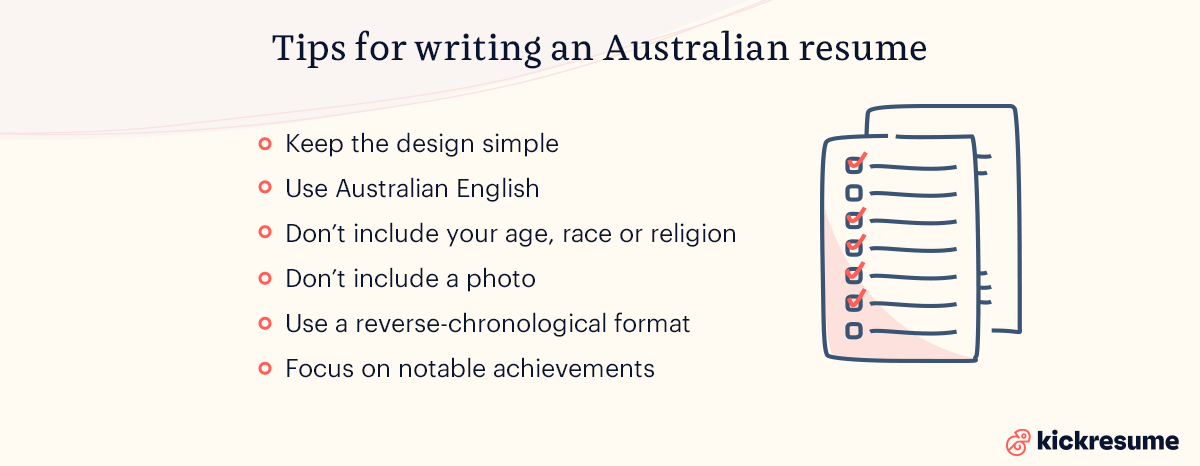
- Less is more. Keep the design simple - no fancy fonts or colors.
- Your resume can be 2-3 pages long. Most resumes are one to two pages long, but in Australia it’s perfectly fine to go over that as long as everything you include is relevant to the job you’re applying for.
- Use Australian English. (yup, it's not the same as American English).
- Keep your personal information to just your name and contact details. Never include an age, marital status, race or religion info in your resume. And no photos!
- Write it in a reversed chronological format. Use bullet points, and aim for around two pages in length.
- Include a mission statement or your career objective at the beginning. Two or three sentences will do.
- If you’ve worked in a small company, write a company description. A well-known American company may not be so well-known in Australia. Therefore, always try to explain a little about the business or company.
Here’s an example of a resume that applies all these tips and landed a job in Australia:


Create your cover letter fast with artificial intelligence.

Cover letter
A cover letter should work as an extension of your resume, where you have the chance to explain your motivation and why you're the perfect fit for the company while showing a bit of personality. It shouldn’t just state the same things as your resume.
The general tips for writing a good cover letter:
- Do some research. Before you start writing, learn more about the company and the role. It’ll help you find the right keywords, match their tone, and show that you actually understand what they do.
- Avoid using buzzwords. Your cover letter should be authentic and focus on your achievements and how you can fit the company instead. Mention the company by name, the position you’re applying for, and show that you’ve done your research. Generic letters rarely work.
- Keep it short. One page is plenty. Don’t ramble about your dreams of working abroad or write a mini biography. Get straight to the point and stay relevant.
- Focus on value. Instead of explaining why you want the job, explain what you can bring to the company — skills, results, or ideas that would help them.
Here are some tips on how to make a great cover letter in Australia.
- Use Australian English. This rule applies to both resumes and cover letters; you should always match the tone of the context you’re applying to.
- Mention work rights if relevant. If you’re applying from abroad, briefly note your visa or work eligibility (e.g., Eligible to work in Australia – Subclass 482 visa).
- Keep it concise and conversational. Australian employers appreciate a direct, down-to-earth tone. Skip the overly formal phrases or dramatic introductions — stay focused on getting the job, not getting to Australia.
Not sure about your cover letter? This cover letter guide explains everything you need to know.
Australian job search engines
To help you with your job search process we have compiled a list of the best Australian job search engines (or job boards). So, if you ask how to find a job in Australia as a foreigner ― this is how!
- Seek. Australia's largest employment marketplace. So, make sure to create a seek profile and browse the site's large database.
- Australian Government Job Search. It's the second leading resource for job seekers in Australia.
- Adzuna. Bringing every job into one place so you can find yours. Includes features such as find local salary and hiring trends.
- CareerOne. Upload your CV to create a profile in seconds and find jobs based on your skills, experience and desired job criteria.
- Indeed. Australian page of the online portal which lets you upload your resume and search by city and job title.
Volunteering jobs in Australia for foreigners
Volunteering can definitely help your career. You'll acquire soft and hard skills which inevitably boost your employability. It's a great for you to really stand out among other candidates. There are so many volunteer opportunities in Australia that it's not difficult to find the right job for you and your circumstances.
"Our experience is that volunteering really is a career selling point." says head of SEEK Volunteer, Rebecca Miller.
Check out some of these volunteering search engines for volunteer jobs in Australia for foreigners:
Not sure what to include in your volunteer resume? Check out volunteering resume examples.
Popular cities to work in Australia
Okay, you've decided to try your luck and move to Australia. Consequently, the next step should be to decide where exactly you'd like to move. Australia is a big and diverse country, offering many opportunities.
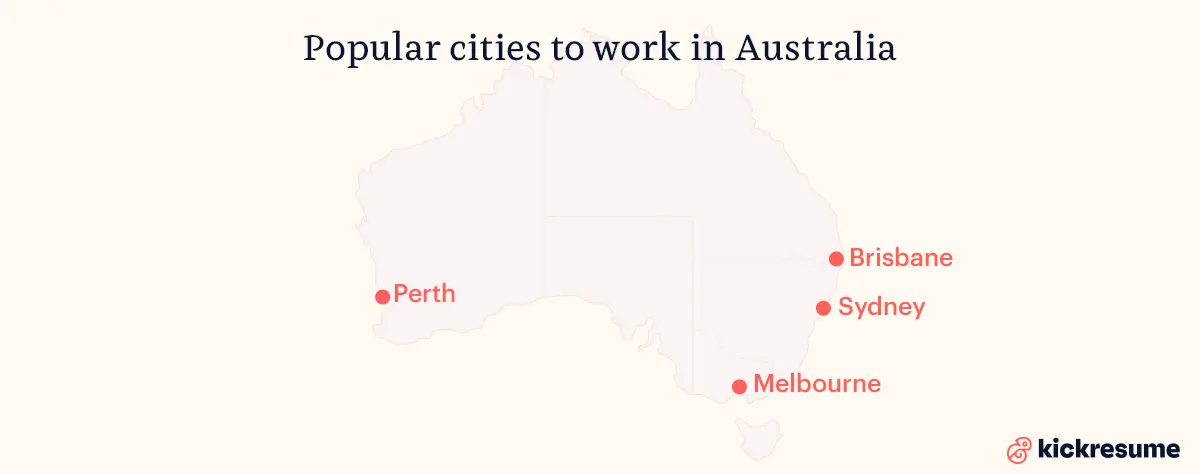
Have a look at four of the most popular cities to work in Australia:
- Sydney. Apart from being Australia's centre of economic interest, Sydney is also by far the the largest and most populated city. It's the home to many multinational companies, which makes it very friendly and welcoming to foreigners searching for a job.
- Brisbane. The capital city of Queensland's job market is growing at more than twice the rate of population growth and now accounts for 47 percent of Queensland's total jobs growth.
- Melbourne. Housing the headquarters of many of Australia's largest corporations, including five of the ten largest in the country, Melbourne is definitely an important financial centre.
- Perth. The relative isolation of the the only major city on the West Coast, its economic base and population size have created development opportunities for many businesses oriented towards local or more diversified markets. It has also become a hub of technology focused startups which provide a pool of highly skilled jobs.
In case you'd prefer to work in Auckland or Wellington, check out: How to find job in New Zealand as a foreigner?
American companies hiring in Australia
Can Americans work in Australia? Of course they can, there's a big pool of jobs in Australia for Americans. Have a look at some of the American companies hiring Down Under to find a job in Australia in many different sectors, such as Business & Finance, Hospitality, Information Technology, and Customer Service.
- American Express. This multinational financial services corporation offers positions such as Financial Analyst, Customer Care Professional or Sales Specialist.
- FMS. With offices across Australia & New Zealand, First Mortgage Services Pty Limited and First American Title Insurance form part of the First American Financial Corporation.
- Bank of America. Provides a full suite of financial products and services, from banking and investments to asset and risk management. They offer job positions in the field of financial and statistical analyses.
- TGIFridays. TGI Fridays currently has 14 locations across Victoria, South Australia, Western Australia, Queensland and New South Wales offering jobs in hospitality sector.
- Starbucks. No need to say much about this big and popular company, just know that if you're a fan of coffee, you could always opt to work at Starbucks in Australia.
FIFO jobs in Australia: what they are and how to apply
If you’re thinking about working in Australia, you might come across something called “FIFO jobs” in Australia. FIFO stands for fly-in fly-out, and it’s a very common way of working in industries that operate far away from cities.
Explained very very simplistically, you don’t live where you work.
Instead, your employer flies you to a remote work site, you work there for a set period of time (called a roster), and then you’re flown back home again for your time off. That home base could be a city like Perth or Brisbane.
What fly-In fly-out work looks like
Not familiar with this type of employment? Here are the basics you need to know about working FIFO jobs in Australia:
- You work in rosters. Depending on the company, you might work two weeks straight, then have one week off at home, or eight days on and six days off.
- You work in remote areas. FIFO roles are usually located deep inland, far from major towns.
- Accommodation and meals are provided. While on site, you usually stay in company-provided housing or camps. Food, basic facilities, and transport to work are normally included.
- It’s not only mining jobs. FIFO jobs cover a wide range of roles. Many are in mining, resources, and energy, but they also include support roles like hospitality, cleaning, administration, mechanics, and trades.
FIFO work is concentrated in areas where Australia’s natural resources are. For example, you can find yourself working in Western Australia, Queensland, South Australia, or Northern Territory.
Even though these sites are remote, workers often live in major cities like Perth, Brisbane, or Adelaide and fly to work when their roster starts.
Where to look for FIFO jobs in Australia
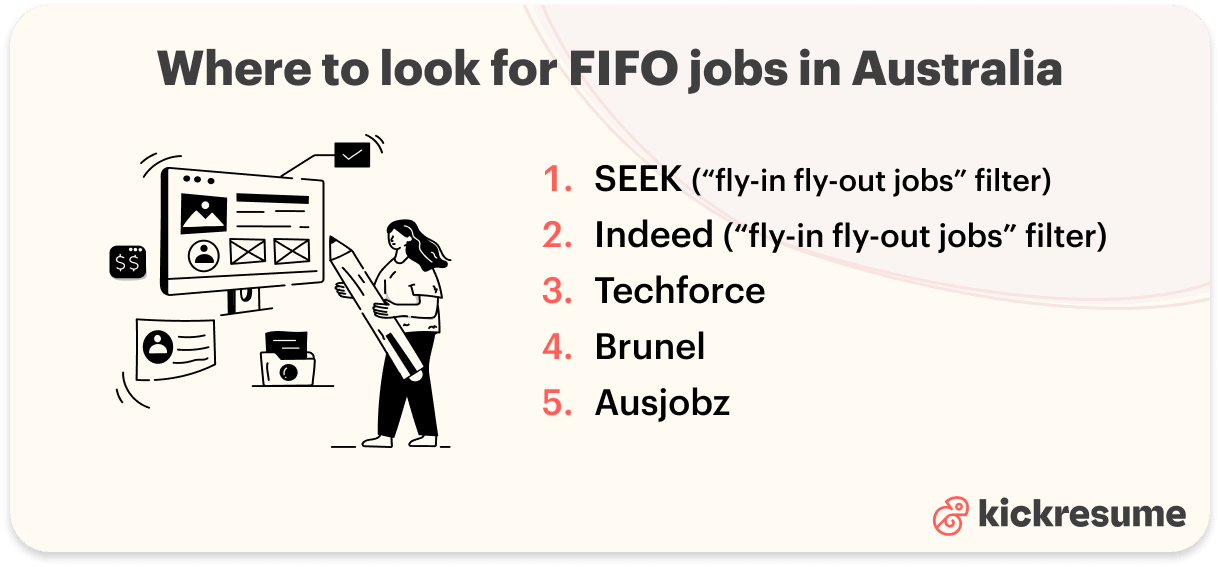
- SEEK (with “fly-in fly-out jobs” filter)
- Indeed (with “fly-in fly-out jobs” filter)
- Techforce
- Brunel
- Ausjobz
Summer jobs in Australia for foreigners
Are you intrigued by the Work & Holiday visa we mentioned earlier? You might be wondering what are the opportunities to find a holiday job in Australia and what types of summer jobs are popular. But, bear in mind that summer in Australia begins in December and lasts until February.
Most people coming to Australia for Work & Holiday visa work in:
- hospitality, doing bar work and other casual jobs;
- childcare and aupairing;
- farming and harvest work, such as fruit-picking;
- tourism, as a deckhand, dive-instructor, or surf leader.
Clearly, some of these are not strictly summer jobs. They're also seasonal jobs or jobs which are popular with foreigners in Australia with the work holiday visa.
Christy's word of advice
"The good news is, applying for jobs in Australia is very similar to the US, Canada, NZ, and UK, so you can use the same resume format and length. Keep your tone professional and confident (think UK factual modesty vs US super confidence!). Something to be aware of: Australian English is a distinct English, so use an Australian English spellchecker to review your application (or go for US English if you’re not sure). Finally, did you know Australia has a Working Holiday Visa Scheme? What a great way to build your international experience!"
—Christy Morgan, Resident HR Expert
Salaries in Australia
So, how much money does a person working in Australia make? Well, that depends on a lot of factors. Firstly, it depends on the career field, since some are better assessed than others.
Secondly, the more years of experience you have, the higher your salary. Lastly, it also depends on your level of education ― higher means more.
- Salary range in Australia. Salaries vary from 23,000 AUD per year (minimum salary) to 405,000 AUD per year. However, it's the maximum average salary, so your actual salary can be even higher.
- Average salary. Typically, a person working in Australia earns around 90,800 AUD per year.
- Quartiles. The median salary in Australia is 89,000 AUD per year, which means that 50% of people in Australia lie in the first and second quartile and thus, make less money. Meanwhile, 50% of people have a higher salary than 89,000 AUD.
Highest paying careers in Australia
Change in salary very much depends on the career field as well. Displayed here are the top 5 highest paying careers in Australia with the average annual salary, according to SalaryExplorer.
- Surgeons and doctors. Earning on average 338,000 AUD per year.
- Judges. With an average annual salary of 284,000 AUD.
- Lawyers. Unsurprisingly, lawyers earn on average 230,000 AUD annually.
- Bank Managers. With an average annual salary of 216,000 AUD.
- Chief Executive Officers. Earning on average 203,000 AUD per year.
Try our AI Resume Writer and have your resume ready in minutes!
