

 ChatGPT
 Perplexity AI
 Claude
It’s no wonder that simple questions like “How far back should a resume go?” or “Does a resume have to include all the jobs?” feel harder to answer than ever.
Our world is vastly different than it was just two decades ago. People job-hop at nearly twice the rate, staying at one job for 10+ years has become very uncommon, and many resumes are first reviewed by ATS systems or created with the help of AI tools.
So how far back should a resume go in 2026 — without making it too long, outdated, or irrelevant?
We’ll go over how much work history to include on your resume, regardless of whether you're
- a student
- a fresh graduate
- an experienced professional
Plus, we look at how many jobs to include, when to remove old jobs, and answer your FAQs.
Find out your resume score!

How far back should a resume go in 2026?
While the traditional rules still apply, modern resumes in 2026 also need to account for ATS systems, keyword optimization, and more flexible career paths.
The common advice is to keep the work experience in a resume between 10 to 15 years. Doing so will give your hiring manager a general outline of your career beginnings, your growth, and where you find yourself now.
It’s also worth noting that most recruiters — and applicant tracking systems — focus primarily on your most recent and relevant experience. Older roles carry significantly less weight unless they demonstrate skills that directly apply to the position you’re targeting.
However, this rule isn't set in stone, and the answer can vary depending on a few factors, such as:
- How long you’ve been in the workforce;
- Does your experience align with your job target;
- And your qualifications.
Generally, if a job provided you with valuable experience and skills that align with your target job, then you want to add it to your resume.
On the other hand, if your past experience from years ago isn't relevant for the desired job, you should consider skipping it and giving more attention to other sections — like skills and resume objective.
Student or recent graduate work experience (0 – 2 years of experience)
As a student or recent graduate, you're probably not concerned about how far back your resume should go.
In fact, you might be concerned about the opposite. Do you even have enough years of experience on your resume?
All we have to say to this is — don’t worry. It's expected for you to have minimal experience when entering the workforce. Besides, you’ll realize in a bit that you’re more qualified than you think.
You don’t need to have years of experience on your resume to show your employer you’re the right candidate for the job.
You can do so by highlighting your:
- Transferable skills (gained while you volunteered, interned, fundraised, or co-worked on a project);
- Hard skills (like programming languages, data analysis, SEO, etc.)
- Relevant projects, dissertations, or research.
- High-school and college achievements;
- Part-time and summer jobs;
As you can see, as a recent graduate your best strategy is to focus on your skills. A resume that is skills-based, is also called a functional resume. It's also great for people changing careers and those with employment gaps, since it takes away attention from the lack of work experience.
Just make sure that what you jot down in your resume is relevant to the job and that it reflects your character and work ethic. Most employers are quick to notice when a resume is full of fluff.
Also, just because you weren't paid as an intern and/or volunteer doesn't mean what you did wasn't work. You can still write them down as work experience, for example:
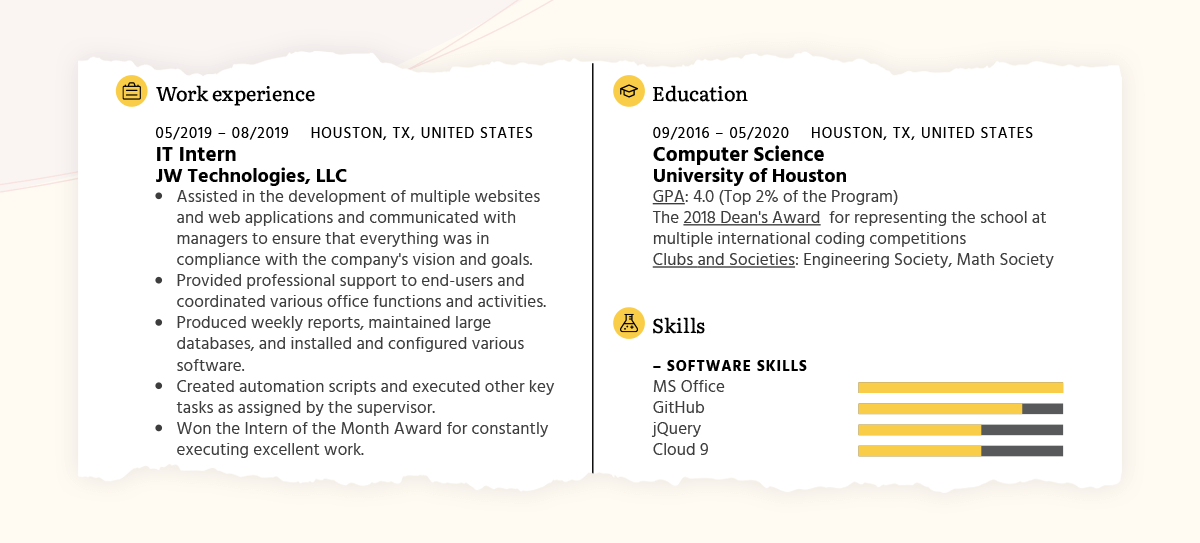
In 2026, many students also use AI tools to help structure their resumes. While this can save time, it’s essential to personalize project descriptions, internships, and skills. Recruiters expect junior candidates to show potential and motivation — not just the perfect, generic wording.
Entry level work experience (2 – 5 years of experience)
If you're someone with entry-level work experience, it’s time to minimize the importance of your college experience.
That means removing your college courses, awards, school projects, and GPA from your resume.
Instead, your main focus should be on your post-graduation experience. Whether that be your first job(s), internships, or volunteering.
Because you're still fresh into the workforce, you might find that your resume’s job experience is lacking.
In such cases, apart from including a work experience section, you can complement it with other resume sections, such as:
- Skills. Regardless of the job and your experience level, skills are essential to any resume. Whether that be hard, soft, or transferable skills. Or all of these. Nowadays, skills are actually often more sought after by employers than work experience.
- Projects. Including personal projects on a resume that align with your job prospect is a great way to show a hiring manager your dedication and internal motivation to succeed in your career.
- Achievements and awards section. Here you can mention any relevant achievements for the job. It can include scholarships, competitions, work-related awards, or even promotions to higher positions in your job.
- Volunteering. Another way to make up for missing experience is through volunteering. You may have gained valuable skills that align with the job requirements. Plus, it shows that you’re proactive and willing to go the extra mile.
Mid-level and experienced professionals (more than 5 years of experience)
If you’ve been in the workforce for 5 to 10 years, you’re still not at the point where you should be worried about how far back you should go on a resume.
However, it’s advised not to write down every single job you’ve had. Instead, list only the jobs that are related to the job in question.
For those who have worked for more than 10 years, it's now time to start implementing the 10 to 15 year rule.
By implementing the 10 to 15 year rule you’re making sure your resume is:
- Relevant. In a fast changing world, jobs that took place long ago may be irrelevant to today's job market.
- Clear. You want the hiring manager to have a clear outlook of where you started, how you progressed and how you got to where you are now.
- Concise. Limiting your job listings makes it easier to stick to an appropriate resume length (1-2 pages).
- Tailored. Adding only the jobs that align with an employer’s job description is a great way to get noticed. Especially as on average hiring managers sift through 100’s of resumes per job.
Also, by not going further than 15 years in your work history, you lessen the probability of ageism in the workplace.
Another benefit of limiting older roles is clarity. Recruiters typically spend only a few seconds scanning a resume for key information, and highlighting your most recent achievements helps them immediately understand where you're in your career today.
If however, you find yourself with older experience that is still relevant to the job at hand. You could always showcase the skills gained at that job in your professional summary.
How many jobs should I put on my resume?
This question depends on the type of career you have. If for example, you have a government job or work in academia, then you might have to provide an extensive and oftentimes complete work history.
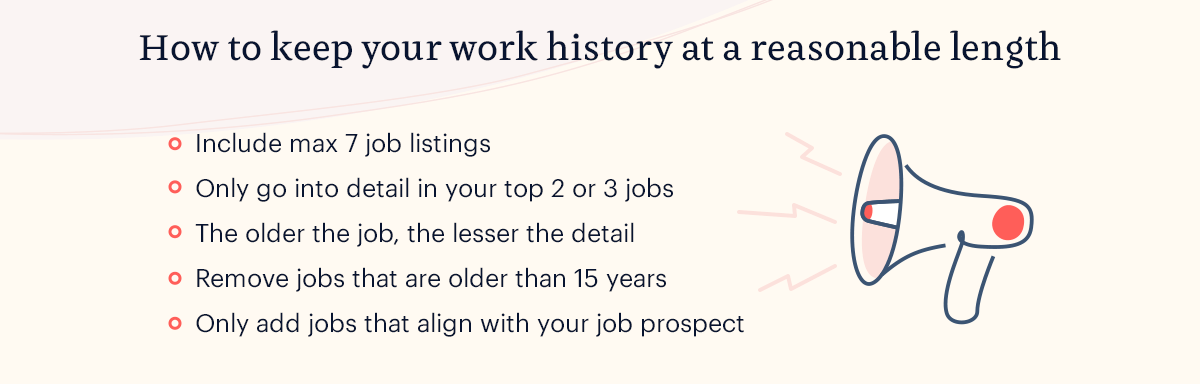
However, the general advice is to add between 3 to 7 job listings.
Adding more than that will only serve to distract the recruiter.
Also, as a rule of thumb, you only need to go into detail in your last two to three jobs. Then, decrease the level of detail the further back you go. Eventually, your older job listing should be only the dates of employment, your role, and the company’s name.
Christy's word of advice
“How long is a piece of string? How far back your resume should go depends on your industry, career level, and the experiences you’d like to highlight. A junior professional can usually leave it all in, whereas for a mid- or senior-level person, 6-8 years of increasingly shorter job descriptions is generally fine, followed by just the companies/titles/dates for earlier jobs (or removing them entirely if not relevant/quite junior). Anything relevant beyond that could even be simplified with a one-line statement (e.g. Previous experience: Junior Program Manager, Assistant Program Coordinator)”
— Christy Morgan, Resident HR Expert
When to remove old jobs from a resume ?
Ideally, you want to tailor your resume so that the jobs you list in your work experience are:
- no older than 15 years;
- relevant to the job you’re applying for.
That means if you have a mid-level to experienced role, there's rarely a need to add a summer job you had in high school. Remove it.
All in all, there will rarely be a need for you to jot down your entire job history on a resume. It's a marketing document, not a legal one.
If you’re still having a hard time deciding which jobs to remove or add to your resume, remember that the same advice you’ve applied when learning how to write a resume applies here — keep your work experience relevant, clear, and concise.
Try our AI Resume Writer and have your resume ready in minutes!

This article was recently updated. The original article was written by Jakub Kaprál in 2021.