Sick days are a standard part of most employee benefits packages. They exist to give employees time to deal with physical illness, whether that means staying in bed with the flu or recovering from something more serious. You feel unwell, you call in sick, and you stay home.
That’s the theory. But how does it really work in practice? Do people always use sick days the way they’re intended, or do they sometimes “bend the rules”?
Kickresume surveyed 1,897 people worldwide to see how sick days fit into the broader trend of “ghost vacationing.”
Here's what we've learned:
- The majority of respondents admitted to using sick days for reasons other than physical illness.
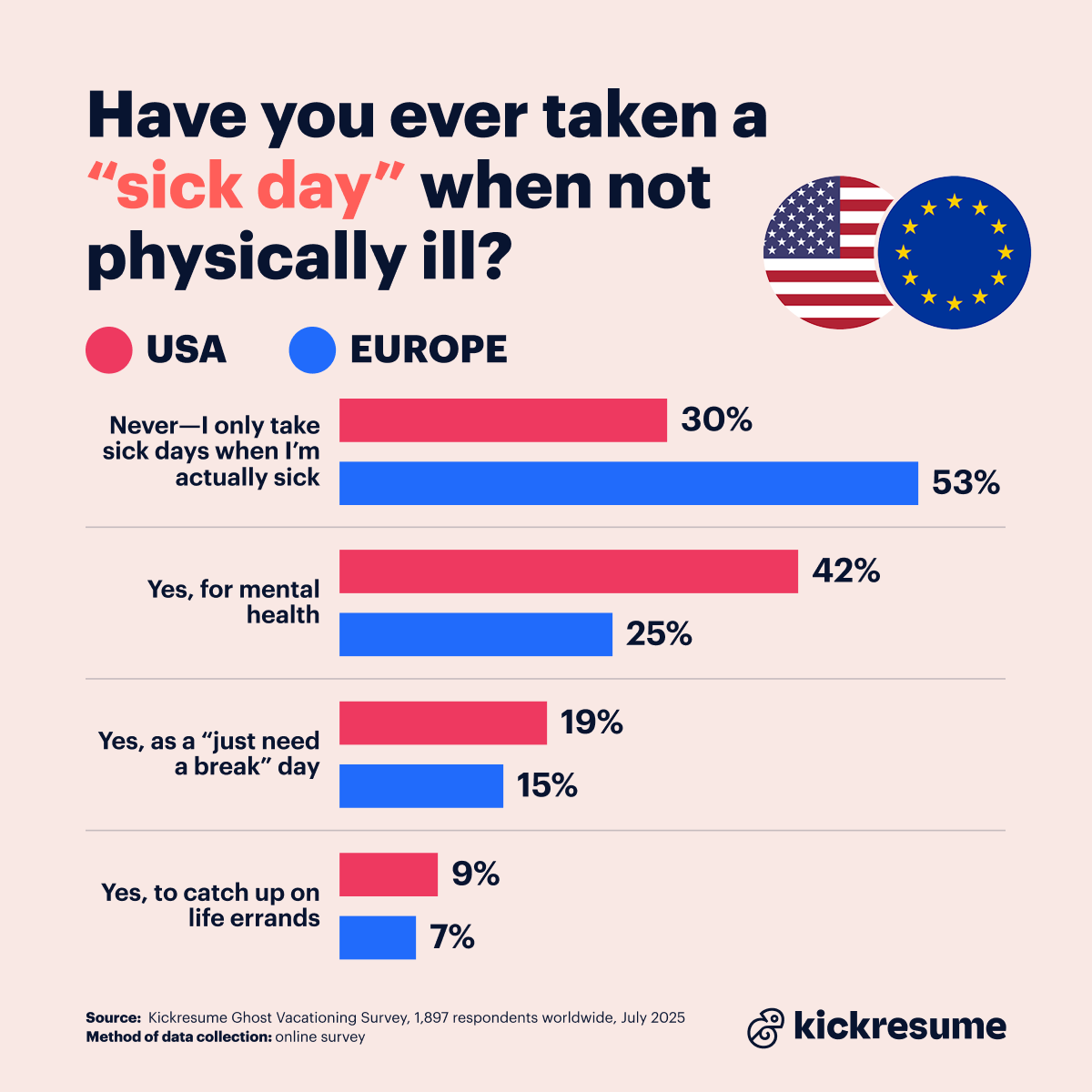
- 42% of Americans admit using sick days for mental health, compared with only 25% of Europeans.
- Only 11% of employees say they completely switch off during sick days, leaving almost 9 out of 10 still tied to work.
- 12% of respondents think they could disappear from work for a day without anyone noticing.
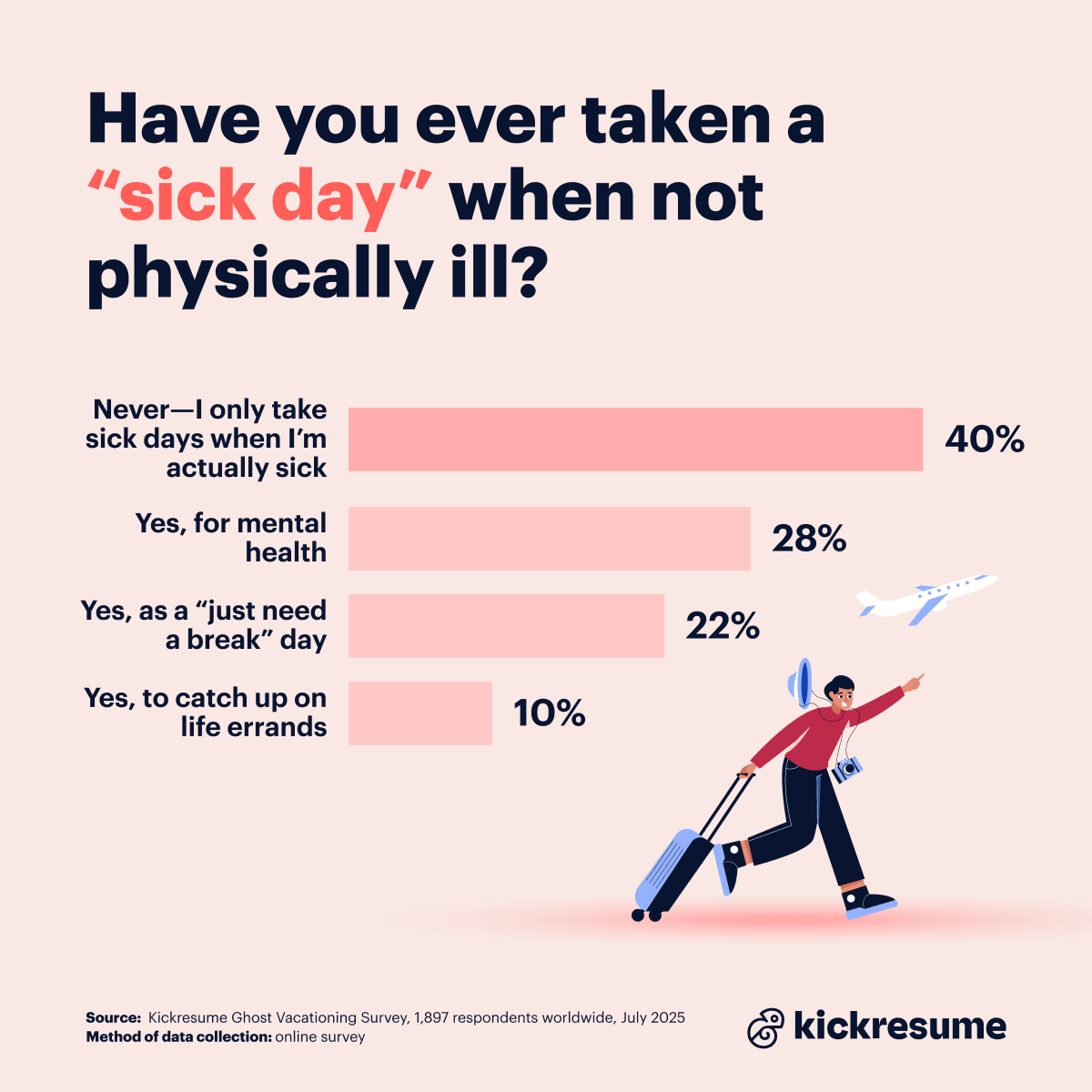
Only 40% take sick days when they're sick—everyone else has other plans
The majority of people don’t limit sick days to physical illness. In fact, most of our respondents admitted they use them for other reasons:
- Only 40% said they never take sick days unless they’re actually ill.
- Another 28% said they use sick days to protect their mental health.
- 22% admitted to using them as a “just need a break” day.
- And 10% take sick days to catch up on life errands like doctor’s appointments, paperwork, or waiting for a plumber.
Taken together, the numbers show that sick leave is evolving into something broader.
That brings us to ghost vacationing. Simply put, it’s when people take time off without letting their employer know. No official request. No explanation. Just a quiet time away.
When we asked ghost vacationers why they did it, here’s what they said:
- 34%: Family or personal reasons
- 31%: Burnout or mental health
- 20%: Just wanted a break
- 11%: Lack of real work to do
- 4%: Other
What stands out is how closely these answers mirror the way people use sick days. Many take a sick day for mental health (28%) or simply because they need a break (22%). Ghost vacationers give almost the exact same reasons: burnout or mental health (31%) and wanting a break (20%).
This overlap is too obvious to simply brush off. Together, these results suggest that when it comes to stress, exhaustion, or mental health, people simply don’t feel they can be upfront. Instead, they turn to quiet workarounds. Sometimes that means calling in sick when they’re not physically ill. Other times it means disappearing without saying anything at all.
Either way, workers clearly need space to recover, but they don’t always feel safe or comfortable asking for it directly.
Americans need mental health days more than Europeans
However, looking at sick days across regions, Americans and Europeans don’t treat them in quite the same way.
In the U.S.:
- 30% said they only take sick days when they’re physically ill.
- 42% use them for mental health.
- 19% for when they just need a break.
- 9% to catch up on life errands.
And in Europe:
- 53% said they only take sick days when physically ill.
- 25% use them for mental health.
- 15% for when they just need a break.
- 7% to catch up on life errands.
Our data shows that Americans are far less likely than Europeans to stick to the “sick days are only for sickness” rule. Only three in ten Americans say they do, compared with more than half of Europeans.
On the other hand, Americans are much more likely to use sick days for mental health.
This difference reflects deeper contrasts in work culture. Our previous survey about American and European work cultures has shown that Americans work longer hours and take fewer vacations than Europeans. That means fewer official breaks to recover.
It’s no surprise, then, that U.S. workers lean more heavily on sick leave to cope with stress and exhaustion.
Legislation and workplace norms also play a role. Paid time off policies are generally more generous in Europe, and cultural attitudes toward work-life balance are stronger.
We also saw this pressure come through in another way. In the very same survey, nearly one in five American (19%) respondents told us they feel pressured not to take a sick day even when they’re genuinely unwell. In Europe, only about one in ten felt the same (10%).
In summary, Europeans are more likely to reserve sick days for physical illness, while Americans rely on them as a substitute for mental health days and missing vacation. It’s another sign of how differently the two regions approach the balance between work and rest.
Just 11% can truly unplug on sick days
Whatever the reason for taking a sick day may be, the flu, a mental health break, or just a day to recharge, very few people actually manage to switch off completely.
When we asked if respondents had ever worked while on a sick day, the answers looked like this:
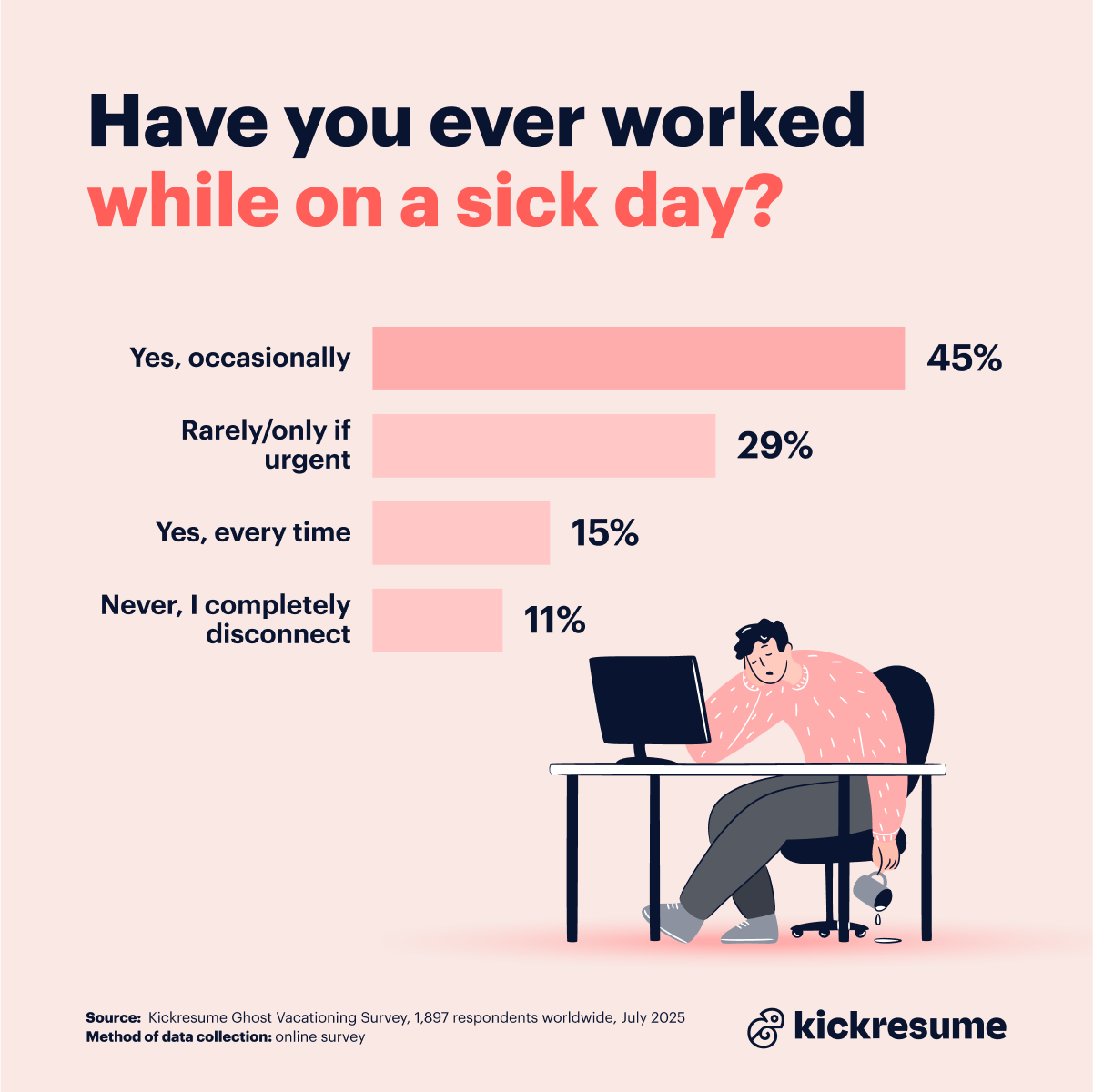
In other words, almost nine out of ten workers still feel tied to their job even on days meant for rest.
But what makes it so hard to disconnect?
Part of it might come down to modern work culture. With laptops and phones always nearby, the boundary between work and personal time is thin. Notifications make it easy to slip back into work mode, even when you shouldn’t. There’s also the fear of falling behind, letting colleagues down, or missing something important.
Another factor may be how people are using their sick days in the first place. If they’ve taken the day for stress, burnout, or just a break, people might not feel “sick enough” to justify fully unplugging. That can create a mighty sense of guilt and a need to at least stay available, just in case.
The result is that sick leave often doesn’t serve its intended purpose. Instead of rest and recovery, many workers end up in a half-work, half-rest limbo that helps neither their health nor their productivity.
From Gen Z to Gen X everyone struggles to disconnect
Not all generations treat sick days the same. Some are more likely to switch off, while others stay tethered to work no matter what.
Gen Z respondents were among the most likely to say they step away fully, with 13% reporting that they disconnect completely. Most, however, still admitted to some level of work:
- 42% said they occasionally check in.
- 34% only in urgent cases.
- And 11% stay switched on every time.
Millennials stood out for being the least likely to unplug:
- Nearly half (46%) said they work occasionally, 30% only if urgent, and 16% work every single time.
- Just 8% of Millennials manage to fully disconnect.
Gen X is the most contradictory generation. On one hand, they were the most likely to work every time (17%), but also the most likely, alongside Gen Z, to cut the cord entirely (14%).
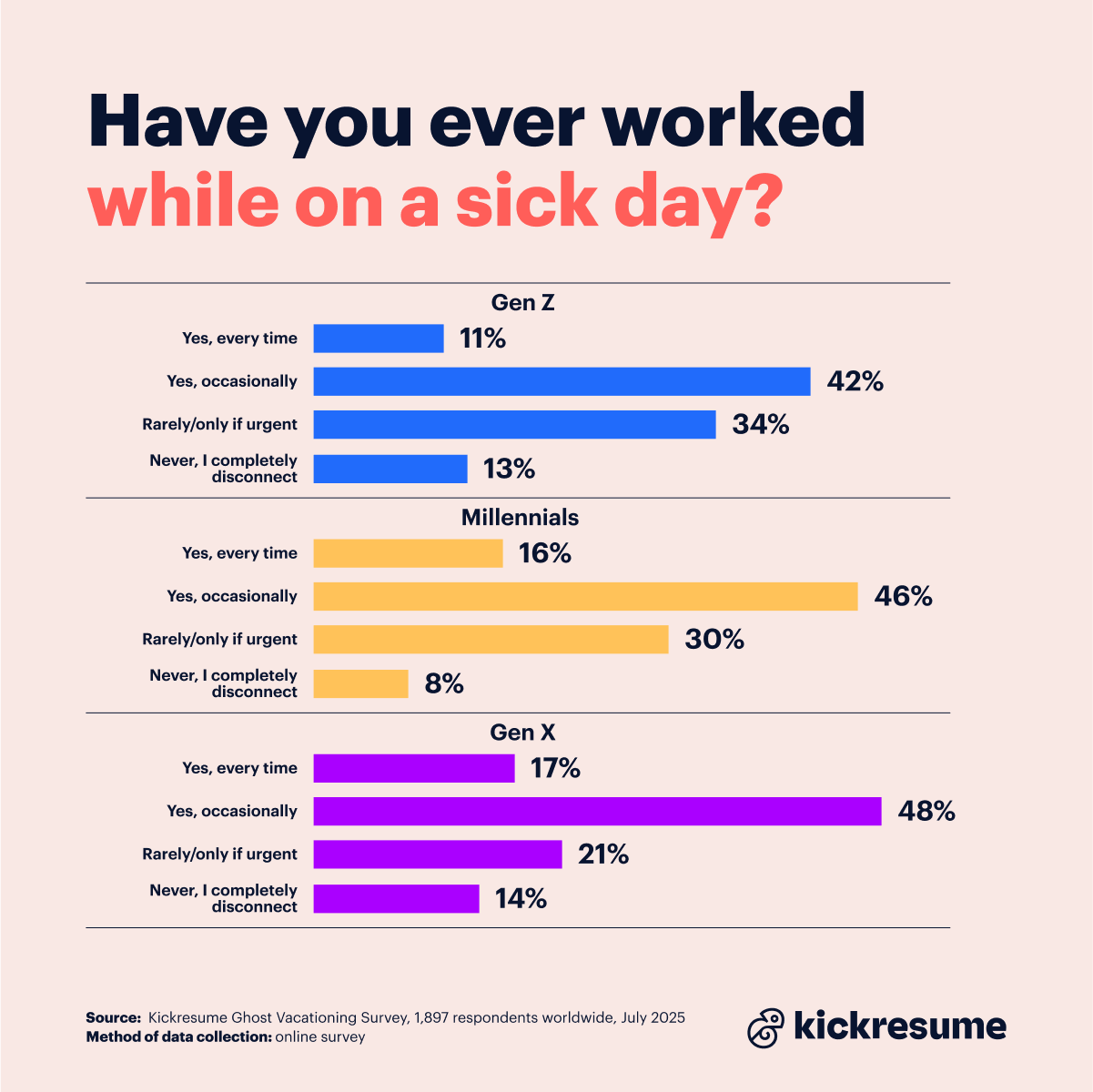
One explanation for this wider range (when compared to younger generations) might be their experience. The older the generation, the more years in the workforce. And with time comes a broader mix of habits. Some seasoned workers may have learned to protect their time, while others may have developed a pattern of always being available.
As workers get older, the number who admit to being “always on” during sick days rises. Workers from older generations are more likely to hold senior or managerial positions. With that often comes a certain level of responsibility. They need to make sure the team runs smoothly, be on call to answer questions, or step in when issues arise. Combined with their expertise and practical experience, this can create a pressure to remain reachable, even when officially off sick.
Taken together, the numbers show that boundaries vary across generations, but the challenge of disconnecting remains universal.
Disappearing from work? 39% say impossible
We’ve already seen the overlap between how people use sick days and why they ghost vacation. In both cases, the biggest drivers were the same: protecting mental health and simply needing a break.
When push comes to shove, though, most people find it easier to bend the rules with a sick day than to vanish without explanation. Which makes sense because it's much safer.
But not everyone plays it that safe. Some workers do try to fly under the radar, taking time off without flagging it to anyone. How realistic is that strategy in practice?
To find out, we asked people how long they could disappear before someone noticed their absence.
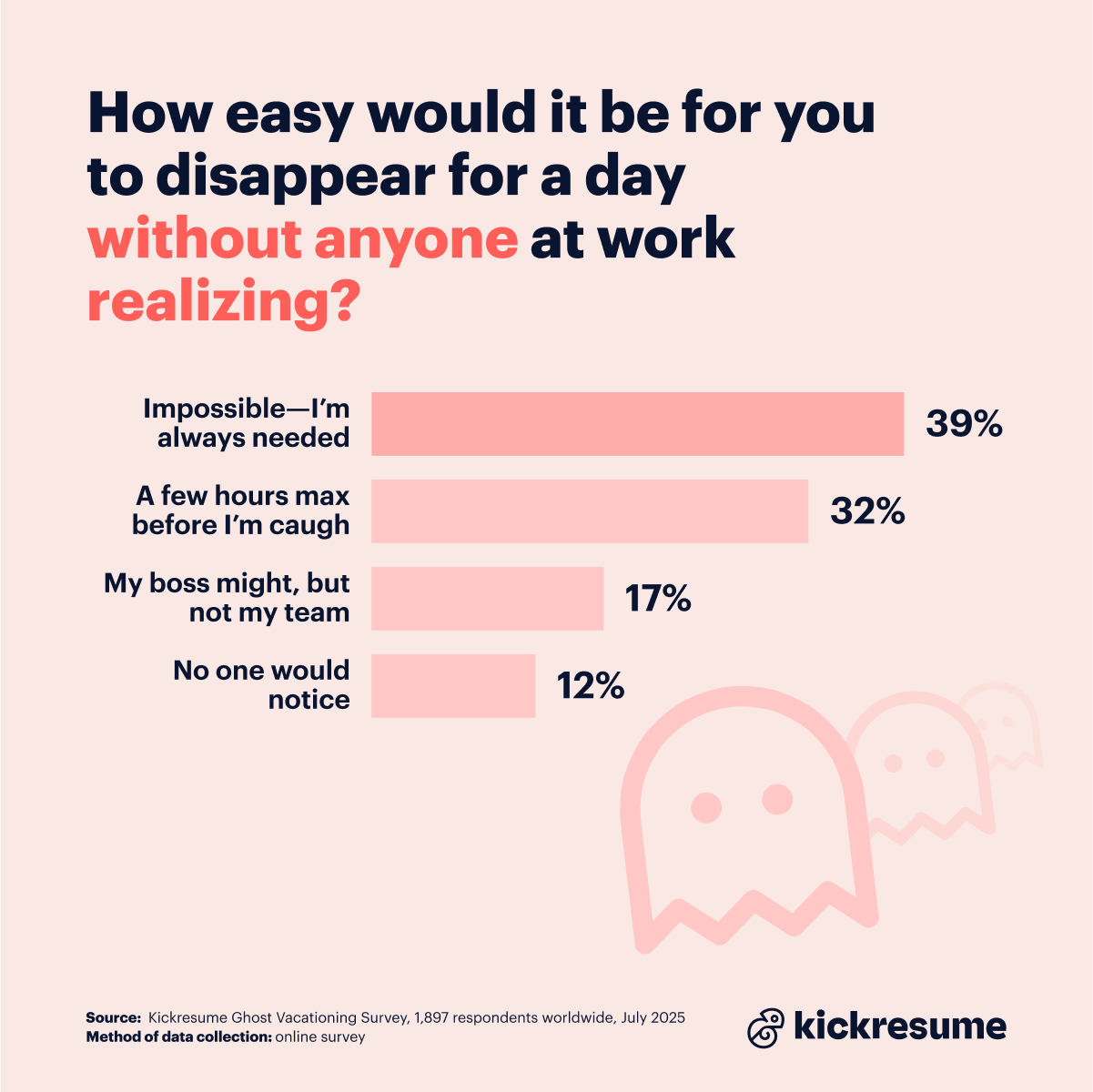
- Nearly four in ten (39%) said it would be outright impossible.
- Another 32% thought they could maybe get away with a few hours at most.
- A smaller share (17%) believed their boss might notice, but their team wouldn’t.
- And only 12% felt confident no one would notice at all.
Of course, not everyone who wants time off is willing to call in sick or risk vanishing without a word. That gray zone in between is where people get creative. So naturally, as a part of our survey, we asked respondents to share their most out there excuses that actually worked.
Here are our favorites:
Final thoughts
Sick days and ghost vacationing reveal the same underlying pressures: workers need time to recover, manage stress, and protect their mental health.
Our survey shows that the majority of workers use sick days for reasons beyond physical illness, while some quietly take time off without telling anyone. At the same time, fully disconnecting is rare.
This reveals a gap between policy and reality. Sick days exist to protect health, yet many employees feel they must find workarounds or get creative to take the breaks they need.
Closing that gap means creating workplace cultures where taking time off is genuinely supported. When rest and recovery are accepted, employees don’t have to hide, make excuses, or ghost vacation. They can simply take the time they need, guilt-free.
Demographics
Gender
- Male: 69%
- Female: 30%
- Non-binary or other: 1%
Age
- Under 18: 2%
- 18–28: 33%
- 29–43: 42%
- 45–60: 21%
- 61–79: 2%
- 79 or older: <1%
Work
- In-office: 40%
- Hybrid: 32%
- Remote: 28%
Location
- Africa: 12%
- Asia: 32%
- Australia/Oceania: 2%
- Europe: 21%
- Latin America: 8%
- North America: 25% (87% based in the USA)
Note
This anonymous online survey by Kickresume, conducted in July 2025, gathered insights from 1,897 respondents globally. All participants were reached via Kickresume's internal database.
About Kickresume
Kickresume is an AI-based career tool that helps candidates source jobs and raise salary with powerful resume and cover letter tools, skills analytics, and automated job search assistance. It has already helped more than 8 million job seekers worldwide.