If salary talk is supposed to break the ice at work, most of us are still skating carefully around it. The workplace today might be a little more open about money, but it’s still a minefield of awkward chats, secret suspicions, and a few bold truth-tellers.
To find out how these money talks actually happen, Kickresume surveyed 1,850 employees around the world. We asked how people talk about pay, how it affects trust and fairness, and what happens when it’s time to raise the topic with the boss.
Here’s what we found:
- Only 31% say salary is discussed openly at their job—while 37% work somewhere that bans talking about pay.
- Curiosity, not envy, is the top reaction when pay comes up—most people simply want to know where they stand.
- More than a half have learned a coworker earns more for the same role, and most were upset.
- Almost half support full salary transparency, but Gen X is much more likely to want privacy.
- Nearly half of women believe men have it easier getting raises. Most men don’t see a gap.
- Most employees feel nervous or anxious about talking money face-to-face with their boss.
Let’s dive into how salary conversations are changing, why transparency matters, and who still sweats when it comes to talking pay.
Salary talk still rare: Less than a third openly discuss pay
You hear a lot about salary transparency these days. It’s the subject of new workplace policies and countless social media debates. But is talking about pay actually getting any easier at work? We asked employees if they’ve ever discussed salary with their coworkers—and here’s what we found:
- Only 31% say salary is openly discussed at their job, while 37% are employed at companies that forbid conversations about pay.
- Meanwhile, 24% say they deliberately steer clear of money talk at work.
- Notably, 37% of respondents say their workplace prohibits salary discussions. Of those, 20% follow the rule and do not discuss pay, while another 17% quietly swapped salary information even though they weren’t supposed to, hinting at a silent push against the rules.
- Another 8% don’t talk about pay with their coworkers, but secretly wish they could.
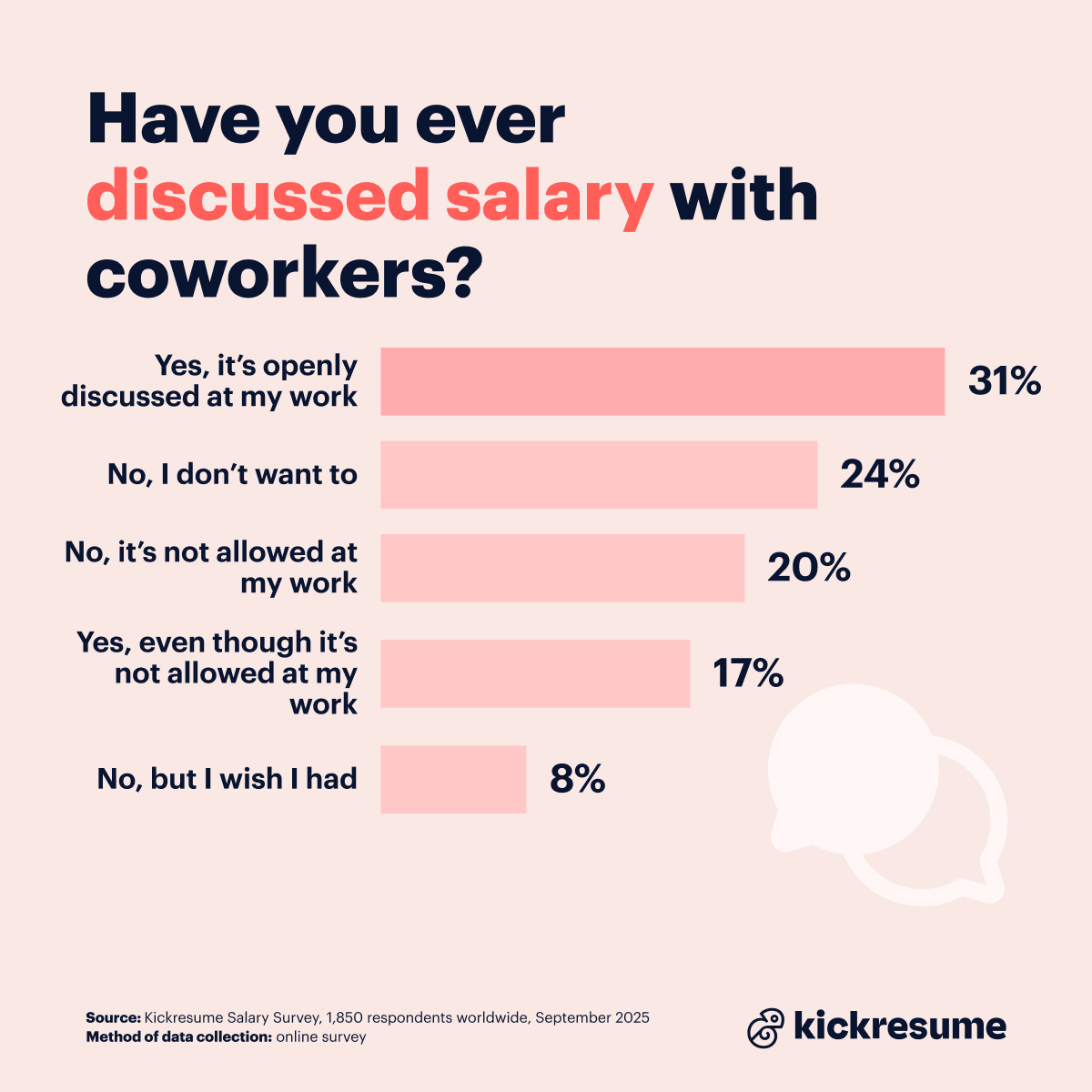
And so, even with all the recent attention, real salary talk remains quite rare in most workplaces. For many employees, discussing pay is still a delicate—and sometimes risky—subject.
What does this actually look like around the world, and does it change depending on your generation?
One in three Asians not allowed to talk about salary at work
Where you live can make a big difference when it comes to pay transparency.
- In Europe, salary is most likely to be an open topic: 34% of European workers say it’s discussed freely at work. Compare that to just 27% in the US and only 24% in Asia.
- But it's the U.S. that leads in keeping pay talk off the table, with one in three workers saying they simply don’t want to discuss salary at all.
- In Asia, explicit company bans are most common—nearly a third of respondents say workplace rules prevent them from ever bringing up money.
Why do these gaps exist? In places like the US and Asia, talking about salary is often seen as too personal—and company rules sometimes make it even harder. Meanwhile, in Europe, there’s more discussion about fairness and stronger worker protections, making open conversations about pay more common.
Gen Z breaks the rules on salary talk, Gen X keeps quiet
Generational differences add another layer to the story.
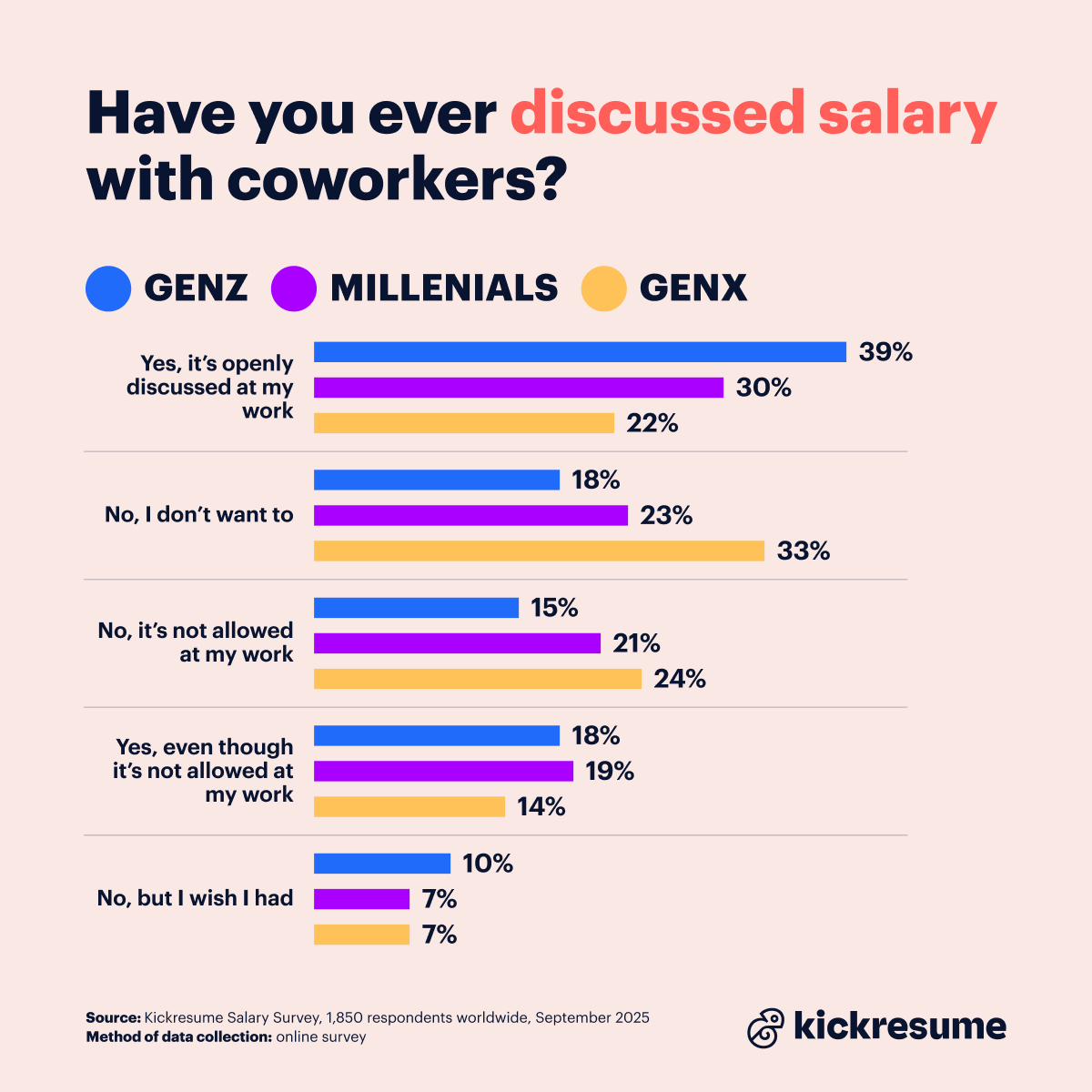
- Nearly 40% of Gen Z respondents say salary is openly discussed at work, almost double the rate of Gen X, where just 22% say the same.
- Gen Z also seem far more willing to break unwritten rules—18% say they’ve talked salary even when it wasn’t technically allowed.
- On the other hand, Gen X are much more likely to avoid the conversation altogether: one in three prefer not to talk about pay, compared to only 18% of their Gen Z counterparts.
One explanation could be that Gen Z has grown up with more openness and information online, making them more comfortable raising the topic of salary. On the other hand, for Gen X and older workers, talking about pay at work still carries the stigma from a time when it was simply off-limits.
Curiosity rules, but salary talk still feels awkward for many
Our data makes one thing clear: talking about pay is more emotional than you might expect. And surprisingly, it’s not all negative. When we asked how people feel about coworkers discussing their salary, curiosity—not jealousy—was the most common reaction.
About a third of workers (32%) admit they’re genuinely interested when a coworker mentions what they earn.
- Gen Z leads the pack, with 38% describing themselves as curious—a sign that salary transparency is most appealing to the youngest employees.
- Women are a touch more curious than men (34% vs. 31%), and curiosity peaks in Europe at 36%.
But curiosity isn’t the only response. For many, salary talk still brings awkwardness or silence.
- Nearly one in five respondents (19%) say salary conversations at work just feel awkward. For Gen X, who entered the workforce when salary was a taboo topic, that number rises to 24%.
- In contrast, only 15% of Gen Z feel that same awkwardness, showing how quickly workplace norms can shift.
- 19% say salary talk never comes up, with that silence most common in Asia (22%) and among Gen X (22%). Whether shaped by culture or age, the tradition of keeping quiet about pay still runs strong in many corners of the workforce.
How many people are actually at ease with discussing salary?
- Only 18% overall—men slightly more than women (20% vs. 15%) and Gen Z leading the way at 22% feel comfortable talking about pay with their coworkers.
And if you thought that envy and resentment will be common feelings when a coworker brings up their salary, that idea doesn’t hold up in our survey.
- Just 8% of respondents feel annoyed when salaries are discussed.
- A tiny 4% admit to jealousy—a number that’s surprisingly stable across groups, with small peaks among Gen Z and in Asia (5%).
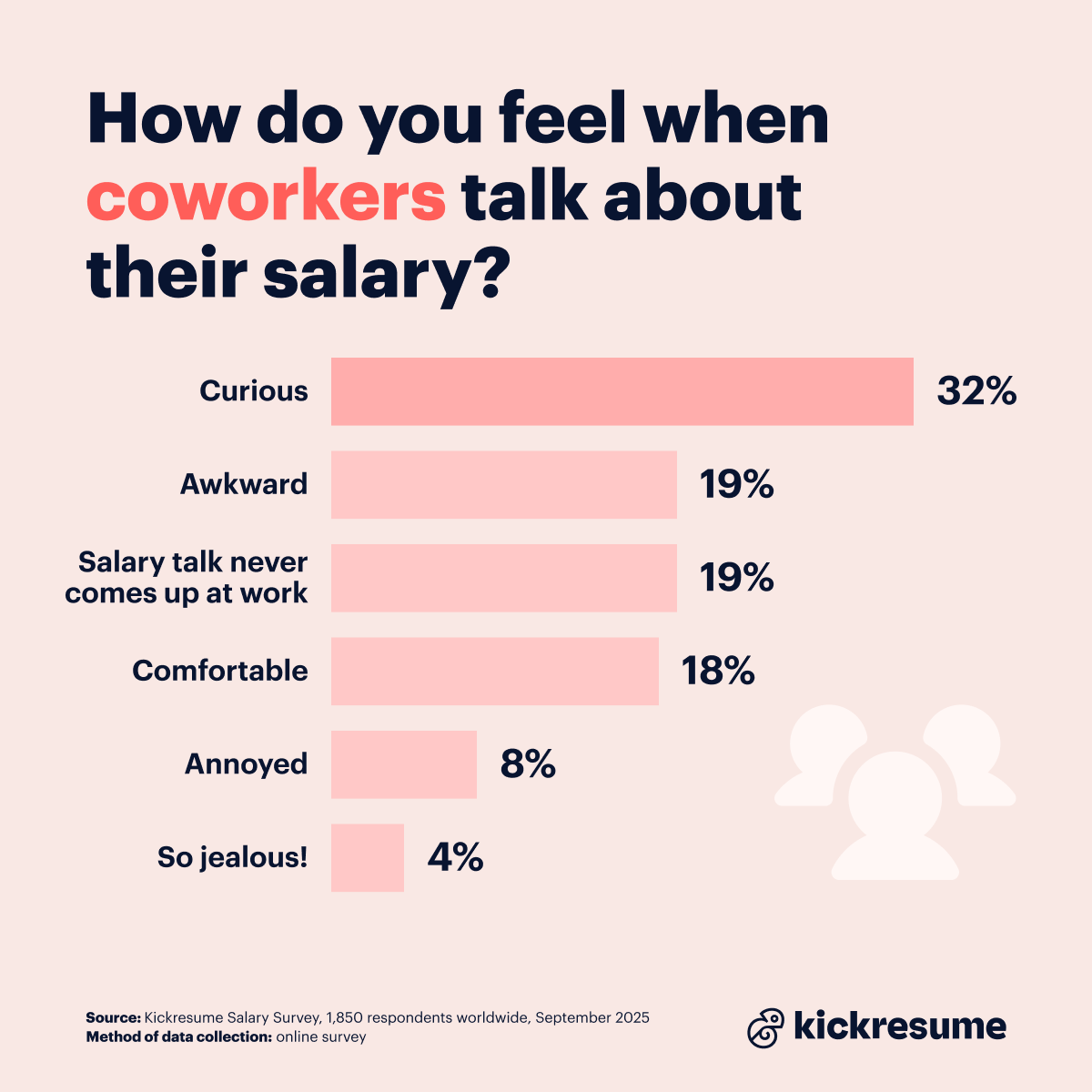
All in all, curiosity is now the dominant emotion when money comes up at work. Older workers may still cringe when the subject is raised. But younger employees are more open and more comfortable than ever. As this generational shift continues, the stage is hopefully set for more open and less awkward salary conversations in the years ahead.
More than a half learn a coworker makes more for the same job
Few things ruffle feathers at work quite like discovering that a coworker earns more for doing the same job. Our survey reveals just how upsetting—and widespread—these moments can be, and how much your reaction depends on your gender, age, and even where you live.
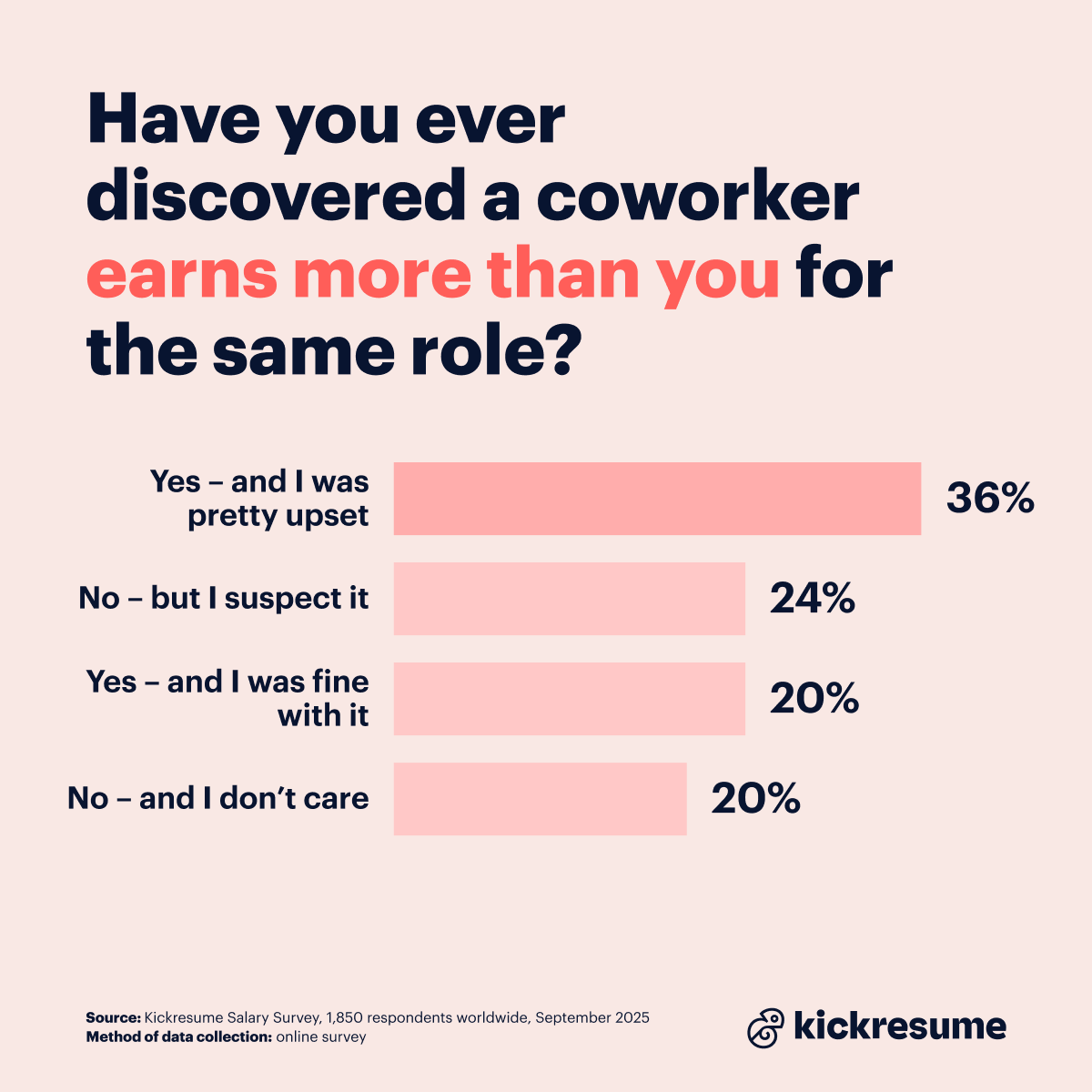
- More than half of respondents (56%) have discovered that a coworker earns more than they do for the same job. Of these, 36% said this finding left them “pretty upset,” while another 20% were unbothered by the difference.
- Another 24% haven’t found proof, but suspect they’re earning less—a feeling that quietly eats away at trust in the workplace.
- 20% said they’d be fine even knowing others earned more.
Women feel pay gaps more deeply
- In our survey, 45% of women said finding out a coworker earns more for the same job made them upset, compared to just 33% of men.
- And while nearly a quarter of men (23%) said they’d be “fine with it,” only 13% of women felt the same.
For many women, pay gaps may hit harder because of long-standing patterns of unequal pay, under-recognition, and fewer opportunities for negotiation in the workplace. This helps explain why calls for greater pay transparency continue to be so important.
Yes, culture also shapes how we cope
- Americans were the most likely to harbor suspicions without proof: 29% believe a coworker earns more, but haven’t actually seen the evidence.
- In Asia, attitudes are more laid back—28% would be “fine” with a colleague earning more (the highest of any region), though a significant 39% still say they’d be upset if they found out.
- Europeans end up in the middle: 37% admit they’d be upset, while about a quarter quietly suspect a gap.
Millennials are most frustrated by pay gaps
- Of all age groups, millennials are most sensitive to unfair pay. 39% have found out about a pay gap and were upset by it—higher than Gen Z (34%) or Gen X (37%).
- Gen Z is the most likely to say they’d be “fine with it” (24%), possibly showing that more open conversations about pay are changing expectations.
In the end, our data confirms that pay inequality isn’t just an abstract issue—it’s a deeply personal, emotional experience for many. Finding out you’re paid less than someone else doing the same job can really sting.
Yet, not knowing for sure can be just as stressful, fueling doubt and mistrust at work. And some—especially younger generations—may be learning to brush it off. But for most, unfair pay remains a real source of frustration that needs to be addressed.
Nearly 50% call for salary transparency at work
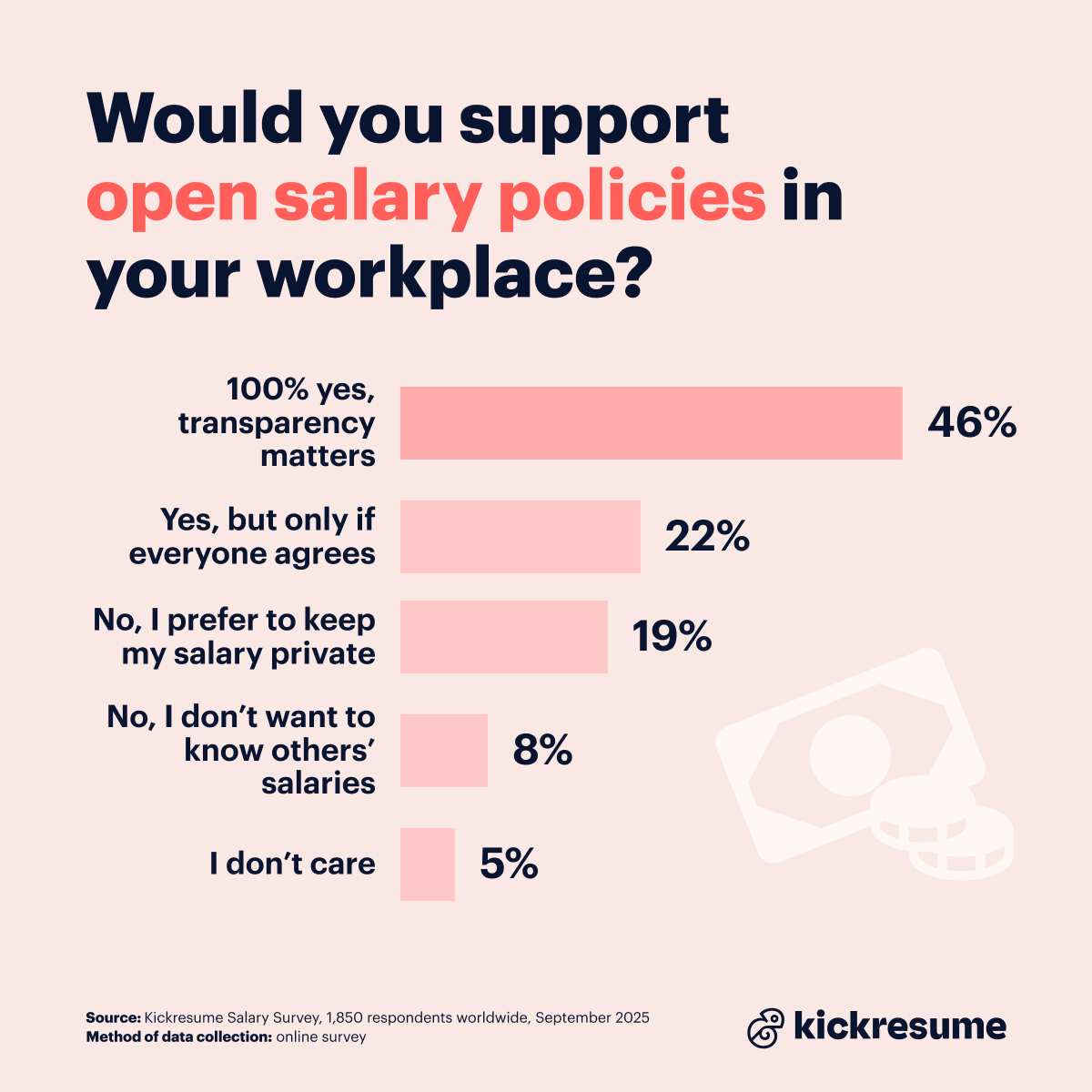
When we asked workers whether they support open salary policies, nearly half (46%) said a resounding “yes,” making it clear that many now see knowing what colleagues earn as key to fairness and trust.
But the data also show that the culture of secrecy dies hard. About one in five workers prefer to keep their salary private, and another 8% would actually rather not know what anyone else makes. These “private pay” holdouts are especially common among Gen X (where a quarter prefer privacy) and among Asian respondents, reflecting longstanding cultural and generational traditions.
Transparency rises, but a third of Americans avoid pay talk
- Workers in the U.S. and Europe are leading the way: 48% in both regions say they fully support open salaries—a tick above the global average.
- Meanwhile, Asia is more reserved. Only 42% of Asian respondents are in favor of full transparency and they are also the most likely to want to keep pay private.
Gen Z pushes openness, Gen X holds back
- Nearly half (49%) of Gen Z respondents support total openness, and just 14% prefer to keep pay private.
- Millennials are close behind, but Gen X stands out for their preference for privacy—only 41% support full transparency, while one in four would rather keep pay private.
- Even among transparency-minded Gen Z, there’s a notable push for consensus, with 25% saying they’d want everyone to agree before making pay fully open. This shows that even as norms shift, younger workers still care about workplace dynamics and harmony.
The momentum for salary transparency is real, especially among younger workers in places like the U.S. and Europe. Still, the idea of sharing what you earn isn’t simple for everyone. For many, worries about privacy, company policies, or just plain awkwardness keep open conversations about pay from becoming the norm.
For employers, moving toward transparency means more than just changing a policy—it’s about respecting the personal and cultural reasons people might hold back. The path to open pay is being built, step by step, but plenty of employees seem to take that journey with caution.
Almost half of women say men have it easier getting raises
It’s clear that the way we talk about pay (or avoid talking about it) doesn’t just affect the mood at work. It also shapes how we trust each other and what we think is fair or possible in our careers.
That’s why we dug deeper and asked our respondents: do you think men and women have an equal chance at getting raises where you work?
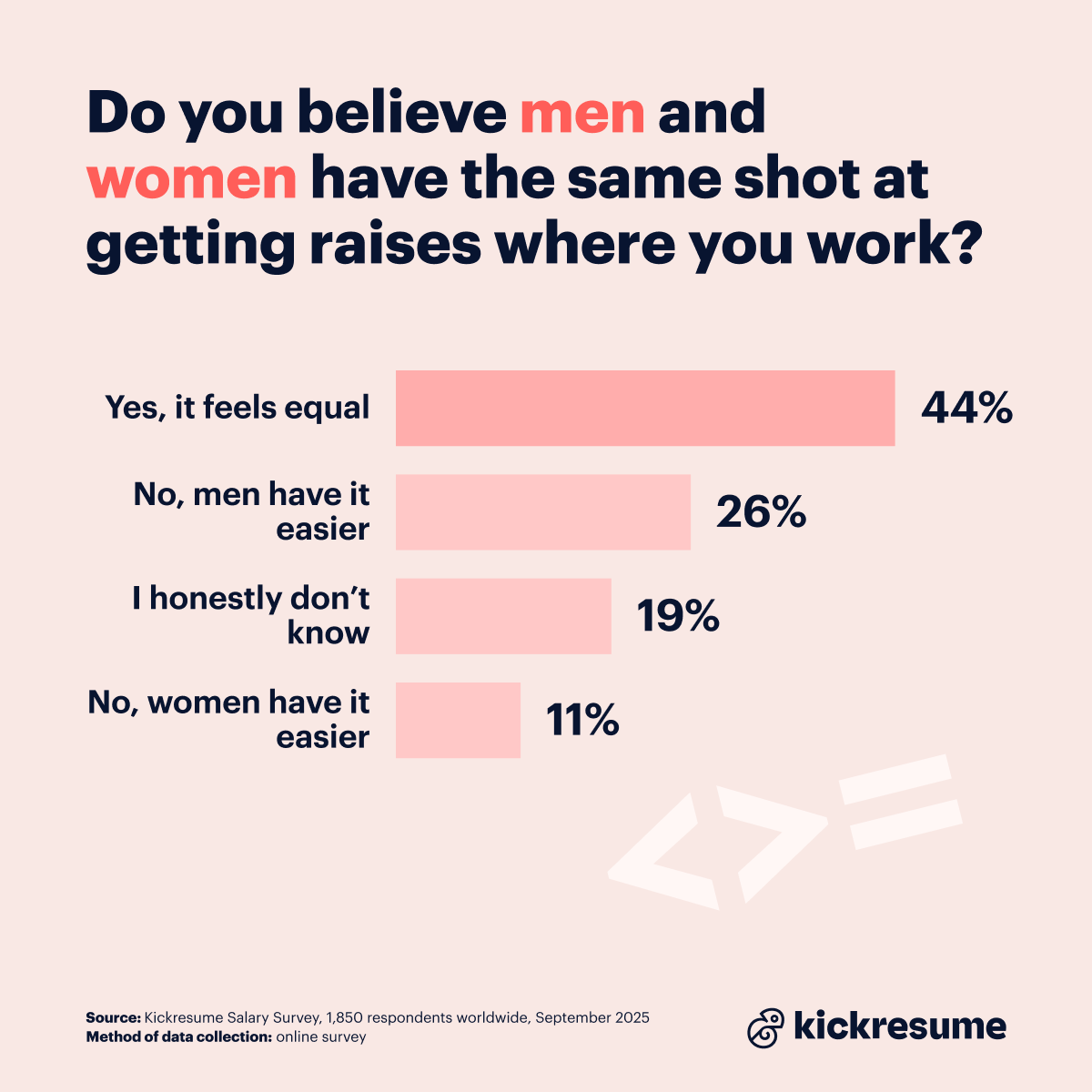
Our survey reveals a sharp split:
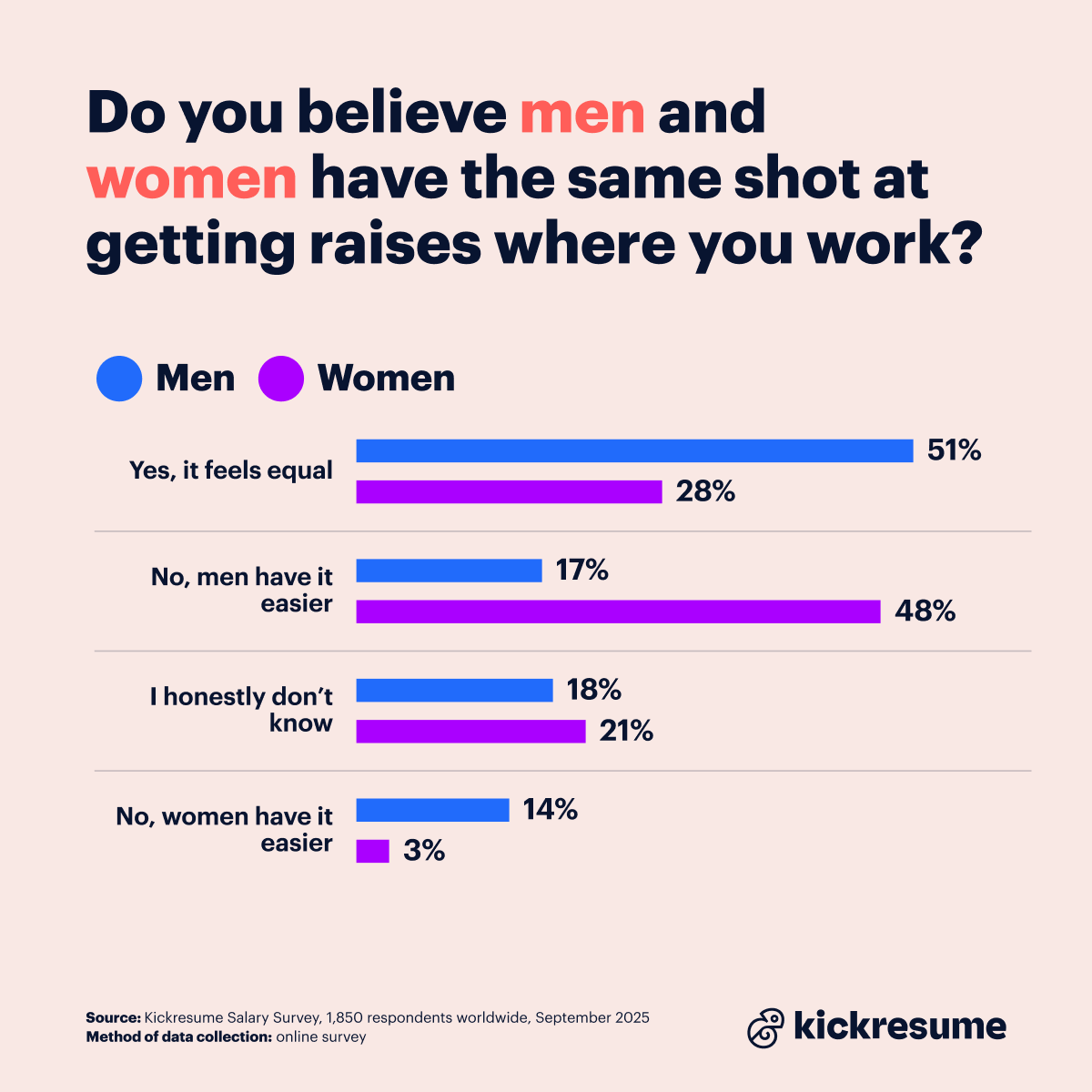
- While 44% of all respondents believe men and women have an equal shot at raises, nearly half of women (48%) say men have it easier.
- On the other hand, only 17% of men agree that their gender has the advantage.
- Over a quarter of all employees—men and women alike—see a gender gap in favor of men, and almost one in five simply aren’t sure either way.
So what makes this issue so murky? The bridge is transparency—or the lack of it. The less we talk about salary, the more room there is for doubts and frustrations to take root.
When employees aren’t sure how raises are really decided—or what colleagues are actually earning—questions about fairness inevitably follow. What’s more, secrecy about pay or promotions creates space for biases and favoritism to quietly shape outcomes.
In the same Kickresume survey, 18% of workers said favoritism, not hard work, was the main driver behind pay—outnumbering those who thought effort alone determined salary. For women, that number was even higher: 20% felt favoritism was key, compared to 17% of men.
If workplaces want to close these gaps, embracing a culture of open dialogue about pay isn’t just a nice-to-have—it’s essential. Because talking money isn’t just about numbers—it’s about showing everyone they’re valued and treated fairly.
Salary talks with boss: 39% nervous, only 24% at ease
While salary transparency is slowly transforming workplace culture, the real test often comes when it’s time to talk money with the person who actually signs off on your pay: your boss.
We asked how comfortable people are talking to their boss about their salary, and our survey shows this remains a nerve-wracking moment for many.
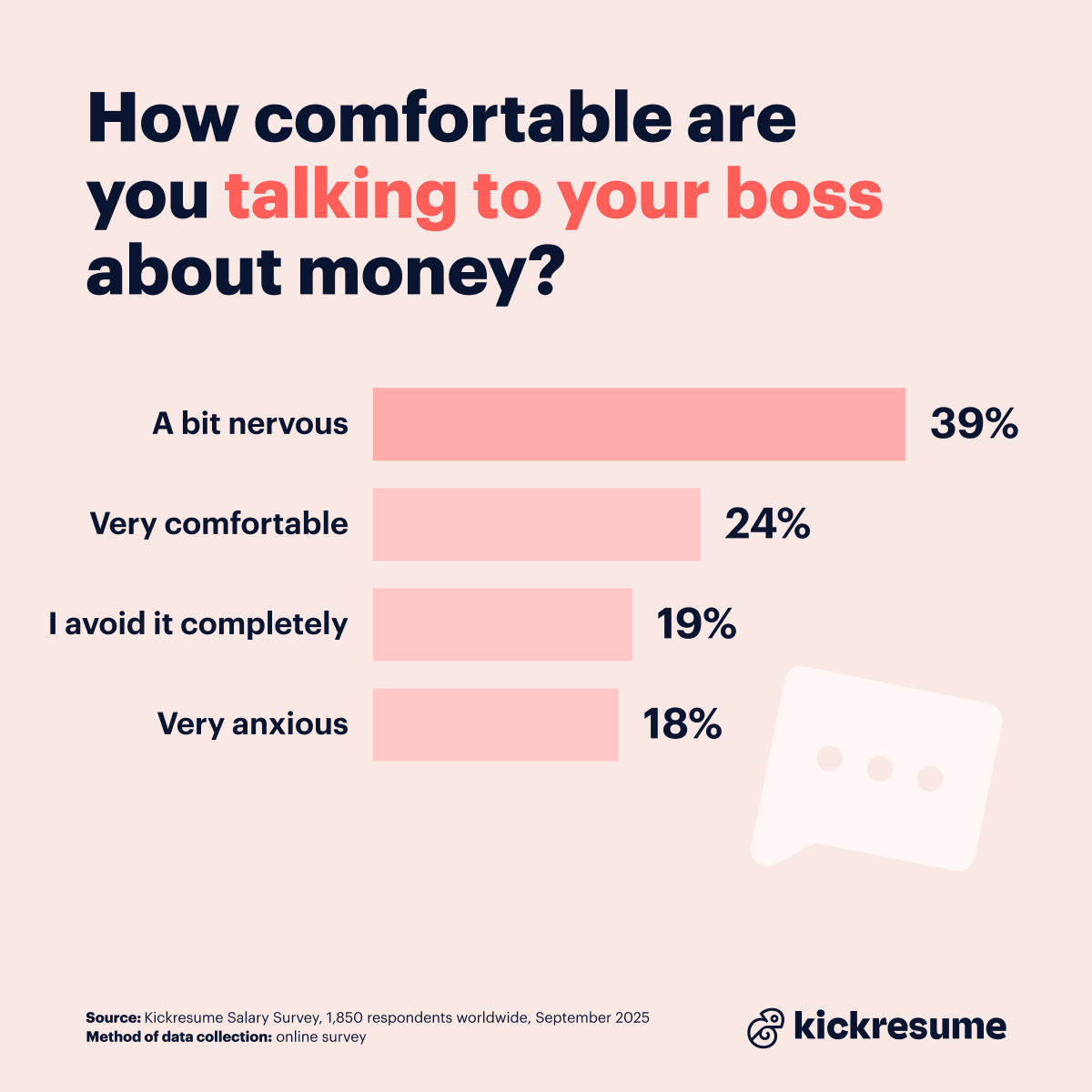
- Nearly four in ten employees (39%) feel “a bit nervous” discussing pay with their manager.
- Almost one in five (18%) describe themselves as “very anxious.”
- Only 24% say they’re “very comfortable” navigating these high-stakes chats.
- Another 19% avoid the subject of pay with their boss entirely.
Women far more likely to feel anxious or avoid pay conversations
- Men are more than one-and-a-half times as likely as women to feel “very comfortable” (27% vs. 16%).
- On the flip side, women are more likely to feel “very anxious” (22% vs. 16%) or avoid the topic completely (23% vs. 17%).
Europeans most nervous to discuss pay
- Europeans are the most reserved—almost half (46%) say they’re “a bit nervous,” and only 21% feel “very comfortable.”
- Americans are more at ease (27% “very comfortable”) and least likely to feel nervous (34%), while Asians fall in between, with 25% “very comfortable” and 38% admitting to nerves.
Confidence grows with age
- Gen X leads in “very comfortable” conversations with their boss (29%), compared to Millennials (22%) and Gen Z (20%).
- Younger workers (Gen Z) are most likely to feel nervous (41%) and just as likely to avoid or feel anxious about the conversation as their Millennial counterparts.
So what does this mean for the future of salary talk? Despite increased transparency among coworkers, approaching the boss about money remains a major hurdle. Culture, gender, and age all influence how we handle these conversations—but each honest discussion, even a shaky one, chips away at old taboos.
Final thoughts
If salary talk still feels awkward, secretive, or even risky, you’re not alone. The path toward pay transparency is clearly gaining momentum, but it’s also full of real-world obstacles—cultural traditions, company rules, personal discomfort, and long-standing taboos all play a part.
Our survey shows that while more people are pushing for openness, honest conversations about pay still take courage. Generational shifts are starting to break down barriers, and curiosity, not envy, is now the leading emotion when money comes up at work. Yet, gender gaps and deep-rooted anxieties remain, reminding us that real change takes time.
One thing is certain: every honest salary talk, whether with a coworker or a manager, brings us one step closer to fairness and trust. In the end, talking about money isn’t just about numbers—it’s about respect, equality, and making sure everyone feels valued at work.
Demographics
Gender
- Male: 70%
- Female: 29%
- Non-binary or other: 1%
Age
- Under 18: <1%
- 18–28: 27%
- 29–43: 46%
- 45–60: 24%
- 61–79: 2%
- 79 or older: <1%
Location
- Africa: 10%
- Asia: 22%
- Australia/Oceania: >2%
- Europe: 25%
- Latin America: 10%
- North America: 30% (88% based in the USA)
Note
This anonymous online survey by Kickresume, conducted in September 2025, gathered insights from 1,850 respondents globally. All participants were reached via Kickresume's internal database.
About Kickresume
Kickresume is an AI-based career tool that helps candidates source jobs and raise salary with powerful resume and cover letter tools, skills analytics, and automated job search assistance. It has already helped more than 8 million job seekers worldwide.