
Money is one of the most sensitive topics at work. Most of us know how much we earn, but we rarely talk about whether our salary is fair or sufficient. It’s the kind of topic people avoid, even when it’s on their mind.
Still, questions don’t just go away. Am I paid enough for what I do? Do my efforts match my paycheck? And if not, can I even bring it up with my boss?
To get some answers, Kickresume asked 1,850 people worldwide how they really feel about their salaries.
Here’s what we found:
- Only 28% of people described themselves as content with their current salary.
- A striking 80% of respondents are skeptical whether their employer understands the true cost of living.
- When asked how much more they should earn, men went straight for the top bracket, while women clustered around smaller increases.
- Just 18% of respondents fully trust their company to pay them fairly without asking.
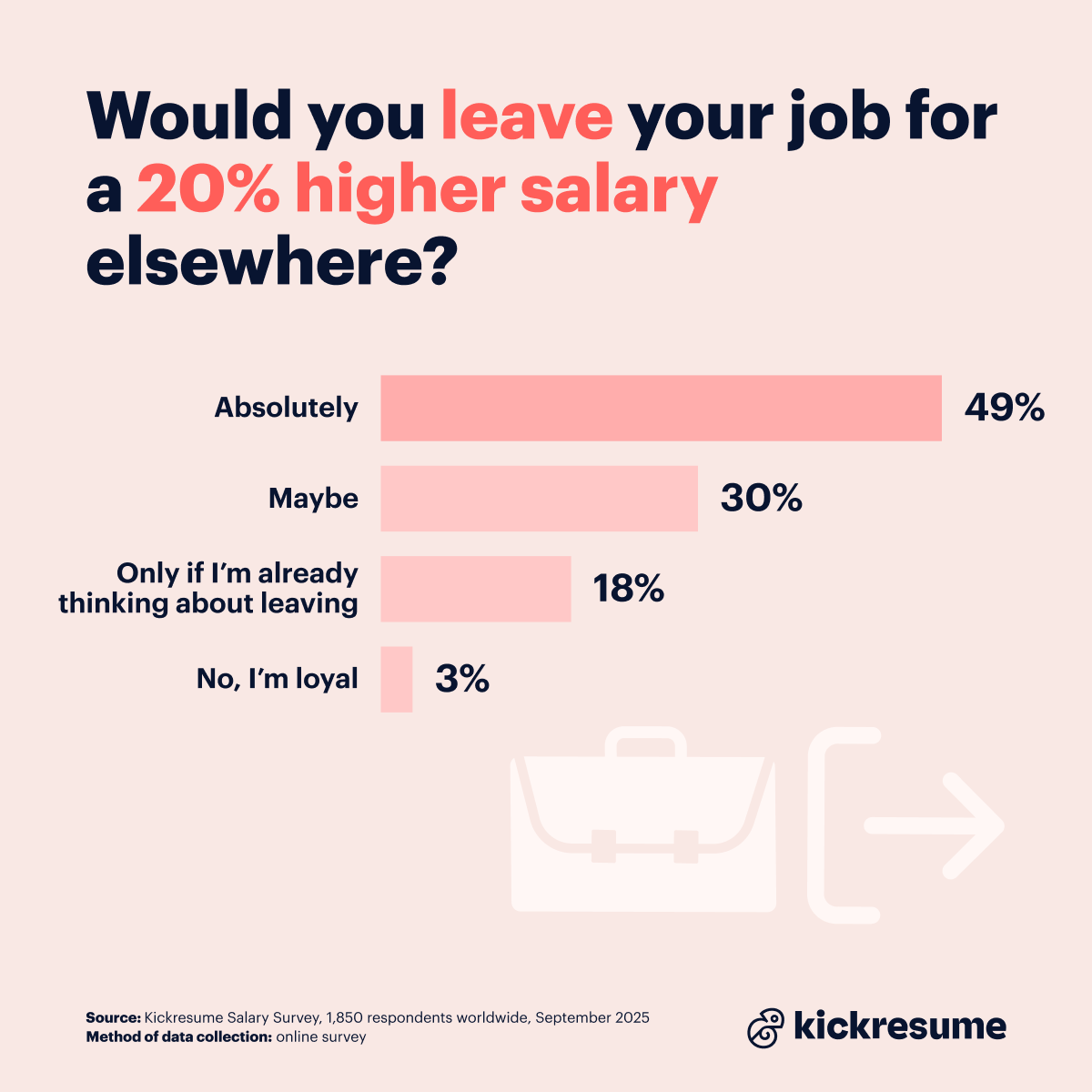
- 49% would leave for 20% more pay. In the US, it’s 61%.
Unhappy with your pay? 55% feel the same
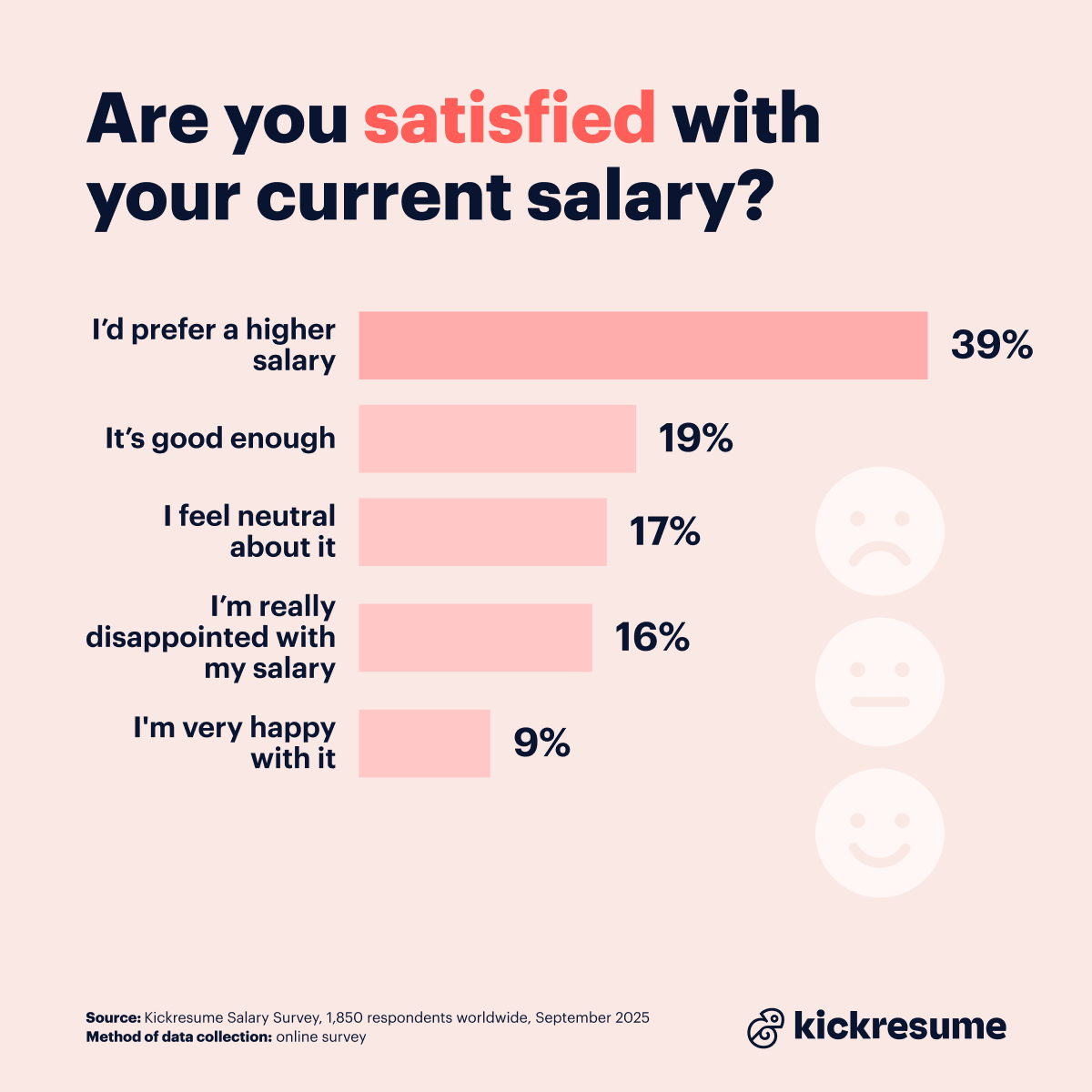
We opened our survey with a direct question: Are you satisfied with your current salary? Perhaps unsurprisingly, a considerable share of people said they would like to be paid more. In fact, 39% of respondents feel their salary should be higher.
- Another 19% said their pay is good enough, while 17% felt neutral about it.
- As many as 16% admitted they are really disappointed with their salary.
- On the other end of the spectrum, only 9% said they are very happy with what they earn.
The gap between satisfaction and disappointment is obvious. Only 28% of respondents described themselves as content with their salary, while 16% said they are really disappointed. The rest fall somewhere in between, but this suggests that genuine satisfaction is far from the norm.
Gender and geography are also angles worth examining.
Women appear more dissatisfied with their salaries than men. They were more likely to say they wanted a higher salary (41% vs. 38%) and more likely to report being really disappointed (19% vs. 14%). This finding speaks to broader issues like unequal pay or differences in how comfortable people feel negotiating their salary.
In the US, frustration with pay is slightly more common, with 41% saying they’d like a higher salary (38% in Europe). But In Europe, fewer people said they were really disappointed with their pay (12% vs 16% in the USA). This suggests that stronger labor protections and social benefits help balance out how people feel about their income.
And then there's Asia. Only a third of respondents there said they wanted a higher salary, and 12% even described themselves as very happy with what they earn. That’s the highest share of satisfied respondents across all regions!
The most dissatisfied industry? It's not what you think
Looking at pay satisfaction across different industries, some of the results go against what you might expect.
Take disappointment, for instance. The industry with the highest share of workers saying they’re really disappointed with their salary isn’t education or healthcare, two sectors that are usually in the spotlight for being underpaid. It’s marketing, advertising, and PR, where nearly one in five (18%) say they feel undervalued.
These fields often attract ambitious, creative people with the promise of exciting work and fast-moving career paths. But the reality often means long hours, demanding clients, and the constant pressure to prove results. If the paycheck doesn’t reflect all that effort, disappointment can set in quickly.
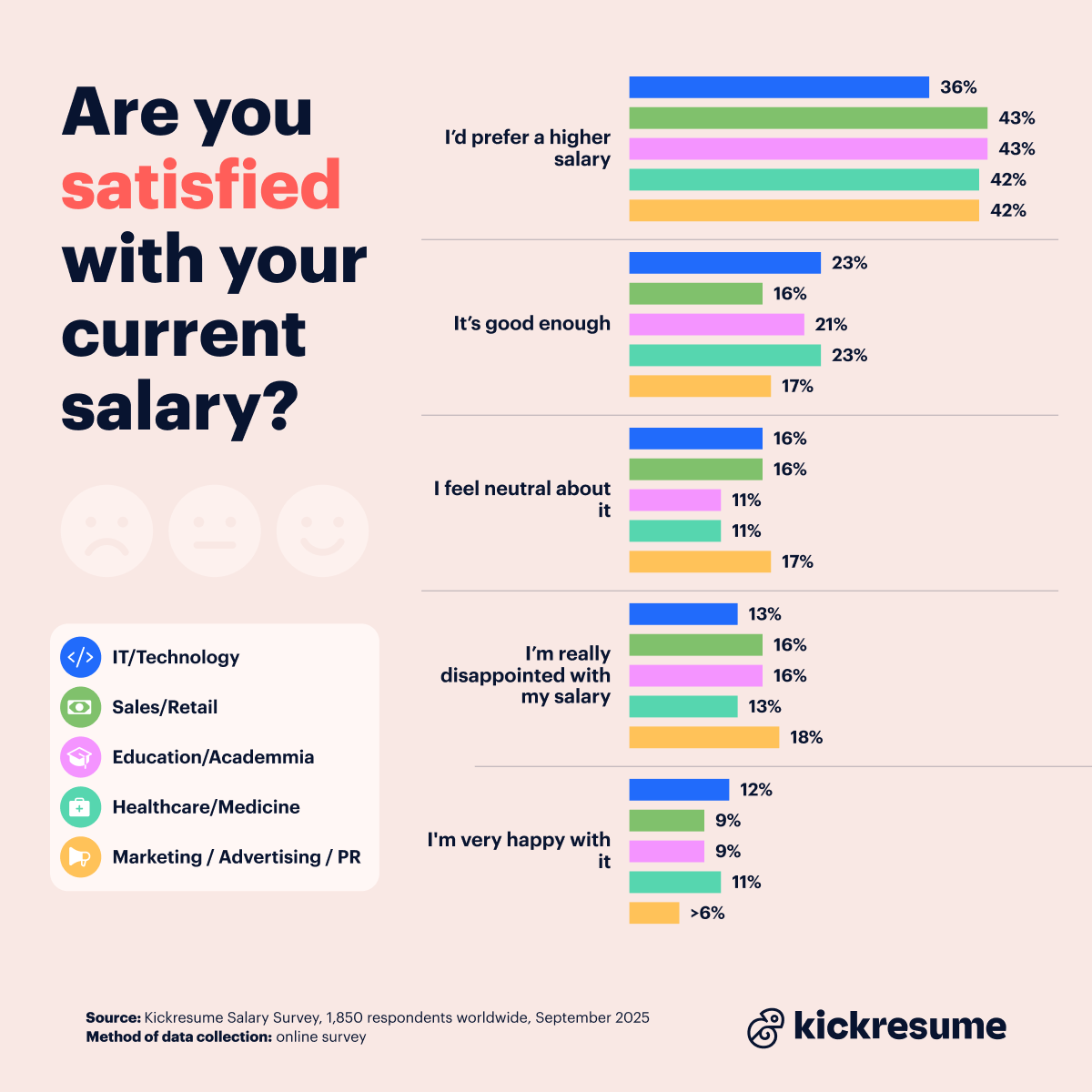
- Sales and retail also rank high on the disappointment scale (16%). Unlike marketing, the issue here may be less about expectations and more about sheer financial strain.
- By contrast, healthcare workers, who often make headlines for being overworked and underpaid, actually report lower levels of disappointment (13%), with a solid 11% even saying they’re very happy with their salary.
- While plenty of workers in both IT and finance would prefer a higher salary, they also include some of the happiest respondents overall (12% and 11% respectively saying they’re very happy with their pay).
- Education looks more predictable. About 16% of academics and teachers say they’re really disappointed, which is high, but not as high as in marketing. Still, their “very happy” numbers remain low (just 9%).
Over a third of underpaid workers say they deserve 30% more
For those who feel underpaid, we wanted to know how much more they believe they should earn to feel fairly compensated. Their answers went like this:
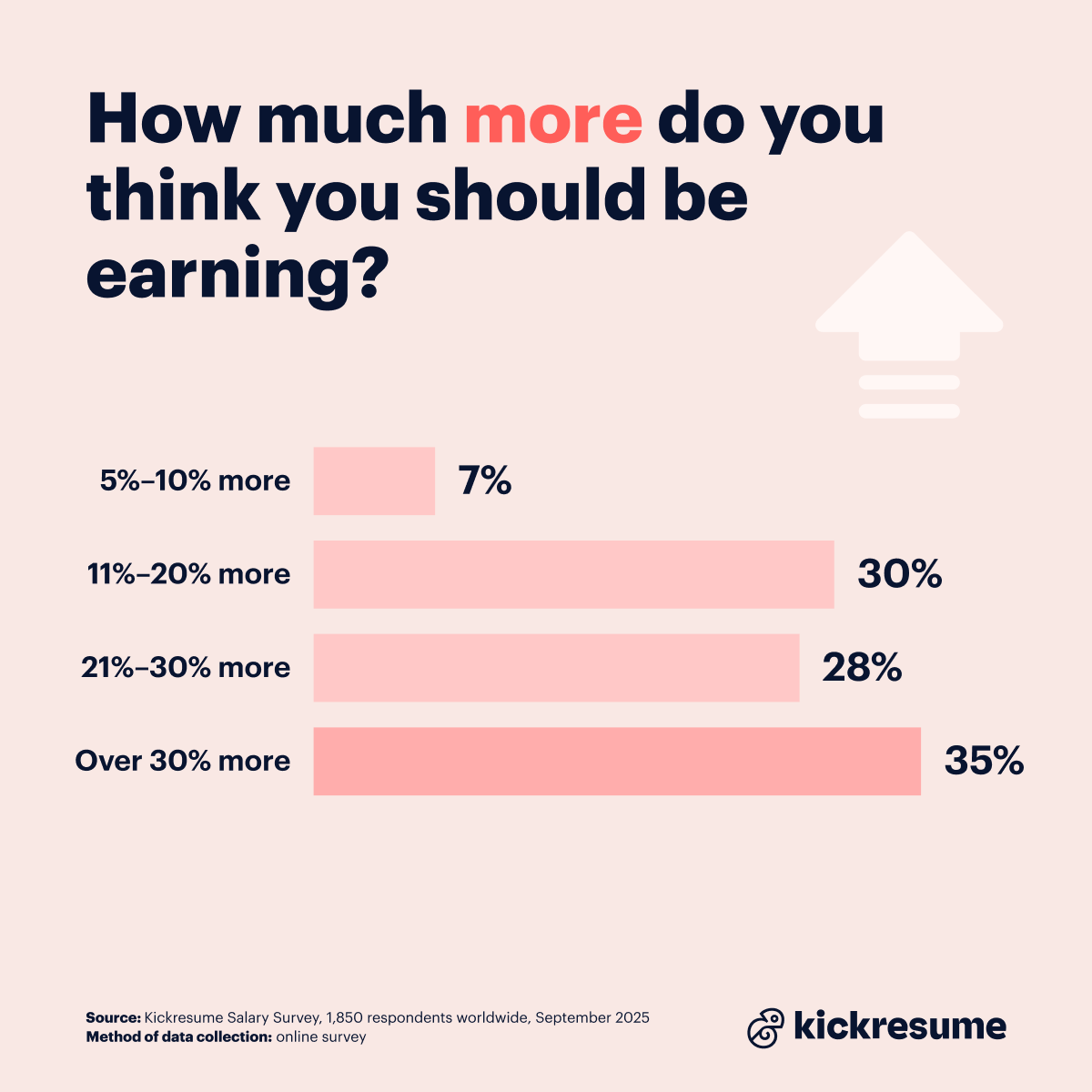
The most eye-catching figure is at the top. More than a third of dissatisfied respondents think they should be earning over 30% more than they currently do. That’s far from just a minor adjustment!
Another 28% would settle for a 21–30% raise, and nearly the same share (30%) would be happy with 11–20% more. Only 7% of those who feel underpaid said a modest increase of up to 10% would be enough.
What to make of all this?
Employee expectations are high, and they go far beyond the typical annual raise or cost-of-living adjustment. But it would be far too simplistic and ignorant to blame this on greed. Against the backdrop of the current rising living costs worldwide, people aren’t just feeling a little stretched. For many, their current pay feels far out of step with what they think their work is worth.
When we look at men and women separately, the gap isn’t huge, but it’s still telling:
- Men were more likely to say they should be earning over 30% more (38%), while women leaned toward smaller increases.
- A third of female respondents (33%) felt that 11–20% more would be fair, and 11% said even 5–10% more would be enough (as opposed to 28% and 6% for men respectively).
This suggests that women may set their expectations lower, or at least more modestly, compared to men. It could also reflect differences in how men and women judge fairness, or perhaps how confident they feel in stating what they deserve.
Regional differences, however, are a bit more palpable.
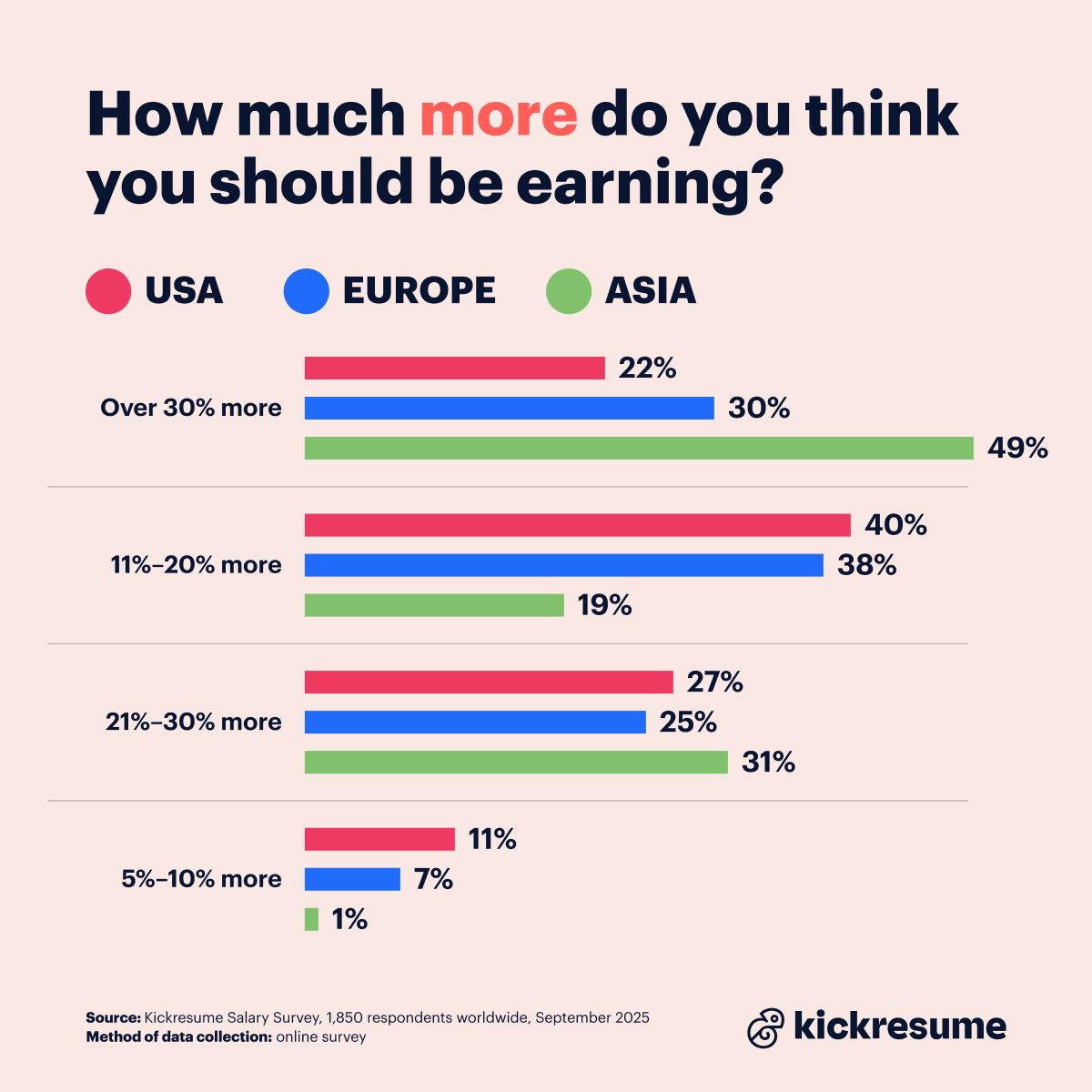
- USA: Most people here weren’t asking for dramatic increases. The largest group, 40%, said 11–20% more would be enough, while only 22% thought they should earn over 30% more.
- EU: Europeans landed in a similar middle ground. 38% wanted 11–20% more, while 30% said they should be earning over 30% more.
- Asia: This region stood out the most. Almost half of Asian respondents (49%) said they should be earning over 30% more, the highest share of any region. At the same time, only 1% said a small raise of 5–10% would be enough.
This is especially notable because, in the earlier question, Asia had the highest number of respondents who said they were very happy with their pay (12%). It seems that while some are satisfied, those who aren’t feel seriously underpaid.
Our data likely reflect a mix of economic conditions and expectations. In the US, where salaries can already be relatively high, people may see a smaller raise as enough to feel fairly compensated. In Asia, differences in wages and rapid changes in living costs could explain why dissatisfaction, when it appears, comes with much bigger expectations.
Only 1 in 5 think their boss understands living costs
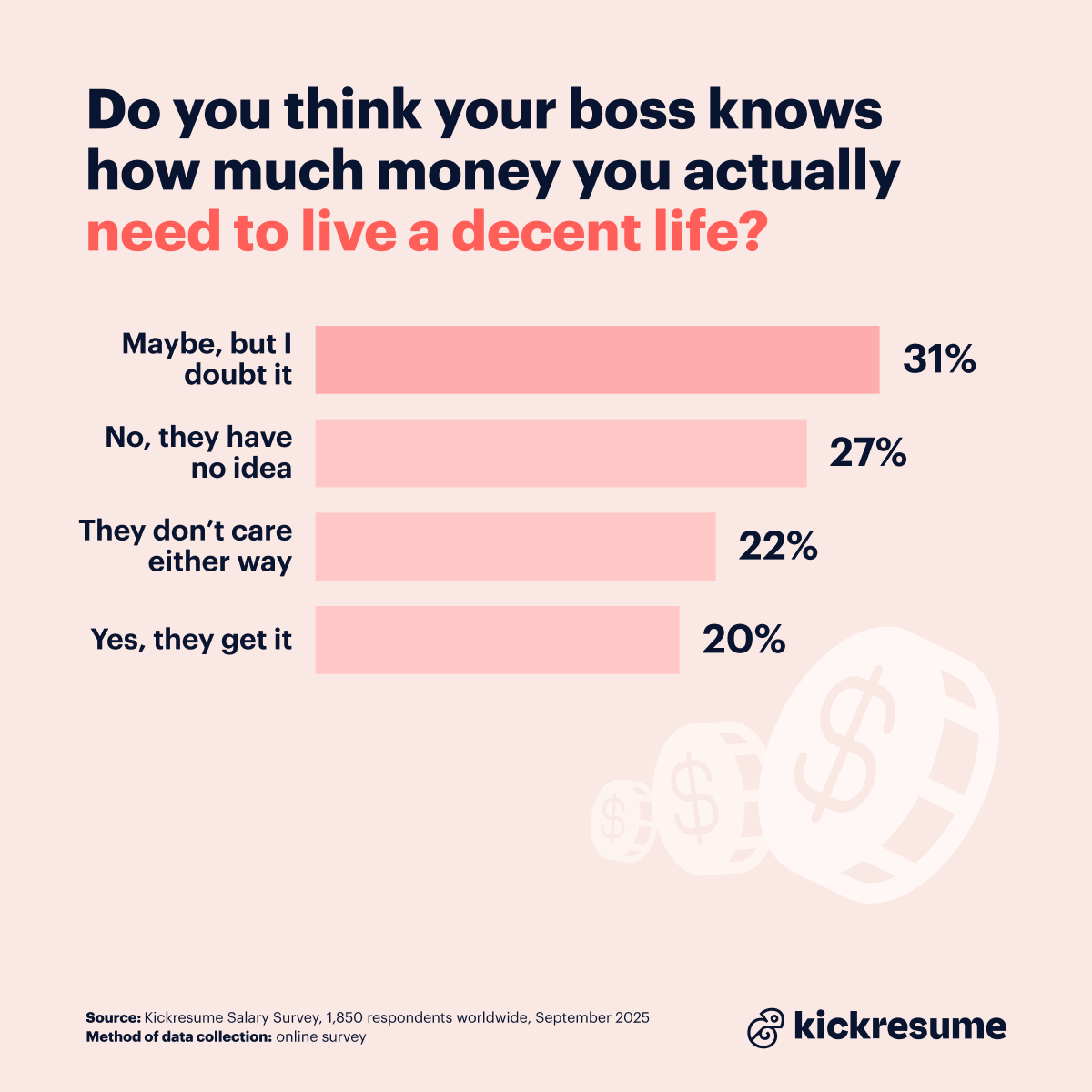
Speaking of factors like worsening inflation and the rising cost of living, do employers keep track of what’s happening and understand how much money their employees actually need to live decently?
80% of our respondents are skeptical!
- About a third (31%) said maybe, but I doubt it, while another 27% were more direct, saying no, they have no idea.
- Another 22% believed their bosses don’t care either way.
- Only 20% thought their employers really “get it.
More than gender or geographical location, age seems to be a major influence on how employees perceive their bosses:
- Gen Z: Yes, they get it: 21% | No, they have no idea: 26%
- Millennials: Yes, they get it: 20% | No, they have no idea: 27%
- Gen X: Yes, they get it: 19% | No, they have no idea: 30%
This data shows that the older and more experienced people are, the less faith they have in management’s awareness of everyday financial realities. This could reflect years of watching employers overlook or downplay cost-of-living concerns. By contrast, younger workers, with less time in the workforce, may be more inclined to give their bosses the benefit of the doubt.
But this could also be due to something more prosaic: older generations usually have to shoulder more responsibilities than people in their 20s. Many Gen Xers, for instance, are caring for aging parents while also feeling responsible for supporting their children. Therefore, their understanding of what a “decent life” means may be widely different.
Most workers don’t believe fair pay happens without asking
Skepticism about bosses also translates into general distrust in organizations and companies.
When asked whether they trust their company to pay them fairly without asking, our respondents leaned heavily toward doubt:
- A third of respondents (34%) said not really, I have to push for it.
- Another 32% admitted kind of, but I still double-check.
- Only 18% expressed full trust in their employer, while 16% took the opposite extreme, saying no way, they’d underpay me otherwise.
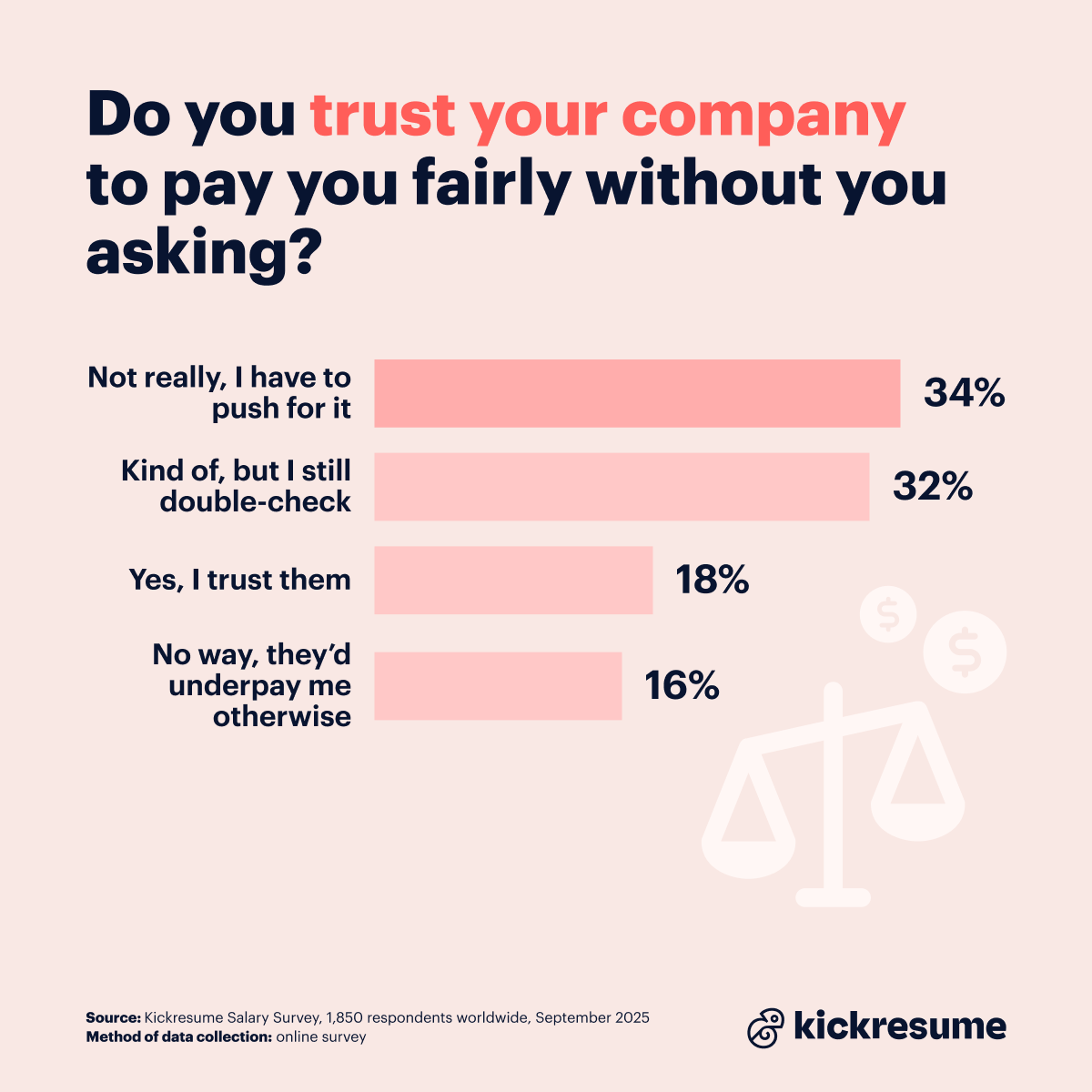
Taken together, these numbers suggest that most people don’t see fair pay as automatic. Even when employees do receive what they deserve, they tend to believe it’s the result of their own vigilance or persistence. True, only a small minority outright accused their employer of wanting to underpay them, but the fact that just 18% feel comfortable trusting their company fully speaks volumes.
The overall confidence in the system seems fragile at best.
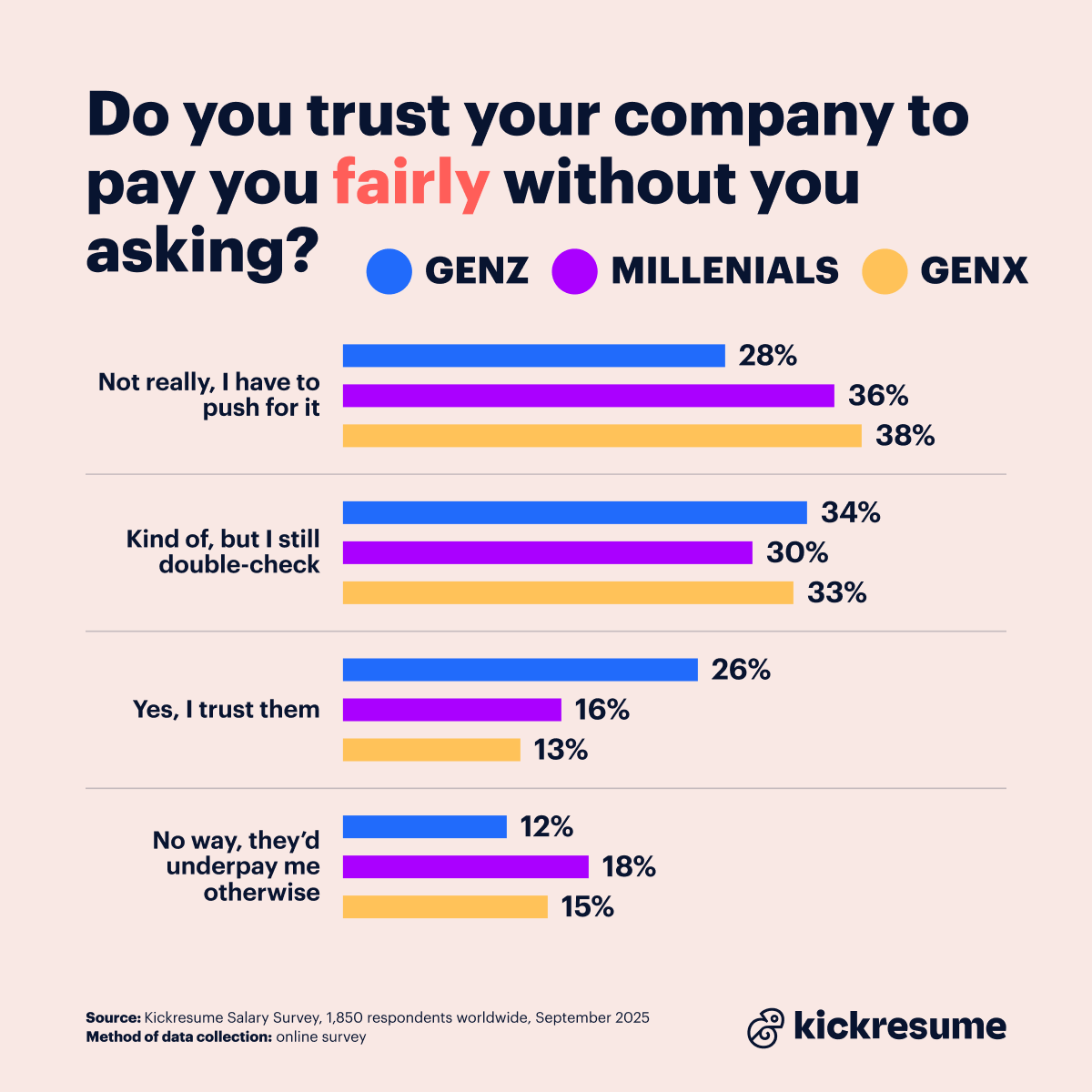
And much like attitudes towards bosses, the level of trust in the company is also age-dependent.
A quarter of Gen Z respondents (26%) said they trust their company to pay them fairly, compared to only 16% of Millennials and 13% of Gen X.
Once again, the older and more experienced employees get, the less likely they are to believe their company will do the right thing without being asked. This hints at a kind of workplace vulnerability among younger workers, who may not yet have the same skepticism that comes with years on the job.
Gender also plays a role in trust:
- 20% of men said they trust their company to pay them fairly, while only 15% of women felt the same.
- On the other hand, 19% of women believed their company would underpay them if they didn’t speak up, compared to 14% of men.
18% say favoritism drives pay more than effort
Who gets rewarded more — the one who puts in the most effort, or the one who wins the boss’s favor? For our respondents, there was no clear winner. Performance matters, but so do other, less objective factors.
Here's what our respondents said:
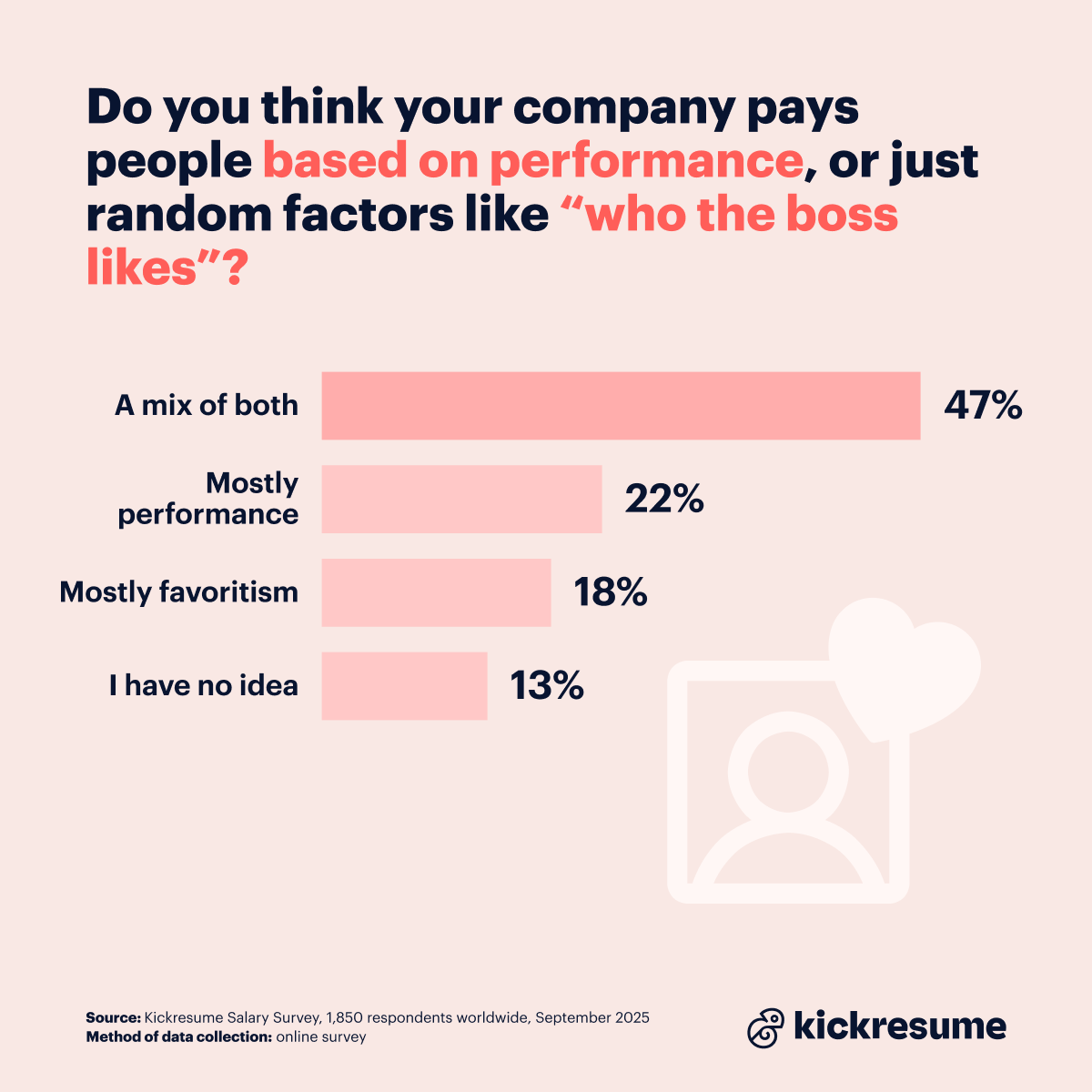
Based on what the survey showed us so far, seeing that women perceive favoritism more strongly than men probably won’t shock anyone:
- 20% of women said pay is mostly based on favoritism, compared to 17% of men.
- Women were also more likely to say I have no idea, suggesting more uncertainty about how decisions are made (11% for men).
These results fit into the broader pattern we’ve seen in earlier questions. Men tend to express more trust in their employers, whether it’s about pay fairness or company awareness of living costs.
Women, on the other hand, report more skepticism. Their answers suggest they are less convinced that workplaces reward them fairly, and more aware of the role that bias or favoritism may play in financial recognition.
Generational differences also shape how people view performance and favoritism at work:
Gen Z
- A mix of both: 48%
- Mostly performance: 26%
- Mostly favoritism: 13%
- I have no idea: 13%
Millennials
- A mix of both: 48%
- Mostly performance: 20%
- Mostly favoritism: 18%
- I have no idea: 14%
Gen X
- A mix of both: 44%
- Mostly performance: 22%
- Mostly favoritism: 23%
- I have no idea: 11%
Once again, these results feel familiar. Just like with the earlier questions about pay fairness and employer awareness, younger workers are more willing to believe in fair processes, while older employees lean toward skepticism (or perhaps realism) based on years of experience.
61% of Americans are ready to leave their jobs for more pay
All through our survey, one theme has kept coming up: people aren’t exactly brimming with confidence in how they’re paid or how fairly their companies handle compensation. All this eventually comes into play when another employer comes knocking with a bigger paycheck:
- Nearly half of respondents (49%) said they would absolutely leave their current job for just a 20% higher salary elsewhere.
- Another 30% said “maybe,” while 18% admitted they’d jump ship only if they were already thinking about leaving.
- And loyalty? Just 3% said they’d stay no matter what.
The gender perspective
- Women were more ready than men to say they’d absolutely take the money and go (53% vs. 48%).
- Only 2% of women described themselves as loyal, compared to 3% of men.
This lines up with the skepticism women expressed earlier in the survey: they trust companies less, feel favoritism plays a bigger role, and are more likely to think their employer would underpay them if they didn’t ask. In that sense, women may simply be more realistic. If you feel like the system feels stacked against you, why wouldn’t you keep the door open for a better offer?
The age perspective
Generational differences are subtle as well:
- Gen Z tops the list with 51% saying they’d absolutely leave, compared to 49% of Millennials and 48% of Gen X.
At first glance, this might seem contradictory: younger workers were also the ones more likely to trust their employers and believe pay is linked to performance. But perhaps that’s the point.
Their optimism about fairness doesn’t necessarily translate into company loyalty. If anything, it makes them more confident that they’ll be treated fairly somewhere else.
Older workers, on the other hand, may carry more responsibilities (mortgages, families, caregiving), which makes switching jobs riskier even if they feel underpaid. What looks like “skepticism” in the older groups may actually be a hard-earned sense of caution.
The regional perspective
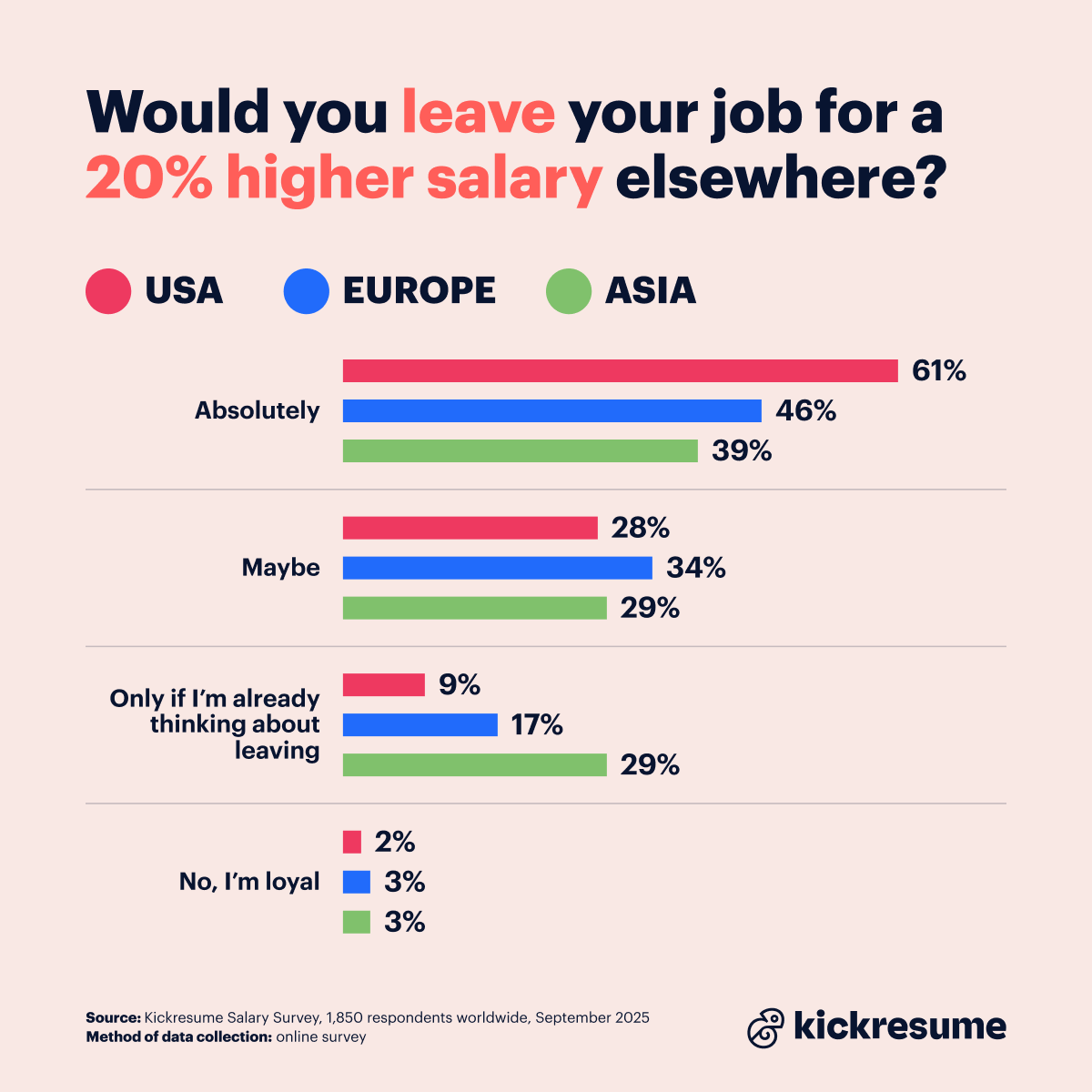
Americans were by far the most willing to leave for a 20% raise:
- 61% said “absolutely,” which makes sense in a labor market where mobility is high and loyalty often carries little reward.
For many in the US, job-hopping is already a normal way to grow your income, so the bar for switching is low.
Europeans, by contrast, were more cautious:
- Only 46% said they’d definitely leave, with a larger share answering “maybe.” Stronger labor protections, benefits, and cultural norms around job stability could all be at play here.
When healthcare, pensions, or long vacation allowances are tied to your job, the decision to leave becomes more complicated than just comparing two salaries.
Asia, though, is the most complex case:
- Only 39% say they’d absolutely leave for higher pay, the lowest globally. But those who are unhappy with their salary are also the most likely to feel seriously underpaid.
So why do so many choose to stay, even when dissatisfaction runs deep?
This likely reflects pressures that go beyond money alone. Family expectations, societal emphasis on stability, and the risks tied to leaving a secure position may discourage people from moving on. In some industries, opportunities for upward mobility may also be more limited, so the calculation isn’t just about pay but about whether a better option realistically exists.
Final thoughts
The economic landscape is tough right now. Inflation keeps eating into paychecks. Prices for essentials like housing, food, utilities are climbing faster than many salaries. For a lot of people, simply keeping up feels like a struggle rather than progress.
Our survey shows many workers believe they aren’t getting paid fairly. Either in how much they earn or how their companies treat performance and favoritism. There’s widespread doubt about whether employers truly understand what employees need, whether compensation systems are just, and whether people can trust their pay without pushing for it.
Yet there’s also a clear consequence: many say a 20% higher salary elsewhere would be enough to make them leave. Women and younger workers seem especially ready to move on when they believe their pay doesn’t reflect their contributions or when transparency is low. Regions differ, but across the board, dissatisfaction is linked to mobility: unhappy employees are just one better offer away from jumping ship.
If companies want to retain good people, fair pay, trust, and clarity are central to keeping talented employees.
Demographics
Gender
- Male: 70%
- Female: 29%
- Non-binary or other: 1%
Age
- Under 18: <1%
- 18–28: 27%
- 29–43: 46%
- 45–60: 24%
- 61–79: 2%
- 79 or older: <1%
Location
- Africa: 10%
- Asia: 22%
- Australia/Oceania: >2%
- Europe: 25%
- Latin America: 10%
- North America: 30% (88% based in the USA)
Note
This anonymous online survey by Kickresume, conducted in September 2025, gathered insights from 1,850 respondents globally. All participants were reached via Kickresume's internal database.
About Kickresume
Kickresume is an AI-based career tool that helps candidates source jobs and raise salary with powerful resume and cover letter tools, skills analytics, and automated job search assistance. It has already helped more than 8 million job seekers worldwide.