To explore what job seekers prioritize the most when making their career decisions, we carried out analysis to investigate which factors different generations value the most when searching for a new role.
We’ve also partnered with Ruth Tegen, a career coach with over 10 years experience who’s offered tips to help job seekers feel more confident about discussing what they want from a role during the interview process.
Here’s what we found out:
- Work-life balance is the most important priority for millennials and Gen X
- Financial security is Gen Z’s number one priority
- Baby boomers look for job stability and benefit packages
- Overall, salary and compensation is a top priority amongst job seekers
- After the initial screening or first round interview is the best time to ask about salary according to a career coach
- Asking for the salary range lets hiring managers know you’re serious about the opportunity
Job seekers emphasise salary, work-life balance, and flexibility
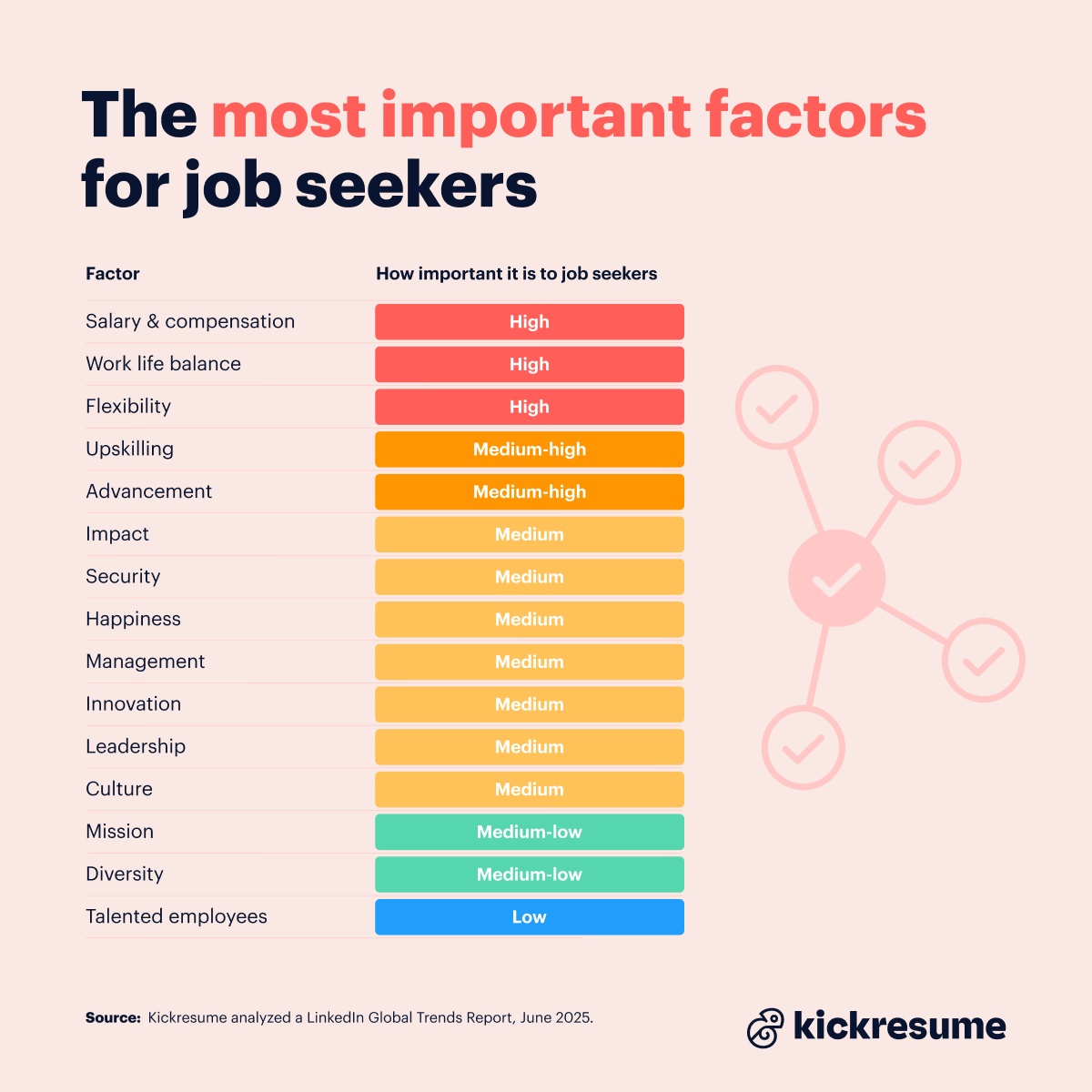
Overall, by analyzing a LinkedIn Global Talent Trends report, we found that the top three factors that job seekers across all generations look for are salary and compensation, healthy work-life balance, and flexibility.
When making a final decision on whether or not to accept a job, salary and compensation was found to be the most significant factor overall.
Having a healthy balance between work and your personal life is another top priority for job seekers, as our analysis of a LinkedIn trends report found it to be the second most valued priority overall. Having policies in place to promote a healthy balance between an employee's work and personal life is a must-have for job seekers, and is a significant factor that goes into their decision on whether to take a new role.
To help job seekers feel more confident in bringing up salary and benefits during the hiring process, we teamed up with career coach Ruth Tegen, who’s provided expert tips and guidance. They’re a key deciding factor for the majority of job seekers, so knowing how and when to find this information out can help those looking for a job save time on the hunt for the right role.
Ask about what you’re looking for with confidence
Ruth Tegen’s tips focus on knowing what to say, and when to say it during the hiring process. Many people find it intimidating asking about salary, benefits or other factors that help them decide whether they want the position. But the career coach shared with us that you don’t need to worry about making the company lose interest in you as a candidate if you politely negotiate for what you want in a job.
Let’s begin with bringing up flexible working arrangements. When it comes to discussing additional benefits like flexible working during a job interview, Ruth Tegen suggests asking a question like, “what is the team’s approach to flexible work or hybrid arrangements?” She says that this phrasing is “open-ended and invites a broader discussion.” This is a direct yet professional way for job seekers to see if a role is the right fit for them in the beginning stages of the hiring process.
Salary is a critical factor for job seekers, so if the salary range isn’t listed in the job description, job seekers may want to bring it up at the end of their first round interview.
Ruth Tegen also says that this question lets the hiring manager know that you’re “serious about the opportunity” and you “know their own value.” When preparing for a job interview, having questions planned toward the end may allow you to come across as a serious and professional candidate.
If the salary range is already stated in the job description, then asking for confirmation is what Ruth Tegen advises. You can ask, “I saw the posted range of $80,000 to $95,000, can you confirm if that’s still accurate for this role?”
The career coach explained that asking this way “shows you’ve done your homework, and helps clarify whether the range still reflects the employer’s budget, while letting the hiring manager know that you’re still interested.”
Following this, you can then get specific about your salary expectations. The career coach offers this question to help negotiate the salary you want, without it looking like you’ve pulled a figure from nowhere.
Saying something along the lines of, “based on my background in data analytics and the scope of this role, I’d be targeting the higher end of that range-around $92,000. Does that align with your expectations?” allows you to demonstrate that “your request is grounded in objective reasoning” according to Ruth Tegen.
Bringing up benefits is a similar story, if this hasn’t been discussed in the interview already, Ruth Tegen suggests mentioning it up as part of your decision-making process. You could say, “As I consider the opportunity more seriously, I’d love to understand what the benefits package includes. Could you walk me through the standard offerings?” This way, you stress the importance while remaining professional.
The career coach also says, “whenever you discuss salary, you want to be clear on your own value. You need to be confident in what you bring to the table. You want to remain factual in your experience and leverage your previous work history or skillset but also remember to avoid getting defensive or apologetic – you want to treat this as a business transaction. Being assertive isn't about being confrontational, but being clear on what you have.”
So when is the best time to bring up these all-important questions? Ruth Tegen suggests that “the ideal time to ask about compensation and benefits is typically after the initial screening or first-round interview—once mutual interest has been established.”
She also says it’s best to wait until the end of the first interview or the beginning of a follow up interview, as you’ll have had a chance to communicate your value. She says, “asking too early can risk signaling that compensation is your sole motivator, but waiting too long may waste time if expectations are misaligned.”
How generations align & differ in their career decisions
Let’s delve into what matters most to each generation in more detail, to explore what different age groups might be most likely to enquire about in the hiring process.
The youngest working generation, Gen Z, values salary and flexibility above all else. According to data from Deloitte, 48% of Gen Z reported not feeling financially secure—perhaps that’s why salary ranks as their top priority.
Gen Z also needs to be challenged. Learning and development is the third most important factor that goes into Gen Z’s decision when it comes to a new job, according to our research.
For Gen Z, there needs to be opportunities for skill development, but not necessarily to climb the corporate ladder. According to Deloitte data, 89% of Gen Z employees consider meaningful work important for job satisfaction.
While Gen Z are ambitious and hungry to learn, leadership isn't necessarily on their mind, as according to Deloitte data, only 6% of Gen Z employees say their primary career goal is to enter a leadership role. Gen Z prioritizes a healthy work-life balance with the option to work flexibly.
If you’re a Gen Z job seeker looking for opportunities to learn and develop your skills, this could be something to bring up when your interviewer asks if you have any questions. It’s also a question that could help you come across as keen, enthusiastic, and driven!
Millennials are in the same boat, as learning and development is their second highest factor when it comes to switching roles. Like Gen Z, millennials look for opportunities to advance their skills—but it needs to be meaningful.
However, the factor that millennials prioritize the most when it comes to deciding on a new job is work-life balance. For Gen Z this comes second to salary, but is still a significant factor nonetheless.
A sense of purpose is the third most important factor for millennials, as 92% consider this to be significant when it comes to how satisfied they're in their jobs.
We also found that despite financial security not making it into the top three priorities for this generation, nearly half (46%) of millennials don't feel financially secure, according to Deloitte data.
Gen X factor in flexibility and work-life balance into their decision above everything else. This generation appreciates flexibility in their work schedule the most, as well as autonomy within their roles. Gen X’s main priority is whether their job can fit around their busy family lives, like caring for their young children and aging parents.
Baby boomers look for job stability, financial security, and a quality healthcare plan when it comes to making a career decision. This generation is motivated by retirement and healthcare benefits offered by employers, and is the generation least concerned about flexible working.
Different industries consider different factors
As well as generational differences, there are also industry differences when it comes to making big career decisions. We found that the healthcare industry and tech industry have totally different thinking when it comes to weighing up a change in job.
Analyzing the LinkedIn Workplace Learning report, we found that those in the tech industry value roles where there's opportunity for skill development and career growth the most.
This is likely because the tech industry is constantly evolving, meaning to keep up, employees need to be learning and adapting to the changing landscape.
Working with AI and emerging technologies is particularly exciting for tech employees, and they may look for companies that offer advanced career development opportunities for this reason.
The LinkedIn workplace report shows that 84% of employees say that learning gives them a sense of purpose. Companies that encourage employees to grow and expand their skillset through offering tools and support systems can help grow a more motivated team. This may also help attract and retain top talent.
It’s a different story for those in healthcare, as this industry might appeal to those seeking job stability and security the most. From our analysis of the U.S. Bureau of Labor Statistics (BLS), the healthcare industry is projected to add the most jobs of any sector over the next decade.
As a result, those trained in healthcare have skills that are in high demand, meaning this sector might offer the most job security. In times of instability with redundancies increasing in a number of sectors across the US, including tech in particular, it would make sense that people enter this industry looking for that security—there's always demand for healthcare workers.
After these top priorities, while tech and IT industry workers might be drawn to competitive salaries, healthcare workers might be attracted to the sector’s health and wellness benefits.
While both industries can involve high pressure in their own different ways, each offers its own rewards for hard work.
Glassdoor, Payscale, and cost of living calculators—essential tools for job seekers
To make the right decision for you when it comes to saying yes to a new role, there are tools at your disposal to help!
Glassdoor is a popular tool to help job seekers gauge what the company culture is like at their prospective jobs. Glassdoor is a hub for past and current employees to share their honest thoughts and experiences at their former or current job. This gives job seekers insight into what working for a company is actually like, and if that aligns with their values.
Glassdoor reveals information on salaries, flexible work, and growth opportunities, making it a valuable analytical tool for those thinking about a change. It might also help you think of important questions to ask during your interview. For instance, if you see a review in which a previous employee mentions enjoying the company’s learning and development program, why not ask for more information?
Compensation is a critical factor overall, so tools like salary and cost of living calculators aim to help job seekers make a more informed financial decision.
Another tool, Payscale offers a salary calculator to help job seekers see if they’re being fairly compensated or not through salary benchmarking.
Salary calculator tools can help employees negotiate raises, and allow job seekers to see the salary ranges for the role they’re applying for. This is especially helpful for those moving to a new area where they may be unsure of typical salary ranges.
Utilities, information, & finance—the U.S’ highest paying industries
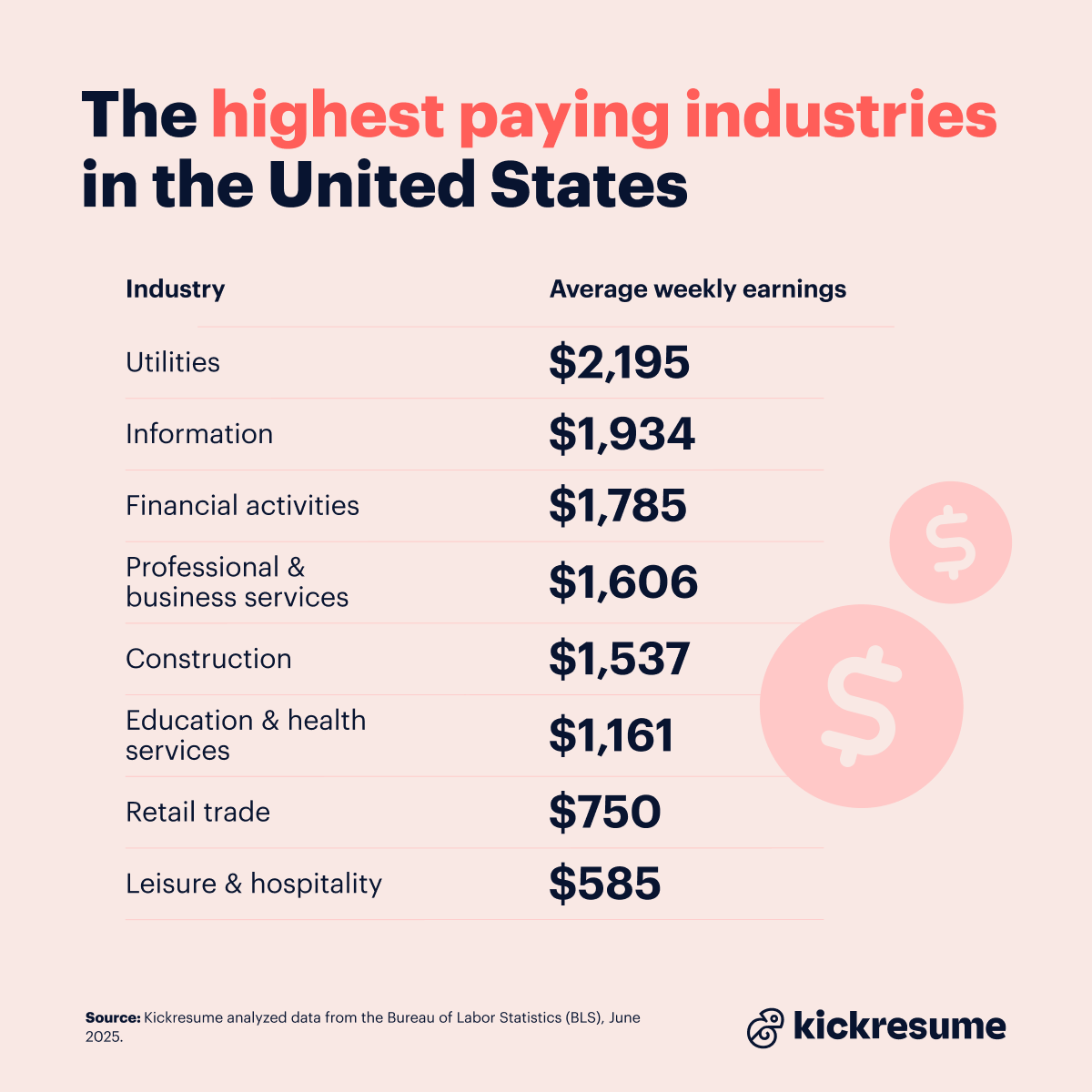
Compensation is, of course, a major factor that goes into the decision to take a new job. Being financially secure is an important priority, which is why we analyzed data from the BLS to find out the top paying industries in the United States.
According to our research, the sectors with the highest average weekly earnings are utilities, information, finance, professional and business services, and construction.
This could mean that people who are motivated by earning a high income may be more likely to consider a career in these industries. While finance and professional and business services may be well-known for being highly paid, some of the other top paying sectors might be surprising.
In comparison, the average weekly earnings for workers in the retail trade or the leisure and hospitality sector are lower, meaning that people in these industries may be less likely to have been strongly motivated by money when they first entered the sector.
These sectors may also have a higher number of young employees and students entering the workforce for the first time, meaning entry level salaries.
How online resources can help job seekers secure a role
For job seekers who are looking to dive into a growing industry that offers long-term job security, there are online resources to help streamline job searching.
The BLS and LinkedIn Economic Graph provide job seekers with insights on which skills are in demand. This could help job seekers find roles quicker, and allow them to focus on gaining the right skills that some companies value the most.
Our analysis of data from the BLS revealed the top skills many occupations find the most important:
- Adaptability
- Customer service
- Interpersonal skills
- Leadership
- Project management
- Speaking and listening skills
All of these in-demand skills (besides project management which is a mix of both soft and hard skills) are classed as soft skills, suggesting employers are searching for candidates with certain people skills.
It could be well worth brushing up on these skills, and highlighting them on your resume to show employers you’re qualified and come with valuable interpersonal skills too.
If you're considering a career change but unsure which sector to pursue, looking at lists of the most in-demand skills may help you decide.
For instance, if you feel like you're particularly strong in project management, you could look up jobs that require this skill. Or if you’re great with customers, but looking to move out of customer service work, there are lots of other ways this skill could be applied with other clients or stakeholders.
Final thoughts
It seems like job seekers think about salary and compensation above all else when deciding on a new job. This makes sense, as regardless of age and industry, having a fair salary matters the most.
Older generations like Gen X need to be financially secure to support their families, and Gen Z are working towards building their careers during a cost of living crisis. This makes salary and compensation a critical factor for all.
There also seems to be some generational differences amongst job seekers in terms of what they want most from a job. The younger generations value flexibility and learning and development highly, whilst job security is prevalent in baby boomers and Gen X need autonomy in their careers.
Overall companies may benefit from taking on board what job seekers need, as this could be a way of attracting talented employees. Companies in the tech sector or looking to hire Gen Z workers might focus on implementing robust learning and development opportunities, and office-based businesses could arrange flexible working policies to keep staff happy.
Fair salaries, flexibility, and offering competitive benefit packages are all top factors for job seekers, and companies could retain some of their best workers by incorporating and maintaining these wants and needs.
For those looking for a new role that aligns with their needs, following the advice of career coach Ruth Tegen may help job seekers find what they’re looking for quicker. Asking direct but polite questions at the right stage in the hiring process can help candidates find out if a role is right for them much earlier on.
Note
Using sources like the U.S. Bureau of Labor Statistics, LinkedIn data, and Deloitte data, Kickresume was able to find out the top priorities for job seekers overall, and how different generations and industries aligned and differed. Kickresume also worked with Ruth Tegen, a career coach of over 10 years, who provided insights into how to discuss salary and compensation during job interviews.
About Kickresume
Kickresume is an AI-based career tool that helps candidates land jobs and raise salary with powerful resume and cover letter tools, skills analytics, and automated job search assistance. It already helped more than 8 million job seekers worldwide.