


We’ve all had that boss. The one who makes every day feel like a test of patience, where you’re constantly walking on eggshells, unsure of what mood they’ll be in next. Toxic leadership is more common than we’d like to admit, and its effects on employees can be far-reaching.
But how do these bosses affect workers, really? After our previous survey about Annoying Coworkers, we wanted to dive into a different but equally pressing issue: the role of bosses in shaping the work environment.
In our latest survey, Kickresume asked 1,109 professionals how they deal with difficult bosses, what behaviors they consider the most damaging, and how it impacts their work and well-being.
Here’s a glimpse at what we found:
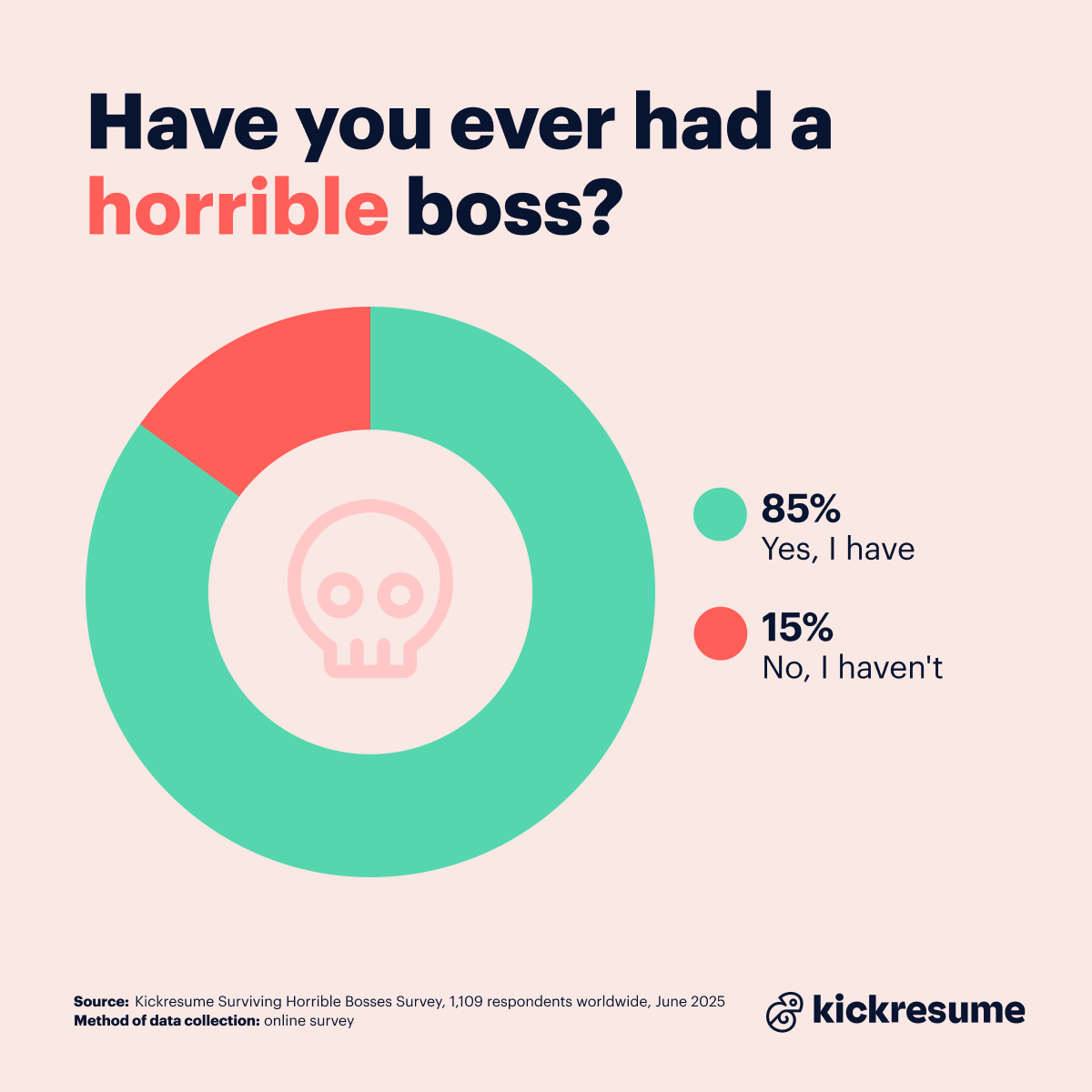
- 85% of respondents reported having worked under a boss they would describe as "horrible."
- The average horrible boss is a Millennial man
- Nearly half (49%) of respondents who had a horrible female boss described her as emotionally unstable. Only 38% of male horrible bosses were labeled this way.
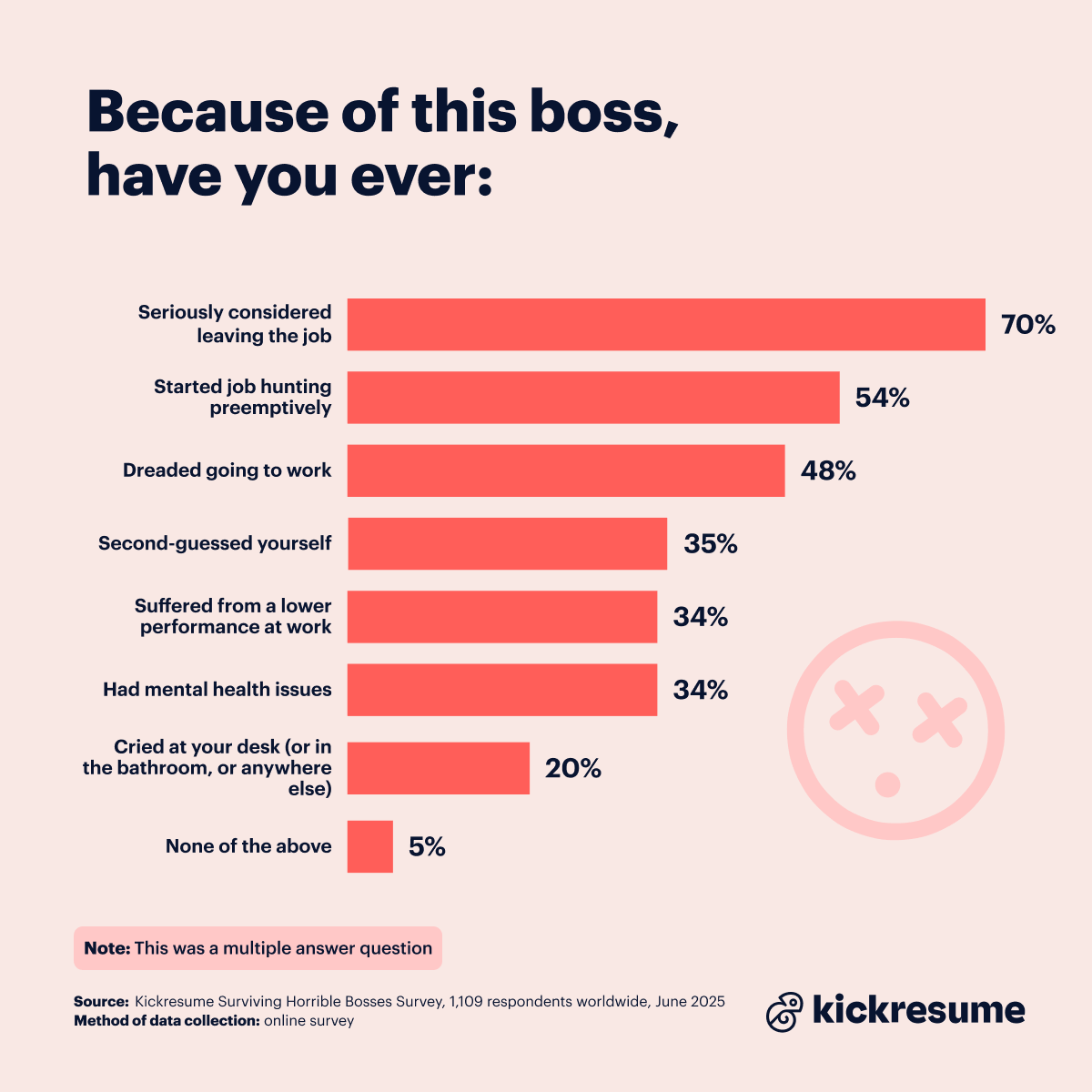
- One in five respondents (20%) admitted to crying at work due to their boss's behavior.
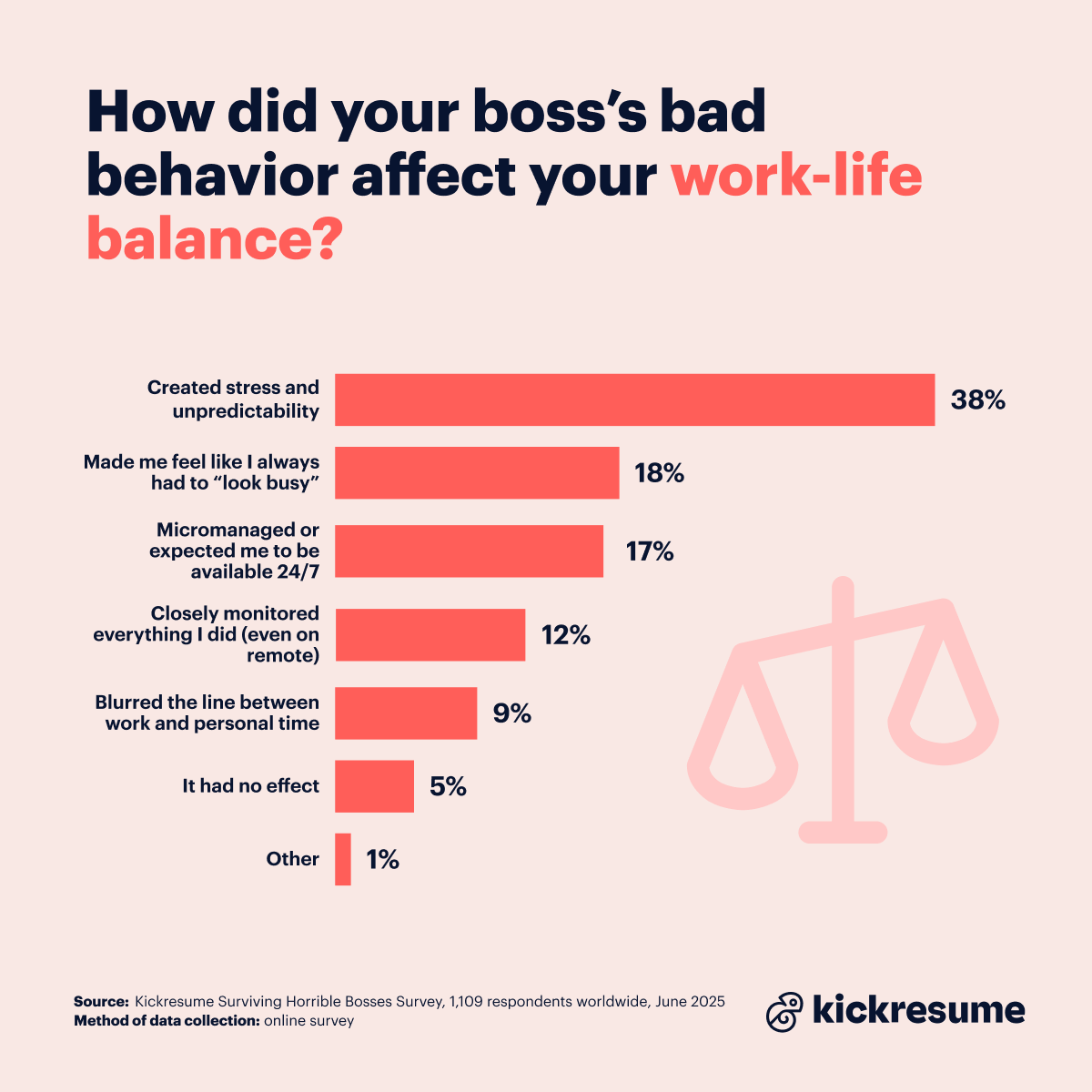
- 94% of respondents said their horrible boss negatively affected their work-life balance.
- 70% seriously considered quitting because of their boss's behavior.
- Only 5% of employees reported toxic bosses to HR.
The average horrible boss is a millennial man
According to our survey, 85% of respondents reported having worked under a boss they would describe as "horrible."
So, who exactly is the typical "horrible boss" that employees have to endure?
64% of our respondents said that their difficult boss was male, while only 35% reported a female boss.
While men are twice as likely to be described as horrible bosses, this result can likely be attributed to the gender imbalance in leadership positions, where men still dominate.
When it comes to age, the leaders causing the most frustration aren't the older generations of Gen Xers or Baby Boomers. Actually, 43% of the horrible bosses were Millennials (born 1981-1996). Baby Boomers, often stereotypically seen as the most "old-school" or difficult, make up only 3% of the difficult bosses mentioned by respondents.
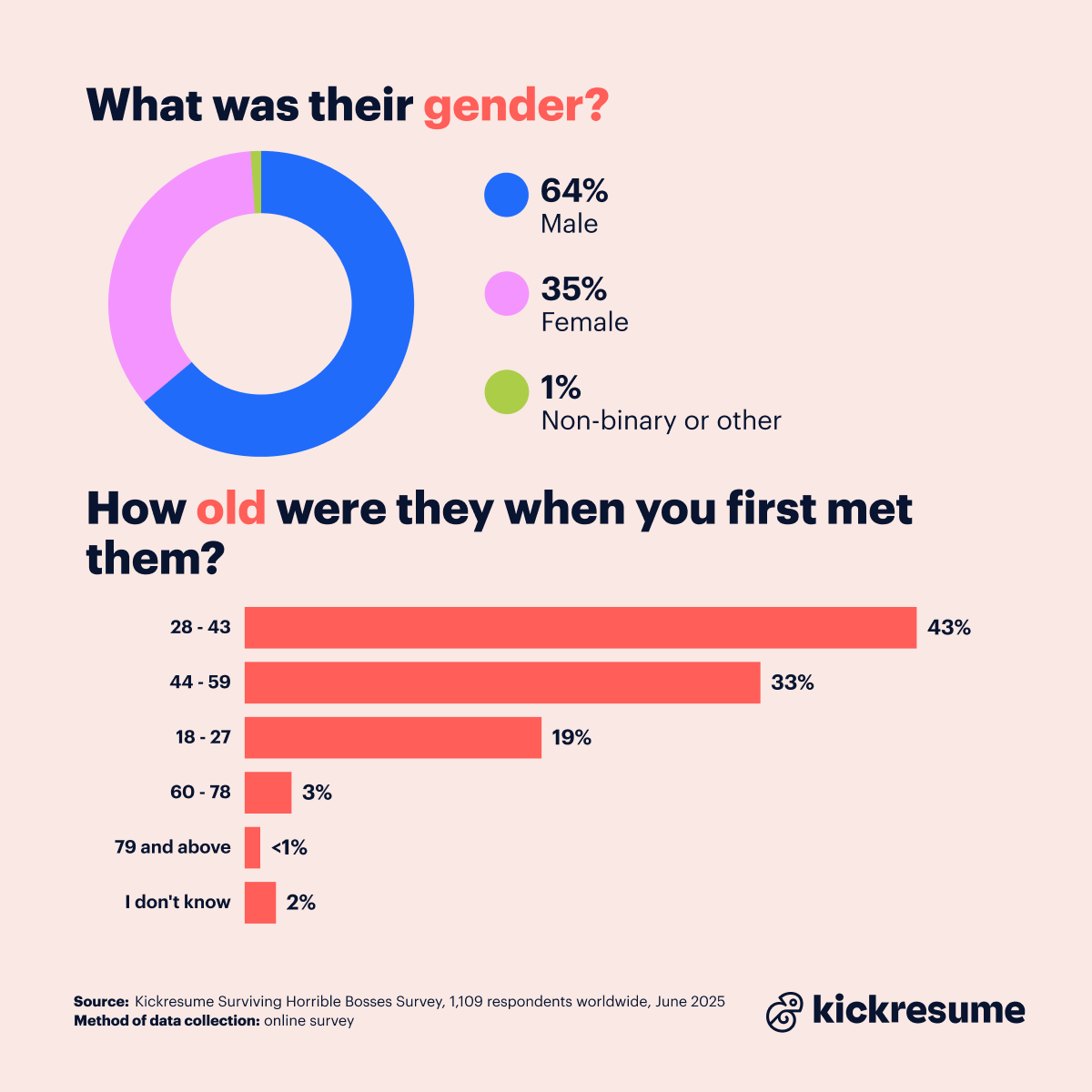
Based on these findings, it seems that the average horrible boss is likely to be a Millennial man. This suggests that the stereotype of grumpy, out-of-touch Baby Boomer bosses doesn’t quite hold up in today’s workplaces.
Unfair treatment, disrespect, and micromanagement top the list of toxic boss behavior
So, what exactly are the behaviors that make a boss unbearable to work for? We asked our respondents to share the traits that made their bosses stand out for all the wrong reasons.
- Unfair treatment and favoritism topped the list, with 53% of respondents pointing to these as key issues.
- Following closely behind, 51% also mentioned being subjected to disrespectful or rude behavior.
- Micromanagement was another common complaint, also cited by 50% of respondents.
Here's what the rest of the ranking looks like:

While the gender of a horrible boss might change, their overall behavior tends to follow a similar pattern. But that doesn’t mean there weren’t a few key differences worth noting:
- Female bosses were more often called out for favoritism and unfair treatment, with 61% of respondents pointing this out, compared to 48% for male bosses.
- Nearly half (49%) of respondents who had a horrible female boss described her as emotionally unstable. Only 38% of male horrible bosses were labeled this way.
On the flip side, male horrible bosses were more likely to cross serious boundaries. For example:
- Sexually inappropriate behavior was reported more than twice as often among male bosses (11%) than female ones (5%).
- Pressuring employees to work overtime or on weekends was also more common with male bosses (37%) compared to female bosses (32%).
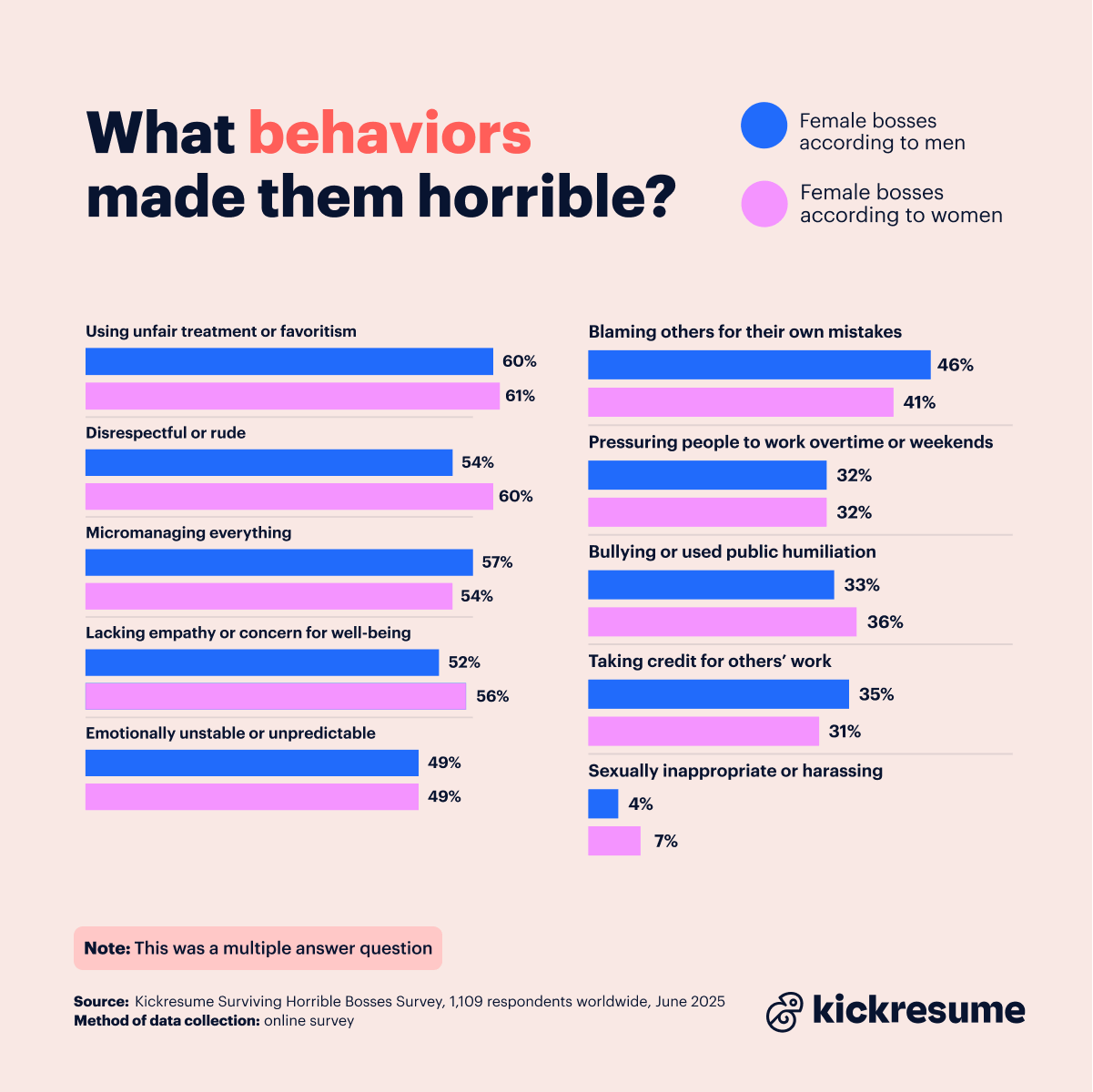
After spotting those differences, we started wondering: could part of this be influenced by gender bias? To dig a little deeper, we looked at how male and female respondents described their female bosses specifically.
We found that female respondents tended to rate their female bosses more harshly than male respondents did.
In almost every negative category, women were more critical of their female bosses than men were. That’s not to say the criticisms weren’t valid, but it does raise interesting questions about how we view women in leadership, especially through the lens of same-gender dynamics.
The only categories where male respondents judged female bosses more harshly were all related to competence:
- Micromanaging
- Blaming others for their own mistakes
- Taking credit for others’ work
These findings suggest that while toxic leadership is toxic regardless of gender, how it's perceived may not be entirely objective.
The worst bosses are narcissistic, volatile, or insecure
Although the previous question revealed that the top horrible behaviors include favoritism, rude treatment, and micromanaging, the underlying issues might actually go deeper. In many cases, it’s less about what a boss does and more about who they are.
To get a better sense of the personalities behind the bad behavior, we asked our respondents: “If you were to give your horrible boss a nickname, which one would it be?”
Here’s how they answered:
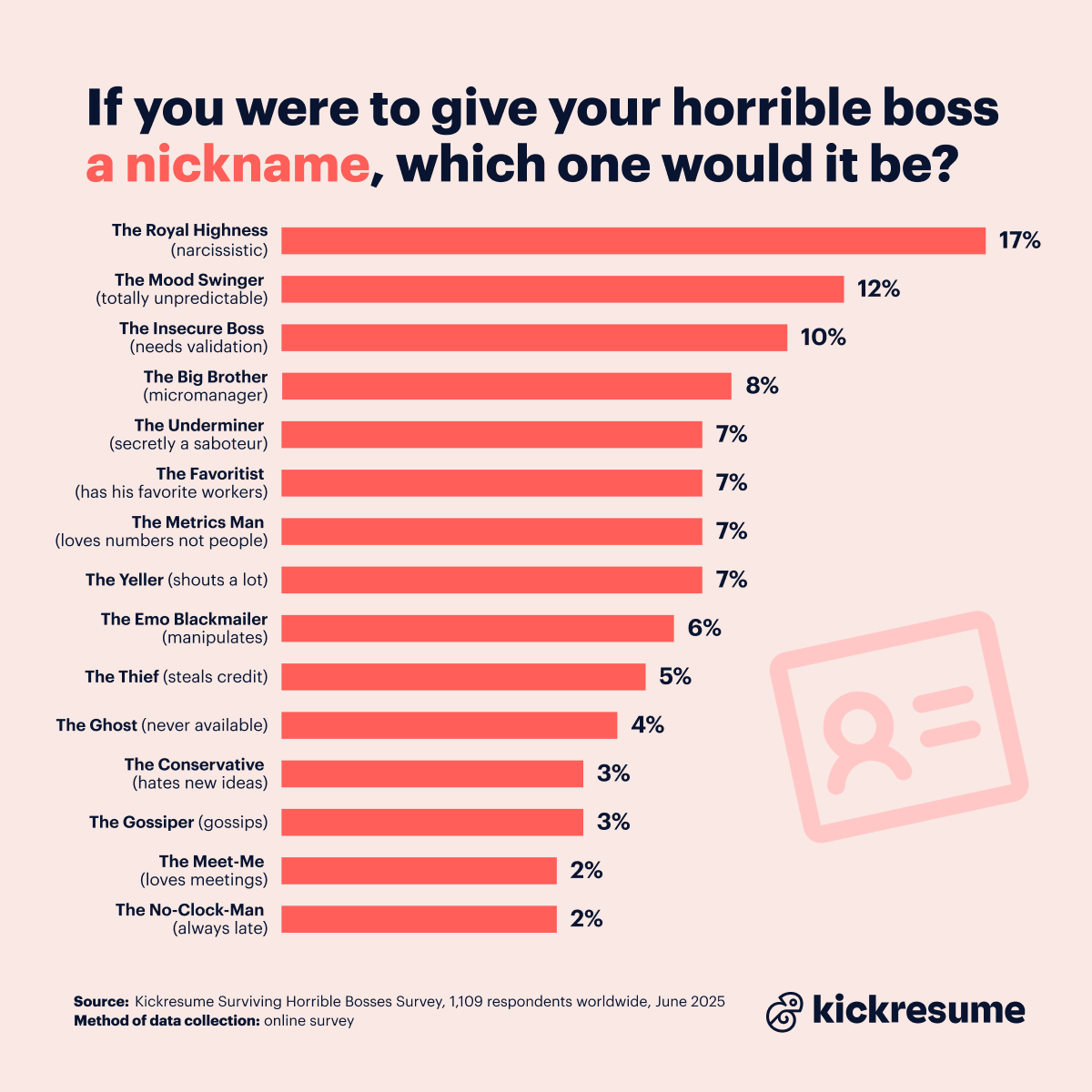
Nearly 1 in 5 respondents picked “The Royal Highness,” suggesting that ego and entitlement are at the heart of many toxic leadership styles.
“The Mood Swinger” came next. These are the bosses whose unpredictability keeps everyone on edge. When their reactions change by the hour, it creates a workplace where people never feel safe or steady.
“The Insecure Boss” was also a common pick. These bosses crave constant validation, often overcompensate, and may tear others down just to build themselves up.
In short, while certain behaviors stand out on the surface, what’s driving them is often rooted in personality traits like narcissism, insecurity, volatility, or a need for control.
Toxic leadership is a work-life balance killer for nearly everyone
Bad bosses don’t just make work annoying. They can seriously affect people’s well-being, confidence, and even their health:
- 70% said they had seriously considered leaving their job, and 54% had already started job hunting, even before things got truly unbearable.
- Almost half of our respondents (48%) said they dreaded going to work, and over a third (35%) began second-guessing themselves. That kind of constant self-doubt can slowly chip away at a person’s confidence.
- About 34% of people reported that their work performance suffered, and the same percentage said their mental health took a hit.
- One in five respondents (20%) admitted to crying at work — whether at their desk, in the bathroom, or somewhere else.
- Only 5% of people said they felt unaffected by their boss’s behavior.
Work-related stress doesn’t always stay at work. For many people, having a horrible boss made it harder to switch off after hours and protect their personal time.
When we asked how their boss’s behavior affected their work-life balance, 94% of respondents said it had a negative impact:
- The most common problem was stress and unpredictability, reported by 38% of people.
- Another 18% said they felt like they always had to look busy, even when they weren’t.
- About 17% said their boss expected them to be available at all times, and 12% said they were closely monitored, even while working remotely.
- For 9%, the line between work and personal life was completely blurred.
Over time, that kind of pressure adds up. It can leave people feeling drained, disconnected, and like they’re never really off the clock. A boss's behavior doesn’t exist in a vacuum. It follows people home, it affects how they sleep, how they show up for their families, and how they feel about themselves.
One bad boss turns teamwork into turf wars
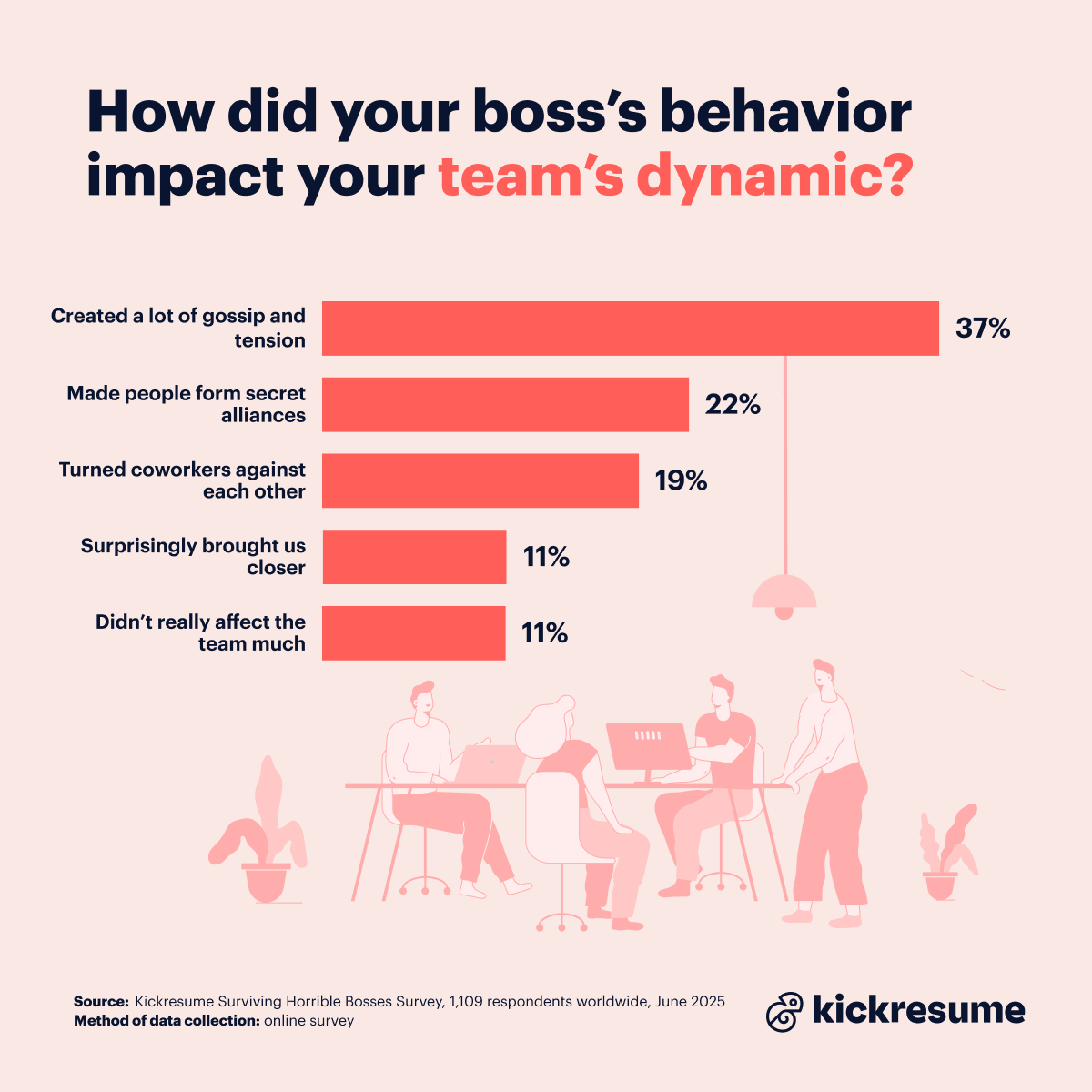
According to our respondents, the ripple effects of a bad boss can reach far beyond individual employees and deeply affect team dynamics.
The most common outcome was gossiping and tension, reported by 37% of employees. When trust in leadership is low, people often stop communicating openly. Instead of raising concerns, they keep quiet or talk in circles. Over time, this creates an atmosphere of discomfort and suspicion.
22% of respondents said that people started forming secret alliances, while 19% experienced situations where their boss actually turned coworkers against each other. These numbers show how quickly a team can shift from collaboration to competition when leadership creates a hostile or unpredictable environment.
But not every outcome was negative. 11% of respondents said that dealing with a horrible boss actually brought their team closer together. Sometimes, shared frustration creates a sense of solidarity. But even in those cases, people were bonding over a problem, not around a strong or positive leader.
Another 11% said their boss had no real effect on the team. This group was the minority.
Overall, these findings suggest that the presence of a horrible boss can disrupt how people work together, communicate, and support each other. It only takes one person in a position of power to shift the tone of an entire team.
Bad boss antics hit hardest face to face but don't stop online
When we asked respondents when their boss’s behavior was hardest to deal with, 39% selected “while working in the office.” Face-to-face interactions leave less room to breathe. Micromanagement, passive-aggressive comments, or tense silences become part of the daily atmosphere.
34% said the behavior was just as bad in both settings, reinforcing the idea that the problem isn’t location but leadership. A toxic boss doesn't need to be in the same room to create stress or conflict.
Only 12% said remote work made things worse, while 29% noted they had only worked in one setting and couldn’t compare.
Since respondents could select more than one answer, these results highlight how consistently bad leadership can follow employees, whether on Zoom or in a conference room. But the office seems to intensify the experience.
55% don't confront their horrible boss — they cope or quit
When faced with a toxic boss, people don’t always feel empowered to speak up or push back. More often, they focus on simply getting through the day.
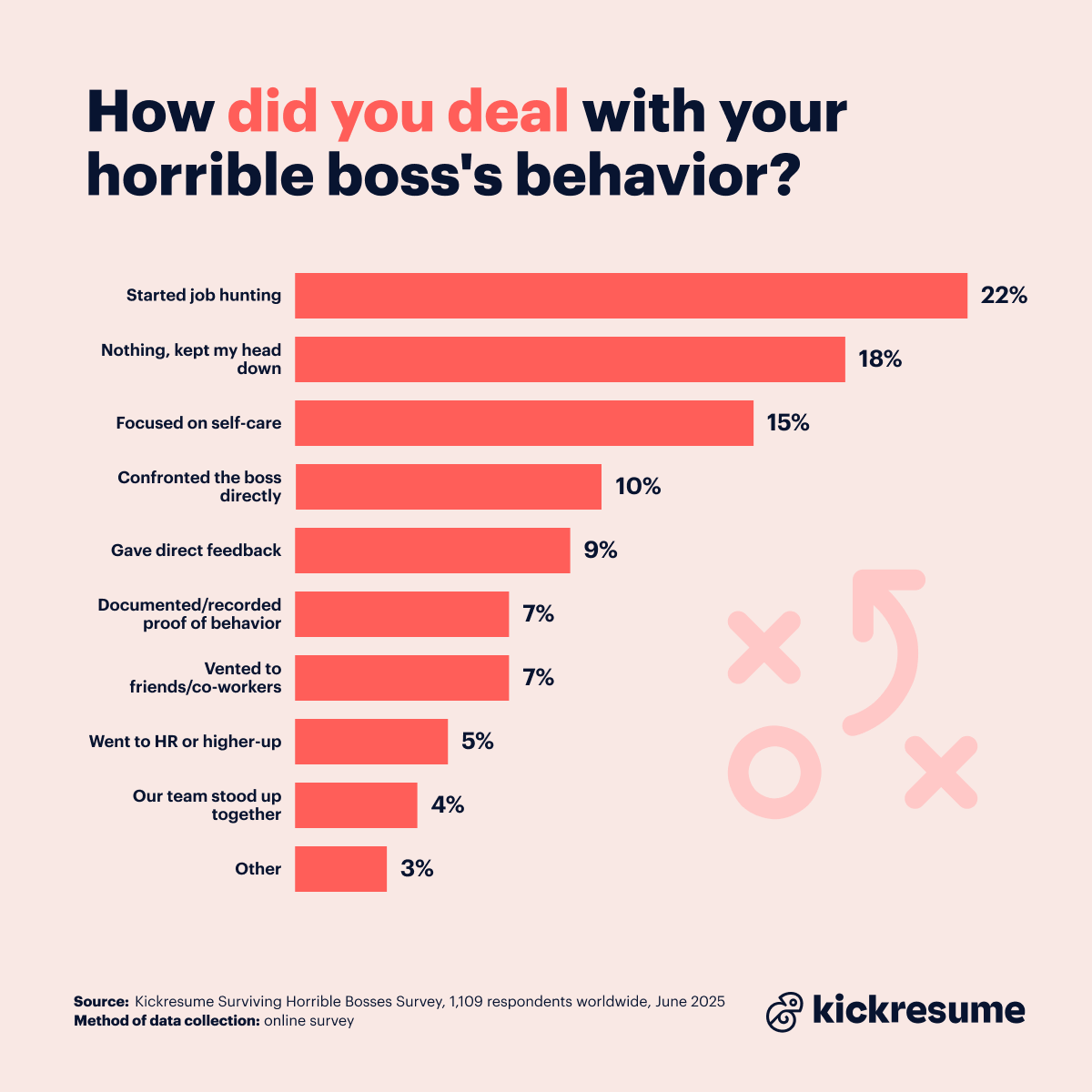
The most common reaction to a horrible boss was to start looking for another job. That was the route 22% of people took.
Others chose to stay quiet. 18% said they kept their head down and did nothing. Another 15% focused on self-care, trying to protect themselves emotionally and mentally without getting involved in any confrontation.
In total, 55% of respondents chose to manage the situation by changing their own behavior, not their boss’s. This speaks volumes about how powerless many people feel when dealing with someone in a position of authority.
Only a small number decided to confront their boss (10%) or give them direct feedback (9%).
And while documenting toxic behavior is often recommended as the “right” thing to do, only 7% actually recorded or collected proof. It’s a smart step, but one that clearly doesn’t feel realistic or safe for many people.
And what about HR? Just 5% of people said they reported the issue to HR or a higher-up. This suggests that many employees don’t see HR as a safe or effective avenue for handling problems with their boss. In environments where leadership is already toxic, HR might be viewed as too close to the problem. Or simply not powerful enough to fix it.
Our data shows that most people don’t feel empowered to take action against toxic leadership. Whether it’s fear of retaliation or just lack of trust in company structures, the result is the same: people stay quiet, protect themselves, and try to get out when they can.
But did these coping strategies actually help?
When we asked whether their actions made the situation better, 39% said nothing had changed, and another 19% said it had actually gotten worse, either mildly (7%) or significantly (12%).
Only 26% said their situation had improved meaningfully, while another 16% saw slight improvement.
At first glance, that might sound encouraging. But when we looked at what this more “successful” group actually did, it told a different story. Among those who reported positive change:
- 40% had started job hunting
- 13% focused on self-care
- 12% did nothing and kept their head down
In other words, for many, “making things better” didn’t mean resolving the issue. It meant finding a way out or learning to endure it quietly. Very few people improved their situation through confrontation or institutional support.
Companies see the problem but rarely act
Speaking of institutions, we wanted to understand how these horrible bosses were perceived within their companies. Were they seen for who they really were, or did the system somehow work in their favor?
Here’s what our respondents told us:
- 31% said their boss had a mixed reputation. People saw the problems, but no one took a clear stance.
- 24% said others simply tolerated them. Not liked, not admired, just endured.
- 21% said their boss was feared, not respected.
- 13% described them as weirdly admired, and 11% said they were genuinely respected, even if not personally liked.
In many cases, problematic behavior seems to be accepted. Whether it’s because of results, tenure, or politics, bad bosses often remain in power despite the damage they cause.
While employees struggle in silence, horrible bosses often remain protected. This disconnect helps explain why only 5% of people felt comfortable going to HR, and why most chose to deal with the problem quietly, by focusing inward or walking away.

Final thoughts
A horrible boss isn't just a personal annoyance. It's a structural problem with ripple effects that reach across teams, workplaces, and careers. What our survey shows is just how often people are left to manage that damage alone.
Most employees don't confront, report, or challenge toxic leadership. Not because they don't care, but because they don't feel safe or supported enough to do so. Instead, they adapt, internalize, and look for the nearest exit.
It's easy to assume bad bosses are outliers. But the numbers suggest otherwise. They're common and sometimes even respected by their companies. Meanwhile, the people working under them are quietly burning out, doubting themselves, and trying to stay afloat.
And yet, this isn't a hopeless story. The data also shows what people need: validation, trust, accountability, and a workplace culture that doesn't reward power at the expense of employees. When institutions make space for real feedback, and when leadership is held to the same standards as everyone else, change becomes possible.
Demographics
Gender
- Male: 64%
- Female: 35%
- Non-binary or other: 1%
Age
- 28–43: 46%
- 44–59: 25%
- 18–27: 25%
- 60–78: 3%
- Under 18: <1%
- 79 or older: <1%
Note
This anonymous online survey by Kickresume, conducted in June 2025, gathered insights from 1,109 respondents globally. All participants were reached via Kickresume's internal database.
About Kickresume
Kickresume is an AI-based career tool that helps candidates source jobs and raise salary with powerful resume and cover letter tools, skills analytics, and automated job search assistance. It has already helped more than 8 million job seekers worldwide.