Our recent survey into Horrible Bosses revealed that 70% of people who have worked under a difficult boss have seriously considered quitting. A fifth even said their manager had driven them to tears at work, at 20%. But what should people do when their boss is making their work life miserable?
To find out, we spoke to Jayne Murphy (MA, MACIPD), an HR consultant with 25 years of experience. She gave us her professional advice on how to deal with a horrible boss—as well as her tips for managers who are worried that they might be one. Here are a few key takeaways:
- Red flags like poor communication or a lack of interest in your professional growth can be early warning signs of a horrible boss.
- Try to understand your difficult manager, in order to anticipate conflict at work before it happens.
- Take steps like building relationships with other colleagues, both within and outside your current team.
- Remote work may have reduced presenteeism issues, but could also have made distant or overbearing bosses’ behavior worse.
- Managers should actively seek feedback from their team—not just their higher ups.
Watch out for these boss red flags
Before we get into how to deal with a difficult manager, we asked HR Consultant Jayne Murphy to tell us some of the red flags that might signal that your relationship with your boss might be tricky.
- Poor communication: Unclear instructions, sudden changes in direction on a project that leave you feeling blindsided, or inconsistent feedback on your work.
- How your boss approaches ownership of the team’s work: Taking credit for your work, or throwing you under the bus when things go wrong.
- Favoritism: Certain employees being offered more perks and flexibility than others, or being picked for high-profile assignments over their equally well-qualified team mates.
- Unrealistic expectations: Overworking the team or giving unreasonable deadlines.
- Micromanagement: Asking for constant updates on your work, not giving you autonomy to make decisions.
- Outbursts: Lashing out at employees, or speaking angrily about them behind their backs.
- No interest in your professional development: You might get a sense of this as early as the interview stage, if you ask what professional development is available and they don’t give you an enthusiastic answer.
.png)
Understanding your horrible boss will help you deal with them
Jayne Murphy followed up with what people should do when they realize their manager’s behavior is affecting them at work. One thing you can do is try to understand where your boss is coming from. You don’t have to agree with them, but once you have a sense of this, it’s easier to work with them, or “manage up”.
For instance, she suggests considering whether your boss is under pressure from higher-ups and simply passing that stress down to you. Or have they only recently been promoted to manager, and are they struggling in their new role? They might also be misguided about something, such as how long your tasks typically take.
The HR consultant also advised that it might help to try and recognize any patterns in your boss’ behavior. Is there a particular situation in which they tend to kick off, for instance when a deadline is approaching?
Jayne Murphy told us, “This insight helps you tailor your communication—whether that means giving regular updates to a micromanager or seeking clarification when instructions are vague.” Learning to work together more effectively like this might help reduce conflict.
Allies at work can lend support and perspective
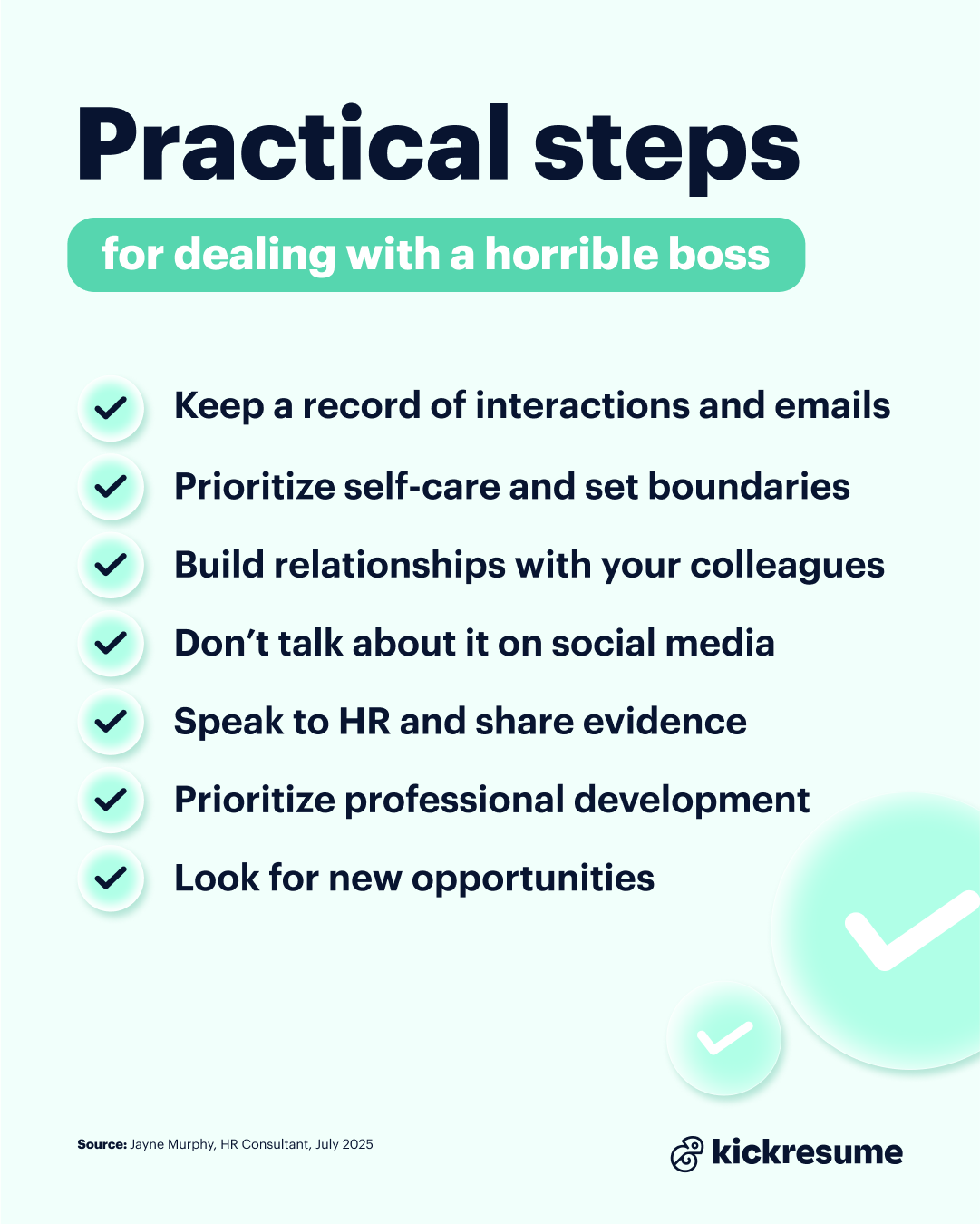
We asked Jayne Murphy what kind of practical steps people should take when they’re struggling with a horrible boss. She advised us, “It’s hard and often incredibly stressful having to deal with a difficult boss, but it can be managed with the right approach. Start by quietly documenting difficult situations: record dates, details, and decisions, and keep email chains where you’re concerned about something.”
Keeping a record will give you clarity for your own peace of mind. It’ll also provide evidence you can use if you decide to seek support from HR. In the meantime, prioritize self-care and try to set boundaries with your manager to protect your peace of mind.
The HR consultant recommended building relationships with supportive colleagues to help you keep your head up. You might also find out that other members of your team have had difficult experiences with your boss, too. Building connections elsewhere in the business could also lead to opportunities to move to a new team.
Jayne Murphy warned that if you’re in this situation, don’t talk about it on social media. Anything you post on Instagram, Facebook, X, Reddit, Quora, TikTok or elsewhere could be traced back to you and used in an investigation. In general, it’s best not to post about your work on social media at all.
The expert advised, “If the behavior crosses into bullying or breaches company policy or handbook, don’t hesitate to speak to HR.” That’s why keeping a written record is so important. Managers aren’t exempt from company policy and rules, and HR’s there to make sure that everyone’s in line with what’s expected.
Lastly, focus on your professional development and network. The skills you have (and the people you know) could be the gateway to a new job with a better boss.
Don’t feel guilty about leaving the business if you need to
Sometimes, however much you like the other aspects of the job, it’s not sustainable to stay.
If your boss is affecting your mental health, it might be time to move on to a new role. In Jayne Murphy’s words, “You deserve to work in an environment that values and supports you—remember you’re not powerless, even if it feels that way.”
The HR consultant said if you’re preparing to leave your job, it’s important to begin networking and searching for your next role if you can. You should also make sure your LinkedIn and resume are up to date, especially the work experience section. Then, if you see any opportunities come up that you’re interested in, you’ll be ready to jump on them.
Remote work may have led to a rise in anxious or distant bosses
We asked Jayne Murphy whether remote work has led to an increase in horrible bosses. She named a few ways in which this could be the case:
- Without face-to-face time, new managers might not develop essential soft skills.
- A lack of trust in remote workers might lead to micromanaging, with constant check-ins and monitoring.
- Bosses might seem unapproachable, if they don’t make enough effort to reach out and provide direction or support to remote staff.
- Something that could’ve been a quick chat in the office might become a long, confusing email thread, leading to miscommunication.
- Managers might favor certain employees who are more vocal on video calls, meaning some team members are left out.
However, the HR consultant shared that remote work may have empowered people to set better boundaries. Jayne Murphy also suggested that it’s given managers new ways to focus on results, not presenteeism. A boss who trusts their team to get things done will still be a good leader, in-person or online.
Managers, always ask for feedback from your team
Are you worried that you might be a horrible manager? There are a few ways that people can accidentally slip into bad boss behaviors—especially if you’re promoted but not given enough manager training. You might need to improve your communication with your team, or learn to trust them and stop micromanaging.
Jayne Murphy told us the key is self-awareness. Once you’re aware there’s room for improvement, you should be open to getting further training, or seeking feedback from your team.
The HR consultant advised that the opportunity to give anonymous feedback might make your team feel more confident sharing how they feel. She highlighted 360-degree appraisals as one especially useful tool. This method of feedback gathers responses from people at all levels of the business, and sometimes clients, customers or suppliers, too.
She also shared her top tips on how to be an excellent manager:
- Set clear expectations.
- Communicate with your team and have regular one-to-one meetings.
- Delegate effectively and trust your team to deliver.
- Lead by example, and follow the example of managers you admire.
- Admit your mistakes and stay open to learning.
- Acknowledge your team’s effort, and give them praise in one-to-ones as well as in front of other colleagues.
- Understand that your team members are all different, and find the best ways to motivate and inspire every one of them.
Final thoughts
There are plenty of ways to handle a difficult boss, like learning to anticipate what sets them off. But if your manager is making you dread work and feel anxious, there’s nothing wrong with looking for new opportunities. The way your manager treats you is a key part of psychological safety at work—knowing that you’re respected and accepted at work.
A review of studies into psychological safety at work shows that it boosts collaboration, individual performance, and creativity, and lowers employee stress. That’s the kind of working environment that everyone should get to experience—under the leadership of a supportive manager.
If you recognize any traits in yourself of being a bad boss, it’s never too late to change. Just be open to feedback and learning. As well as undertaking training, you can always speak to a coach or professional mentor who can help you become a manager your team will love to work with.
Note
Kickresume spoke to HR Consultant Jayne Murphy, MA MACIPD in July 2025. The HR consultant shared her advice on how employees can deal with having a difficult manager. She also provided advice for managers on how to make sure they’re treating their staff well.
About Kickresume
Kickresume is an AI-based career tool that helps candidates land jobs and raise their salary with powerful resume and cover letter tools, skills analytics, and automated job search assistance. It already helped more than 8 million job seekers worldwide.