


Many people take time off work. But fewer actually tell their boss about it. This trend, known as “ghost vacationing,” is slowly coming out of the shadows in office life. It’s when employees take a day (or several) without formally reporting their absence. No official leave request, no out-of-office email.
Kickresume surveyed 1,897 to see how common this really is and whether it plays out differently around the world. To narrow our focus, we zeroed in on the U.S. and Europe specifically, where the balance between work and time off is often viewed very differently.
Here's a quick look at the most revealing findings:
- Around 32% of U.S. employees and 33% of Europeans admitted to taking unannounced time off at least once, despite very different vacation policies.
- Over 70% of ghost vacations last less than a day, with only 5% of Americans and 3–4% of Europeans daring to vanish for more than a week.
- 36% of Americans who’ve never ghost vacationed say mental health struggles would push them to do it, almost double Europe’s 20%.
- 42% of Americans and 41% of Europeans have both asked for and been given cover during ghost vacations, hinting at unspoken pacts to help colleagues escape.
Generous vacation policies don’t stop secret escapes
This isn’t the first time we’ve looked into the contrasts between American and European work cultures. In our earlier surveys, two patterns stood out clearly.
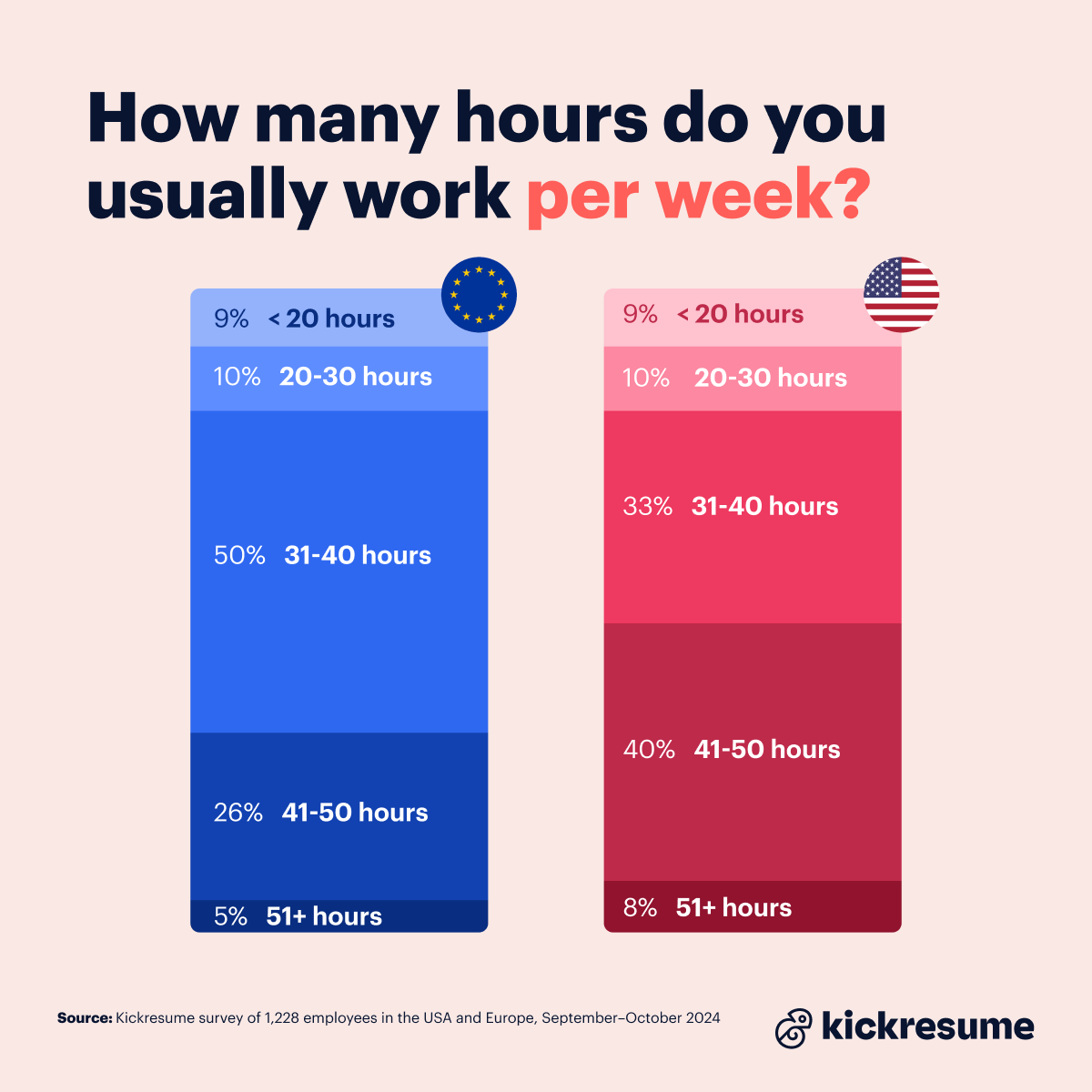
The first was how long people stay on the clock. We found that 50% Europeans reported working a standard 31–40 hour week, while over 40% of Americans put in 41–50 hours.
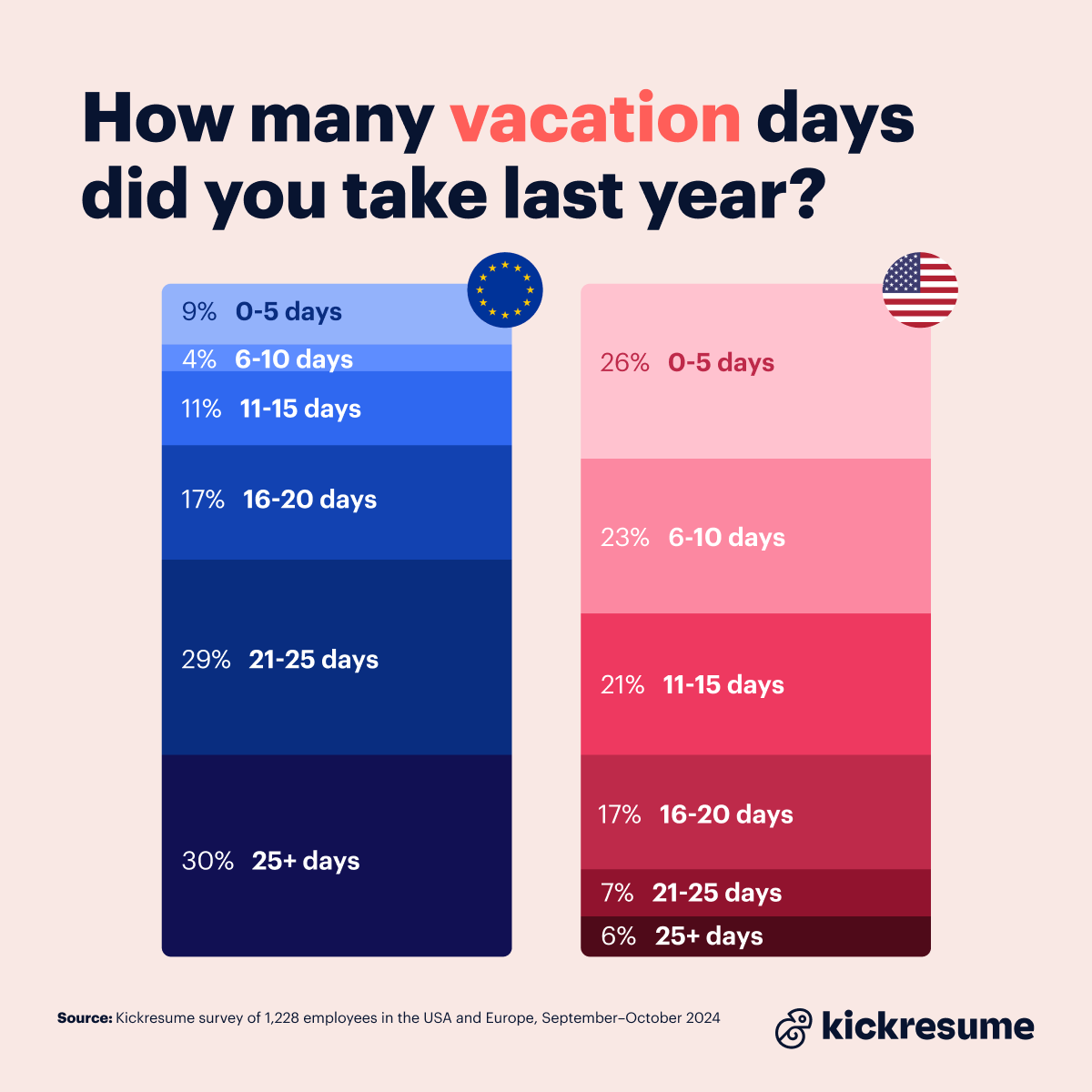
The second difference was how much time people actually manage to take off. Nearly 60% of Europeans enjoyed three weeks or more of vacation, but almost half of Americans took just 10 days or less.
Based on these results, it would be natural to expect Americans to lead the way in ghost vacationing. After all, if official time off is scarce and workloads are heavier, quietly disappearing for a day here or there could be a way to cope. In Europe, where the system is more generous and structured to meet workers’ needs, there seems to be less reason to go under the radar.
And yet, the data doesn’t fully support this assumption.
When we asked respondents whether they had ever taken a ghost vacation, the answers on both sides of the Atlantic were surprisingly close:
- In the U.S., just under half of workers (49%) said they had never done it. About a third (32%) admitted they had ghost vacationed at least once, and a small share said it’s something they do regularly (3%).
- Europe wasn’t far behind. Slightly more than half of respondents (53%) claimed they’d never done it, but just as many as in the U.S. (around one in three) confessed to having taken unreported time off, and a few (5%) said it’s a recurring habit.
The bottom line is that in both regions, a striking share of employees (roughly one out of three) have taken unannounced time off at least once.
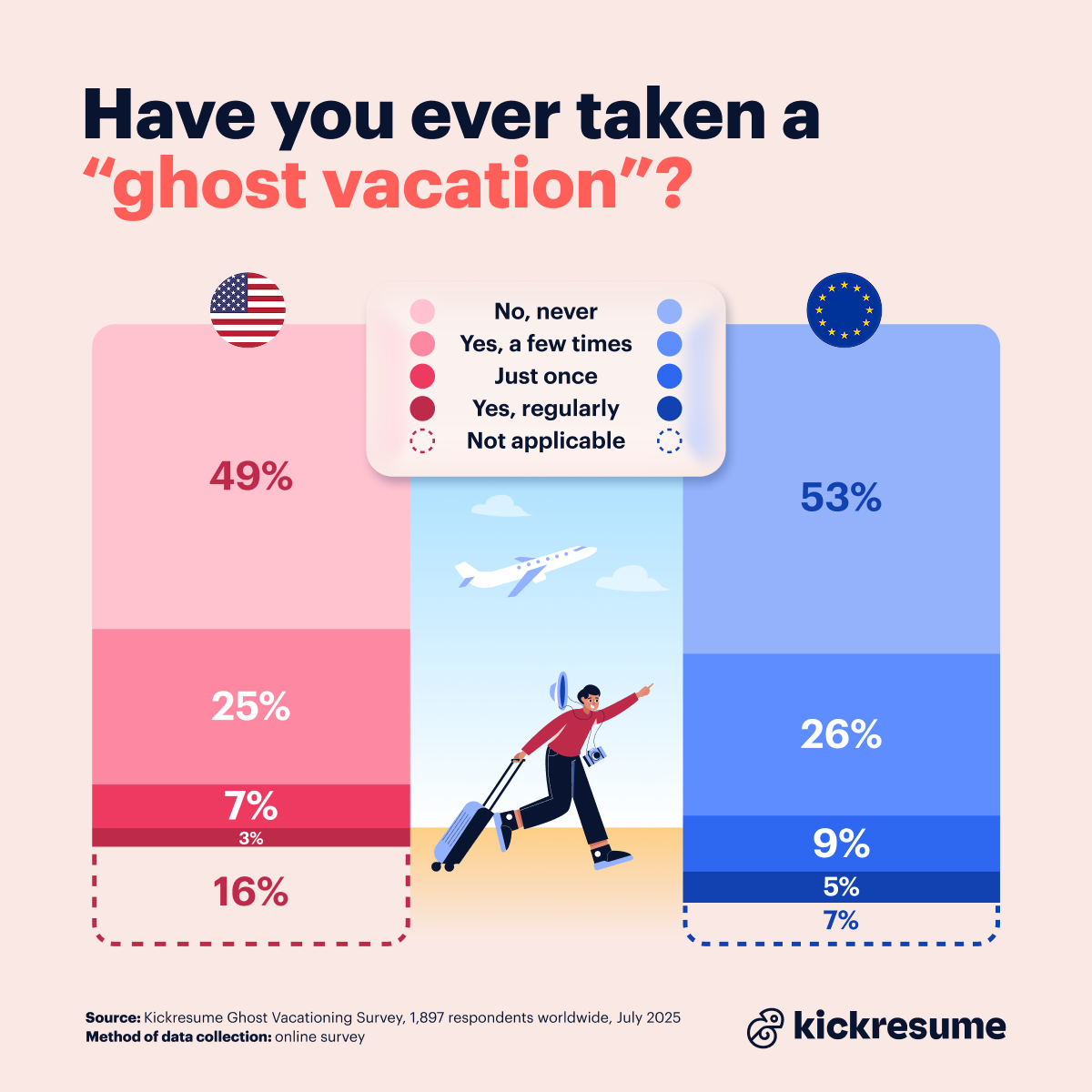
These numbers suggest that official policies only go so far in shaping behavior. Even in Europe, where vacation is more accessible, many workers still feel the need to step away quietly.
Ghost vacationing is a quick escape for 70% of workers
If ghost vacationing is common on both sides of the Atlantic, the next question is how long people actually disappear for. We looked at the answers from those who admitted to taking unannounced time off, expecting that Americans might be more likely to stretch their ghost breaks longer. But the data doesn’t support that assumption either.
In the U.S., most ghost vacations were short:
- A single day off was the most common choice, reported by 27% of respondents.
- Another 21% said they had only slipped away for half a day, while 24% kept it to just a few hours.
- Longer ghost vacations were rare: 18% said they took two to three days, only 5% reported taking four to seven days, and another 5% had gone off the grid for more than a week.
European responses were nearly identical:
- 28% said they took a single day, 23% half a day, and 21% just a few hours.
- Slightly more (22%) stretched their time off to two or three days, but only 4% managed four to seven days, and 2% said they ghost vacationed for more than a week.
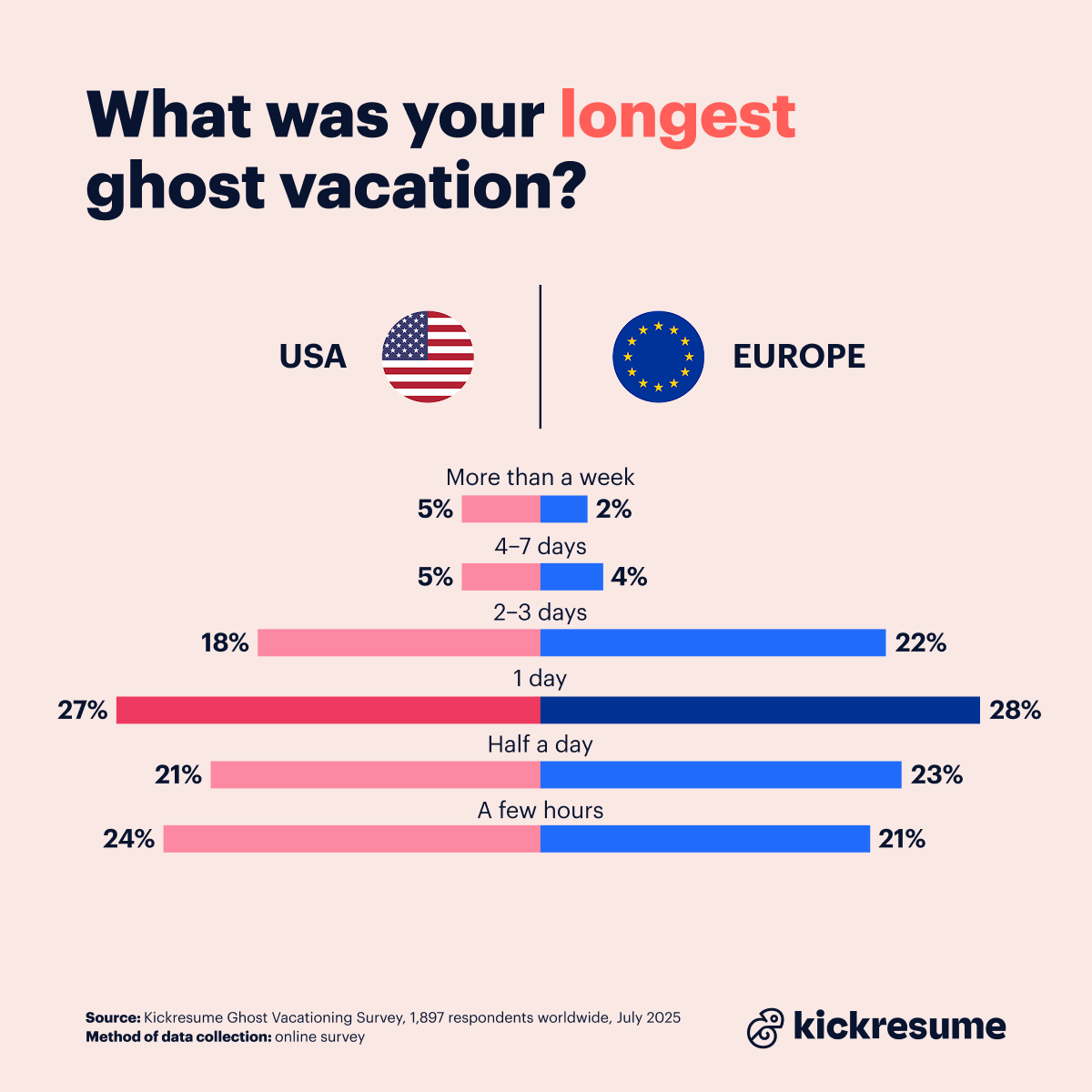
This pattern suggests that ghost vacationing is rarely a long escape, no matter where you live. Most people take very short breaks, just enough time to catch their breath. Even in the U.S., where official vacation is harder to come by, ghost vacationing doesn’t usually turn into extended unofficial holidays. It seems to be more about carving out small, discreet pockets of time off rather than disappearing for days on end.
Ghost vacationing is about coping, not slacking
Ghost vacationing doesn’t happen without a reason. As it turns out, workers aren't trying to avoid their responsibilities; they're responding to pressures they don’t feel comfortable addressing openly.
For those with firsthand experience, the top two reasons were shared on both sides of the Atlantic: family or personal responsibilities and burnout or mental health struggles.
- In the U.S., 34% of ghost vacationers named family or personal reasons, and another 34% pointed to burnout or mental health.
- Europeans gave similar answers: 38% for family needs and 33% for burnout.
- Other motivations were less common, with only around 14% of Americans and 13% of Europeans saying they simply wanted a break, and a small share citing “lack of real work to do” (around 11–12%).
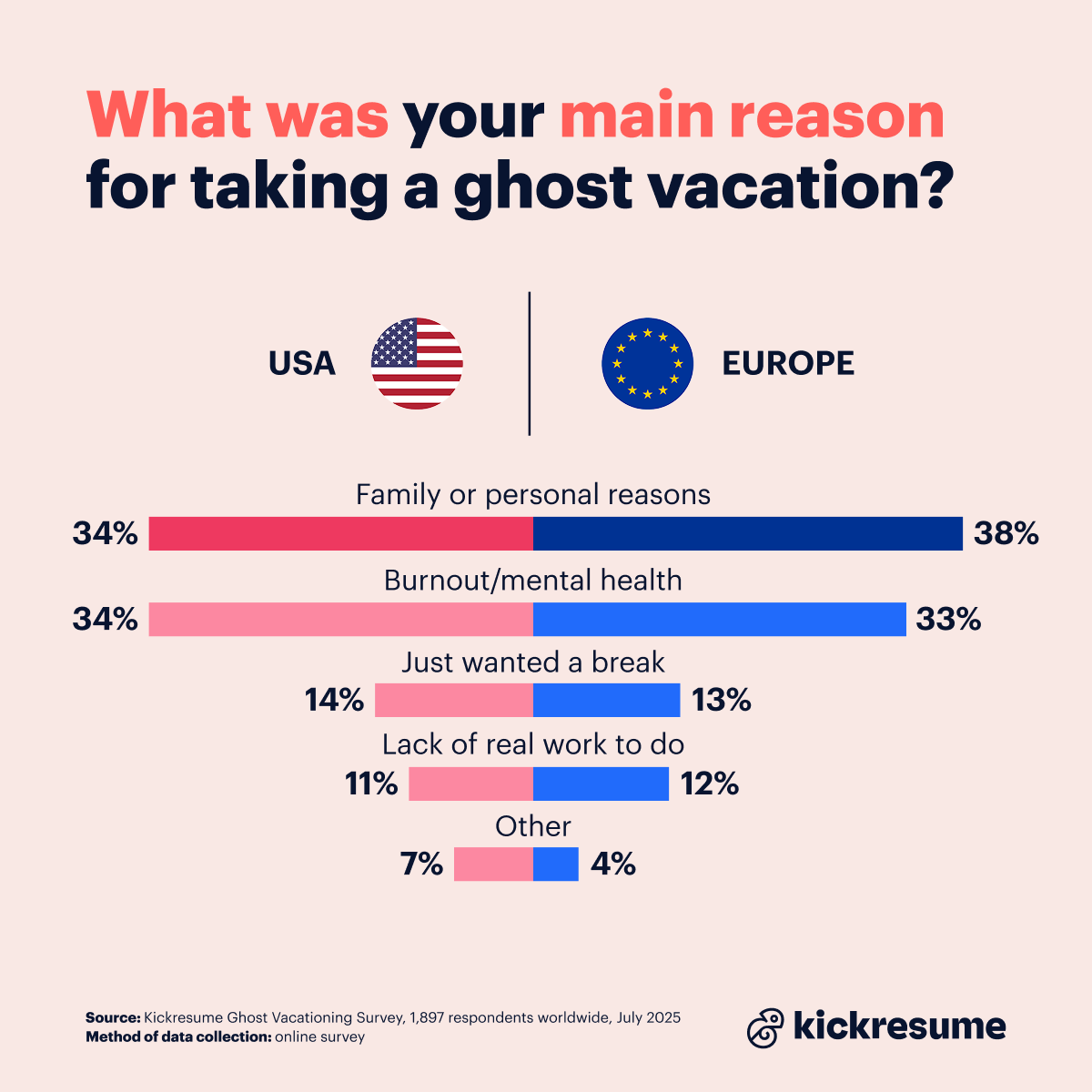
We then asked those who said they’ve never taken a ghost vacation what could tempt them to do so.
- In the U.S., 36% said burnout or mental health would push them to take unreported time off, compared to 20% in Europe.
- Europeans were also more likely to say they “wouldn’t do it” (34%) compared to Americans (28%).
- And while very few Americans (3%) said they might ghost vacation because they had little real work to do, that number was more than double in Europe (7%).
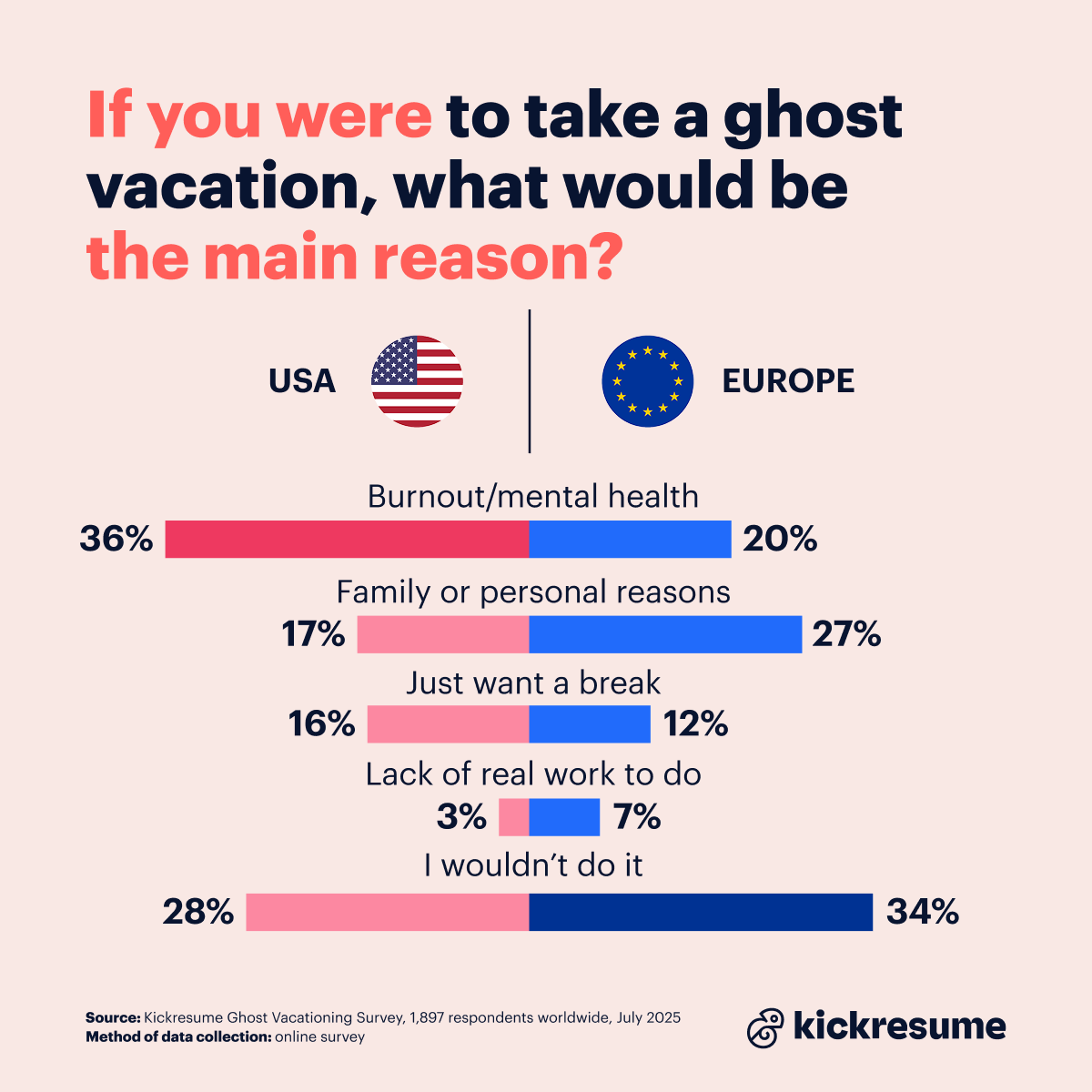
These differences suggest a few cultural undercurrents. The higher share of U.S. respondents citing burnout, both among those who have ghost vacationed and those who might, aligns with the longer hours and shorter official vacations highlighted in our earlier findings.
Europeans, on the other hand, were more likely to say they wouldn’t ghost vacation at all. A third of European respondents rejected the idea, compared to just over a quarter of Americans. This could reflect a workplace culture where asking for leave is more acceptable and less risky.
Finally, the "lack of real work" answer, though a small percentage overall, was more common in Europe. This may hint that some European workplaces have periods of slower activity where employees could step away without consequences, but instead of being transparent about it, a few opt for a quiet break.
(Note: This data was collected in July, a time when it's customary in many European countries to take extended summer holidays.)
Overall, the findings suggest that ghost vacationing is rarely about laziness or disengagement. More often, it’s tied to very human needs: taking care of family or protecting mental health. And while both U.S. and European workers experience these pressures, Americans seem more likely to feel pushed to ghost vacation because the official pathways for taking a breather are less forgiving.
10% of Europeans have ‘No Concerns’ about ghost vacationing vs. 6% of Americans
Not everyone feels comfortable taking time off under the radar. Even when family needs or mental health pressures are there, something makes people hesitate. We wanted to understand what that “something” is. Which concerns keep employees from ghost vacationing or make them uneasy when they do it?
In the U.S., the most common answer was simple:
- 28% said they had never even considered ghost vacationing. The same was true for 26% of Europeans.
- Among those who had thought about it, the biggest worry on both sides of the Atlantic was losing trust or credibility at work (22% in the U.S., 25% in Europe).
- Fear of being caught by a boss or HR (14% in both regions), missing out on important updates (9–10%), or facing disciplinary action (8% in the U.S., 4% in Europe) also appeared, though less frequently.
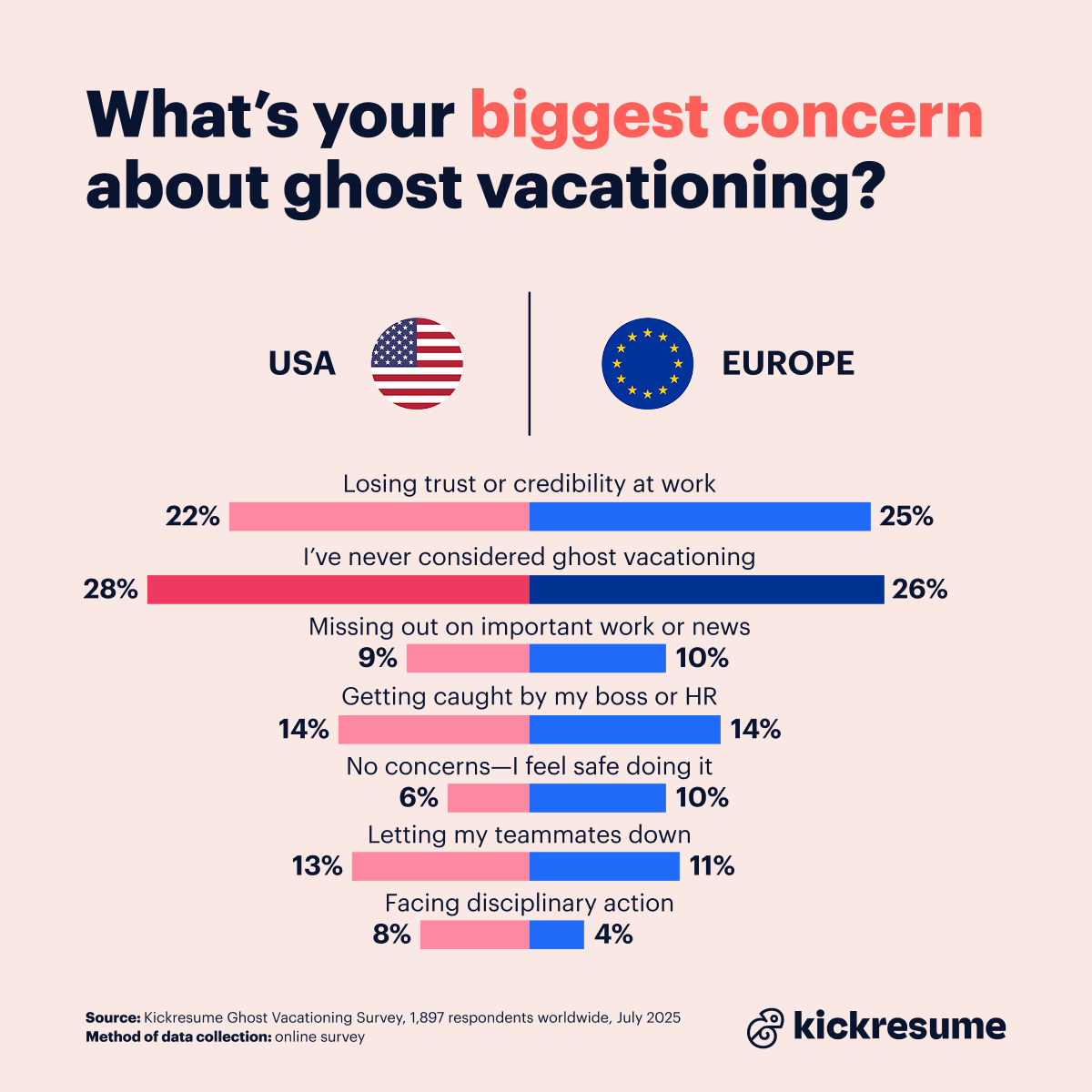
But two findings stand out in what they say about workplace culture. The first is the share of people who said they had “no concerns” about ghost vacationing. Here, Europe was higher, with 10% compared to 6% in the U.S. While this is a small group overall, it suggests that in Europe, informal time off may feel safer.
The second telling contrast is in the response “letting my teammates down.” Americans chose this slightly more often (13%) than Europeans (11%). This guilt about burdening colleagues connects with a broader cultural difference we’ve seen before.
In our previous survey about work cultures, nearly half of Europeans (49%) said they don’t feel guilty at all about taking official time off. Only 32% of Americans felt the same way. Meanwhile, 33% of Americans admitted they often feel guilty for taking leave, compared to just 18% of Europeans.
The same sentiment appears here in ghost vacationing. American workers seem to carry more emotional weight around absence, worrying not just about their employer’s reaction, but also about leaving teammates to pick up the slack.
Overall, these findings suggest that Americans are more wary of the consequences and more prone to guilt, while Europeans appear slightly more at ease, perhaps because official time off is already more accepted and less tied to feelings of personal responsibility.
Nearly half of workers have covered for a colleague’s ghost vacation
Ghost vacationing may often feel like a solo act, but as it turns out, it doesn’t always happen in isolation. Sometimes, it relies on quiet cooperation between colleagues.
After exploring why people ghost vacation and what holds them back, we wanted to know whether workers ever cover for each other when someone takes unreported time off.
The responses showed that informal teamwork around ghost vacationing is fairly common in both U.S. and European workplaces:
- In the U.S., nearly half of respondents (47%) said they’ve never been involved in this kind of arrangement.
- But a slightly smaller share (42%) reported that they have both asked someone to cover for them and returned the favor for a colleague.
- A few said they’d only been on one side of the exchange: 5% admitted to only asking for help, and 6% said they’ve only covered for someone else.
Europe showed a similar pattern but leaned more toward helping others:
- While 39% of Europeans said they’ve never engaged in ghost vacation cover, a comparable number (41%) had done it both ways.
- Europeans were also more likely to say they’d covered for others only (14%), more than double the U.S. share.
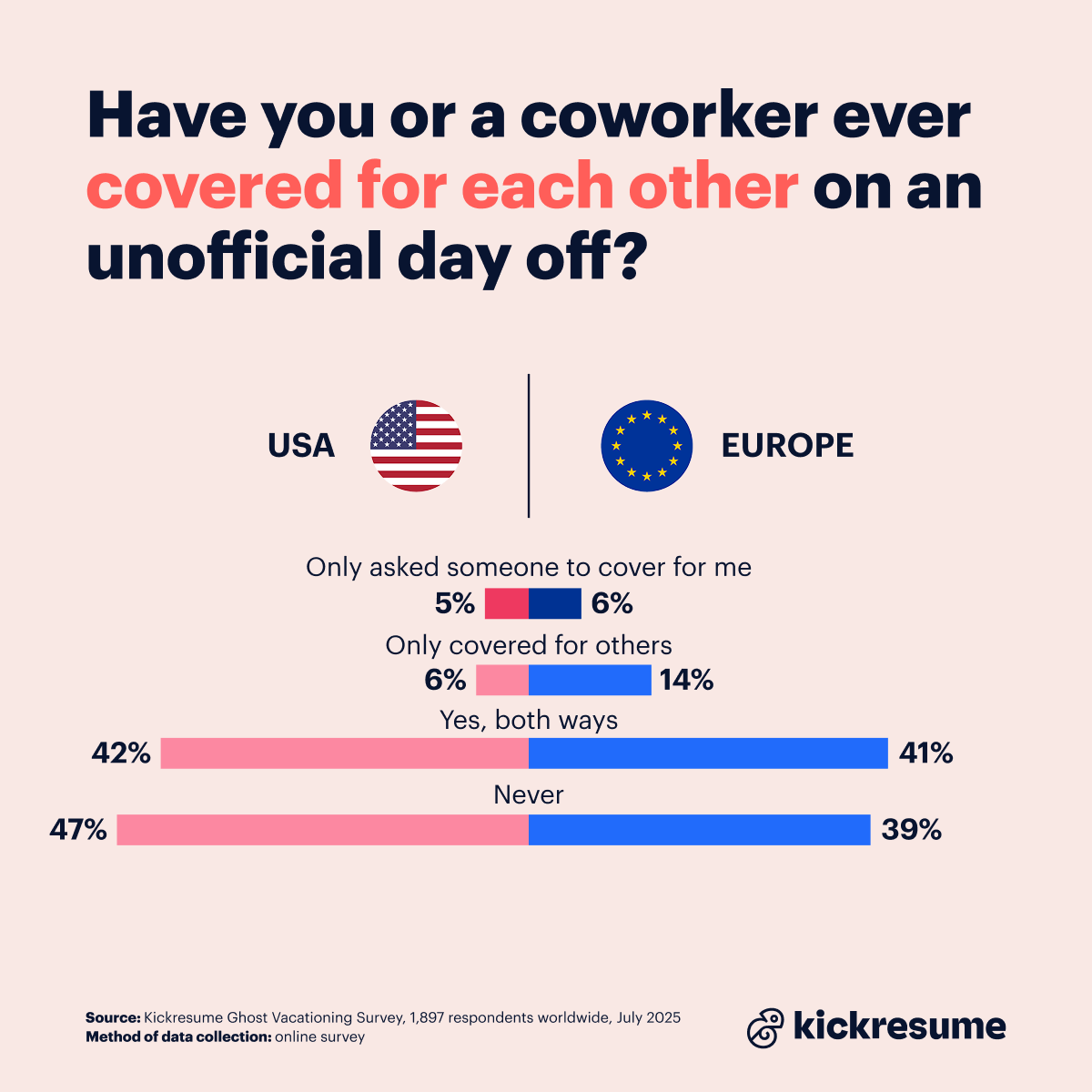
These numbers reveal that while ghost vacationing may be unofficial, it doesn’t happen in a vacuum. In many workplaces, colleagues act as a safety net, stepping in to keep things running while someone takes a breather. This kind of mutual support seems slightly stronger in Europe, where employees were more willing to help others cover than in the U.S.
Ultimately, these findings reinforce a recurring theme: ghost vacationing is not just about individual choices. It's a reflection of the broader workplace culture and unspoken agreements among colleagues. In some environments, taking unofficial time off feels risky, personal, and guilt-laden. In others, it can quietly become a shared understanding, where coworkers help each other make space for rest, even if it isn’t on the official calendar.
Final thoughts
Ghost vacationing reflects deeper pressures that workers face around burnout, family responsibilities, and mental health. Our research shows it is a common response to these challenges rather than a sign of laziness or disengagement.
At the same time, concerns about trust, guilt, and consequences influence how people take unofficial time off. This reveals a disconnect between formal policies and the realities of everyday work life.
Addressing this gap means building workplace cultures where taking time to rest and recharge is accepted and supported so that employees don't feel they need to hide their need for breaks.
Demographics
Gender
- Male: 69%
- Female: 30%
- Non-binary or other: 1%
Age
- Under 18: 2% (excluded from the survey)
- 18–28: 33%
- 29–43: 42%
- 45–60: 21%
- 61–79: 2%
- 79 or older: <1%
Work
- In-office: 40%
- Hybrid: 32%
- Remote: 28%
Location
- Africa: 12%
- Asia: 32%
- Australia/Oceania: 2%
- Europe: 21%
- Latin America: 8%
- North America: 25% (87% based in the USA)
Note
This anonymous online survey by Kickresume, conducted in July 2025, gathered insights from 1,897 respondents globally. All participants were reached via Kickresume's internal database.
About Kickresume
Kickresume is an AI-based career tool that helps candidates source jobs and raise salary with powerful resume and cover letter tools, skills analytics, and automated job search assistance. It has already helped more than 8 million job seekers worldwide.