

Making the leap from classroom to workplace isn’t always easy. For some, it’s exciting. For others, it can feel overwhelming. And while every generation of graduates faces this transition, we wanted to know: was it easier before?
To explore how today’s fresh graduates navigate the world of work, and how that compares to those who came before, Kickresume reached out to 1,277 respondents.
These were then divided into two groups:
- The first included students about to graduate, recent graduates, and those who have been working for less than a year (referred to as “fresh graduates”).
- The second group consisted of people with more than a year of work experience, regardless of when they graduated (referred to as “earlier graduates”).
We asked both groups a series of matching questions to see how their views and experiences compare. Here are the most intriguing findings:
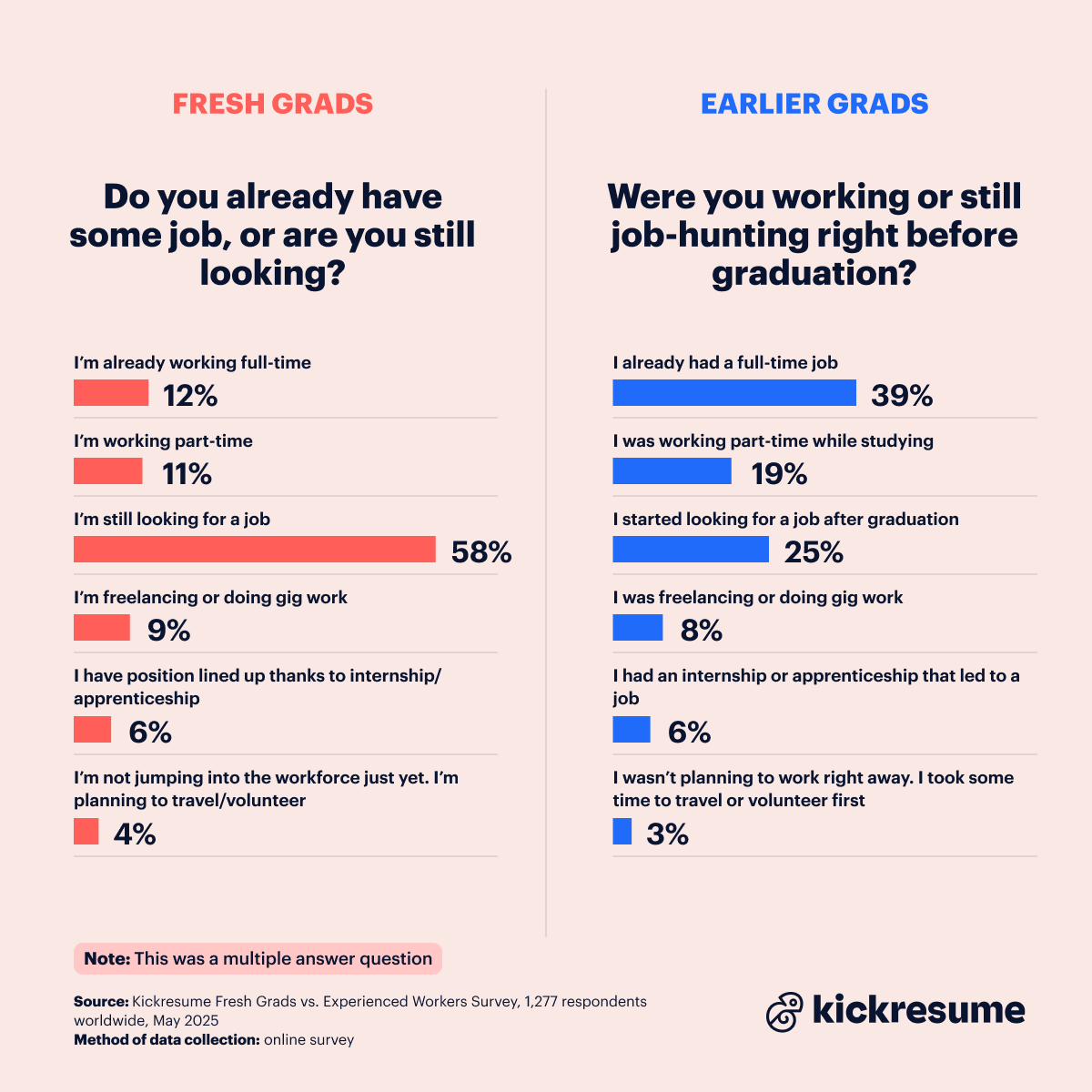
- 58% of fresh graduates are still looking for their first job after graduation, while only 25% of earlier graduates had been in the same position.
- Use of social media platforms for job searching has nearly quadrupled between earlier graduates and fresh graduates (7% to 26%).
- LinkedIn has now dethroned traditional job boards as the top job-hunting tool for fresh grads.
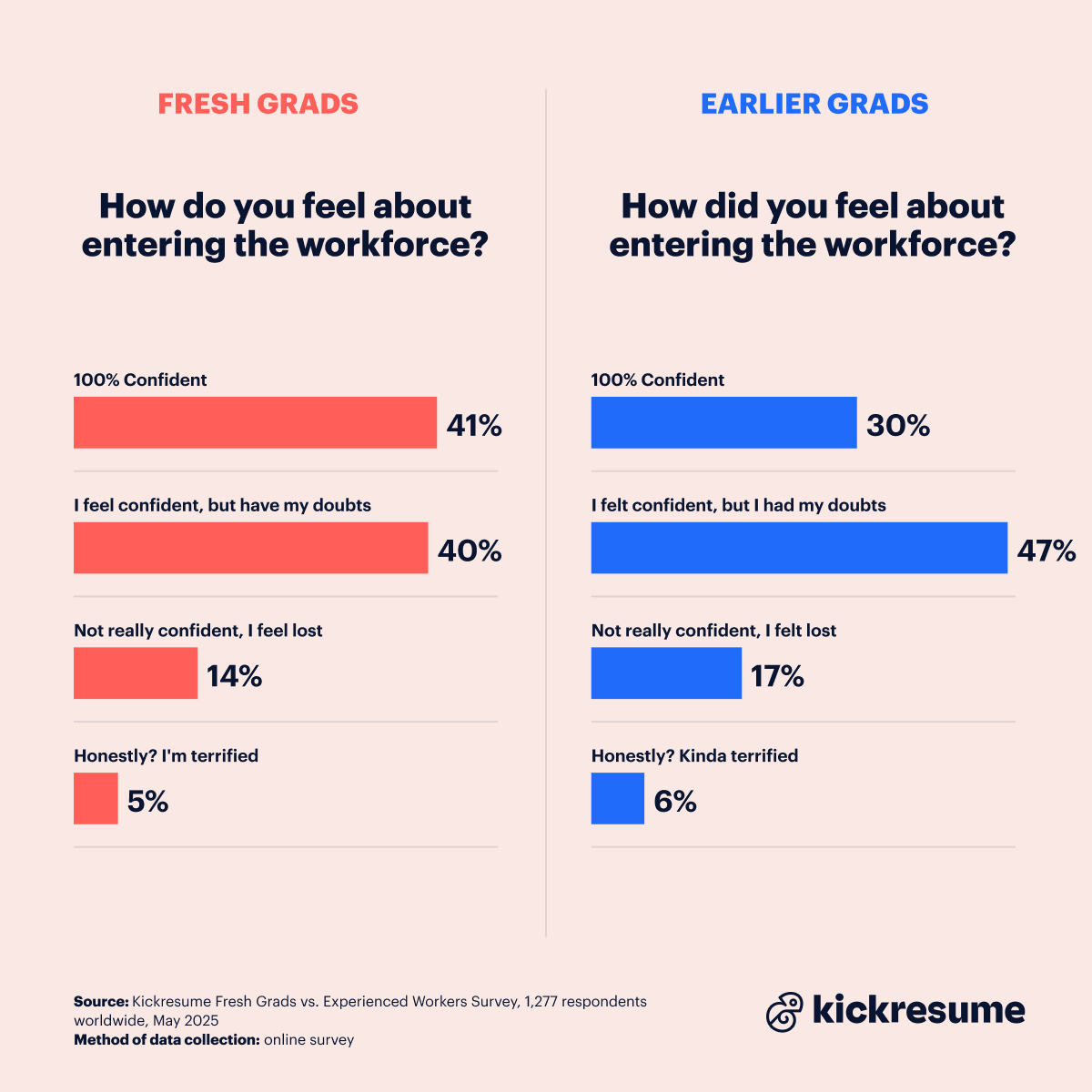
- Despite facing a tougher job market, today’s fresh graduates report higher levels of confidence when entering the workforce than earlier graduates.
- 14% of earlier graduates say much of what they learned now feels outdated, with AI cited as a major reason.
- Resumes continue to be the part of the job-hunting process where graduates, past and present, struggle most.
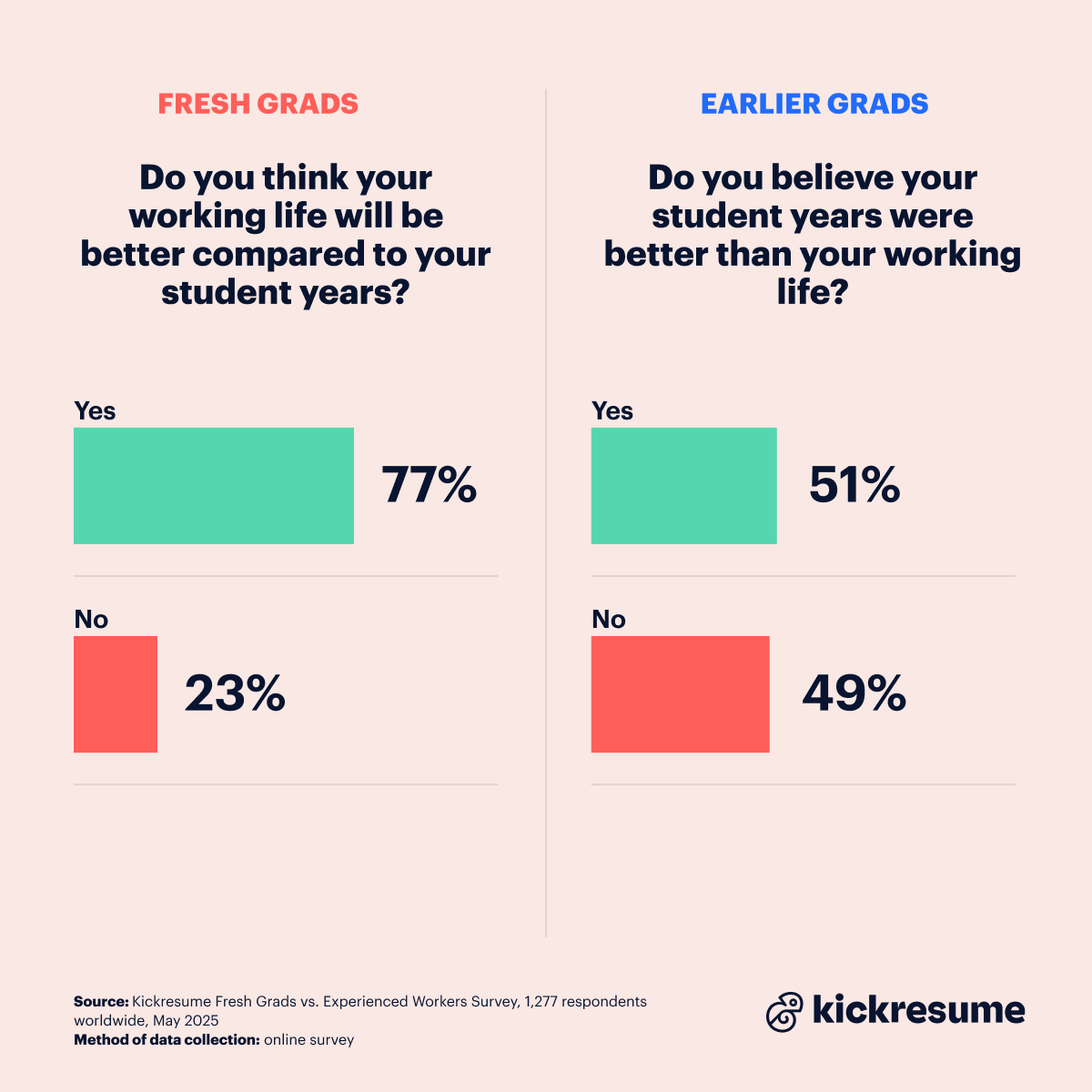
- Most fresh graduates (77%) expect their working life to be better than their student years, but in hindsight, more than half (51%) of earlier graduates say their student years were better.
So… What’s next? 58% of grads don’t know yet
Our survey reveals that graduates today are roughly three times less likely to have a full-time job secured before leaving school. Nearly four in ten (39%) of those who graduated earlier had a full-time role lined up by the time they finished their studies. Among today’s fresh graduates, only 12% can say the same.
This difference is further reflected in the number of graduates still looking for work. Today, 58% of fresh graduates say they are still searching for their first job. In contrast, only 25% of those who graduated earlier said they began their job search after finishing school.
All other answers were fairly similar across both groups:
- Around 11% of today’s fresh graduates are working part-time, compared to 19% of earlier graduates who worked part-time while studying.
- Freelancing or gig work is equally common, with 9% of today’s fresh graduates and 8% of earlier graduates taking this route.
- About 6% of both groups secured a job through an internship or apprenticeship.
- A small share also chose to take time off to travel or volunteer—4% among today’s fresh graduates and 3% among those who graduated earlier.
These results suggest that today’s fresh graduates are entering the workforce with less job security than their predecessors. Fewer are securing full-time roles before graduation, and many begin their job search only after leaving school.
LinkedIn becomes the top job search platform for fresh grads
Considering that today’s fresh graduates face a different job market than those who came before them, it’s no surprise that their job search patterns have also shifted.
By far the most significant change has been the rise of LinkedIn and social media as key job search tools:
- More than half of today’s fresh graduates (57%) used LinkedIn to look for their first job. Among those who graduated earlier, that number was just 29%.
- Social media platforms show an even greater jump from only 7% (earlier graduates) to 26% (today’s fresh graduates).
What might be driving this trend? Part of it is simply the growing presence of these platforms in professional life. Over the past decade, LinkedIn has evolved from a digital resume board into a dynamic space for networking, job hunting, and company outreach. At the same time, platforms like TikTok and Instagram have opened new avenues for connecting with potential employers, especially in industries that value creativity, media presence, or personal branding.
For fresh graduates, LinkedIn has now dethorned traditional job portals as the top place to look for a job. Even so, many other job search patterns remain relatively stable:
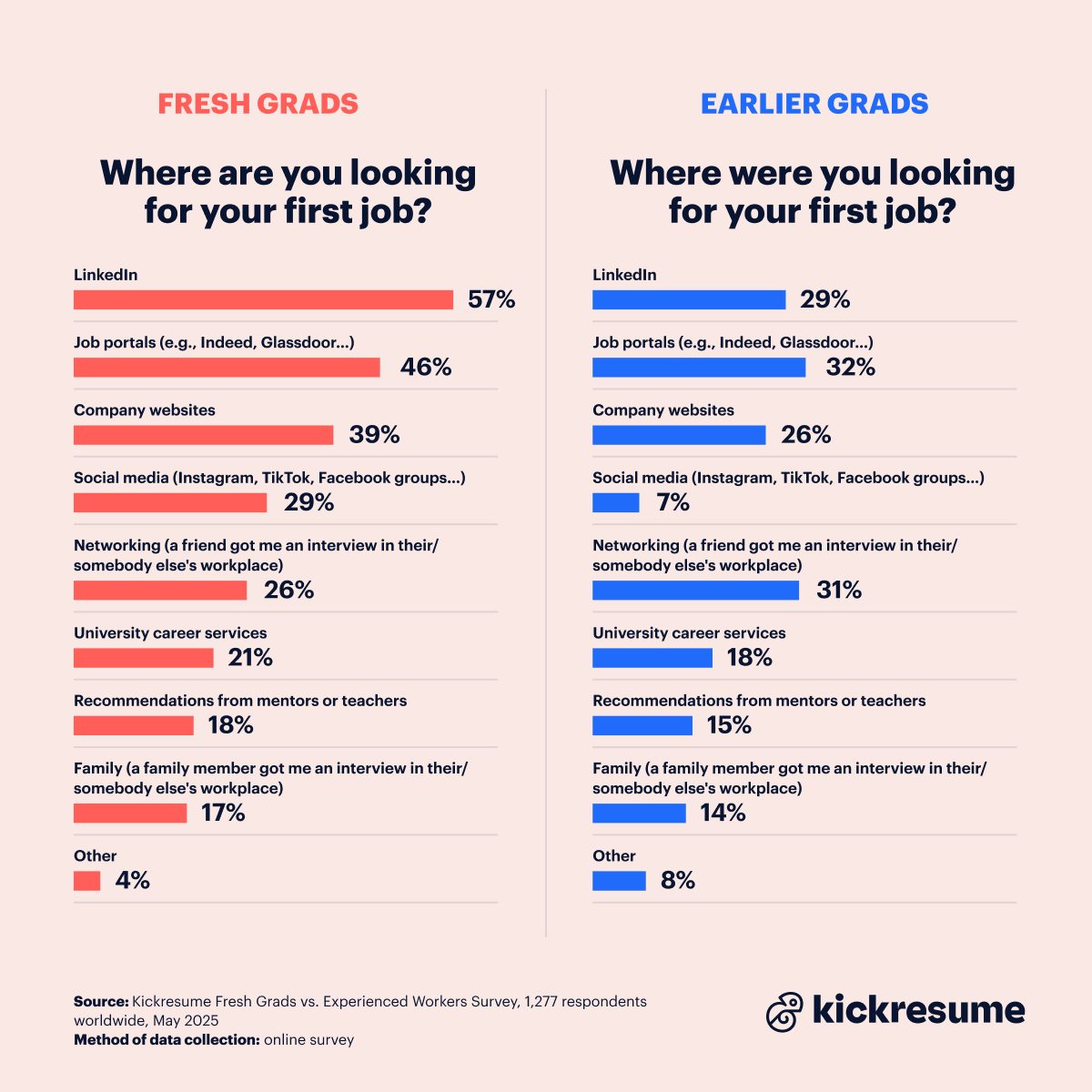
It’s worth noting that this was a multiple-answer question and respondents could select as many options as they liked. The fact that fresh graduates’ answers show higher percentages across nearly every option suggests they are using more channels overall. In other words, landing a first job now seems to require a broader approach than it once did.
Entering the workforce more confident while facing the same struggles
Despite the fact that today’s graduates experience less job security (with 58% still looking for a job after graduation, compared to just 25% of earlier graduates) and need to search more broadly to land their first role, they seem to enter the workforce with more confidence.
When asked how they feel about making the transition from school to working life, 41% of today’s fresh graduates said they feel 100% confident. Another 40% said they feel confident but still have some doubts.
By contrast, only 30% of those who graduated earlier said they had felt fully confident at the time. And nearly half (47%) said they had felt confident but with doubts.
The less confident responses also show a slight shift:
- 14% of today’s fresh graduates admitted to not feeling very confident and feeling somewhat lost, compared to 17% among earlier graduates.
- And 5% of today’s fresh graduates described themselves as “terrified” about the transition, versus 6% of those who had been through it before.
Why might that be? One likely reason is that confidence tends to be higher before real-world experience puts expectations to the test. So, some of this optimism may stem from inexperience. Whether this confidence will hold steady once they encounter the realities of the job market remains to be seen.
Even though the level of confidence has changed, the things that made graduates nervous back then still weigh on the minds of today’s freshers.
We asked both groups: What were you most nervous about when entering the workforce? Here’s how the answers ranked, with percentages from both fresh and earlier graduates:
Not feeling “good enough” or qualified
- Fresh graduates: 31%
- Earlier graduates: 24%
Dealing with interviews and rejections
- Fresh graduates: 17%
- Earlier graduates: 19%
All of the above
- Fresh graduates: 16%
- Earlier graduates: 17%
Messing up or failing at the job
- Fresh graduates: 14%
- Earlier graduates: 15%
Not being able to find a job in the field I studied
- Fresh graduates: 9%
- Earlier graduates: 7%
Not knowing what I really want
- Fresh graduates: 8%
- Earlier graduates: 11%
I don’t feel nervous / wasn’t nervous at all
- Fresh graduates: 5%
- Earlier graduates: 4%
Fitting in with coworkers
- Fresh graduates: <1%
- Earlier graduates: 3%
Confidence may have gone up slightly, but the core anxieties haven’t moved much at all.
Experience is still the #1 obstacle for graduates
Even though today’s graduates might feel a bit more sure of themselves, the challenges they face haven’t exactly gotten easier. In fact, when we asked both groups what made finding their first job difficult, their answers looked strikingly familiar:
- The most common frustration was the same for everyone: experience. Both fresh and earlier graduates pointed to the same problem. Employers expect it but rarely offer a way to gain it. Among earlier graduates, 44% said this was one of the main obstacles. Among today’s graduates, that number rises to 65%.
- Unrealistic job descriptions came up often too. About 30% of earlier graduates said they regularly saw listings with demands that felt out of touch. Today’s graduates feel the same, although a bit fewer mentioned it at 28%.
- A similar attitude can be seen around self-promotion. 29% of earlier graduates said they didn’t know how to "sell" themselves. For fresh graduates, the number is slightly lower at 26%, but still significant.
- Roughly one in five people in both groups said they felt pressure to accept any job, not just the one they actually wanted. That’s 19% among earlier graduates and 20% among fresh ones.
- A similar share mentioned not getting enough guidance after graduation, with 20% of earlier graduates and 19% of fresh ones selecting this option.
However, today’s graduates were more likely to say they’re facing a lack of job openings in their field. 22% mentioned this, compared to 19% of earlier graduates.
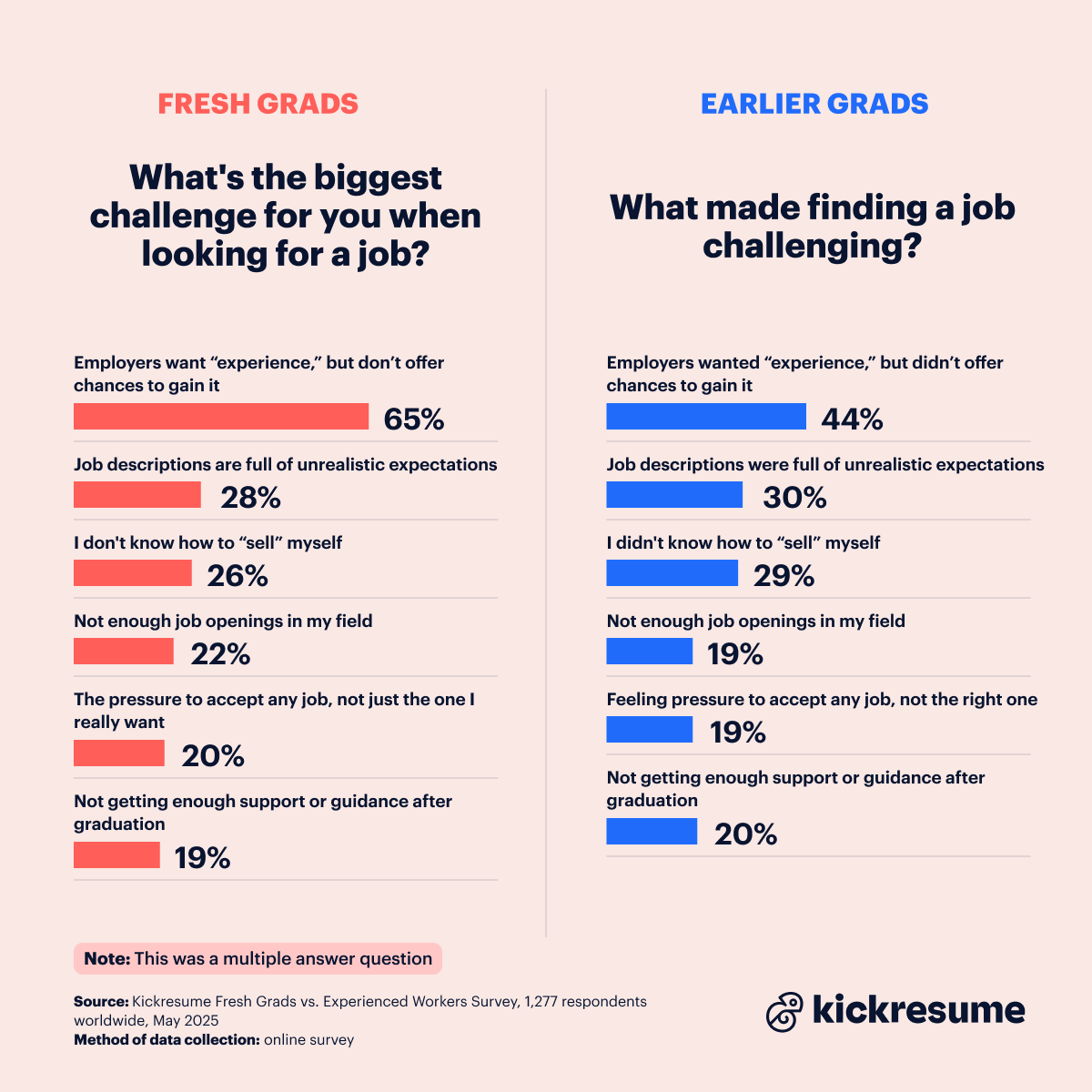
What these results imply is that not much has changed at the core of the graduate job search. The complaints you might expect to hear from someone starting their career ten years ago are still being voiced today.
Some of these changes might be due to a more competitive hiring environment. But other challenges (like unrealistic expectations or trouble with self-promotion) have been around much longer. This could point to a gap in how schools prepare students for real-world hiring. Many graduates still struggle to understand job ads or build the confidence to pitch themselves.
The most elusive part of the job hunt? Still the resume
Even with all the templates, how-to guides, and AI tools, writing a strong resume still causes the most stress. More than a third of today’s graduates (34%) said it’s the part they struggle with most. It was also the top answer among earlier graduates, though slightly fewer (27%) pointed to it.
The second challenge is closely related: knowing what employers actually want. 12% of fresh graduates chose this as their biggest hurdle, and 17% of earlier grads said the same. The wording of job ads doesn’t help. They’re often packed with vague phrases, soft skills, and corporate buzzwords that are hard to decode if you haven’t worked in that world before. It’s not always clear what’s really required, or how much of it is negotiable.
Interviews, on the other hand, didn’t cause as much stress as one would expect. 11% of both groups said this was the most difficult part of the process. That’s noteworthy, especially considering how often younger generations are criticized for lacking interpersonal skills, supposedly due to social media or the effects of pandemic isolation. But the nerves around interviews are consistent across both groups.
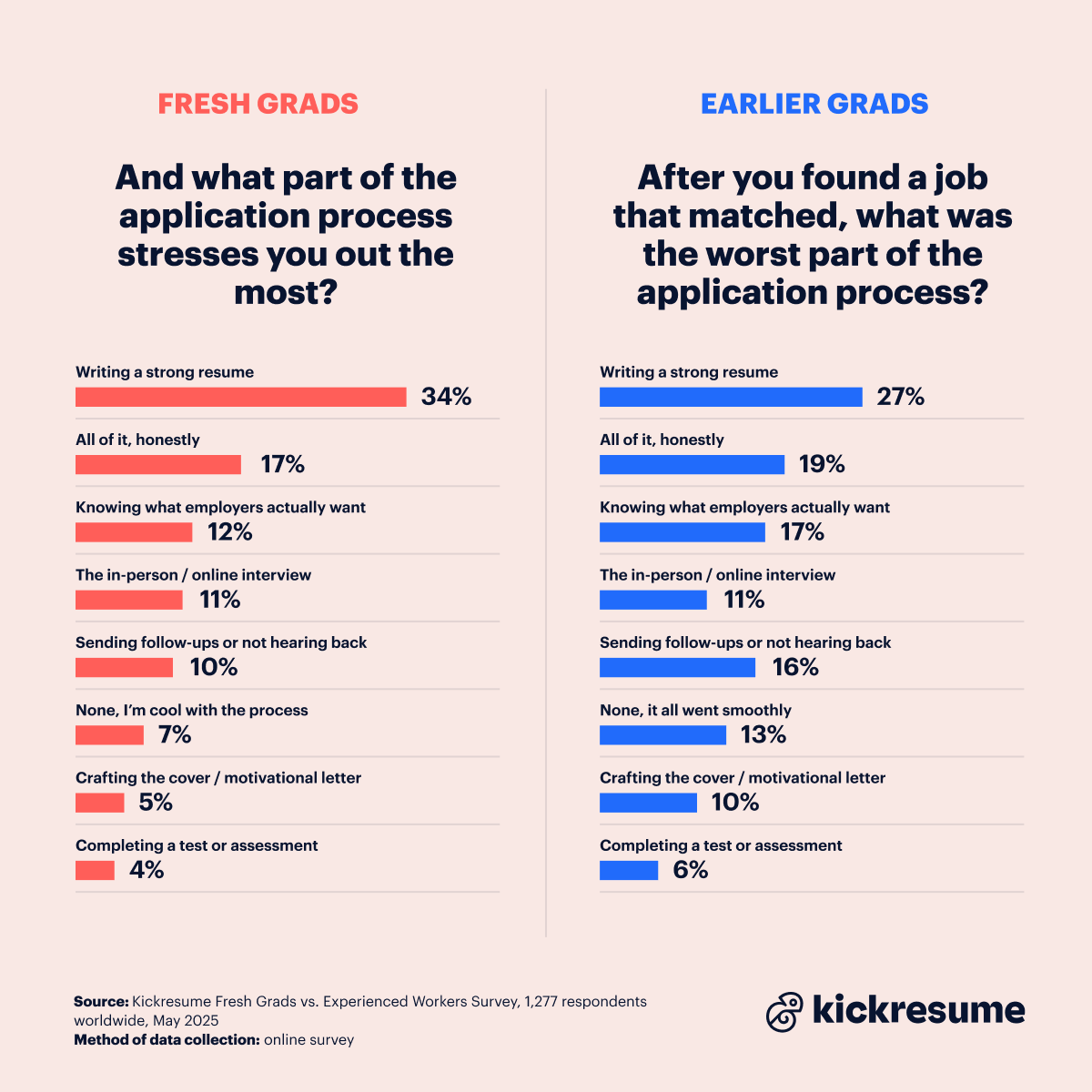
On the other hand, the stress of crafting cover and motivational letters seem to be fading into the background. Only 5% of today’s graduates found them to be the most challenging part of the process, compared to 10% of earlier graduates. That drop probably says less about growing confidence and more about shifting norms, as fewer employers ask for them.
So while the hiring process may feel modernized, it hasn’t become any clearer. Resumes are still a challenge. Job ads are still confusing. And most people still aren’t sure exactly what employers want from them.
First job matters, it can shape a lot in your work-life
We often tell graduates not to stress too much about their first job. It’s just a starting point, not a life sentence.
And that’s more or less how fresh graduates see it:
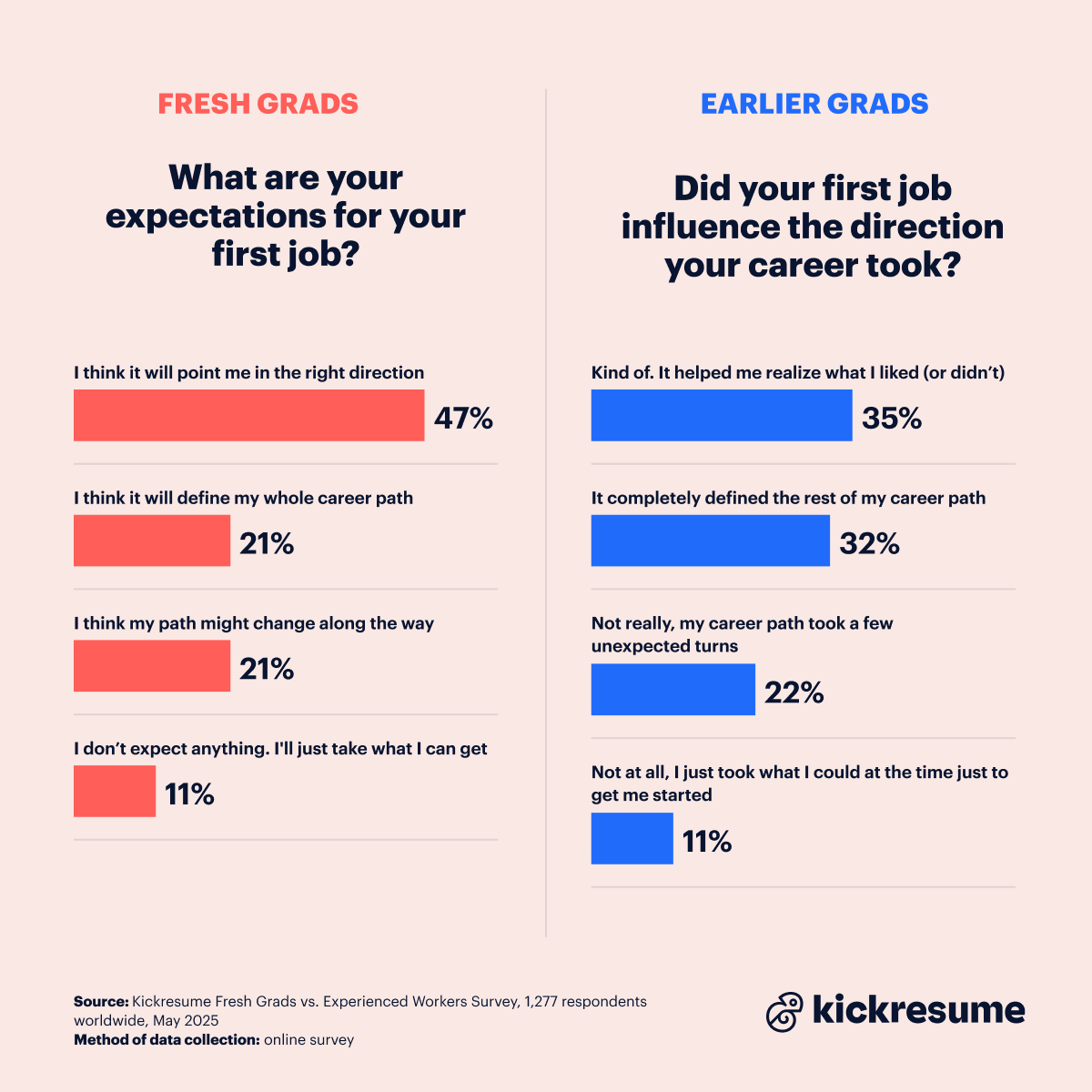
- When we asked what they expect from their first role, nearly half (47%) said they believe it will point them in the right direction, but not necessarily lock them into a single path.
- Another 21% think their path might change along the way.
- Only 1 in 5 expect that their first job will define their entire career.
- And 11% said they don’t expect much at all. They’ll just take what they can get.
It’s a pretty sober outlook. Most fresh graduates seem hopeful, but they’re not placing too much weight on one decision. But when we asked earlier graduates to look back, the picture shifted:
- A full 32% said their first job completely defined the rest of their career.
- Another 35% said it helped them figure out what they liked, or didn’t.
- 22% admitted that their path took unexpected turns.
- And 11% said their first job didn’t influence them at all.
Looking back, very few saw it as “just a job.” So while fresh graduates may be right not to panic about making the perfect choice, this data suggests that first jobs matter more than we think.
Belief in school’s value drops after entering the workforce
After looking at expectations around that all-important first job, we were curious to see how graduates (past and present) feel about the years they spent preparing for working life? Was the time and money they put into education worth it?
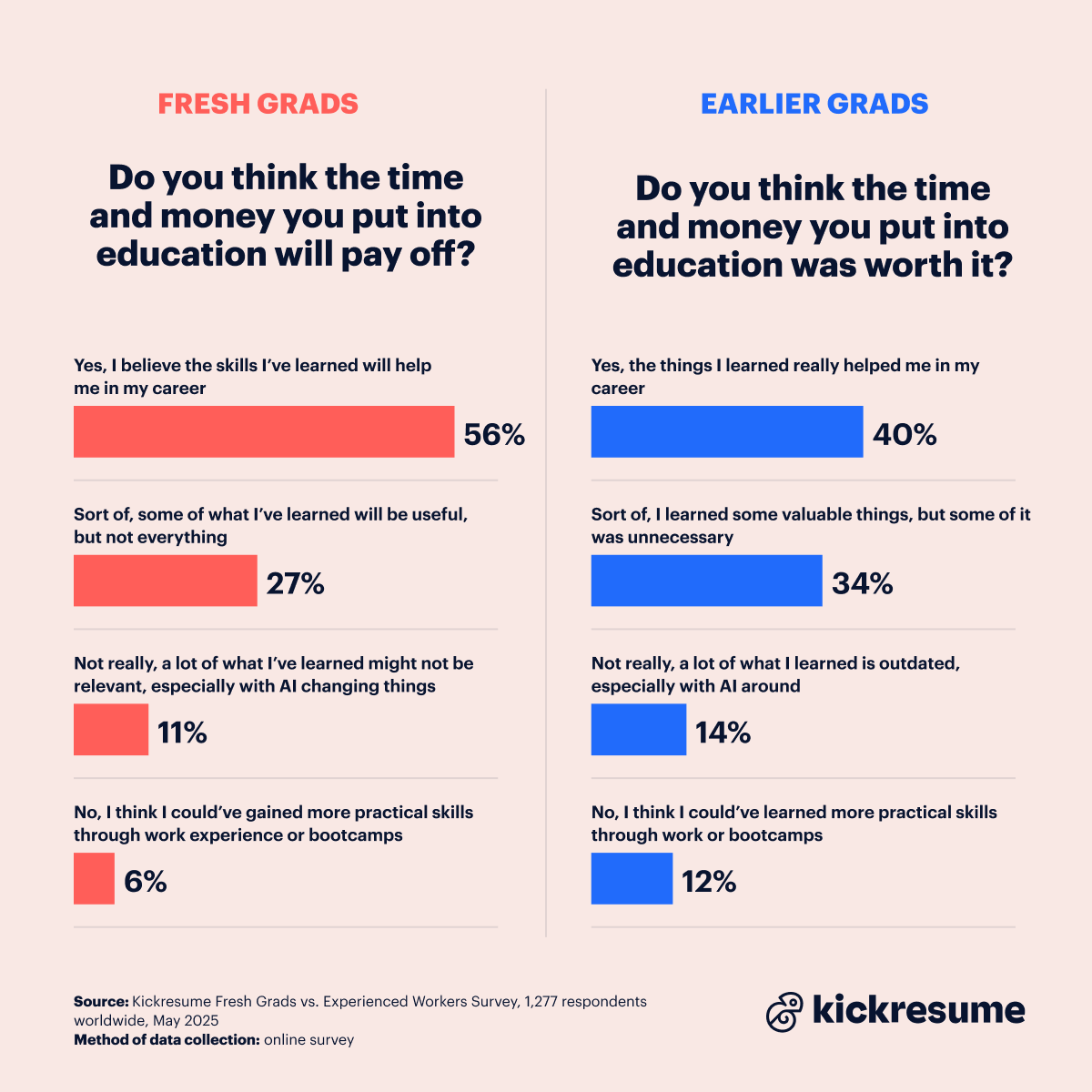
Most fresh graduates answered with a cautious optimism:
- 56% said yes, they believe the skills they’ve learned will help them in their careers.
- 27% said sort of—some of what they learned will be useful, but not everything.
- 11% weren’t so sure, pointing to the growing influence of AI and questioning whether their education still feels relevant.
- And 6% said no. They believe they could’ve picked up more practical skills through work experience or bootcamps.
It’s a hopeful outlook overall. The majority still sees value in what they’ve learned, even if they don’t expect everything to carry over into the real world.
We asked earlier graduates the same question, this time in retrospect. And the good news is that for many, the optimism proved justified:
- 40% confirmed that the things they learned really did help them in their careers.
- Another 34% said they learned some valuable things, though not everything turned out to be useful.
- 14% said much of what they learned now feels outdated, with AI playing a part in shifting what’s considered relevant.
However, 12% of earlier graduates said they now believe they could’ve learned more through hands-on experience or alternative paths like bootcamps. That’s double the number of fresh graduates who feel that way right now (6%).
This result might reflect a growing awareness that theory and credentials don’t always translate into readiness for work. Or that traditional education isn’t always built for speed, especially when technology and job requirements move fast.
Detour taken, nearly a quarter of experienced employees don't work in their field of study
Of course, few careers unfold exactly as planned. Paths change. With that in mind, we wanted to see how fresh graduates today think about the link between their studies and their future work.
We asked fresh graduates whether they expect their careers to be connected to what they studied. And we also asked earlier graduates whether their current jobs are actually related to their field of study.
Here’s how their answers compare:
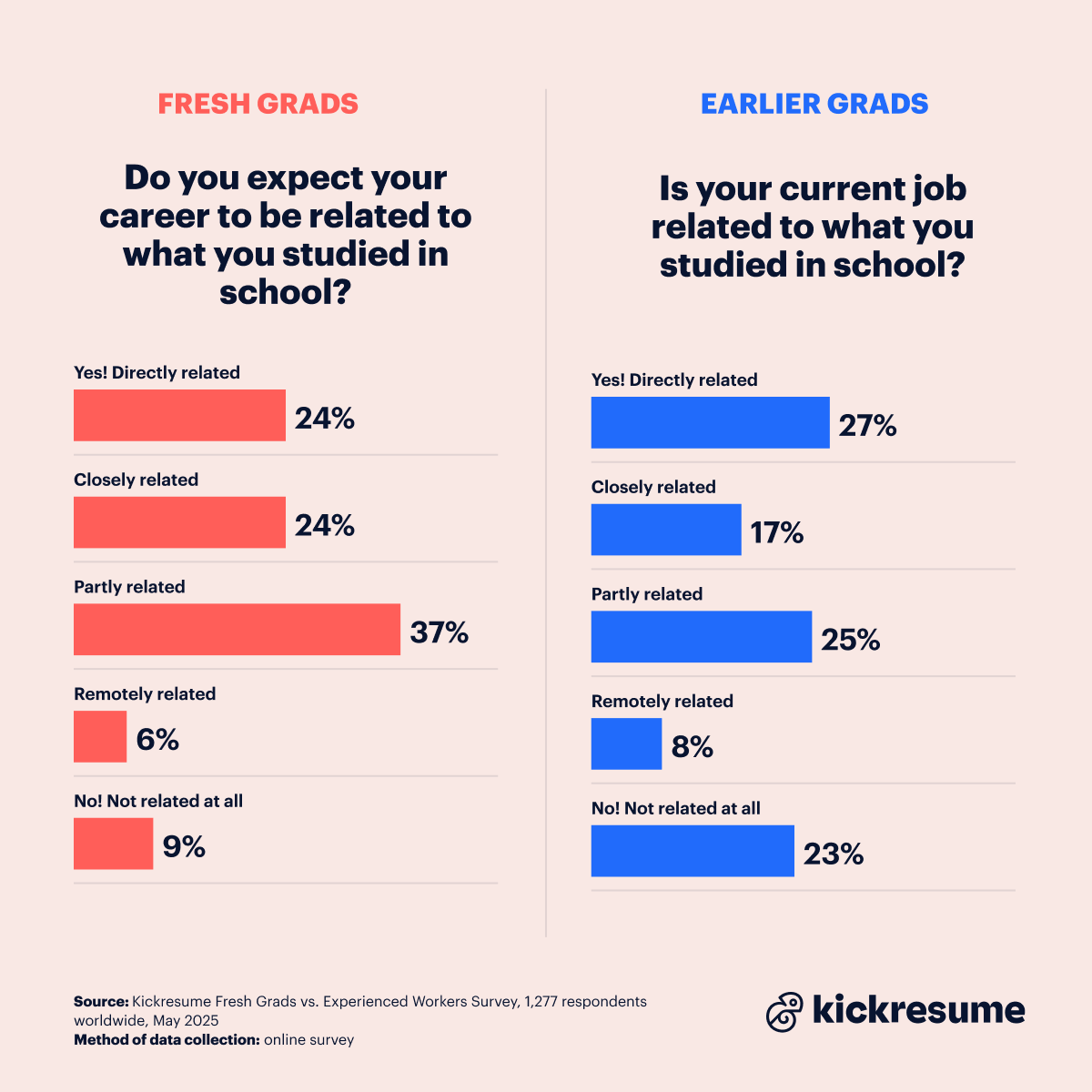
A much larger share of earlier graduates reports working in jobs completely unrelated to what they studied (23%), compared to just 9% of fresh graduates who expect that outcome. This suggests that while many graduates do find ways to apply what they’ve learned, career paths often take detours along the way.
It’s also worth noting that outcomes vary by industry. Among earlier graduates, the largest share of those working in fields directly tied to their studies came from Information Technology and Computer Science. Meanwhile, the group most likely to report working in completely unrelated roles were graduates in Business, Management, Marketing, and Sales.
77% of Grads are excited for their work life
And for the final questions, we asked both groups for a simple gut-check. Fresh graduates told us whether they expect their working life to surpass their student years. Earlier graduates reflected on whether it actually did.
Turns out, a full 77% of today’s fresh graduates believe their working life will be better. Only 23% think their student years will be hard to top.
Among those already in the workforce, the view is more divided. 51% now say their student years were better, while 49% feel working life has been an improvement.
It’s a bittersweet contrast. Early on, the excitement of earning a paycheck, building a career, and gaining independence is strong. But over time, the pressures and routines of full-time work can make the freedom and flexibility of student life feel more appealing in hindsight.
Final thoughts
The journey from classroom to career has never been straightforward. But it’s clear that today’s graduates are entering a job market that’s more uncertain, more digital, and arguably more demanding than ever.
And yet, they’re not backing down. Despite the uncertainty, fresh graduates are entering the workforce with a striking level of confidence.
Interestingly, while the tools have changed, the core struggles haven’t. Gaining experience, crafting a standout resume, understanding job ads… these hurdles remain firmly in place. If anything, they’ve just taken on new forms.
Most graduates approach their first job with cautious optimism. Few believe it will define their whole career, but many hope it will set them in the right direction. Their expectations for working life are high, with over three-quarters believing it will be better than their student years.
But hindsight tells a more complicated story. Many earlier graduates now say the freedom and simplicity of student life were hard to beat. And when looking back, it turns out that the first job mattered more than they thought.
Demographics
Education Level
- Bachelor's or Associate degree – 48%
- Master's degree – 26%
- High school (secondary school) – 17%
- Vocational/Technical training – 5%
- Doctorate (PhD) or Professional degree (e.g., MD, JD) – 4%
- None of the above – less than 1%¨
Seniority Level
- Mid level – 29%
- Senior level – 26%
- Student – 17%
- Entry level (over 1 year of experience) – 10%
- Fresh Grad – 7%
- Entry level (1 year of experience or less) – 7%
- C-suite/Executive – 4%
Field of Study (Students)
- Information Technology / Computer Science – 31%
- Business / Management / Marketing / Sales – 16%
- Engineering (Mechanical, Electrical, Civil…) – 15%
- Medicine / Nursing / Healthcare – 8%
- Mathematics / Statistics / Data – 5%
- Natural Sciences (Biology, Chemistry, Physics…) – 4%
- I haven’t worked in a specific field – 4%
- Psychology / Sociology / Social Work – 3%
- Education / Teaching / Training – 3%
- Law / Legal Services / Public Administration – 3%
- Humanities / Culture / Translation / Languages – 3%
- Arts / Design / Architecture – 2%
- Hospitality / Tourism / Culinary – 2%
- Transportation / Logistics / Security – 1%
- Media / Communication / Journalism – 1%
- Customer service / Retail – 1%
- Skilled trades (e.g., electrician, mechanic, builder…) – 0%
Field of Study (Workers)
- Business / Management / Marketing / Sales – 31%
- Information Technology / Computer Science – 25%
- Engineering (Mechanical, Electrical, Civil…) – 8%
- Education / Teaching / Training – 6%
- Medicine / Nursing / Healthcare – 5%
- Customer service / Retail – 4%
- Law / Legal Services / Public Administration – 3%
- Arts / Design / Architecture – 3%
- Hospitality / Tourism / Culinary – 3%
- Natural Sciences (Biology, Chemistry, Physics…) – 2%
- I haven’t worked in a specific field – 2%
- Media / Communication / Journalism – 2%
- Transportation / Logistics / Security – 2%
- Mathematics / Statistics / Data – 2%
- Psychology / Sociology / Social Work – 2%
- Humanities / Culture / Translation / Languages – 1%
- Skilled trades (e.g., electrician, mechanic, builder…) – 1%
Note
This anonymous online survey by Kickresume, conducted in May 2025, gathered insights from 1,277 students, graduates, and experienced workers, globally. All participants were reached via Kickresume's internal database.
About Kickresume
Kickresume is an AI-based career tool that helps candidates source jobs and raise salary with powerful resume and cover letter tools, skills analytics, and automated job search assistance. It has already helped more than 8 million job seekers worldwide.