Have you ever missed out on a job opportunity, because while you said all the right things at the interview, you could tell that your face was giving the wrong impression? Facial expressions have been proved by psychological studies to have a massive influence on how we're perceived by others.
After our successful collaboration with body language expert Dr Vadim Subbotin, we’ve explored academic psychological research to find out just how important it's what we say with our faces. We also spoke to Jacquie Wilkinson, a Holistic Intuitive Coach. Jacquie told us some exercises to help you relax, and come across as calm, friendly, and professional in your next interview or important meeting.
Here are the key takeaways:
- People who look anxious in job interviews are less likely to be hired.
- Mindfulness practices can help your performance in interviews and meetings.
- Exercises like relaxing your facial muscles as you slowly breathe out can help.
- Use deep breathing techniques like the 4-7-8 method before going in for your interview.
- Practice keeping a neutral expression—not only does it help you look calm, but it can also have a positive effect on your mood.
The smallest facial movements can reveal deep emotions
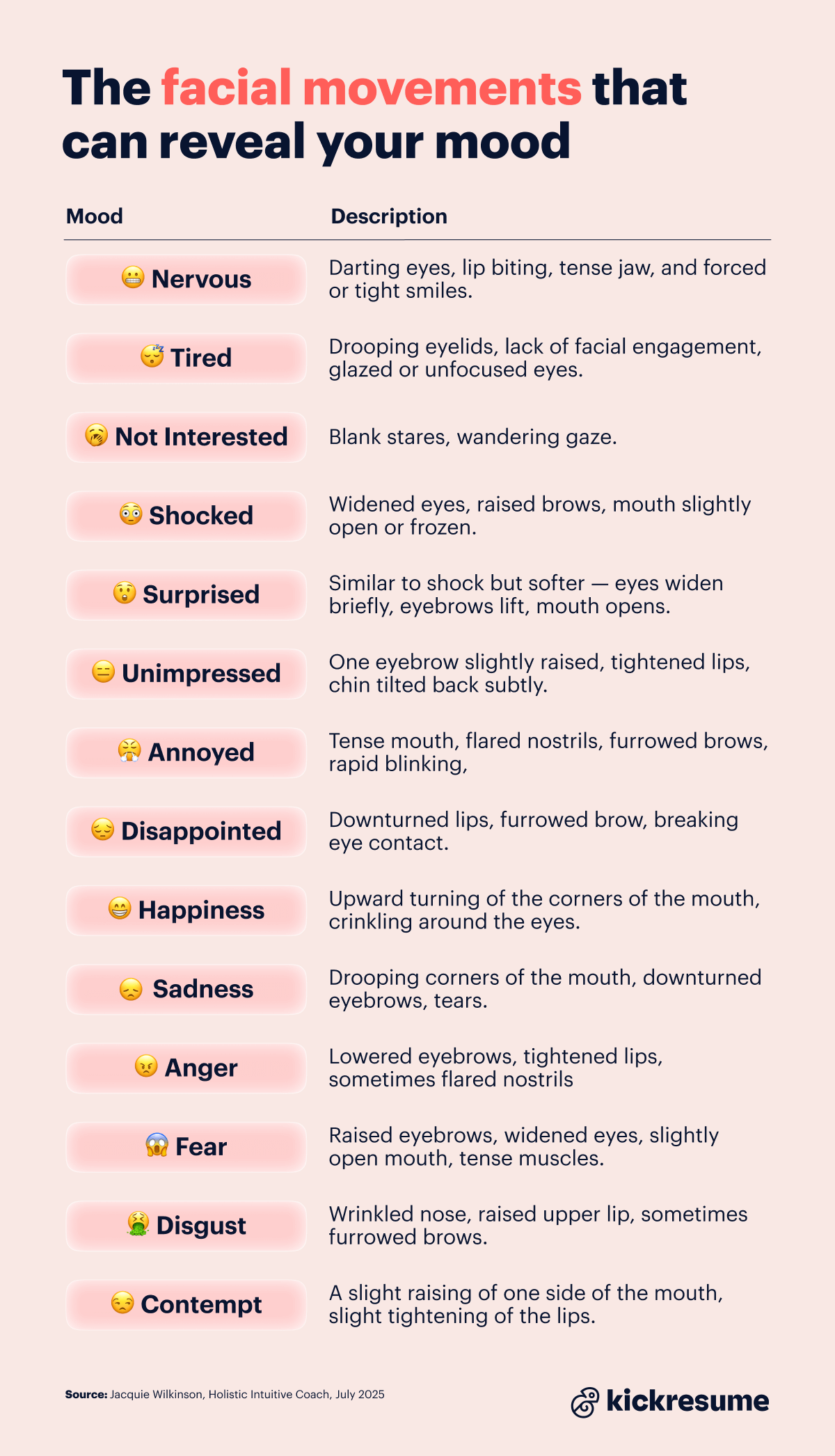
Facial expressions are an important part of how we communicate with the world around us, reflecting how we feel, or how we want people to think we feel. They can range from voluntary (a polite smile) to involuntary (a genuine laugh), or anywhere in between. Micro-expressions can also flash across our faces in a fraction of a second, giving a glimpse of how we’re feeling.
We asked Jacquie Wilkinson, a Holistic Intuitive Coach with 25 years of coaching experience, to tell us how expressions can reveal your emotions. This breakdown of how facial expressions work shows that the same movements can indicate different moods. However, as you can see, some movements like furrowed eyebrows tend to reveal negative emotions.
Looking anxious in an interview could cost you the job
When we are stressed or anxious, it often has a visible impact on our expression, even if we try to hide it. Unfortunately, this means that when we are worried about making a good impression, we might actually come across worse. It’s been found that looking nervous can actually be bad for your career.
A 2018 overview of academic research over the years found that interview candidates who seem anxious are overall less likely to perform well in their job interviews. This may be partly because being perceived as nervous makes you less likely to be considered warm and enthusiastic.
There are plenty of moments in a job interview where you might find yourself feeling especially anxious—like if you're asked a tricky situational interview question about how you’d deal with a particular problem. There are infinite situations the interviewer might want to ask you about, so these questions can be particularly hard to prepare for.
Even though you might just be anxious because you’re hoping to get the job, it could backfire. This might be why people sometimes talk about feeling less stressed in an interview for a job they don’t want, and even being offered it—their relaxed attitude is showing.
Manage your emotions, don’t just hide them!
It's been found that people who have expressive faces are more likely to be well-received by those around them. That’s not just positive expressions! The theory is that all expressions make you easier to read, making you come across as open and trustworthy.
But even so, it’s clear to see that expressions that are associated with negative emotions can hold you back. Strategies that involve making an effort to change how you feel inside might be more effective than just faking it until you make it. Mindfulness practices have been shown to help improve both job satisfaction and mood regulation.
Another way to help you stay calm in your job interview is to make sure you’re fully prepared. Bring everything to the interview that you’ll need, from an extra copy of your resume to a pen and notebook to jot down any notes. This will help you feel more confident.
Nervous? Relaxation and breathing can save your interview
There are a few ways to reduce the number of stress and anxiety-related expressions you make in an interview. Holistic Intuitive Coach Jacquie Wilkinson told us some exercises she recommends to her clients to help them calm down.
The first exercise she recommended is visualisation. Jacquie advised that imagining yourself looking calm and giving a great impression can help you stay relaxed under pressure. As well as being a key tool in meditation, visualisation is often used by people who are setting any kind of goal.
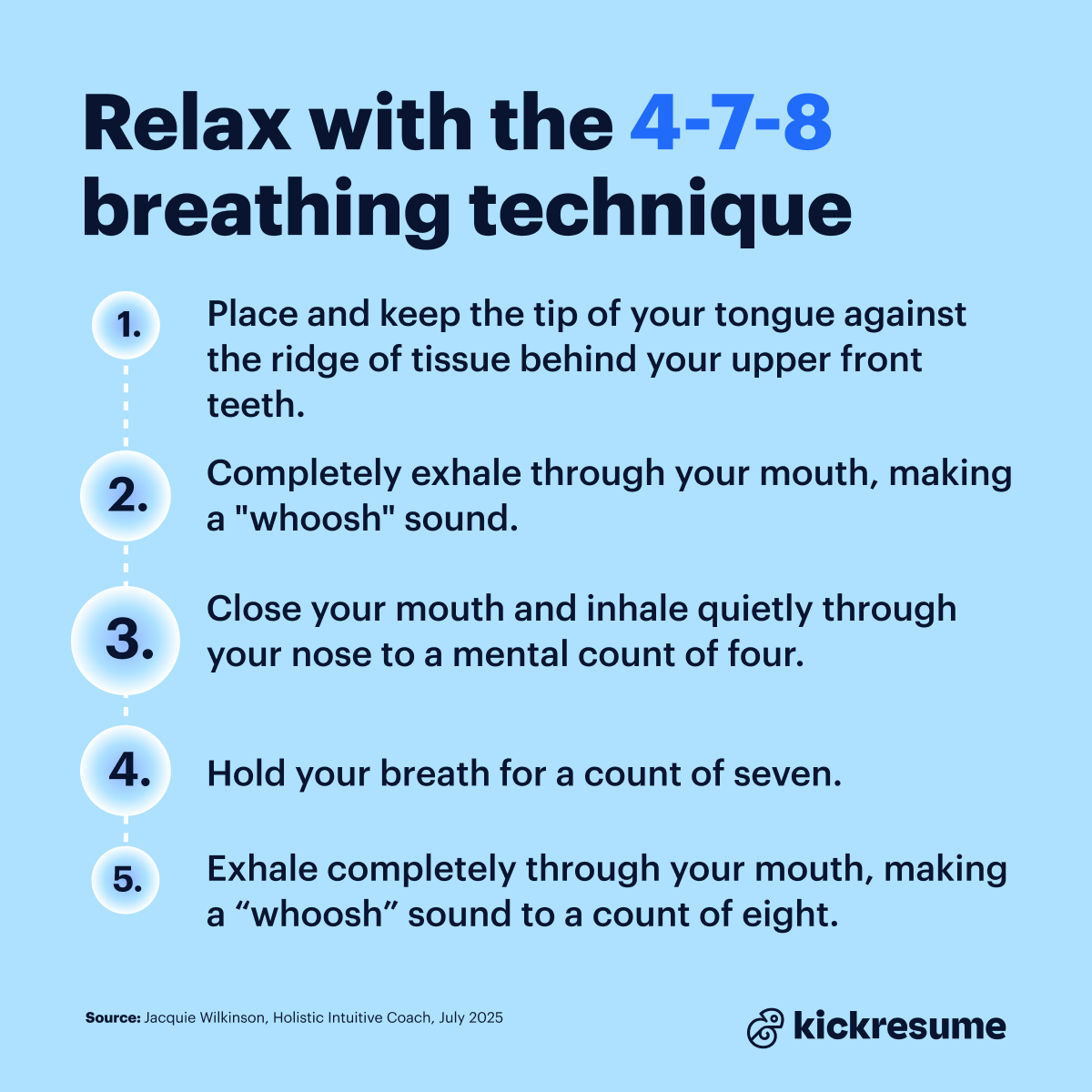
The coach’s second recommendation was deep breathing exercises, and in particular, she highlighted the 4-7-8 breathing technique. She said: “This breathing exercise is a natural tranquilizer for the nervous system.” Jacquie advised that you should sit up with your back straight when you try this.
Here are the steps for the 4-7-8 breathing exercise according to Jacquie:
- Place and keep the tip of your tongue against the ridge of tissue behind your upper front teeth for the duration of the exercise.
- Completely exhale through your mouth, making a "whoosh" sound.
- Close your mouth and inhale quietly through your nose to a mental count of four.
- Hold your breath for a count of seven.
- Exhale completely through your mouth, making a whoosh sound to a count of eight.
A thorough review of experiments into deep breathing found that, overall, it can lead to reduced anxiety and increased feelings of relaxation and positivity. We can’t think of a better frame of mind to walk into your interview with!
One more grounding exercise suggested by the coach was using an ‘Anchor Thought’. This means thinking of a short phrase that you think to yourself to change your mood, like “I am calm, I am open and I am present”. Repeating an anchor thought in your mind can help you regulate your emotions during a potentially stressful situation.
Try the mirror! Test your expressions at home
Jacquie Wilkinson told us that she advises her clients to spend time developing an awareness of their own facial expressions in front of a mirror. She shared that it’s important to observe your “resting” expression, as it might not be as neutral as you think.
Jacquie also recommended practicing talking in the mirror, paying attention to the expressions you make: do you furrow your brows or tighten your lips when speaking? Both of these natural expressions could make you look less open.
The coach also recommended practicing softening your eyes, as tense or darting eyes can make you seem stressed or even less friendly. She said, “Practice focusing your gaze gently on one point while softening the muscles around the eyes.”
Jacquie Wilkinson suggested a fun, simple exercise to try that might make you feel more comfortable checking your own facial expressions in the mirror, called the Lion/Mouse exercise. Open your eyes and mouth as big and wide as possible, then scrunch your face as small as possible, going back and forth between these two expressions. This exercise can also help you warm up your facial muscles quickly, so it’s also perfect to try before giving a presentation!
Calm expression practice, as well as learning to calm yourself down internally, can do wonders for you. This is especially true when you look at studies that prove your facial expressions might actually influence how you feel inside, not just the other way around! Smiling might be able to make you feel a bit happier.
Final thoughts
Looking anxious in a job interview is a very normal response to a stressful situation, so it might be worrying to hear that it can affect the hiring manager’s opinion of you as a candidate. But there are plenty of strategies that you can use to help yourself feel more relaxed, and present a more calm appearance.
As well as trying the Holistic Intuitive Coach’s exercises at home, it might also help to analyze other people’s facial expressions. Next time you’re watching a movie, see how the actors convey emotions, and try to copy them. It’s a fun way to learn to be more expressive.
If you’re worried about seeming nervous in your next interview or meeting, remember that being well-prepared should reduce that anxiety. Spend some time in the days before practicing the questions you think will come up, take 5 minutes before your appointment to breathe deep and relax, and you will give yourself the best chance of making a great impression.
Note
Kickresume’s team compared academic papers published in academic psychology and business studies journals to find out how our facial expressions influence our careers, as well as how people can reduce this impact by learning how to manage their emotions and control their expressions. Kickresume also spoke to Jacquie Wilkinson, a Holistic Intuitive Coach with 25 years life coaching experience, in July 2025. She provided the team with the tips she gives her clients to help them stay calm, and manage both their emotions and their expressions.
About Kickresume
Kickresume is an AI-based career tool that helps candidates land jobs and raise salary with powerful resume and cover letter tools, skills analytics, and automated job search assistance. It already helped more than 8 million job seekers worldwide.