ChatGPT
 Perplexity AI
 Claude
Is your personal trainer cover letter in urgent need of a refresh? Or maybe you're about to write a brand new one? Either way, you landed on the right page!
Our guide'll walk you through the entire cover letter writing process step-by-step. We'll show you practical cover letter examples, templates you can tailor, and essential writing tips (plus some extra ones). And we'll also break down specific personal trainer cover letter samples so you can see what actually works and what doesn't.


 See more examples like these
Keep reading to learn:
- How to analyze and learn from actual personal trainer cover letter samples
- What formatting traps you should watch out for
- How to write your PT cover letter header
- Why you should never underestimate a good headline
- How much effort do you need to put into the right greeting
- How to introduce yourself as a personal trainer
- Which personal trainer skills to lead with
- How to weave action verbs into your PT cover letter naturally
- What it takes to end your cover letter with style
- How to dodge mistakes that can sabotage your cover letter
- Why your personal trainer cover letter has to match your resume
- What salary you can expect as a personal trainer
- Where to look for resources for job-seeking personal trainers
Still looking for a job? These 100+ resources will tell you everything you need to get hired fast.
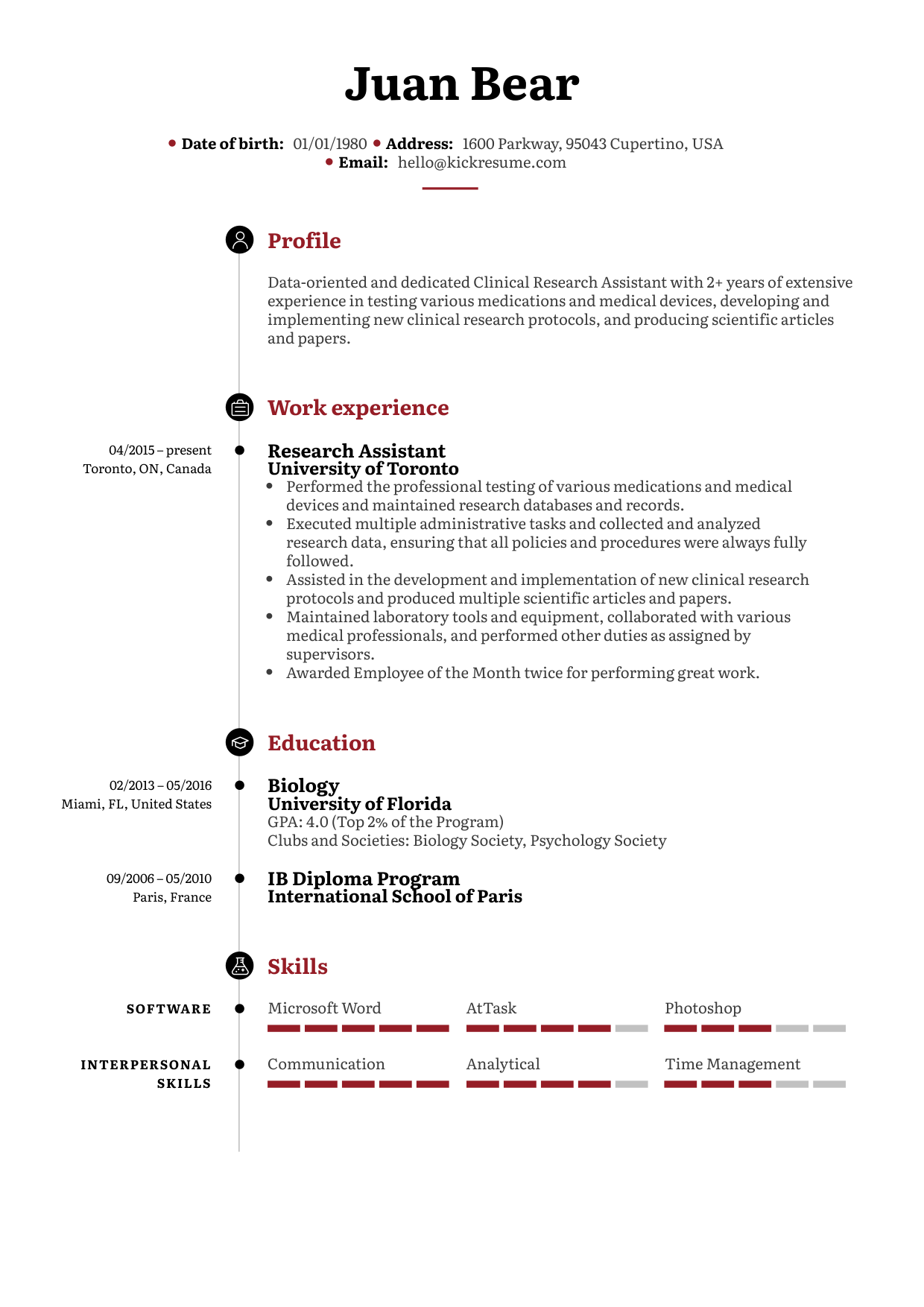
Personal trainer cover letter example


Why does this personal trainer cover letter example work?
- It’s very easy on the eyes: Short paragraphs, plenty of breathing room, and no giant blocks of text. That alone makes the cover letter easy to digest. When someone is reviewing dozens of applications, this kind of layout works really well. The reader can scan it in seconds and still understand the main points.
- It mentions relevant certification: For many, a career in personal training doesn't lead through formal education. So, drawing attention to the fact that you've obtained certification from a respectable institution is a big plus. And it's often the first thing a hiring manager checks for.
- The experience stays grounded in real gym work: Nothing here feels random or off-topic. Group classes, client progress, nutrition guidance, communication. That’s real, day-to-day personal training work.
What could be improved?
- Some lines sound good but don’t actually say much: For example, take a line like “a deep understanding of various training methods.” That sounds almost impressive…almost. But it needs to be more specific. Which methods? Strength training? Functional training? HIIT? Mobility? Rehab-focused programs?
- There are no results to anchor the experience: We hear what the applicant did, but not what came out of it. That’s where this letter misses a chance to stand out. Even one simple outcome would help. Client retention, progress milestones, positive feedback, class attendance.
Weight loss consultant cover letter example

Why does this cover letter example work?
- It uses a real, measurable achievement: The jump in client satisfaction from 85% to 92% is doing a lot of heavy lifting here. It’s specific, easy to understand, and clearly tied to the applicant’s work. This is exactly the kind of detail hiring managers like. Even without knowing every detail behind the number, the reader can see that the candidate made a difference.
- The qualifications match the role closely: A degree in Human Nutrition and Dietetics plus a personal trainer certification is a strong combo for a weight loss consultant role.This makes the application feel intentional. It’s clear this isn’t a random job application. The background actually fits the role being applied for.
What could be improved?
- The opening is very generic: The first paragraph doesn’t really earn its space. Saying “I believe my experience and qualifications make me a strong candidate” is safe, but it doesn’t pull the reader in. This would be a great place to lead with something more specific. For example, a quick mention of the candidate’s experience with client transformations or their results in the previous role. One specific hook would make the opening feel more alive.
- The language section feels underused: Mentioning multiple languages is interesting, especially for a client-facing role. But it’s dropped in without explaining why it matters. If language skills help the applicant connect with diverse clients or support international teams, that connection should be made clear.
Yoga instructor cover letter sample

Why does this cover letter example work?
- It shows range beyond teaching classes: This cover letter does a nice job showing that the applicant wasn’t “just teaching.” They were also involved in scheduling, record-keeping, promotions, workshops, and general operations. That kind of range is valuable in wellness centers where instructors often wear more than one hat.
What could be improved?
- The headline is too generic: “Application for the position of Yoga Instructor” doesn’t add any value. It just repeats what the reader already knows. This spot could be used much more effectively. A simple, descriptive headline like “Certified Yoga Instructor with 3+ Years of Studio and Group Class Experience” would instantly give the recruiter context and set expectations before they even start reading.
- The greeting isn’t personalized: Opening with “Dear Recruiter” is safe, but it’s also impersonal. It makes the cover letter feel more like a formality than a thoughtful application. Taking a few minutes to find a name, or at least addressing the studio or hiring team directly, would make the letter feel more human and intentional.
1. Format your personal trainer cover letter the right way
Cover letter formatting isn't just for show, even though a visually pleasing cover letter never hurts.
While you think about how your cover letter looks, you should format it in a way that makes it easy for hiring managers and recruiters to skim and digest.
If they can’t read it quickly, they won’t read it at all.
Here’s how to format your personal trainer cover letter the right way:
- Choose a simple, readable font: Skip decorative fonts. Stick to clean options like Calibri, Arial, or Times New Roman.
- Use a sensible font size: Go for 11 or 12 points. Anything smaller strains the eyes.
- Set one-inch margins: This gives your letter room to breathe and keeps it from feeling crowded.
- Space your paragraphs: Use single spacing within paragraphs and add a blank line between them.
- Left-align your text: Left alignment looks clean and professional. Don't center or fully justify it.
- Keep it to one page: Four to six short body paragraphs + opening and closing paragraphs are plenty.
- Avoid heavy formatting: Too much bolding or italics distracts from your message.
- Use white space on purpose: Empty space helps important points stand out and makes the page easier to read.
- Use bullet points (if appropriate): Consider using bullet points to highlight some of your best achievements or skills.
Formatting can be frustrating, especially if you start from scratch. That’s where a professionally designed cover letter template helps. It takes care of the layout so you can focus on what actually matters: telling your story clearly and confidently.
Let your cover letter write itself — with AI!

2. Make a focused and informative PT cover letter header
If you’re emailing your job application, it’s fair to wonder if a header even matters. After all, your contact details are already in the email.
True…but you should still write one.
Cover letters are formal documents. Certain elements are expected, and the header is one of them. It makes your letter easy to identify if it gets downloaded, printed, or shared.
A strong header is simple and complete:
Start with your contact information
Place this at the top of the page and double-check every detail:
- Full name
- Phone number with area code
- Professional email address
- LinkedIn profile, if it’s current and relevant
- Optional: add link to your own personal website
Then add the employer’s details
Right below your info, include:
- Hiring manager’s name, if available
- Their job title
- Company name
- Company address
Here’s an example of what not to do:
Bad example of a personal trainer cover letter header
Mike T.
mikethedude123@email.com
555-123
To Whom It May Concern
Peak Performance Gym
Why does this version raise red flags? The contact info is incomplete. The email looks unprofessional. The full name is missing. There’s no job title, no LinkedIn, and no company address.
Now compare that to a clean, polished version:
Good example of a personal trainer cover letter header
Michael Thompson, Certified Personal Trainer
(555) 123-4567
michael.thompson@email.com | linkedin.com/in/michaelthompsonpt
Sarah Lopez, Hiring Manager
Peak Performance Gym
456 Strength Ave
Austin, TX 78701
The header may feel like a formality, but it's a necessary one. It'll make your cover letter look more professional and it doesn't even take that long to write.

3. Write a PT cover letter headline that grabs attention
This is one of the most overlooked parts of a cover letter, and one of the most useful.
Most hiring managers skim before they read. And if nothing stands out fast, they move on.
Your headline is a single line placed right under the header that tells the reader who you are and what you can do in one clear sentence.
A strong PT cover letter headline should be:
- Specific: State your role, focus, or training. General titles don’t help.
- Relevant: Match it to the job you’re applying for, not your entire background.
- Confident: State what you do without sounding unsure or apologetic.
Here’s an example of what NOT to do:
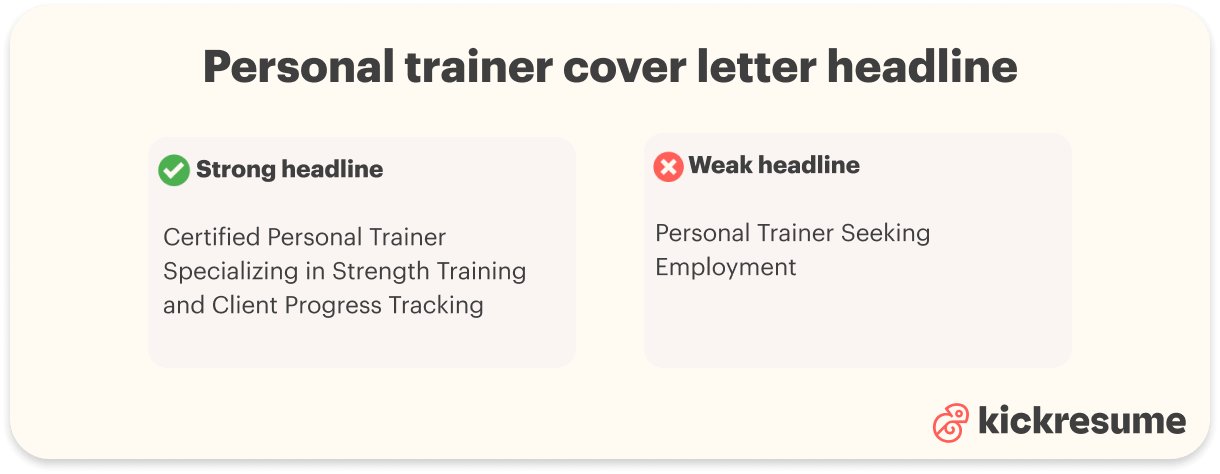
Bad example of a personal trainer cover letter headline
Personal Trainer Seeking Employment
Why not this one? This headline doesn’t add any value. They already know you’re a personal trainer. They also know you’re applying for a job. It gives no insight into your skills, experience, or focus.
Good example of a personal trainer cover letter headline
Certified Personal Trainer Specializing in Strength Training and Client Progress Tracking
What makes this one better? This headline works because it’s clear and useful. It tells the reader what kind of trainer you are and what you’re good at. Direct and effective.
Tips for students and new trainers
If you don’t have years of professional experience yet, just focus on your certification, practical training, or the type of clients you’ve worked with.
Entry-level personal trainer headline example
NASM-Certified Personal Trainer with Hands-On Experience in Small Group Training
A headline won’t get you hired on its own. But it can earn you a few extra seconds of attention, and that’s often all you need to keep someone reading.
4. Dedicate time to personalize the greeting
Once your headline pulls the reader in, the greeting is your next chance to show intent.
This is where many cover letters slip into autopilot and settle for generic greetings like To Whom It May Concern. A phrase that can be copy-pasted to any and all cover letters regardless of the addressee.
But calling someone by their name tells the hiring manager you chose this role and this gym or facility specifically.
How to find the right name
- The job listing: Some postings include a contact person near the bottom.
- The company website: Look for a team, staff, or leadership page.
- LinkedIn: Search the company and scan employee titles. Someone in management or hiring is a good choice.
- A quick call or email: A short, polite message asking who handles applications is completely fine.
Once you have a name, keep the greeting simple and professional.
Examples of personalized greetings for a PT cover letter
- Dear Ms. Lopez,
- Dear Sarah Lopez,
- Dear Hiring Manager Sarah Lopez,
But what if you can’t find a name?
It happens. Some companies keep things pretty tight-lipped, and even your best sleuthing comes up short. That’s okay, even without a name you can still write a greeting that feels thoughtful and not like it was copied and pasted.
Here are some good fallback options:
General but still personal-sounding greetings
- Dear Hiring Manager,
- Dear Peak Performance Gym Team,
- Dear Recruitment Team at Peak Performance Gym,
These still sound intentional. And they’re far better than outdated, impersonal openings.
Getting the greeting right doesn’t take much, but it does help your cover letter land better. It shows you're writing to someone, not just ticking a box.
Find out your resume score!

5. Pack your introduction with information that matters
How to start a cover letter and not let things get boring?
Skip the throat-clearing “I’m writing to apply” line and go straight to the point. Hiring managers already know why you’re writing. What they want is context, fast.
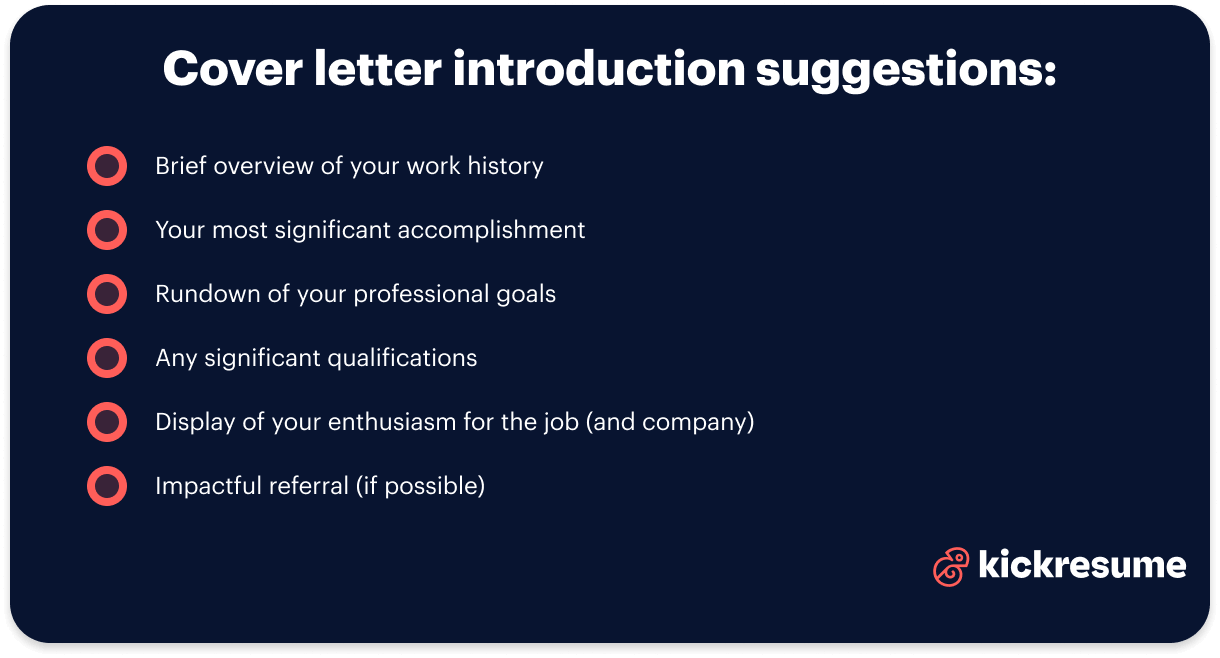
A strong PT cover letter introduction answers at least one of these questions right away:
- What kind of trainer are you?
- What results have you delivered?
- Why this gym, studio, or facility?
- What makes your background relevant here?
If your intro doesn’t answer any of those, it’s simply not good enough.
Here’s what weak looks like.
Bad example of a personal trainer cover letter introduction
I’m writing to apply for the personal trainer position at your gym. I have experience working with clients and would love the opportunity to join your team.
Why doesn't this work? This introduction is safe, but empty. There’s no detail, no direction, and no reason to remember it.
Good example of a personal trainer cover letter introduction (referral)
Alex Morgan encouraged me to apply for the Personal Trainer opening at IronCore Fitness. We worked together for two years, where she saw my focus on structured strength programs and long-term client progress. I’d be excited to bring that same training approach to your members.
What makes this introduction effective? The referral is clearly the biggest strength of this example. Having someone who is already “in” and can vouch for you builds trust and credentials immediately.
Good example of a PT cover letter introduction (accomplishments)
Over the past six years, I’ve coached more than 150 clients through strength and mobility programs, helping increase average session adherence by 35% at my current gym. I’m now looking to bring that same results-focused approach to Elevate Training Studio.
What stands out here? This example leads with outcomes. It’s specific and grounded in real results.
Good example of a PT cover letter introduction (shared values)
Your gym’s emphasis on small-group training and sustainable habits stood out to me right away. As a personal trainer who works primarily with busy professionals, I focus on programs that fit real schedules and support long-term consistency. That alignment is what drew me to apply.
Why does this one work? This one shows research and shared priorities without forcing enthusiasm.
Good example of a personal trainer cover letter introduction
I’m a certified personal trainer with 4+ years of experience working in commercial gym settings, primarily with general fitness and weight loss clients. At my current role, I manage a full training schedule while maintaining high client retention. I’m interested in bringing that steady, client-focused approach to your team.
Why is this one still effective? This example isn't “special” or flashy and yet it still hits all the marks. It’s clear, specific, and easy to trust.
Tips for new and early-career personal trainers
If you’re newer, changing careers, or a student with no experience, focus on what you’ve already done, not what you lack.
- Certifications and hands-on training matter
- Internships, shadowing, and gym floor experience count
- Mention the client types or programs you trained in
- Show motivation without overexplaining
Entry-level personal trainer introduction example
I recently earned my NASM Personal Trainer certification and completed supervised training in both one-on-one and small group settings. During my internship, I assisted with assessments, program adjustments, and client onboarding. I’m excited to continue developing my skills in a gym that values proper coaching and long-term progress.
Whether you’re experienced or just getting started, your introduction should sound like you. Clear, specific, and intentional is what gets someone to keep reading.
6. Zoom in on the most relevant skills and accomplishments
A strong cover letter doesn’t try to cover your entire career. It zooms in on the skills and results that matter to this job, at this gym, right now.
That means reading the job posting closely and responding to it on purpose by tailoring the content of your personal trainer cover letter.
How to decide which skills deserve space
All the clues are right there in the job ad:
- Scan for repeated keywords: If certain skills or responsibilities show up more than once, they’re a priority.
- Note what appears first: Skills mentioned early are usually the most important to the employer.
- Match skills to real results: Only choose skills you can back up with examples, outcomes, or experience.
If the posting emphasizes client retention, assessments, or small-group training, those should be front and center in your letter. Everything else can wait.
The 10 most in-demand personal trainer skills
- Client assessments and goal setting
- Strength and conditioning program design
- Weight loss and general fitness coaching
- Small-group or class-based training
- Injury prevention and movement safety
- Client motivation and accountability
- Progress tracking and reassessments
- Fitness software and scheduling systems
- Member onboarding and consultations
- Clear communication and education
Technical skills matter, but so do people skills (also known as soft skills). How you explain, motivate, and adapt often matters just as much as what program you write.
How to structure the body of your cover letter
Keep this section easy to scan and easy to follow:
- Write 2 to 4 short paragraphs
- Focus each paragraph on one skill or result
- Add context so the reader understands your role
- Use numbers or outcomes when possible
- Tie every example back to this job
Context + Numbers = Impact
Showing skills and accomplishments in a personal trainer cover letter
- Client retention and progress tracking: “At CoreFit Gym, I managed a full client roster while maintaining an 85 percent retention rate over two years. Consistent reassessments and program adjustments helped clients stay engaged and committed.”
- Program design and coaching: “I design strength programs focused on proper form and steady progression. This approach reduced minor injuries and helped clients train consistently without burnout.”
- Communication and motivation: “I explain training plans in plain language so clients understand the purpose behind each exercise. That clarity improved follow-through and session consistency.”
- Onboarding and consultations: “I regularly assist with new member assessments and introductory sessions, helping convert first-time clients into ongoing training relationships.”
What else you can expand on in body paragraphs
Your skills don’t have to come only from job experience. You can also highlight:
- Relevant education or degrees
- Personal trainer certifications or specializations
- Training methods you rely on and why
- Continuing education courses or workshops
- Coaching philosophy or client approach
- Tools or systems you use
Just make sure everything connects back to the role you’re applying for.
Tips for interns and new personal trainers
Just like with the cover letter introduction, focus on all the things you do have. Of course, only if they're relevant to the role at hand.
- Mention internships, shadowing, or supervised hours
- Highlight the client types or training settings you worked in
- Share responsibilities you were trusted with
- Reference feedback from mentors or supervisors
Example for an intern or entry-level personal trainer
During my internship at Active Strength Studio, I assisted with assessments, led warm-ups, and supported small-group sessions. I also helped track client progress and adjust programs under supervision. That experience taught me how intentional coaching impacts client consistency.
Your experience, whether it's 10 years deep or just getting started, is the heart of your cover letter. The more clearly you can show what you’ve done and how it connects to this role, the easier it is for the hiring manager to see you as the best fit.
7. Boost your personal trainer cover letter with action verbs
Have you ever noticed how certain words can completely change the meaning and weight of a sentence? In your cover letter, one of the easiest ways to do that is with action verbs.
These verbs can turn the hesitant and vague turn “I did this” and “I was responsible for” into “I accomplished this” or “I made a difference here.”
Even swapping a few verbs can make your sentences feel sharper, more confident, and more memorable. And in a stack of applications, that little difference can be huge.
Look at the difference:
- Before: I was responsible for designing workout programs.
- After: I designed structured workout programs tailored to individual client goals.
Same experience. Very different impact.
When you write about your work, aim for verbs that show initiative and direction.
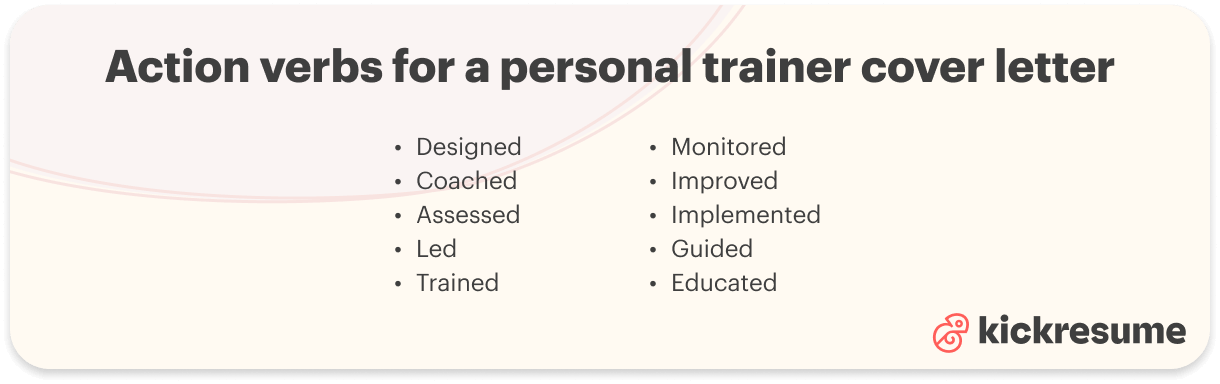
Action verbs that work well in personal trainer cover letters
- Designed
- Coached
- Assessed
- Led
- Trained
- Monitored
- Improved
- Implemented
- Guided
- Educated
Here are a few more quick upgrades.
- Before: I helped clients stay motivated.
After: I motivated clients through goal setting, progress tracking, and regular check-ins. - Before: I worked with new members.
After: I onboarded new members through assessments and introductory training sessions. - Before: I was involved in injury prevention.
After: I coached clients on safe movement patterns and injury prevention strategies.
You don’t need to force these into every sentence. Overdoing it can sound stiff. Just replace vague, passive phrases where they appear.
8. Give your PT cover letter conclusion proper flair
How you end a cover letter matters just as much as its opening. You can either leave a strong impression or fade into “meh.”
Putting together a professional closing paragraph isn't rocket science. You just needs a few basic ingredients:
- Remind them why you’re a fit: A quick nod to your skills or experience.
- Show genuine excitement: Make it clear you actually want this role.
- Make contacting you easy: Mention your phone, email, or both.
- Close professionally: Stay polite, confident, and clear.
Here’s an example of what NOT to do:
Bad personal trainer cover letter closing example
I hope you consider my application. Please let me know if you need any more information.
Thank you.
Best regards,
Sam
Why does this feel wrong? The problem is that while it’s polite, this example doesn’t leave a mark. No personality, no confidence, no reminder of what Sam brings to the table.
Now here’s a version that lands:
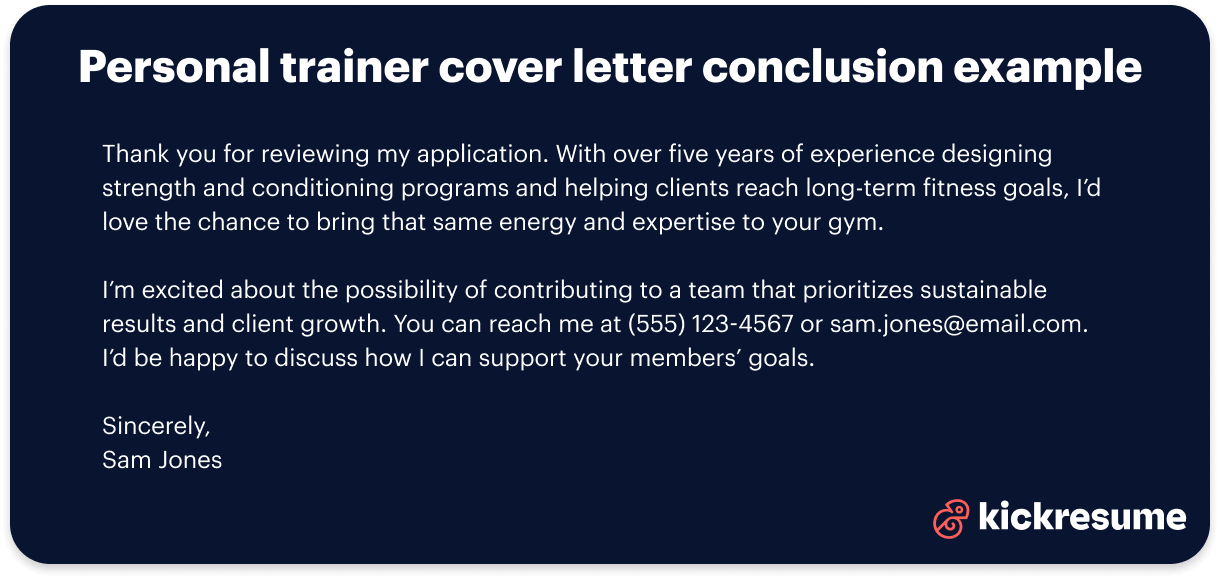
Good personal trainer cover letter closing example
Thank you for reviewing my application. With over five years of experience designing strength and conditioning programs and helping clients reach long-term fitness goals, I’d love the chance to bring that same energy and expertise to your gym.
I’m excited about the possibility of contributing to a team that prioritizes sustainable results and client growth. You can reach me at (555) 123-4567 or sam.jones@email.com. I’d be happy to discuss how I can support your members’ goals.
Sincerely,
Sam Jones
Pro tips for wrapping up
- Avoid vague phrases like “Thank you for your time” without context.
- Keep it short – 3–5 sentences is plenty.
- End on a confident, friendly note – leave the door open for conversation.
- Include clear contact info even if it’s already in your header.
Your conclusion doesn’t need flair in the sense of being flashy. The real flair comes from clarity, confidence, and leaving the reader with a reason to call you.
9. Keep your personal trainer cover letter free from these mistakes
Even if you’ve got the skills, certifications, and passion, a few small slip-ups can make a hiring manager hesitate.
Here are the most common pitfalls in personal trainer cover letters (and how to dodge them):
Mistake #1 One-size-fits-all approach: If you could send the same letter to any gym or studio, it’s too generic.
Mistake #2 Saying too much or too little: Rambling paragraphs or skimpy cover letters both hurt your chances.
Mistake #3 Talking only about yourself: Your experience is important, but the cover letter can't be centered on what you want alone.
Mistake #4 Copying your resume line by line: Your resume already lists all your relevant professional experience. Take advantage of the more narrative cover letter format and add more context.
Mistake #5 Ignoring instructions: Sometimes gyms ask for specific details—a subject line, a reference to a job ID, or certifications. Skipping these makes it look like you didn’t pay attention.
Mistake #6 Typos and sloppy phrasing: Even small mistakes can make a strong candidate look careless.
Mistake #7 Messy formatting: A cover letter that's hard to read loses its audience before anybody even starts paying it attention.
Mistake #8 Being vague about results: Saying you “helped clients improve fitness” is too vague and doesn't show any tangible impact.
All of these steps may seem like “extra” effort, but they always pay off! You've come a long way in this waiting process, so don't let your personal trainer cover letter get sabotaged by mistakes you overlooked because you were too fed up to read what you've written.
10. Pair your personal trainer cover letter with matching resume
Have you thought about how a complete job application actually covers a lot of ground? Your cover letter and personal trainer resume work in tandem, each doing a different job but together conveying the perfect idea of who you are as a trainer.
- Resume = facts (certifications, job titles, experience, and timelines)
- Cover letter = story (why you do what you do, how you approach your work, and what makes you unique)
- Together = complete application (one shows capability, the other shows character and fit)
How to make your documents feel like a cohesive set
- Consistent contact info: Make sure your name, phone number, email, and LinkedIn appear the same on both documents.
- Same font and style: If your resume uses Arial 11pt, keep your cover letter consistent.
- Echo formatting subtly: Mirror elements like bold headings or spacing so the documents look intentional together.
- Match margins and spacing: Even small alignment differences can make your materials look sloppy.
- Use color carefully: If your resume has a small accent color for your name or headers, carry it into the cover letter.
If layout and design aren’t your thing, templates can help. As it happens, we've got tons of professionally designed resume and cover letter templates that can help you out. Some even come as a bundle, so your documents match right out of the box.
Try our AI Resume Writer and have your resume ready in minutes!

11. Average salary and job outlook for personal trainers
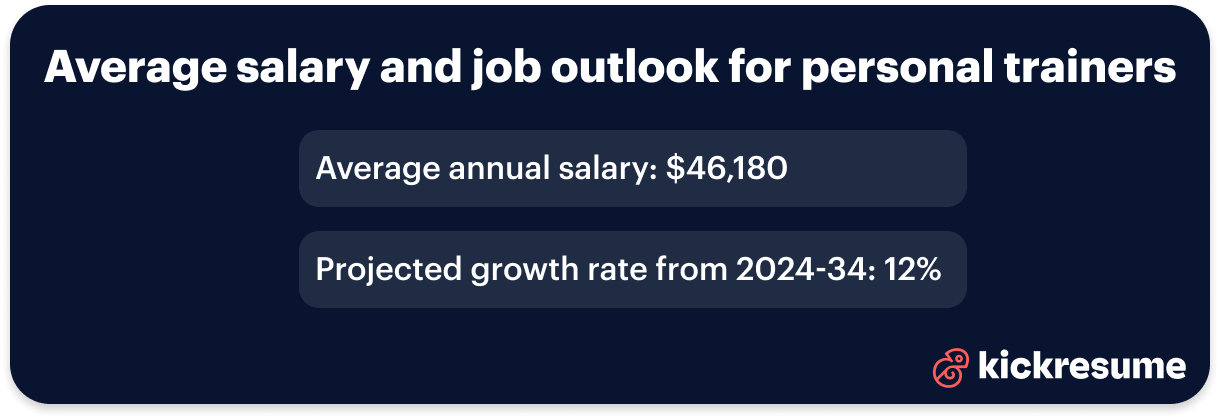
The U.S. Bureau of Labor Statistics reports that the median annual wage for fitness trainers and instructors was $46,180 in May 2024. That median means half earned more and half earned less, and it includes everything from brand-new trainers to seasoned pros.
To give you context on the range:
- The lowest 10% earned under about $27,580.
- The highest 10% earned over roughly $82,050.
So right off the bat, you can see there’s variability in this profession. You might start around the median, but with experience, niche expertise, or strong client demand, you can move well above it.
*Keep in mind this figure reflects pay before tips, bonuses, or side gigs like coaching online clients, writing programs, or selling digital content (things many trainers add to boost earnings).
What affects your salary?
Several real-world factors determine how much you can make:
- Location
- Experience level
- Certifications and specialties
- Client base and reputation
- Additional services (nutrition coaching, small-group training, online programs, and workshops can add meaningful income on top of one-on-one training)
All of these shape your real earning power, often more than the median wage number itself.
Job outlook
Here’s the good news: demand for personal trainers is growing faster than average. The BLS projects a 12% increase in employment from 2024 to 2034, much faster than the growth expected for all jobs.
This reflects a broader societal emphasis on healthy living, preventive care, and fitness culture. Gyms, studios, corporate wellness programs, and even senior fitness initiatives all contribute to this growth.
Is this a viable career with security?
There’s room in this field and a positive employment trend, but it’s not a one-size-fits-all comfort job:
- Job security is moderate: Growth is strong, but many trainers work part-time, freelance, or in variable schedules (nights, weekends).
- AI isn’t a threat in the traditional sense: People hire trainers for human connection, accountability, and hands-on coaching. Machines can’t replace that empathy and live guidance.
- It rewards versatility: Trainers who can teach, coach, hold workshops, run online programs, or work in niche markets tend to be more resilient if trends shift.
If you love coaching, enjoy people, and are willing to keep learning (new methods, business skills, online tools), this field can absolutely be a viable long-term career. But if you’re looking for predictability and a 9–5 rhythm with the same straight paycheck every week, you might need to weigh your priorities carefully.
12. Resources for job-seeking personal trainers
Job searching doesn’t have to be a solo effort. There are plenty of reliable resources out there that can help you find openings, sharpen your skills, and stay competitive in a crowded field. Here are some worth bookmarking:
- Industry-specific job boards: Sites like ExerciseJobs and FitnessJobs focus specifically on fitness and wellness roles, which means fewer irrelevant listings and better-targeted opportunities.
- General job search websites: That doesn't mean that you should ignore traditional websites. Platforms such as Indeed, Glassdoor, and ZipRecruiter still matter. Use filters and keywords like “personal trainer,” “strength coach,” or “fitness instructor” to narrow results.
- Professional associations: Organizations like the National Academy of Sports Medicine (NASM) and the American Council on Exercise (ACE) often post job boards, host networking events, and provide career guidance for certified trainers.
- Certifying bodies and education providers: Staying connected with groups such as NSCA or ISSA can open doors to job listings, continuing education, and employer partnerships.
- Continuing education and specialization programs: Advanced courses and specialty certifications help you stand out. Look into areas like corrective exercise, nutrition coaching, or sports performance through trusted providers like Coursera or edX.
- Gym and franchise career pages: Large chains often hire directly and post openings before they hit job boards. Think Equinox, Orangetheory, F45, or Barry’s. Checking these regularly can give you a head start.
- Local gyms, studios, and wellness centers: Many fitness employers still hire through referrals or in-house postings. Check company websites regularly and consider stopping by in person with a resume.
- Social media as a job-search tool: Following gyms on Instagram or TikTok can alert you to hiring posts that never make it to formal job boards.
The more you treat job searching like training itself, consistent effort, smart tools, and continuous improvement, the better your results will be. These resources won’t replace a strong cover letter and resume, but they can absolutely help get them in front of the right people.
Personal Trainer Cover Letter FAQ
How do I write a strong personal trainer cover letter with no experience?
Focus on what you do have. Certifications, internships, gym floor hours, coursework, or volunteer coaching all count. Use your cover letter to show how you work with people, how you learn fast, and why you’re serious about this career. Hiring managers don’t expect perfection, they expect potential and effort.
How long should a personal trainer cover letter be?
Every cover letter, regardless of the level of your experience, should be strictly one page long! Ideally 3 to 5 short body paragraphs. If it feels long, it probably is. Hiring managers want clarity, not your full life story.
Do I need certifications to write a personal trainer cover letter?
Most of the time, yes. Certifications like NASM, ACE, ACSM, or ISSA are often required or strongly preferred. If you’re still working toward one, be upfront about it and include your expected completion date.
Should I customize my personal trainer cover letter for every job?
Yes. Always. Even small tweaks matter. Mention the gym or studio by name, reference their training style or client base, and adjust your skills to match the job description. Generic cover letters are easy to spot and easy to skip.
What should I include in a personal trainer cover letter?
Stick to the essentials. A short intro, your most relevant experience or training, a few key skills, and a confident closing. Mention certifications, client-facing experience, and the type of training you specialize in. Keep everything relevant, focused, and easy to scan.