ChatGPT
 Perplexity AI
 Claude
Today, we're taking a closer look at job applications. More specifically, we're digging into an important part that people often forget: how to list professional references on your resume.
Think of it like this. You're interviewing for a job. You've presented your skills, experience, and enthusiasm to the employer.
But, there's a little doubt lingering in their minds—are you as good as you claim to be on your resume?
This is where professional references play their part. Basically, they act as a validation for your job application claims, give employers much-needed reassurance, and confirm you're not just good on paper.
In this article, we're going to answer these pressing questions:
- What are professional references and what they do on a resume?
- Why do these references matter so much to employers?
- When should you list references on a resume?
- Who to ask for a reference?
- …if you’re a student or fresh graduate?
- …if you’re a seasoned professional?
- How to ask for a reference?
- How to list references on a resume?
- Should you put them directly on your resume?
- Can LinkedIn’s recommendations make your life easier?
What are professional references?
Professional references, often listed in a dedicated references section on your resume, are people who can vouch for you and provide your future employer with more information about your abilities.
References help your future employer find out how you performed in your previous jobs or throughout your academic career. They can get an idea about your professional attitude and competency before hiring you.
These can include your teachers, advisors, coaches, colleagues, employers or your direct supervisors.
The key here is that they've worked closely with you, and they can confidently recommend you to a potential employer. They should be able to talk about your skills, qualifications and back up what’s on your resume, and vouch for your character.
Employers usually only contact your references once they get to the last stage of the hiring process. Or sometimes, in case you’re a freelancer, they may ask you to provide references in advance.
Why do these references matter so much to employers?
It's all about trust and validation. Employers want to be confident that they're making the right hiring decision. And you never know when someone may be lying on their resume.
A resume can tell them about your achievements, but a reference can provide insight into your work ethic, problem-solving ability, and overall team fit.
A strong professional reference is the "green light" employers need to move forward with a hire. They bridge the gap between a fantastic resume and solid employment.
After all, nothing beats a positive word from those who've already experienced your skills and work style firsthand.
When should you list references on a resume?
Including references in your resume used to be more common in the past. Sure, it’s good to prepare a list of references in advance, but including it in your resume isn’t always the best course of action.
But in some specific situations, it’s still okay to put them on your resume or together with your application. It’s not customary but certainly acceptable if:
- The job listing asks for references from the get-go, you should include them without much hesitation.
- Your reference is someone well-known in the company or industry. Sometimes you don’t want to wait until the last round of interviews to play your strongest card.
- You’re a fresh graduate. Probably you still don’t have enough experience to fill an entire resume. Moreover, as a student, you have no authority yet. Let others do the bragging for you.
- You’re a freelancer. For companies it’s sometimes hard to find a dependable freelancer. Of course, your portfolio is still the most important of your application, but you should always be ready to provide a list of references from your past clients.
- There’s an employment gap on your resume. Including references on your resume is an effective way to balance out your work gap.
Expert tip: Always ensure your references are kept in the loop. If you're considering adding their details to your resume, inform them beforehand and make sure they are okay with it. This allows them to prepare for possible calls from potential employers, ensuring that when they do receive a call, they can provide a well-informed, positive reference.
But If none of the above applies to you, don’t do it. It’s neither customary nor expected. There are several reasons for that:
- Waste of space. Your one page can be used much more effectively.
- Problematic verification. Recruiters don’t have enough time to verify references on every resume they receive. They’ll only check references of the final 2–3 candidates.
- Privacy. Your references have agreed to let you give their contact information to a potential employer. Don’t betray their trust by sending their references to just about anyone.
Find out your resume score!

Who to ask for a reference?
Short answer, anyone respectable who can vouch for your ability and character. As a rule of thumb, try to obtain 3–4 professional references and 1–2 personal references.
Personal references can vouch for your character. It can be any esteemed person from your personal life: past teachers, non-profit leaders, instructors, etc. Just make sure you don’t include anyone from your family.
Professional references attest your professional ability. Ask your past superiors and partners to put in a good word for you. It goes without saying that you should never ask for a reference someone less experienced than you.
Choosing the right professional reference comes down to finding someone who can do two things:
- Attest to your skills
- Make a positive impression
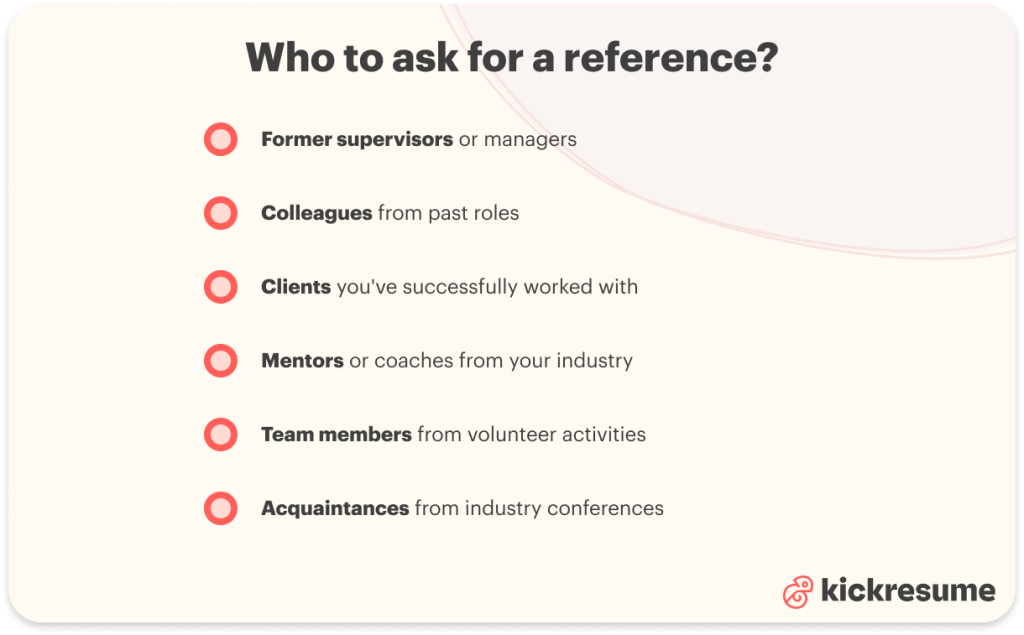
They're typically individuals you've worked with closely. This could be:
- Former supervisors or managers;
- Colleagues from past roles;
- Clients you've successfully worked with;
- Mentors or coaches from your industry;
- Team members from volunteer or extracurricular activities;
- Teachers, especially if you're a recent graduate;
- Professional acquaintances from industry conferences.
Who NOT to ask for a reference?
Examples of bad references:
- Distant acquaintance or a person who barely knows your work
- A friend or family member (unless you have no alternative and they are in a professional capacity)
- Someone in conflict with you or someone whose feedback might appear biased
- Someone who hasn’t agreed to be your reference
Think about the people you worked for and worked with. Which of them could speak well of your qualifications, accomplishments and character?
Who to ask for references if you’re a student or a fresh graduate?
- Teachers and professors.They can testify to your class participation, performance in your school projects or how well you can work in a team.
- Coaches and leaders. They can endorse you for your leadership skills or the ability to work with others.
- Contacts from your volunteer work. They can endorse you for your willingness to help the community, motivation and skills. Plus, volunteering is almost always impressive.
- Employer from your part-time job or internship. Even if you stayed in your job only a few months, your previous employer can speak best about your work ethic.
Who to ask for references if you’re a seasoned professional?
- Past employers. They can vouch for your work skills, overall performance and describe how you interact with colleagues and supervisors.
- Direct supervisors. They know you the best and can vouch for you when it comes to your transferable skills and work ethic.
- Professional mentors. They have a solid understanding of your personality and receptiveness to training and feedback.
Also, think about the relevancy of your reference. How recent is it? Does it come close to the nature of the job you’re applying for today?
Rrecent references should naturally be your first choice. Using someone you worked with years ago as a reference may look like you’re trying to hide something.
But if an older reference is more relevant to the job you’re applying for now, don’t hesitate to put it on your resume regardless of age.
How to ask for references?
You’ve got your wish list. What to do now?
Call each of these people — or meet them in person if possible — to ask for a permission to be your reference. Using email should be your last resort. It’s far less personal than having a real conversation.
Of course, sometimes you don’t have a choice. If sending your prospective reference an email is the only option, be sure to briefly remind them of who you are. Describe the projects you worked on together and explain where you’re heading with your career.
Also, send them a copy of your resume as an attachment. This will help them recall the times when you were working with them and remind them of your achievements and personality.
Give your potential references enough details about the jobs you’re applying for. Be specific in what skills and qualities you’d like to emphasize. Furthermore, you can even send them the job description. This will help them talk to the employer and endorse your key qualifications.
When it comes to formulating your request, try to be a bit diplomatic. Allow people to refuse gracefully. Here are a few ideas on how to frame your question:
- “Would you feel comfortable being my reference in my upcoming job search?”
- “Would you find some time in the next few weeks to meet and talk about being my reference during my job hunt?”
If you get a positive reply, you’re almost finished. Take a moment to get your reference’s current titles and contact information right. Also, ask how they’d prefer to be contacted by the recruiter — usually either by phone or email.
Last but not least, don’t forget to express your gratitude at the end of your email. Also, thank your references for taking the time to consider your request and review your application.
How to ask for references - template
Subject: Larry Brown – Reference Request
Dear Mr. Clark,
I am in the process of seeking a new job as a software architect and was hoping you could provide a reference for me.
Having worked for you for 5+ years between 2011 and 2017, I am positive that you can inform prospective employers about my qualifications and experience.
Your endorsement of the job-relevant skills that I attained during my tenure at Company XYZ will be instrumental in boosting my chances to land the job.
I’m attaching an updated copy of my resume and cover letter. Please let me know if there is any additional information you would need to serve as a reference on my behalf.
Thank you very much for taking the time to review my request.
Best regards,
Larry Brown
444-777-5228
larry_brown@email.com
Should you include references on your resume?
Here's the thing — not every job application requires it. Plus, space on your resume is precious.
You're better off using it to showcase your skills and achievements.
So, in most cases, keep the references off your resume.
However, there are certain situations when it's okay to include references on your resume:
- If the job listing requests them
- If your reference is well-known in the industry or company
- If you're a recent graduate and your resume is sparse
- As a freelancer, where your client references can provide assurance
- If you have an employment gap on your resume, references can offset this
If you find yourself in one of these scenarios, do prepare a separate professional references resume section.
How to list references on a resume?
The easiest way to list professional references is to create a separate "Professional references" resume section, which you can place at the end of your resume, or alternatively, provide them in a separate document attached to your job application.
But what if the employer hasn't asked for your references up front, but you think they might be interested? This is where "References available upon request" comes in.
It's a line you can include at the end of your resume to indicate that you have references ready if needed.
Either way, you should first determine how many references you want to include. This depends on your career level.
You never know. The hiring manager may only contact one or two, or all references on your list. Just make sure they have plenty of options to choose from if one of them is unavailable.
Example of professional references on resume
If you decide to provide full details, consider listing your references in chronological order, starting with the person you worked with most recently.
Here’s what specific information you should include:
- Reference name
- Reference position
- Reference company
- Reference address
- Reference phone number or email address
- Reference description including where you worked together, when you worked together and your working relationship. (optional)
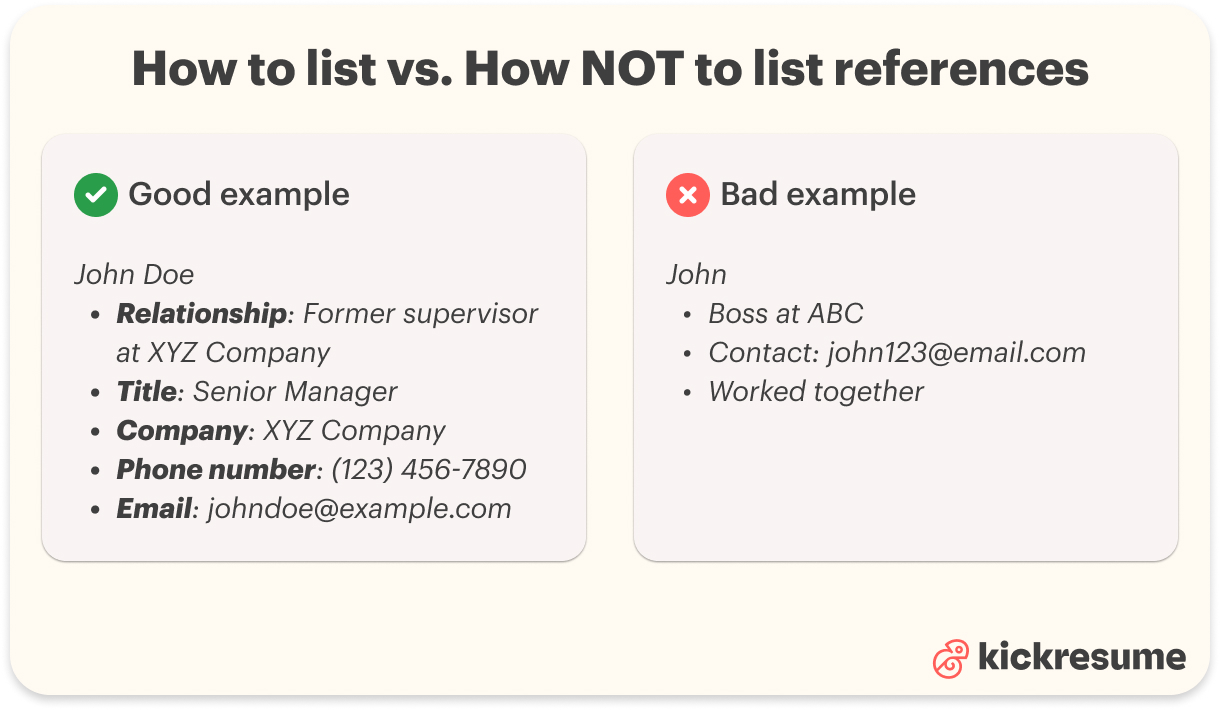
So, in the end, it can look something like this:
PROFESSIONAL REFERENCES
John Doe
- Relationship: Former supervisor at XYZ Company
- Title: Senior Manager
- Company: XYZ Company
- Phone number: (123) 456-7890
- Email: johndoe@example.com
Jane Smith
- Relationship: Former colleague at ABC Corporation
- Title: Project Lead
- Company: ABC Corporation
- Phone number: (234) 567-8901
- Email: janesmith@example.com
Sam Brown
- Relationship: Client from freelance contract
- Title: Owner
- Company: Brown Construction
- Phone number: (345) 678-9012
- Email: sambrown@example.com
If you don’t want to give their contact information right away, you can simply write the phrase "References available upon request" . Then prepare a separate references list that you can provide when requested.
It could look something like this:
PROFESSIONAL REFERENCES
- References available upon request
A well-laid professional references page like this one serves as the perfect finishing touch to your application - a snapshot of people ready to vouch for your professional worth.
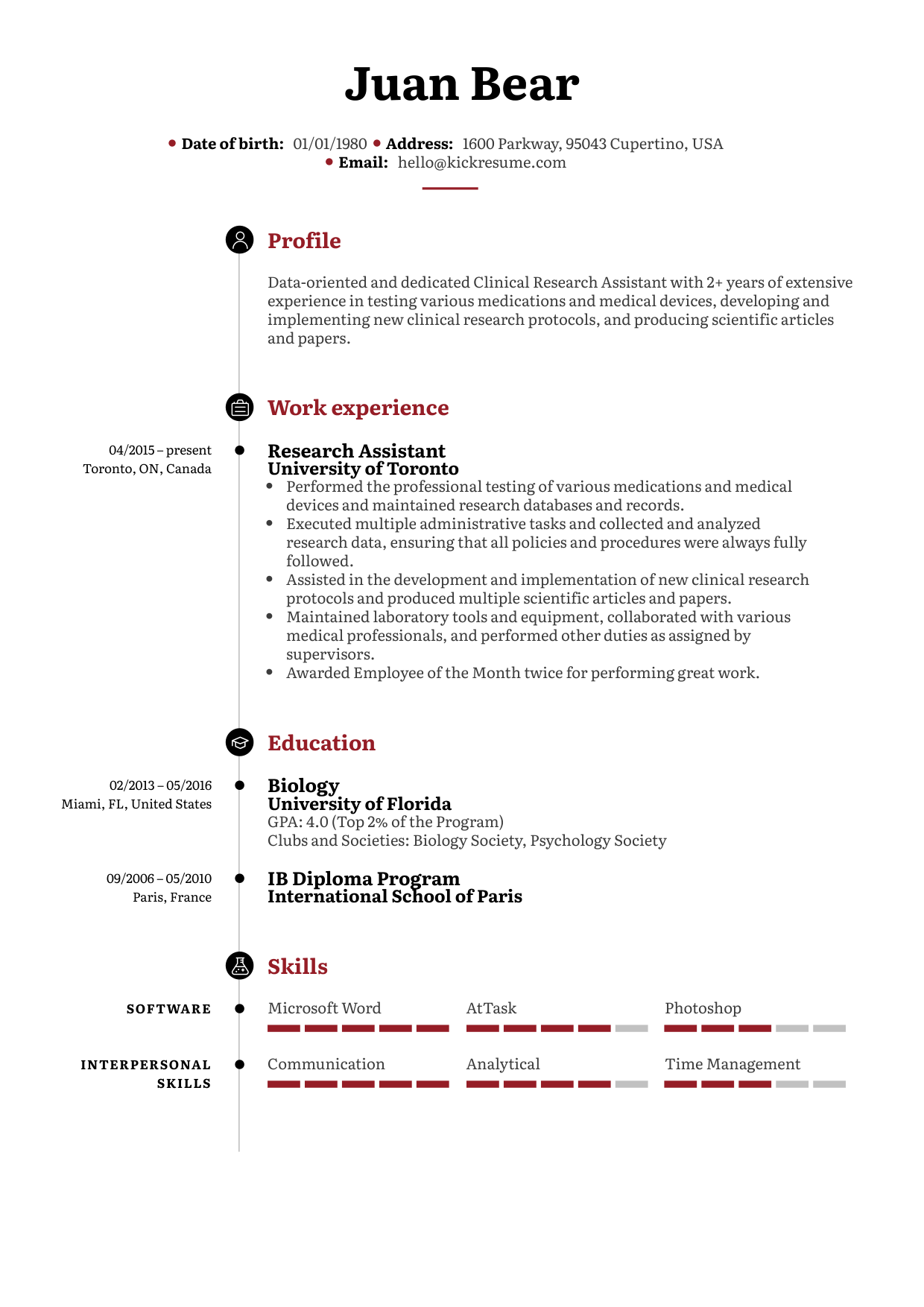
To make it more tangible, we also provide a visual glimpse into how a "References" section can look like in a real-world resume:

You can do this in a super easy way with Kickresume's resume builder, ensuring your references section is not only organized but looks professionally appealing as well. All that in seconds.
Can LinkedIn make your life easier via recommendations?
A recommendation is a statement that can be written by your former employer, colleague, or business partner and is displayed on your LinkedIn profile. You either have to request it or accept it from someone.
You should always include a link to your LinkedIn profile in your resume. Employers are going to look you up and if they see professional recommendations in your LinkedIn profile, it’s a big plus for you.
They are an online equivalent to resume references. The only difference is that they are online and thus visible to everyone (if you choose so).
And you can ask for them anytime and don’t need to think about whether you should include them in your resume or not. In short, they can make your life a bit easier.
Although, it may not be the same as calling a former employer and asking for opinion, a LinkedIn recommendation is often sufficient. Because of that, LinkedIn recommendations should be given just as much credit as traditional references.
Not only do they add a lot of credibility to your LinkedIn profile, they also help you rank higher in searches.
You should try to get at least one recommendation for each role. Try to ask your direct manager or your colleagues with whom you enjoy working. You can either ask for a recommendation while you are still at the company or upon leaving it.
Be selective about who you will ask. Keep in mind that there are two main factors that matter - content and relevance of the recommendation and the credibility of the writer.
Oh, and you can easily turn your LinkedIn profile into a polished resume with just one click.
Common mistakes to avoid with references
- Listing too many references — only 3–5 is ideal
- Providing irrelevant or outdated references
- Including personal contacts over professional ones
- Forgetting to ask permission from your referees
- Using inconsistent formatting or mixing styles
- Putting “References available on request” if space is tight
Key takeaways: Professional references
And there we have it - a comprehensive look into professional references. From understanding their importance to choosing the right people, putting references on a resume, and topping it off with a great example.
The journey might seem extensive, but the power of professional references in job applications is immense.
Just remember two simple ground rules to make the most of your references.
- List only the good references. Ask only those people who can say nice things about you. You don’t want anyone to ruin your job application. Put your biggest fans first. Hiring managers are busy and there’s a chance they’ll only call one person. And they’re likely to start at the top of your list.
- Being relevant is the key. If you want your references to really help your case, you must include only those that have something relevant to say. If you need to emphasize your team-work, it makes sense to list your former colleagues who know how you work within a team.
A good references can provide that precious seal of trust for potential employers, confirming that you are as good as your resume says.
So, make sure to use this opportunity. Take good care of your professional connections, pick your references smartly, and list them neatly and professionally.

![How to Write a Professional Resume Summary? [+Examples]](https://d2xe0iugdha6pz.cloudfront.net/article-small-images/How_to_Write_a_Professional_Resume_Summary_.png)
![How to List Your Education on a Resume? [+Examples]](https://d2xe0iugdha6pz.cloudfront.net/article-small-images/How_to_Put_Education_on_a_Resume_.png)
![How to Describe Your Work Experience on a Resume? [+Examples]](https://d2xe0iugdha6pz.cloudfront.net/article-small-images/How_to_Describe_Your_Work_Experience_on_a_Resume_.png)