ChatGPT
 Perplexity AI
 Claude
Writing an agricultural worker resume shouldn't feel like working a double shift during harvest season. Luckily, it's actually pretty straight-forward. You just need to showcase your hands-on experience and highlight the skills farm employers are looking for.
In this complete resume guide, we'll walk you through everything you need to build a strong agricultural worker resume. You'll find practical tips for presenting your field experience, real agricultural worker resume examples, resume samples you can use as a first draft, and resume templates that help you stand out to farm managers and agricultural employers.


 See more examples like these
Keep reading to learn the answers to the following questions:
- Which resume format is best for an agricultural worker?
- How should an agricultural worker write a resume summary?
- What skills should be included on an agricultural worker’s resume?
- Which details should be included in a work experience section for an agricultural worker?
- How much educational information should an agricultural worker put on a resume?
- Where can you access the best job search resources for agricultural workers?
Farm manager resume sample


Why does this farm manager resume work?
- Quantified production improvements: Craig shows clear business impact with specific metrics—35% increase in production at Bowery Farming and 20% at Smithfield Foods—which proves he can deliver measurable results, not just maintain operations.
- Combines technical and business expertise: The MBA paired with hands-on Animal Science degree demonstrates he can handle both the financial side (budgeting, strategic planning) and the agricultural operations (livestock management, soil testing, equipment maintenance).
- Shows leadership and team management: Managing 20+ farm personnel, training new workers, and coordinating complex operations across multiple areas (breeding, marketing, production) proves he can handle the people management side of farm operations.
What could be improved?
- Profile is too generic: Phrases like "highly driven and dedicated" and "deep understanding" are filler. Replace with something direct: "Farm Manager with 15+ years experience increasing production through operational optimization and team leadership, with proven track record of 20-35% yield improvements."
- Strengths section adds little value: Terms like "Passionate," "Life-long Learner," and "Excellent People Skills" are vague. Either remove this section entirely or replace it with concrete technical skills like specific livestock breeds, farm management software, or equipment certifications.
- Hobbies take up valuable space: Yachting, rock climbing, and business analytics don't strengthen a farm manager application. Use that space to expand on relevant certifications, equipment experience, or specific farming methodologies (organic, sustainable, precision agriculture) instead.
Farm worker resume example

Why does this farm worker resume work?
- Demonstrates leadership and team management: Despite being titled a "Farm Worker," Abram shows he supervised and coordinated a team of 10 workers and participated in management meetings—proving he can handle responsibility beyond basic labor.
- Specific operational experience: The resume details concrete tasks like maintaining heavy equipment (skid steers, payloaders), operating tractors, and handling daily operations at scale (100+ trees), which shows hands-on capability with farm machinery.
- Accredited Farm Manager certification: Abram holds a professional credential from the Society of Farm Managers and Rural Appraisers (you'll find this on the full two-page resume when you click the sample and scroll down), which validates his expertise and commitment to the profession.
What could be improved?
- Certification is buried on page two: The Accredited Farm Manager credential is a major qualification that should be front and center—mention it in the profile or move it higher up so hiring managers don't miss it.
- Profile uses generic language: Phrases like "strong work ethic" and "comprehensive understanding" don't differentiate him. Replace with specifics: "Farm Worker with 5+ years managing teams and operating heavy machinery, specializing in crop cultivation and vineyard maintenance."
- Interpersonal skills section is too vague: Listing "Adaptability" and "Leadership Skills" without context doesn't add much. Remove this section and weave these qualities into work experience bullets instead—like "Led team of 10 through busy harvest season while adapting to weather challenges."
Greenhouse worker resume example

Why does this greenhouse worker resume work?
- Highlights relevant technical responsibilities: Manos demonstrates more than basic labor by mentioning climate control system monitoring, inventory management, and equipment maintenance—showing he can handle the operational side of greenhouse work.
- Recognition for performance: The Employee of the Month Award provides third-party validation of his reliability and ability to meet goals, which matters in agricultural roles where consistency is crucial.
- Multilingual capability: Speaking Greek, English, and French can be valuable in diverse agricultural operations, especially in international companies or regions with multicultural workforces.
What could be improved?
- Only 2 years of experience stretched thin: With just one position listed, the resume feels light. He could strengthen it by adding any seasonal farm work, agricultural volunteer experience, or relevant coursework to show deeper involvement in the field.
- Driver's license on page two is oddly placed: A driver's license is often essential for greenhouse and farm work (operating vehicles, making deliveries). Move this to the skills section on page one or mention it in the profile so employers see it immediately.
- Two separate skills sections create confusion: Having both "Professional Skills" and "Strengths" is redundant and dilutes the message. Combine them into one focused skills section, prioritizing greenhouse-specific abilities like plant care knowledge, irrigation systems, or pest management over generic terms like "Flexibility."
1. Best resume format for an agricultural worker
Generally speaking, the best resume format to choose as an agricultural worker is the reverse-chronological format.
- Reverse-chronological resumes focus primarily on work experience, listing your most recent position first. This gives you the greatest opportunity to illustrate how you have applied your skills within your previous jobs, as well as showcase any accomplishments or achievements.
However, there are scenarios in which the RC resume is not ideal – particularly in the case of recent graduates, professionals changing career paths, or resumes with large gaps in work history.
If any of these apply to you, then you may want to consider using one of the following alternatives:
- The functional resume: The functional resume takes the focus off work experience entirely, instead highlighting educational credentials, skills, and unpaid experience. This format is great for applicants who are recent grads and may have unpaid educational or internship experience, but lack formal professional experience.
- The hybrid resume: The hybrid resume combines elements of both the functional and hybrid resumes by including a work experience section but not making it the main priority of the document. This format is well-suited for applicants changing career paths or working around gaps in their work history.
Try our AI Resume Writer and have your resume ready in minutes!

2. Craft a strong agricultural worker resume summary
While resume summaries are generally considered an optional element on a resume, they serve an immensely important purpose: introducing you to the employer and hooking their attention.
As an agricultural worker, the key is to write a summary that is specific to your field and specialization within the industry.
Here is an example of a weak summary and how to correct it:
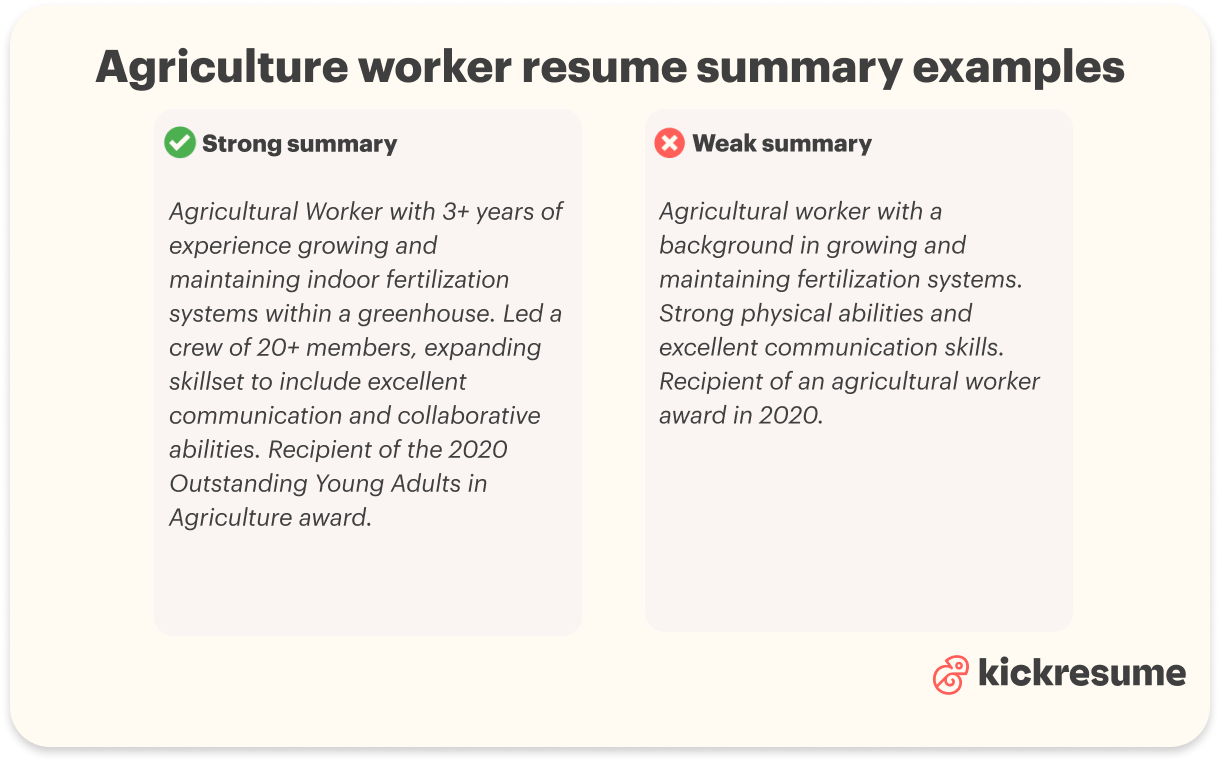
Bad agricultural worker resume summary example
Agricultural worker with a background in growing and maintaining fertilization systems. Strong physical abilities and excellent communication skills. Recipient of an agricultural worker award in 2020.
What's wrong with this example? While all the basic elements of a strong resume summary are present, the applicant needs to be more specific in how long they have worked in agriculture and what they specialize in. They also mention an award they have earned but fail to give context around what that award is.
Good agricultural worker resume summary example
Agricultural Worker with 3+ years of experience growing and maintaining indoor fertilization systems within a greenhouse. Led a crew of 20+ members, expanding skillset to include excellent communication and collaborative abilities. Recipient of the 2020 Outstanding Young Adults in Agriculture award.
Why is this better? This example provides a much higher level of context and specificity in regards to the details included. They clearly list how many years of experience they have and what specialized area of agriculture they work in. Plus, they include the formal title of the award they received.
3. Effective skills to include in an agricultural worker resume
Although working in agriculture is primarily a labor-intensive position, employers still want to hear about your ability to collaborate and work well with others. As such, it is crucial to include interpersonal skills alongside your technical skills on your resume.
Top 10 hard skills for an agricultural worker resume
Technical skills
- Motorized equipment operation (trucks, tractors, etc.)
- Crop growing and maintenance
- Fertilization products and systems
- Irrigation systems
- Livestock care and management
- Mechanical repairs
- Physical stamina and strength (when listing physical skills such as these, make sure to comb through the job’s description for minimum requirements. For instance, if you are required to lift at least 70 lbs., then you want to list this as your strength minimum)
- Agricultural technologies
- Harvest scheduling
- Waterway construction
Top 10 soft skills for an agriculture resume
Interpersonal skills
- Verbal and written communication
- Teamwork
- Collaboration
- Adaptability and flexibility
- Time management
- Multi-tasking
- Creativity
- Problem-solving
- Leadership
- Organization
4. Build a relevant work experience section
Show what you actually did … and why it mattered!
Listing skills is easy. Proving them is what gets you hired.
Your work experience section is where you show how you used your skills in real farming conditions and what kind of results you delivered. Employers want to know: Can this person handle the workload? Do they understand the job? Will they be reliable on my farm?
That’s why vague descriptions don’t work. Specific details do.
What a strong agricultural work experience entry includes
A solid work experience entry usually contains:
- Job title
- Farm or employer name and location
- Dates of employment
- Main tasks and responsibilities
- Achievements or improvements
- Numbers, scale, or outcomes where possible
Ready to see the difference this structure makes? Let's take a look:
Bad agricultural worker work experience example
Agricultural Worker
Local Farm
- Helped with farming tasks
- Took care of crops
- Worked with animals
Why doesn't this work? This description is too broad. It doesn’t say what crops, how many, what kind of animals, or what level of responsibility you had. It could apply to almost anyone who’s ever worked on a farm, which makes it easy to overlook.
Good agricultural worker work experience example
Agricultural Worker
Green Valley Farm, IA | 2020–2024
- Planted, maintained, and harvested seasonal crops across 50+ acres, including corn and soybeans.
- Operated and maintained farm machinery such as tractors, seeders, and irrigation systems.
- Monitored crop health and assisted with pest and weed control to support consistent yields.
- Cared for livestock, including daily feeding, cleaning, and basic health checks.
- Followed safety and hygiene standards to maintain a clean and efficient work environment.
Why does this work? This version is clear and specific. It shows the type of farm, the scale of work, the tools used, and the responsibilities handled. Even without exact yield numbers, it gives employers a strong sense of your experience.
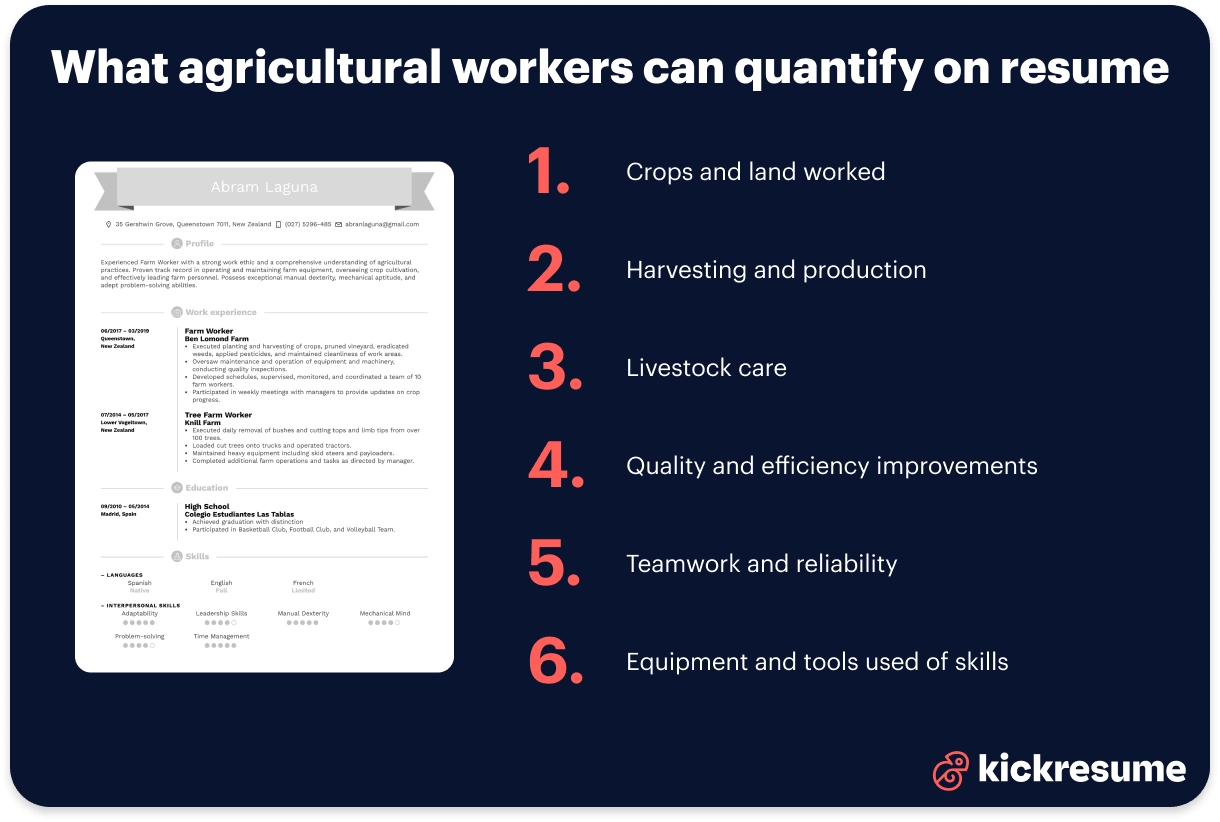
What agricultural workers can quantify on their resume
Agricultural work isn't corporate. And so agricultural workers think their jobs aren’t measurable. In reality, farms run on numbers. You just have to know where to look.
Crops and land worked
- Acres or fields managed
- Types of crops grown or harvested
- Greenhouse, orchard, or open-field work
- Seasonal vs. year-round production
Harvesting and production
- Volume harvested per day or season
- Harvest schedules met
- Packing or sorting output
- Contribution during peak seasons
Equipment and tools used
- Tractors, harvesters, irrigation systems
- Hand tools or automated equipment
- Maintenance or repair tasks
- Safety procedures followed
Livestock care
- Number and type of animals cared for
- Feeding and cleaning routines
- Health checks or monitoring
- Milking or breeding assistance
Teamwork and reliability
- Team sizes worked in
- New workers trained
- Long shifts or seasonal demands met
- Independent vs. supervised work
Quality, safety, and efficiency improvements
- Reduced waste or spoilage
- Improved efficiency or workflow
- Followed food safety or organic standards
- Passed inspections or audits
How to structure your agricultural work experience section
Keep it simple and readable:
- Use 3–5 bullet points for recent roles
- Use fewer bullets for older jobs
- List experience from most recent to oldest
- Focus on the last 10–15 years
- Highlight experience that matches the job you’re applying for
You don’t need to list every task you’ve ever done on a farm. Choose the experience that best proves you can handle this job.
5. Don't hide seasonal and contract work
A lot of agricultural workers worry that seasonal or short-term jobs look unstable. In farming, that’s normal and expected.
Seasonal work doesn’t hurt your resume in agriculture. In fact, it can help. Employers care more about what you did during the season than how long it lasted.
How to list seasonal agricultural work
- Label roles clearly as Seasonal or Harvest Worker
- Group similar seasonal jobs under one heading if needed
- Focus on responsibilities and scale, not duration
Example of seasonal work on agricultural worker resume
Seasonal Agricultural Worker
Multiple Farms, CA | 2021–2023
- Assisted with planting, maintenance, and harvest across 3–4 crop cycles per year, including berries and leafy greens.
- Harvested, sorted, and packed 800–1,200 lbs of produce per shift during peak season while meeting quality standards.
- Worked 10–12 hour shifts, including early mornings and weekends, during high-demand harvest periods.
- Followed food safety and hygiene procedures to support 100% compliance with farm inspection requirements.
- Adapted quickly to different farm layouts, tools, and team sizes, contributing to smooth operations across 5+ worksites.
6. Make your education section stand out
Though agriculture is a major area of study at most universities, you can become a part of the industry through many pathways. If you have chosen an alternative route to formal university education, make sure to include all the relevant details regarding your training and certification in the education section.
Good example of agricultural worker education resume section
Education
B.A. in Agricultural Management | Appalachian State University
Boone, NC
- Major: Agricultural Business Management and Crop Science
- Graduated: 2018
- President of the Student Agricultural Society
Certifications
- Equine Facility Manager | Certified Horsemanship Association
- OSHA Safety Certificate | USDA
- Accredited Farm Manager | Michigan Farm Bureau
And if you prefer watching a short 1-minute video on how to write the education section of your resume instead, you might like this one:
7. Choose optional sections for your agricultural worker resume
Your resume summary, work experience, and skills section form the core of any solid resume. If these sections fill up a full page, you're already in good shape.
But sometimes you have extra space—or you simply want to give employers a fuller picture of what you bring to the table. That's where optional sections come in.
Before you start adding, ask yourself: will this actually help my application?
- Add more if: You have relevant qualifications, achievements, or experiences that strengthen your case. Extra details that show you're more qualified than other candidates are always worth including.
- Leave it out if: You're just trying to fill space. Irrelevant information dilutes your message and can make hiring managers lose interest. Quality beats quantity every time.
Here are some optional sections that can boost your agricultural worker resume:
- Certifications & licenses: Do you have a pesticide applicator license? Forklift certification? CDL? These credentials prove you can legally and safely operate equipment or handle materials, which is a big plus for employers.
- Machinery & equipment skills: Being specific about what you can operate matters. Instead of just saying "experienced with farm equipment," list actual machines—tractors, combines, irrigation systems, or ATVs.
- Safety & compliance training: Farms prioritize safety. If you've completed training in farm safety protocols, first aid, hazardous material handling, or OSHA standards, create a section for it.
- Languages: Agricultural employers value workers who can communicate across language barriers. If you speak any other language common at the farm you want to work at, highlight it.
- Awards & recognition: Got praised for reliability during harvest season? Recognized for safety records or productivity? These acknowledgments show you're a standout worker, not just someone who shows up.
- Seasonal availability: Some farm jobs are seasonal. If you're available during peak planting or harvest times, or if you're looking for year-round work, mentioning this upfront can help match you with the right positions.
One important note: if you've already mentioned licenses or certifications somewhere else in your agriculture resume, don't list them again. Repeating the same information just wastes space.
Example of optional sections on an agricultural worker resume
Certifications
- Pesticide Applicator License – California Department of Pesticide Regulation, Issued 2023
- Forklift Operator Certification – OSHA-approved, Valid through 2026
- CDL Class B License – State of California, 2022
- First Aid & CPR – American Red Cross, Valid through 2025
Equipment Experience
- Case IH and John Deere tractors
- Center pivot and drip irrigation systems
- Grain augers and conveyors
- ATV and utility vehicles
Safety Training
- Workplace Safety & Health in Agriculture, completed 2024
- CPR and First Aid certified through 2026
The goal isn't to make your resume longer—it's to make it more convincing. Only include sections that genuinely support your application and show why you're the right person for the job.
8. Common mistakes on an agricultural worker resume and how to fix them
Strong field experience and the right certifications can still get buried by small, avoidable resume mistakes. Before you send your resume out, run through this list. Any one of these could be quietly costing you interviews.
#1 Typos and spelling errors
It sounds basic, but spelling mistakes make you look careless. And that's not an impression you want to make. Writing "pestcide application" or "irrication systems" can raise doubts before anyone even reads your experience.
#2 Being too vague about what you actually did
"Assisted with farm operations" or "helped with crop production" could describe almost anyone. It tells the employer nothing about the scale of your work, the crops you handled, or the equipment you operated.
#3 Leaving out equipment and certifications
A lot of agricultural workers forget to mention the machinery they can operate or the licenses they hold, either because it feels obvious to them or because they assume everyone has it. They don't.
#4 Sending the same resume to every job
A greenhouse role and a livestock farm position are very different jobs. A resume written for one won't do much work for the other, and employers can tell when something generic landed in their inbox.
#5 Listing tasks without showing scale or results
"Responsible for irrigation" doesn't say much. How large was the system? How often? What happened when something went wrong and you fixed it? Tasks without context make it hard for an employer to gauge what you're actually capable of.
#6 Ignoring seasonal and physical reliability
Agricultural employers care a lot about dependability, especially for seasonal roles. A resume that says nothing about your availability, your track record of returning season after season, or your ability to handle physically demanding conditions is missing something important.
#7 Undervaluing soft skills
Farm work involves more than physical labor. Coordinating with a team during harvest, communicating with a supervisor about crop conditions, training newer workers … these things matter to employers, especially for more senior agricultural roles.
#8 Poor formatting and layout
A cluttered resume is hard to read and easy to skip. Long blocks of text, inconsistent spacing, and mixed fonts make recruiters work harder than they should. Most won't bother.
#9 Including irrelevant personal information
Hobbies and personal details that have no connection to agricultural work take up space that could be used for something useful. A hiring manager at a farm operation doesn't need to know about your interest in urban photography.
Small mistakes can undo solid experience. Taking twenty minutes to check for these before you apply can make a real difference in how your agricultural worker resume lands.
9. Best job search resources for agricultural workers
The world of agriculture is as dynamic as it is vast. Charting a career path in this sector requires solid resources. And that's why we've hand-picked some of the most efficient job-seeking tools for those with a green thumb:
- Sector-specific job boards: Specialist sites such as AgCareers.com and AgHires feature job listings specifically geared toward the agricultural industry.
- Networking platforms: LinkedIn isn’t just for desk jobs. This platform is a fruitful resource to connect with agri-professionals, unearth potential job postings, and enhance your professional visibility.
- Resume-building websites: Online platforms like Kickresume, Zety, or MyPerfectResume can help create professional, industry-specific resumes that highlight the skills cultivated in your field.
- Professional organizations: Agricultural groups, such as the National Farmers' Union or American Agri-Women offer a fertile ground for networking opportunities, industry insight, and members-only job listings.
- Casual labor boards: On-demand job platforms like the FarmPost App are ideal for those looking for part-time or casual farming work.
Food Production Career Outlook in 2026
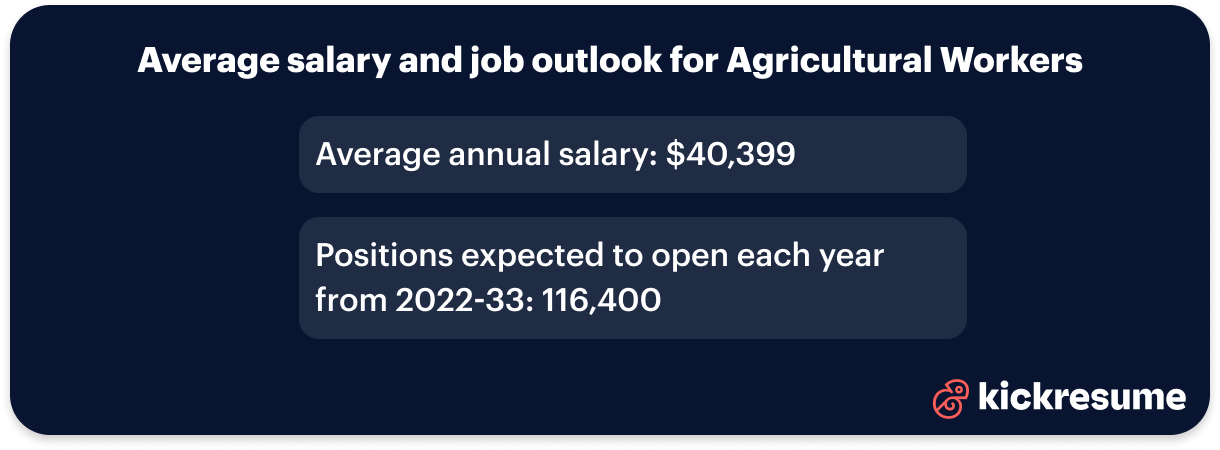
Employment in agricultural and food production roles is projected to decline by around 3% between now and 2034. (Source: U.S. Bureau of Labor Statistics).
Despite this overall decline, around 116,200 job openings per year are expected on average. These openings will largely come from the need to replace workers who retire or transition to other occupations.
In practice, this means that while the total number of roles may shrink, replacement demand remains steady, keeping opportunities available across the field.
At the same time, AI is expanding in food production, but adoption remains limited. According to McKinsey, advanced automation tools are used by only a small share of farms, meaning AI is not replacing food production workers at scale. Instead, it’s shifting demand toward technical roles that operate and maintain modern equipment.
Average US base salaries across popular Food Production roles:
- Farmer: $40,103/year
- Butcher: $45,484/year
- Farm Worker: $43,323/year
- Agronomist: $76,492/year
- Agricultural Equipment Technician: $91,531/year
Salary estimates are based on data from Indeed as of January 2026, combining anonymized salary submissions and job posting data. Actual salaries may vary depending on location, company size, and experience level.
Overall, food production remains a stable, replacement-driven field—particularly for those willing to work in hands-on or technical roles where turnover is higher.
Agricultural Worker Resume FAQ
What are the key skills to mention in an agricultural worker resume?
Highlight both hard and soft skills on your resume. Include specifics like ability to operate farm machinery, knowledge of crop rotation, or livestock care expertise. Don't forget soft skills such as problem-solving, teamwork, and resilience in tough weather.
Is it necessary to have a professional summary on my resume?
Yes, a professional summary can effectively overview your experience, skills, and areas of expertise. It provides a quick snapshot and motivates potential employers to delve deeper into your resume.
How can I make my agricultural worker resume stand out?
Demonstrate results. For example, if you executed a new irrigation technique that improved crop yield by a certain percentage, include that fact. Also, adopt industry-relevant keywords to pass through scanning systems.
Can I include unpaid or volunteer work on my resume?
Absolutely. Especially if you're just starting out, internships or volunteering on a farm add value to your experience section. It demonstrates relevant knowledge and a voluntary spirit.
What's the recommended length for an agricultural worker resume?
Keep it succinct, ideally one page if possible, but no more than two. Ensure the content is relevant, clear, and skimmable to maximize impact within these confines.


![How to Write a Professional Resume Summary? [+Examples]](https://d2xe0iugdha6pz.cloudfront.net/article-small-images/How_to_Write_a_Professional_Resume_Summary_.png)

![How to Describe Your Work Experience on a Resume? [+Examples]](https://d2xe0iugdha6pz.cloudfront.net/article-small-images/How_to_Describe_Your_Work_Experience_on_a_Resume_.png)