

 ChatGPT
 Perplexity AI
 Claude
Should you use objective or summary for your resume? Both are a short paragraphs at the top of your resume, right below your contact information. A summary highlights your past experience and accomplishments, while an objective focuses on your career goals and motivation.
The key difference? Your career stage. Experienced professionals should use a summary, while entry-level candidates should use an objective.
But there's more to it than that. Depending on your situation, you might break these rules or skip both options altogether.
And of course, knowing how to write each one properly is crucial.
In this article, you'll learn:
- The key differences between a resume summary vs. objective
- Whether to use an objective or summary for your resume
- How to write both a resume summary or objective yourself
- When you can skip both entirely
- What’s the difference between terms like "resume profile", "professional statement", “career summary”, etc.
TL;DR: Resume summary vs. objective
Don't have time to read the full article? (Though you'll be missing out on detailed examples and expert tips!) Here's a quick rundown of the key differences between a resume summary and objective:
Key differences between a resume summary vs. objective
Many people confuse resume summaries and objectives, but they're actually quite different. Here's a rundown of the 6 main aspects that set them apart:
Resume summary
- Best for: Professionals with relevant experience of at least 2+ years in the field who already have some results and achievements under the belt.
- Main focus: Presenting your experience along with the hard skills you've gained and the results and achievements you've delivered.
- Goal: To show you’re qualified and the best person for the specific job.
- Content: Years of experience, what you specialize in, specific hard skills, certifications, key accomplishments, and measurable results
- Language: Neutral, professional tone using action verbs and field-specific terminology
- Skills: Hard skills, certifications, keywords from the job ad, courses
- Length: 3-5 sentences or 50-100 words
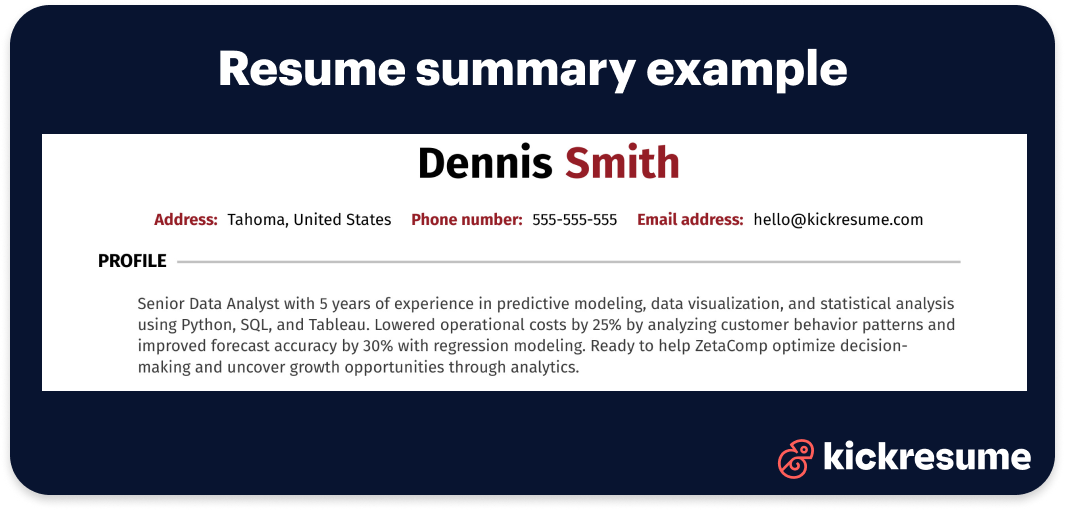
Here’s an exemplary resume summary that does everything right:
Resume summary example
Senior Data Analyst with 5 years of experience in predictive modeling, data visualization, and statistical analysis using Python, SQL, and Tableau. Lowered operational costs by 25% by analyzing customer behavior patterns and improved forecast accuracy by 30% with regression modeling. Ready to help ZetaComp optimize decision-making and uncover growth opportunities through analytics.
Resume objective
- Best for: Objectives suit entry-level candidates, recent graduates, career changers, and anyone with limited experience in their target field.
- Main focus: Quickly show your motivation and enthusiasm for the specific job, and explain how that job fits into your career goals.
- Goal: To answer “Why this job?” and to convince the manager that despite your lack of experience, you're highly motivated, and a good fit for the role.
- Content: Career aspirations, transferable skills, enthusiasm for the role, and what you hope to contribute
- Language: More enthusiastic and personal, showing personal connection.
- Skills: Transferable skills, skills you’re working on (taking courses, etc.), soft skills
- Length: 1-2 sentences or 30-50 words
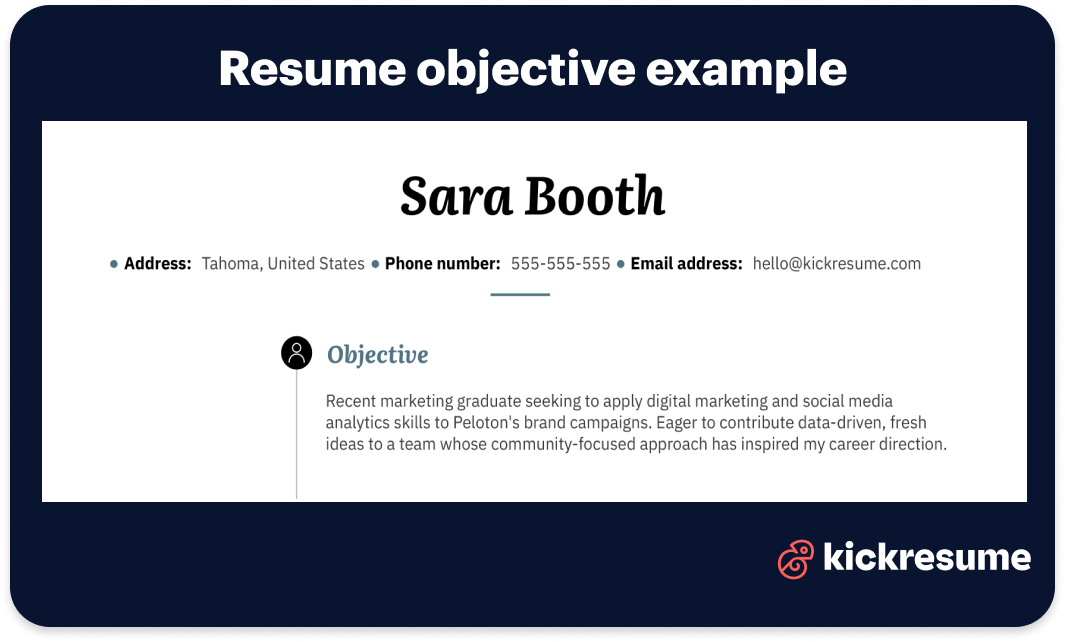
And here’s a great resume objective example:
Resume objective example
Recent marketing graduate seeking to apply digital marketing and social media analytics skills to Peloton's brand campaigns. Eager to contribute data-driven, fresh ideas to a team whose community-focused approach has inspired my career direction.
This objective is effective because it demonstrates specific relevant skills, genuine enthusiasm for Peloton's brand values, and clearly connects the candidate's career goals to the company's mission—all while staying concise and tailored to the role.
Pro tip
Tailor your summary or objective to each specific job. Mirror 2-3 key requirements from the job description, like specific tools (Python, Tableau), skills (data visualization), or priorities (cost reduction). This helps your resume pass ATS filters and immediately shows you're a match.
Should you use an objective or summary for your resume?
The decision is usually straightforward: Use a resume summary if you have 2+ years of relevant experience and you're applying for a job in the same industry/field. Use an objective if you're entry-level, a recent graduate, or changing careers.
But some situations are less clear-cut:
- Returning to work after a career gap? Use a summary to emphasize your previous accomplishments and continued expertise.
- Returning from maternity leave? Use a summary that highlights your experience and briefly mentions your return, like "Marketing Manager with 6 years of experience... now returning from maternity leave and ready to drive brand growth."
- Promoted internally? Stick with a summary to showcase your track record within the company.
- Switching departments internally? Use an objective to explain why you're making the move and what transferable skills you bring.
- International candidate? Choose based on your experience level, but add motivation for relocating—summaries can include "seeking to bring expertise to [location]," while objectives naturally address the "why."
- Freelancer going full-time? Use a summary if you have substantial client results; use an objective if your freelance work was scattered or unrelated to your target role.
When in doubt, match your choice to what you're "selling"—experience and results (summary) or potential and motivation (objective).
How to write a resume summary?
A strong resume summary follows a simple formula that showcases your qualifications in 3-5 sentences. Here's the step-by-step breakdown:
Write a resume summary in 6 steps:
- Start with your job title and years of experience. Open with your professional title and how long you've worked in the field. This immediately establishes your level and credibility.
- List your core skills and specializations. Mention the key areas you specialize in—your main competencies and what you're known for. Match these with the core responsibilities from the job posting whenever possible.
- Include your key hard skills. Add the technical tools, programs, and methodologies you use. Focus on the skills mentioned in the job ad to show you have exactly what they need.
- Add relevant certifications or accreditations (if applicable). Include any professional certifications, licenses, or credentials that are directly relevant to the position. This adds credibility and shows you're qualified beyond just experience.
- Highlight your biggest achievements with numbers. This is the most important part. Use specific metrics and measurable results—percentages, dollar amounts, time saved, or other concrete outcomes. Numbers are far more compelling than generic claims about being "detail-oriented" or "hard-working."
- End with what you'll do for them. Wrap up by showing enthusiasm and stating how you'll add value to their specific company. This demonstrates you're focused on their needs, not just your own career goals.
For a more detailed guide, check out our complete guide on how to write a resume summary, which includes examples of resume summaries from real people hired by top companies.
Quick tips:
- Keep it scannable. Hiring managers spend seconds on this section.
- Use action verbs. Start sentences with words like "Led," "Developed," "Increased," "Managed".
- Stay within 50-100 words. Aim for 3-5 sentences maximum.
- Lead with your strongest points. Put your most impressive achievements early.
Pro tip
Tailor every element to the specific job ad. Use their exact terminology—if the job posting says "customer success" instead of "client satisfaction," use their version. If they mention "Python" specifically, don't just say "programming languages." Match their language to help your resume pass ATS filters and show you're aligned with their needs.
How to write a resume objective?
A resume objective is shorter and more focused than a summary—typically just 1-2 sentences that explain why you want this specific job. Here's how to structure it:
Write a resume objective in 4 steps:
- State your current status or background. Open with who you are right now: "Recent marketing graduate," "Career changer with background in sales," or "Entry-level developer completing a coding bootcamp."
- Mention your relevant skills and what you'll contribute. List 2-3 transferable or technical skills that match the job requirements, and connect them to how you'll add value. Focus on what you can actually do—coursework, personal projects, volunteer work, or skills from previous careers all count.
- Make a personal connection to the company, job, or team. This is your "Why this job?" moment. Reference what specifically attracts you—their mission, values, recent campaigns, company culture, or the team's approach. This shows genuine interest, not just a generic application.
- Express your career goals or how you want to grow. End by stating what you hope to achieve or learn in this role. Keep it relevant to the position—show how this job fits into your career direction and how you plan to develop within the company.
Quick tips:
- Keep it concise. Stay within 30-50 words maximum.
- Be specific, not generic. Avoid phrases like "seeking a challenging position" or "looking for growth opportunities".
- Show genuine interest. Make it clear why this company and this role matter to you.
- Stay positive. Don't apologize for lack of experience or focus on what you're missing.
Pro tip
Just like with summaries, mirror the language from the job ad. If they use "digital marketing," don't say "online marketing." Match their keywords to show you're the right fit and help your resume pass ATS systems.
When can you skip both?
This short paragraph at the top of your resume is one of the 5 standard resume sections. But! You don't always need a resume summary or objective. In some cases, it's better to skip them entirely and let your experience speak for itself.
Skip both when:
- Your resume is already one page and packed with relevant experience. If you're struggling for space and every bullet point showcases strong, relevant achievements, don't waste precious real estate on a summary.
- You're writing a CV instead of a resume. A CV (curriculum vitae) is different from a resume—it's a comprehensive academic document typically used for academic, research, or scientific positions, usually multiple pages long. CVs are exhaustive records of your career and don't need summaries or objectives.
- You're applying to very traditional or conservative industries. Some fields like law, academia, or government prefer straightforward, facts-only resumes without promotional statements.
- You're using a resume for networking or internal applications. When someone already knows your work or you're being referred internally, a summary can feel redundant.
- The job application specifically requests a cover letter. If you're writing a compelling cover letter that explains your motivation and qualifications, repeating the same information in a resume summary is unnecessary.
- You have a strong portfolio or work samples. For creative fields like design, writing, or development, your work often speaks louder than a written summary.
Bottom line: If removing the summary/objective makes room for more impressive accomplishments or the context makes it unnecessary, skip it. Your resume should be a strategic document—only include elements that strengthen your case.
Different names for resume summaries and objectives explained
You might see different names for that short paragraph at the top of your resume—resume profile, professional summary, career statement, and more. Don't worry, you're not missing something.
Most of these terms refer to a resume summary or something very similar to it. The terminology varies, but the concept remains the same: a brief introduction that highlights your qualifications.
If you're an experienced professional, you might see your opening paragraph called any of these names (they all mean the same thing):
Common names people use interchangeably for a resume summary:
- Professional summary
- Resume profile
- Career profile
- Career summary
- Summary statement
- Resume statement
- Professional profile
- Career statement
If you're entry-level or changing careers, your opening paragraph might be referred to as:
Common names people use interchangeably for a resume objective:
- Resume objective statement
- Career objective
- Objective statement
- Professional objective
Key takeaways
Here's everything you need to remember about resume summaries vs. objectives:
- Resume summaries are for experienced professionals with 2+ years of relevant experience—focus on achievements, hard skills, and measurable results in 50-100 words.
- Resume objectives are for entry-level candidates and career changers—emphasize motivation, transferable skills, and career goals in 30-50 words.
Always tailor to the specific job ad using their exact keywords. You can skip both when writing a CV, applying to conservative industries, or when space is tight.
Still not sure where to start, or need to create multiple tailored versions quickly? Try our AI Resume Summary Generator.
Upload your existing resume and our AI will craft a personalized summary based on your experience and the job you're targeting. Not happy with the first version? Just hit regenerate until it's perfect—no hours of rewriting required.