


 ChatGPT
 Perplexity AI
 Claude
If you've ever found yourself scratching your head and wondering about the difference between a motivation letter vs. cover letter, you're not alone.
These two documents, while similar, have distinct uses and contexts that set them apart.
In a nutshell, the main difference between cover letter and a motivational letter lies in the fact that a cover letter is typically used in career settings, while a motivation letter is more common in academic settings.
In this article, we'll dive into the specifics of each document and provide examples to help guide you on when to use which.
Create your cover letter fast with artificial intelligence.

Motivation letter vs. cover letter
What's the difference between a cover letter and a motivation letter?
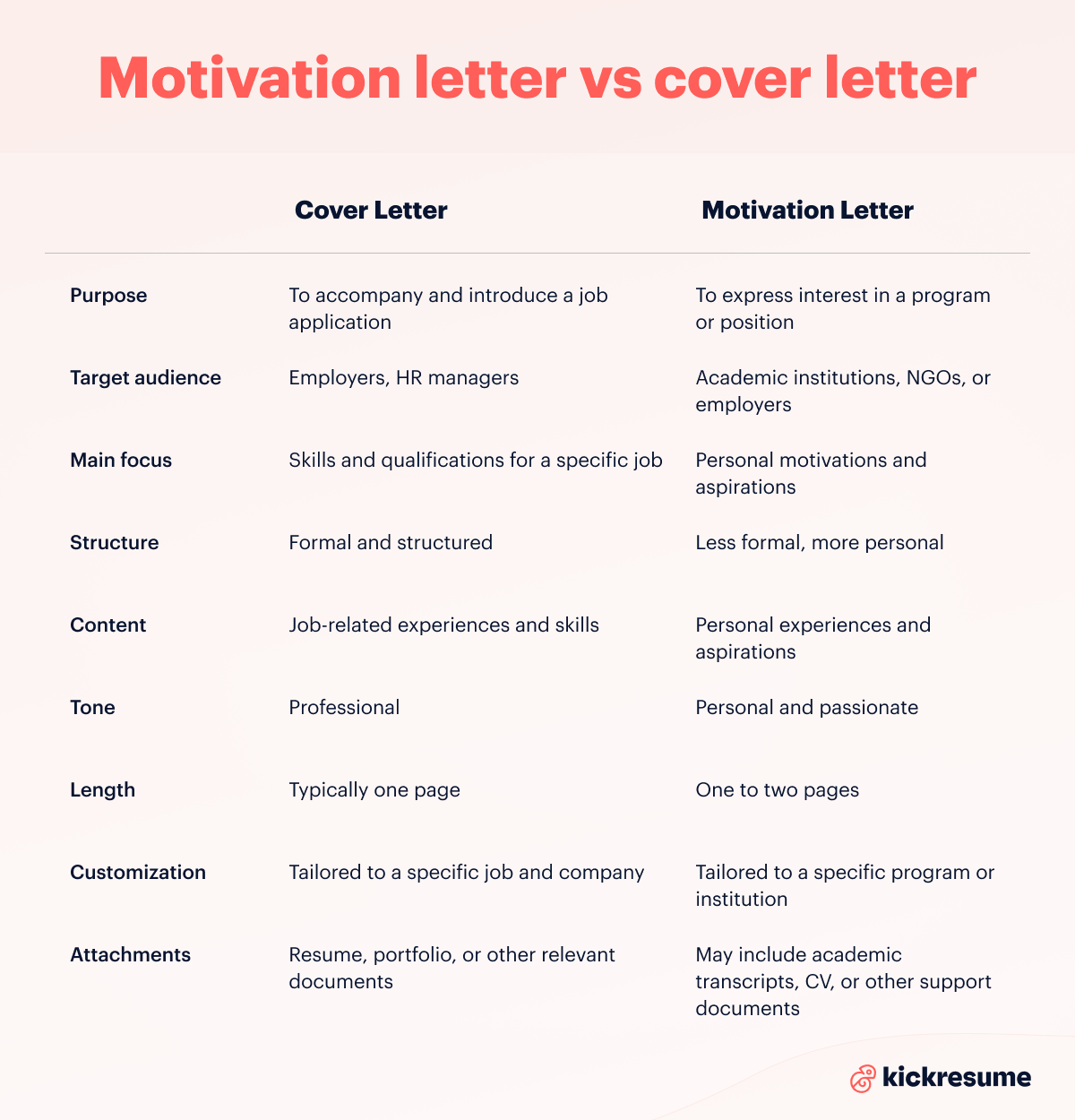
Let's sum it up:
| Document | Cover letter | Motivation Letter |
| Purpose | To accompany and introduce a job application | To express interest in a program or position |
| Target audience | Employers, HR managers | Academic institutions, NGOs, or employers |
| Main focus | Skills and qualifications for a specific job | Personal motivations and aspirations |
| Structure | Formal and structured | Less formal, more personal |
| Content | Job-related experiences and skills | Personal experiences and aspirations |
| Tone | Professional | Personal and passionate |
| Length | Typically one page | One to two pages |
| Customization | Tailored to a specific job and company | Tailored to a specific program or institution |
| Attachments | Resume, portfolio, or other relevant documents | May include academic transcripts, CV, or other support documents |
When to use a cover letter vs. a motivation letter
If you’re unsure which document fits your situation, use these decision criteria:
- Check the application instructions first. If they call for a “motivation letter,” use that. If they ask for a “cover letter,” follow the job-style approach.
- Match to the audience. Use a cover letter when writing to employers and HR. Use a motivation letter when applying to academic institutions, NGOs, scholarships, or volunteer programs.
- Consider the nature of the opportunity. Is it about skills and role fit? Go cover letter. Is it about passion, mission alignment, long-term vision? Lean motivation letter.
- Align with your strengths. If your experience is strong, a cover letter lets you showcase it. If your motivation/story is your best asset, the motivation letter gives you room.
Now, let's have a closer look at each of these documents, together with an example of both a cover letter and a motivation letter.
What is a cover letter?
A cover letter is a document that serves as your introduction to a potential employer, showcasing your background and explaining why you would be a good fit for the position they're offering.
It should accompany your resume and should complement the information in it.
In essence, it's your chance to present yourself, let your personality shine through, and provide additional details that might not fit within the limited space of your resume.
Even if you lack previous experience in the field, a well-crafted cover letter can help you stand out by highlighting your enthusiasm and positive qualities.
How to write a cover letter
When it comes to writing a cover letter, the structure is just as important as the content. Here's a simple breakdown of the key components to include:
- Opening paragraph: Start with a brief introduction, saying who you are and the position you're applying for. This is your opportunity to grab the reader's attention and encourage them to read on.
- Body paragraphs: Use this section to showcase your relevant skills, experiences, and achievements. Be sure to provide concrete examples and explain how they directly relate to the job you're applying for. This is your chance to demonstrate why you're the ideal candidate for the position and how your background aligns with the company's needs and values.
- Closing paragraphs: In your closing paragraphs, restate your interest in the position and summarize your qualifications. This is also an excellent opportunity to express your enthusiasm and eagerness to contribute to the company's success. Don't forget to thank the reader for considering your application and provide any necessary contact information.
Cover letter example
Now that you have a better understanding of what a cover letter entails and how to write one, let's take a look at an example to help illustrate the key concepts.
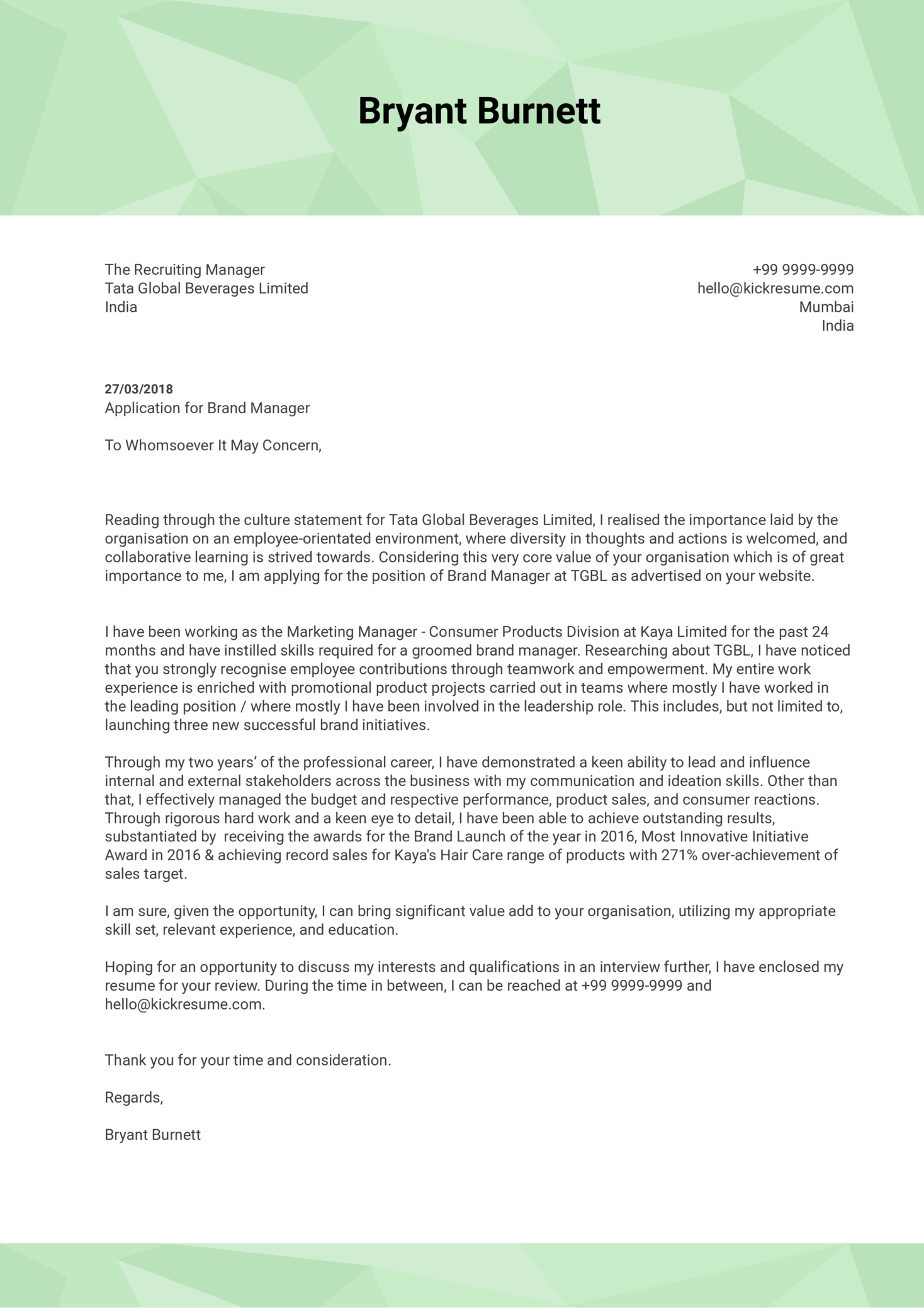
This cover letter sample was provided by a real person who got hired with Kickresume’s help.
What is a motivation letter?
While cover letters are designed for job applications, motivation letters serve a different purpose.
Motivation letter is typically used when applying for academic opportunities such as scholarships, internships, or postgraduate programs, but also when applying for a non-profit organization or voluntary work.
A motivation letter aims to convey your passion for the subject, your personal goals, and how the program or opportunity aligns with those aspirations.
It's an opportunity to showcase your drive, commitment, and enthusiasm for the field, setting you apart from other applicants.
How to write a motivation letter
When crafting a motivation letter, it's essential to convey your genuine interest in the program or opportunity and provide a clear explanation of your motivations.
Here's a simple outline to follow:
- Opening paragraph: Begin with an introduction, stating who you are and expressing your interest in the program or opportunity. This is the perfect chance to capture the reader's curiosity and set the tone for the rest of the letter.
- Body paragraphs: In this section, delve into your motivation for pursuing this opportunity, your long-term goals, and how the program aligns with those objectives. Be specific and provide examples, such as relevant experiences or accomplishments, that demonstrate your commitment to the field.
- Closing paragraphs: Wrap up your motivation letter by reiterating your interest in the program or opportunity and expressing your enthusiasm for the potential it offers. Thank the reader for considering your application and provide your contact information.
Motivation letter example
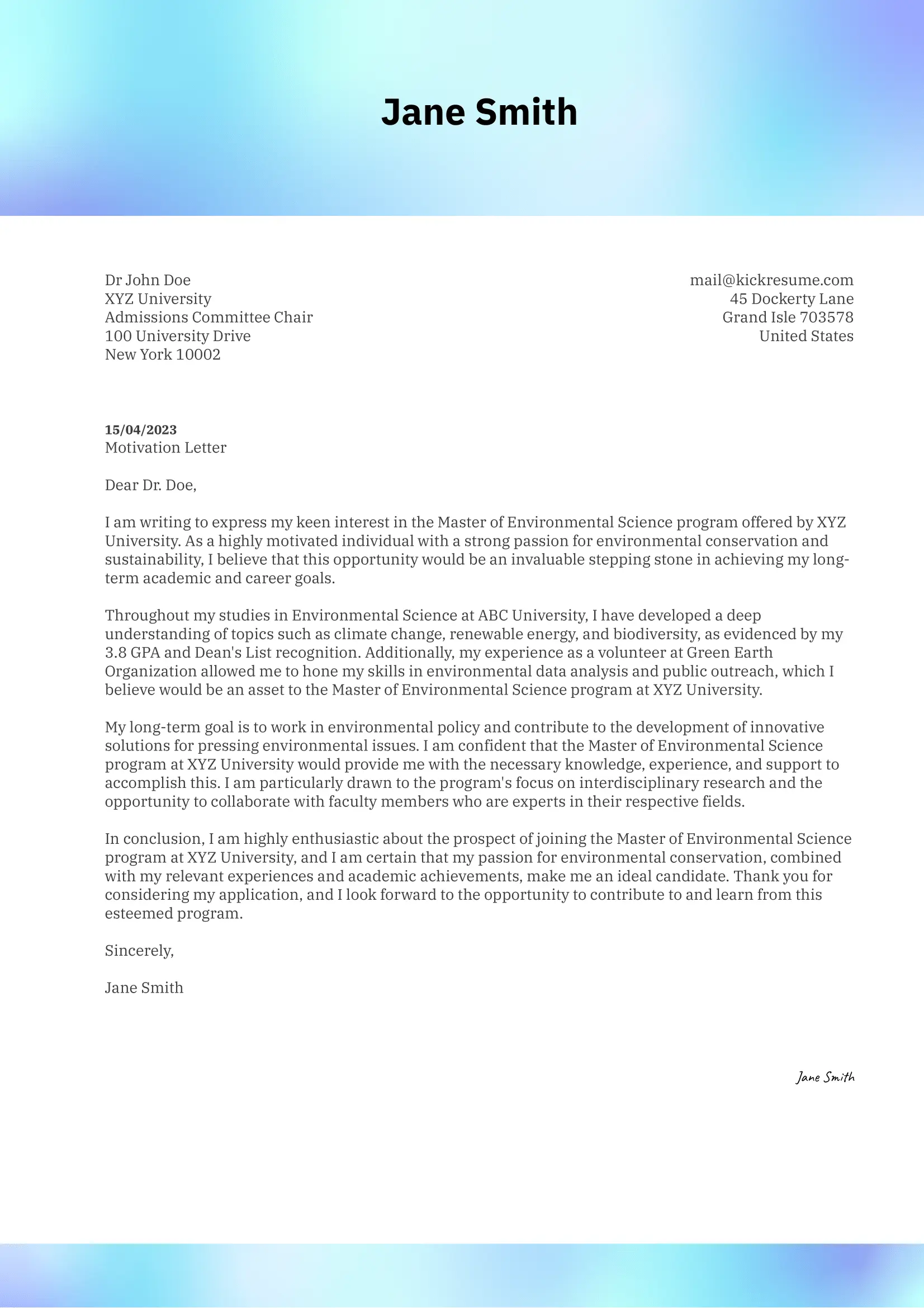
Now that we've covered the purpose and structure of a motivation letter, let's take a look at an example to help bring these concepts to life.
This sample motivation letter will demonstrate how to effectively introduce yourself, share your motivations and goals, and express your enthusiasm for the academic opportunity:
Where are motivation letters most common? (Europe vs US)
Short answer: motivation letters are most common in Europe, particularly for academic programs, scholarships, and EU institution roles, while in the United States, Canada, the UK, and Australia, the default is "cover letter." If you're applying internationally, the document the employer expects usually depends on where they're based and the type of opportunity.
Europe: motivation letter is often the default
Across much of Europe, "motivation letter" is the standard term for the document that introduces an applicant. It's used for both academic and professional opportunities.
You'll commonly see it requested for:
- University and postgraduate programs in Germany, the Netherlands, Belgium, France, Nordic countries, and most of Central and Eastern Europe.
- Erasmus+ exchange and scholarship applications.
- EU institution recruitment, including the European Commission and EPSO.
- NGO, internship, and volunteer programs, especially those run through international networks.
- Some private-sector roles, particularly in DACH countries (Germany, Austria, Switzerland), where the Motivationsschreiben is a recognized format.
The terminology is reinforced by language itself: lettre de motivation in French, Motivationsschreiben in German, motivatiebrief in Dutch. All these translate directly to "motivation letter."
United States and Canada: cover letter is the norm
In North America, "cover letter" dominates almost universally. If a US employer asks for "a letter" alongside your resume, they almost always mean a cover letter.
The motivation letter does still appear in North America, but in narrower contexts:
- Graduate school admissions, where it's more often called a statement of purpose or personal statement.
- Fellowship and scholarship applications like Fulbright or Rhodes.
- Volunteer and service organizations such as the Peace Corps.
- International NGOs that operate globally but happen to be US-based.
UK, Ireland, and Australia
These markets sit closer to the US convention. Cover letter is the default for jobs, while personal statement is the standard term for university applications, especially through the UK's UCAS system.
Quick rule of thumb
- Applying in Europe? Read the instructions carefully. "Motivation letter" is more likely the expected format, especially for academic, EU, or NGO opportunities.
- Applying in the US, UK, Ireland, or Australia? Default to a cover letter unless the listing explicitly asks for something else.
- Applying to an international body or EU institution? Lean motivation letter, and emphasize personal mission and goals over pure qualifications.
When in doubt, look at the application form itself. The wording it uses is your safest signal.
Motivation letter vs. cover letter? Our final piece of advice
Throughout this article, we've explored the key differences between motivation letters and cover letters.
In a nutshell, a cover letter focuses on your qualifications and suitability for a specific job, while a motivation letter expresses your enthusiasm and reasons for pursuing a particular opportunity, often in educational or volunteering contexts.
Furthermore:
- Cover letter typically includes your contact information, addresses the hiring manager, and is tailored to a specific job posting or company.
- Motivation letter is more general, often used for educational or volunteer programs, and emphasizes your passion, personal goals, and reasons for choosing the opportunity.
Pro tips for cover letters and motivation letters
- Be selective with content — don’t try to tell everything; choose the strongest points.
- Reference the institution or company culture — show you did your research.
- Use active, positive language — avoid passive or generic phrasing.
- Make your opening memorable — a strong hook (e.g. a sentence that links your mission to theirs) can set you apart.
- Proofread carefully — grammar or tone mistakes in a motivation letter feel more personal; in a cover letter they feel careless.
By understanding these distinctions, you can confidently craft the right document for your specific needs, be it an academic opportunity or a job application.
Use artificial intelligence to create your resume — FAST!
