


 ChatGPT
 Perplexity AI
 Claude
To stay ahead of the latest trends and emerging technologies, there’s one thing you absolutely have to do: keep learning.
Online courses have become a go-to option for job seekers looking for additional training or an alternative to traditional education, whether you’re a beginner trying to break into tech or a seasoned professional looking to stay competitive.
From coding and data analysis to cloud computing, cybersecurity, artificial intelligence, and web development, the tech landscape is constantly evolving.
Adding relevant courses to your resume can instantly boost your credibility and improve your chances of getting hired.
Why we picked these courses
With so many online courses out there, we narrowed this list down to programs that offer real career value and skills you can use long-term.
Many of the courses we handpicked are taught by top universities and well-known companies, which often means the content is structured, up to date, and grounded in real-world standards.
And yes, the provider name helps too. A certificate from a recognizable institution can greatly boost your resume's credibility and catch a recruiter’s eye.
That said, we didn’t choose courses based on the name alone. Some of the best programs are taught by experienced industry practitioners and focus on practical, job-ready skills.
That’s why every course on this list covers in-demand, transferable skills like programming, data, cloud, and AI, skills that stay useful across many tech roles.
Try our AI Resume Writer and have your resume ready in minutes!

Top 10 Tech courses to take in 2026
- Machine Learning (Stanford University via Coursera)
- Price: Enroll for free (7-day trial). Certificate requires a Coursera subscription (typically $39–$59/month until completion).
- Time: 61 hours
- About: This provides a broad introduction to machine learning, data mining, and statistical pattern recognition. The course also draws from numerous case studies and applications.
- Computer Science for Artificial Intelligence (Harvard University via Edx)
- Price: $518 (Including school-verified certificate)
- Time: 5 months, 2 programs
- About: This series combines CS50’s computer science foundations with an intro to AI with Python. You’ll build practical projects while learning core AI concepts like search, classification, and optimization. By the end, you’ll understand how to start designing simple intelligent systems.
- Google Data Analytics Professional Certificate (Google via Coursera)
- Price: Enroll for free (7-day trial). Certificate requires a Coursera subscription (typically $39–$59/month until completion).
- Time: 6 months
- About: This course gives you a real taste of what entry-level data analysts do day to day. You’ll learn the core skills like cleaning, analyzing, and visualizing data using tools such as spreadsheets, SQL, Python, and Tableau.
- Programming for Everybody (Getting Started with Python (University of Michigan via Coursera)
- Price: Enroll for free (7-day trial). Certificate requires a Coursera subscription (typically $39–$59/month until completion).
- Time: 2 weeks
- About: A beginner-friendly Python course requiring minimal math. Learn programming fundamentals and earn a shareable certificate upon completion.
- DevOps and Software Engineering (IBM via EdX)
- Price: $871 (Including verified certificate from IBM)
- Time: 1 year, 1 month
- About:This IBM certificate teaches you job-ready DevOps skills like CI/CD, testing, and secure deployments. You’ll get hands-on with Python, Linux, GitHub, Docker, and Kubernetes, plus learn the basics of microservices and cloud-native development.
- Meta Front-End Developer Professional Certificate (Meta via Coursera)
- Price: Enroll for free (7-day trial). Certificate requires a Coursera subscription (typically $39–$59/month until completion).
- Time: 7 months
- About: In this course, you’ll learn to build responsive websites with HTML, CSS, and JavaScript, then take it further with React. You’ll also use GitHub for version control and create portfolio projects you can share in job interviews.
- Google Cybersecurity Professional Certificate (Google via Coursera)
- Price: Enroll for free (7-day trial). Certificate requires a Coursera subscription (typically $39–$59/month until completion).
- Time: 6 months
- About: This course covers the basics of cybersecurity and why it matters for modern organizations. You’ll learn to spot common threats and vulnerabilities, then practice protecting systems using tools like SIEM. You’ll also get hands-on with Linux, SQL, and a bit of Python.
- SQL for Data Analysis (Udacity)
- Price: Free
- Time: 4 weeks
- About: This course will teach you how to write efficient SQL queries to successfully handle a variety of data analysis tasks. You'll first learn to extract data, join tables together and perform aggregations. Then you'll learn how to use subqueries, temp tables, and window functions.
- The Complete Prompt Engineering for AI Bootcamp (Udemy)
- Price: Typically $20–$50 (often discounted during promotions)
- Time: 22,5 hours
- About: This course shows you what today’s top AI tools, including ChatGPT and GitHub Copilot, are good at and where they fall short, so you know which one to use for the job. You’ll practice on real projects for text and image generation and pick up the Python basics you need to build and run AI workflows.
- Ultimate AWS Certified Cloud Practitioner CLF-C02 2026 (Udemy)
- Price: Typically $20–$50 (often discounted during promotions)
- Time: 15 hours
- About: A beginner-friendly course that prepares you for the AWS Certified Cloud Practitioner exam, even if you’ve never used AWS before. You’ll learn the core AWS services and cloud basics, then practice with quizzes and a full mock exam.
Find out your resume score!

Best AI courses to take in 2026
Besides the best online tech courses, we also wanted to give special attention to one of the most in-demand and fast-changing skills today: AI.
It’s becoming relevant in almost every industry, not just in tech. Knowing how to use AI tools and automate parts of your work is quickly turning from a “nice bonus” into a real requirement.
That’s why completing an AI course can be a strong addition to your resume. It gives you tangible proof of your skills, whether you’re learning the basics or going deeper into more specialized, career-focused topics that can genuinely change your trajectory.
- Certificate Program in Agentic AI (John Hopkins University)
- Price: Around $3000
- Time: 16 weeks
- About:This program teaches you how to design and build goal-driven Agentic AI systems. You’ll learn core agent skills like perception, planning, and action, plus modern architectures such as LLM-based and multi-agent systems. It’s definitely on the expensive side. It's expensive, but it goes well beyond the basics and is built for people who want deeper, career-level AI skills.
- Vibe Coding: AI-Driven Software Development and Testing (Udemy)
- Price: Typically $20–$50 (often discounted during promotions
- Time: 4 hours
- About: A short, beginner-friendly course that helps you start building with AI right away without committing to a long program. You’ll learn how to turn an app idea into a working prototype using AI agents, use AI to debug and refine your code, and set up your project with version control and clean structure. You’ll also practice writing basic tests to make sure your app works as intended.
- Master AI Automation: Build Real AI Agents from Scratch (Udemy)
- Price: Typically $20–$50 (often discounted during promotions
- Time: 12 hours
- About: This course teaches you how to build practical AI agents and automations from scratch, even with no coding background. You’ll use tools like n8n, Zapier, Voiceflow, and RelevanceAI to create workflows for support, content, and lead follow-up, including a voice agent for calls and bookings.
- AI Agent Developer Specialization (Vanderbilt University via Coursera)
- Price: Enroll for free (7-day trial). Certificate requires a Coursera subscription (typically $39–$59/month until completion).
- Time: 2 months
- About: This course teaches you how to build and deploy intelligent AI agents using Python, tools, memory, and reasoning. You’ll learn to create custom GPTs, apply effective prompt engineering techniques, and design responsible AI systems that follow real-world best practices.
- Generative AI Engineering (IBM via EdX)
- Price: $903,60
- Time: 1 year, 1 month (16 courses)
- About: This professional certificate teaches you how to build real-world generative AI applications using large language models and transformer-based architectures. You’ll work with tools like Python, Hugging Face, PyTorch, GPT, and LLaMA, while learning prompt engineering, NLP, and deep learning fundamentals.
Best platforms to learn career skills
First, let's see if the course you want to take is worth your time or money. Because when it comes to getting a job, not all resources are equally valuable in recruiters' eyes.
So how will you persuade potential employers that you've done more than watched a few unvetted YouTube videos on how to code an app?
The answer is to get an online course from a trustworthy website or a well-known brand.
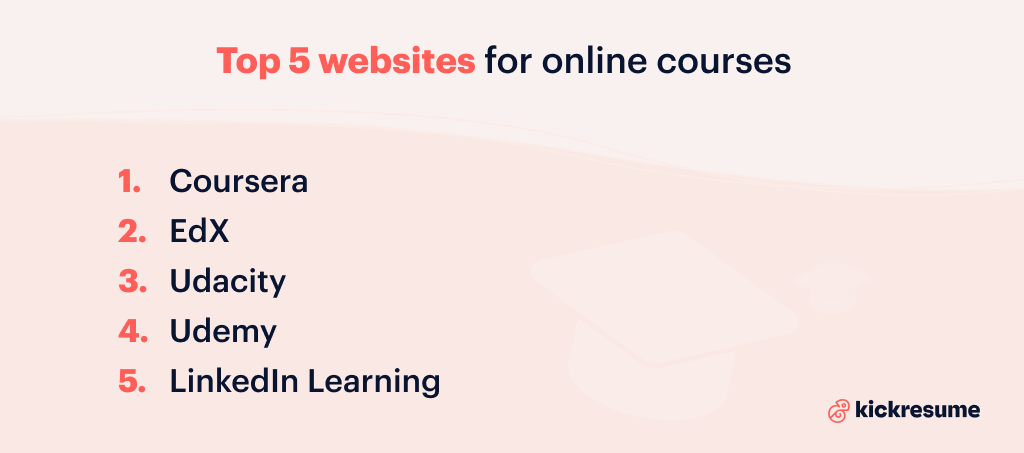
1. Coursera
This well-known online learning platform hosts more than 4,000 courses from major universities such as Stanford and Yale, or well-known companies such as Moreover, Google, or Meta.
You can enroll in either self-paced or timed classes ranging between 4 and 12 weeks. Choose from various courses for professional certificates in data analytics, digital marketing, IT, or other sectors. Google claims their courses are equivalent to 4-year college degrees.
2. EdX
Co-founded by Harvard and MIT, this online learning platform offers 4,600+ free online courses from more than 260 content partners including NYU, Yale, and even companies like IBM or Google.
Many of edX’s most popular courses focus on computer science, data science, artificial intelligence, leadership, and entrepreneurship. You’ll also find programs covering emerging technologies such as blockchain, fintech, and cloud computing.
3. Udacity
Udacity offers 550+ free online courses. However, keep in mind that the most standard version of each course comes without certificates. If you want one, you can try their Nanodegree certificate program - it's a bit more expensive, but you'll get to choose from courses offered by companies such as Google, Facebook, and AT&T.
Moreover, they guarantee you'll get a job after completing it - and if you don't, you'll get a refund.
4. Udemy
A global marketplace for online learning and mastering new skills.
At Udemy, you can choose from a massive offering of over 250,000 self-paced courses taught by expert instructors. There are courses both for students and experienced professionals. Udemy has paid but also free courses. The price depends on the instructor and if you pay, you'll also get a certificate.
Finally, keep in mind that these courses are provided by individual experts, and not by and not well-known institutions or brands.
Therefore, having one on your resume may appear a little less impressive.
5. LinkedIn Learning
LinkedIn's learning platform has a selection of over 16,000 courses in business, technology, and creative skills taught by industry experts.
These online courses come in 7 languages and each course includes several short videos that will make it easier for you to adopt new knowledge.
If you want to see if any of these courses are a good fit for you, just go to your LinkedIn profile.
There, LinkedIn will suggest relevant courses for you, based on your skills and experience. And although it's paid, you get one month of free trial and printable certificates for each online course.
How to add online courses and certificates to a resume
Including online courses and certificates on your resume is always a good idea, as it helps you:
- set yourself apart from other candidates
- show you want to improve your skills and knowledge
- tailor your resume to the job you're targeting
- fill in potential gaps in your resume
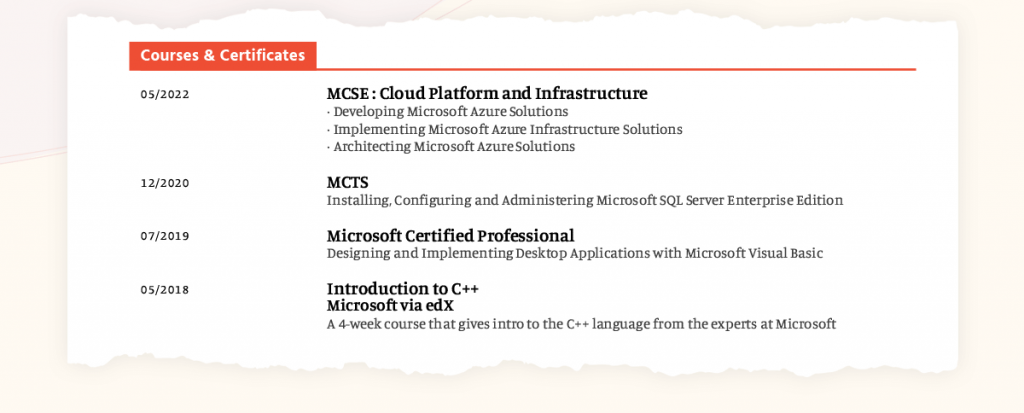
If you want to add an online course and certificate to your resume, you can include it in the education section.
However, if you've completed more than one course, you can also create a separate resume section for your courses. Name this section "Courses", "Courses & Certificates", or "Additional Training".
In it, list the courses in reverse chronological order and include:
- Name of the certification
- Authority
- URL or code (if you have any)
- Any relevant dates
- Description (optional)
In the end, it should look something like this:
This article was recently updated. The original article was written by Jakub Kaprál in 2018.
