Most people don’t love talking about their weaknesses at work. Some hold back. Some overshare. Many aren't sure where the line even is. And when review season comes around, the whole process can feel a bit awkward.
This article follows our earlier report about why so many workers bend the truth in their self-performance reviews. Now we're looking at how people feel when they have to talk about their shortcomings, struggles, and weaknesses.
Kickresume asked 1,365 workers around the world how comfortable they are sharing these things, what they would change to make self-reviews more helpful, and how performance season affects their relationship with their manager.
Here's a quick rundown of what we've learned:
- Almost one in four employees (23%) finish their review still feeling anxious, even after they hit submit.
- A full third (32%) of respondents worry about underselling themselves.
- 41% manage their weaknesses carefully by reframing them as growth opportunities.
- Strong disagreements with managers are common (69%), yet rarely affect the manager-employee relationship negatively.
- One in five workers (20%) want self-reviews to feel more conversational and human.
- More than half of employees (54%) say writing self-review requires outside help, not just self-reflection.
Self-reviews often bring stress, uncertainty, and second-guessing
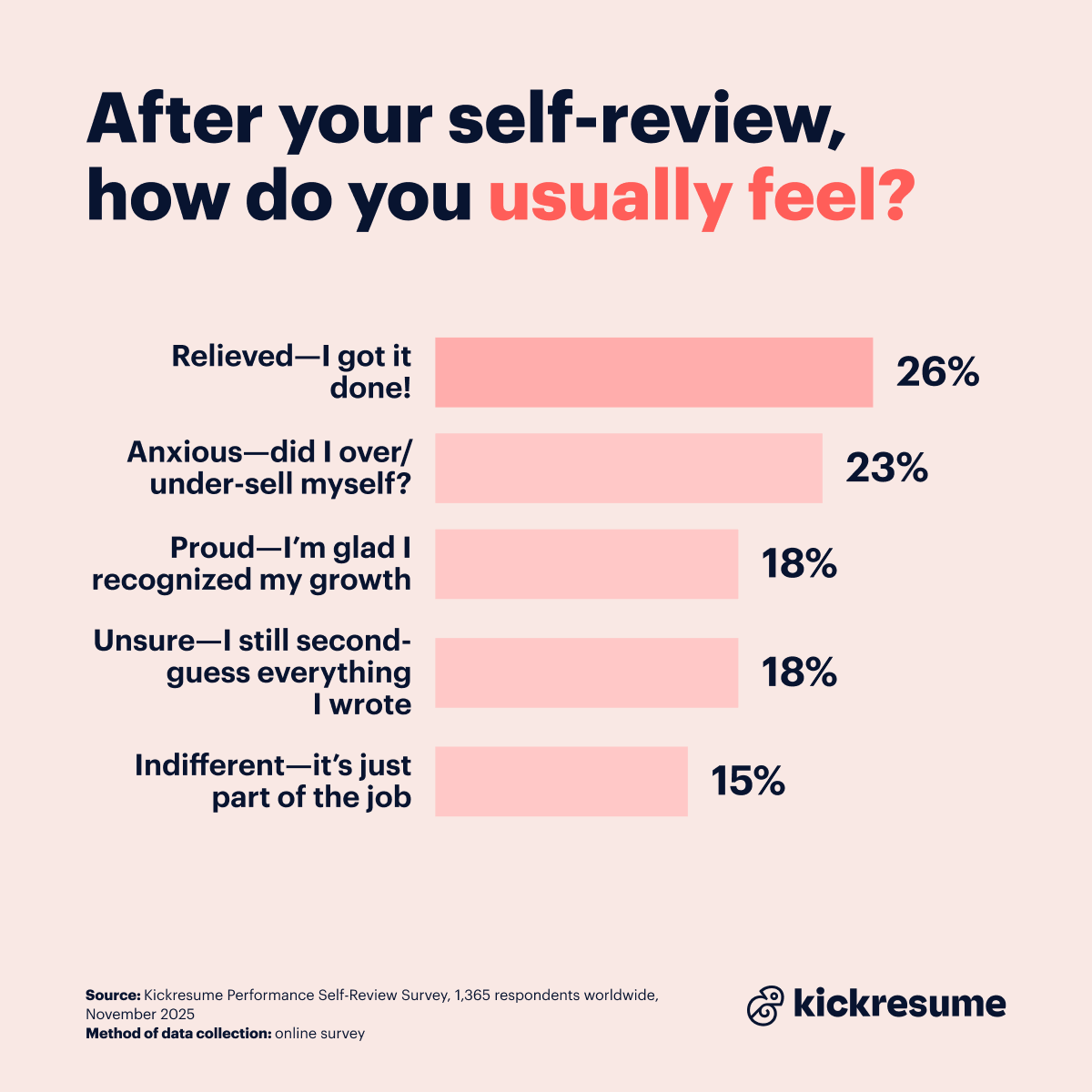
For almost half of the respondents, the self-review process brings some level of stress. To be more precise, 49% said they finish their review either relieved or anxious:
- For 26% of them, the stress lifts once they hit submit and they feel relieved to have it done.
- But for the remaining 23%, the anxious feeling stays even after the review is sent.
- Not everyone walks away tense, though. 18% feel proud because writing the review helped them notice their own progress.
- And another 18% are left unsure and keep second-guessing what they wrote.
- Only 15% remain completely unfazed.
These numbers show that self-reviews are far from a neutral exercise. For many people, the process comes with pressure, uncertainty, and a sense that the stakes are high.
On the other hand, only 33% of people see self-reviews as genuinely helpful for their career growth (per our latest survey).
When we look at that alongside the stress people describe here, a certain mismatch becomes obvious. Employees put effort and emotional energy into a process that doesn’t always lead to meaningful outcomes.
Gen Z leads in both anxiety and pride after self-reviews
- Millennials and Gen X workers gave almost identical answers, with relief as their top feeling (both 28%) and anxiety close behind (23% and 24% respectively).
- Gen Z stood out from both groups. They were the only generation where anxiety was the most common reaction (25%) after submitting a review.
- At the same time, Gen Z also had the highest share of people who said they felt proud.
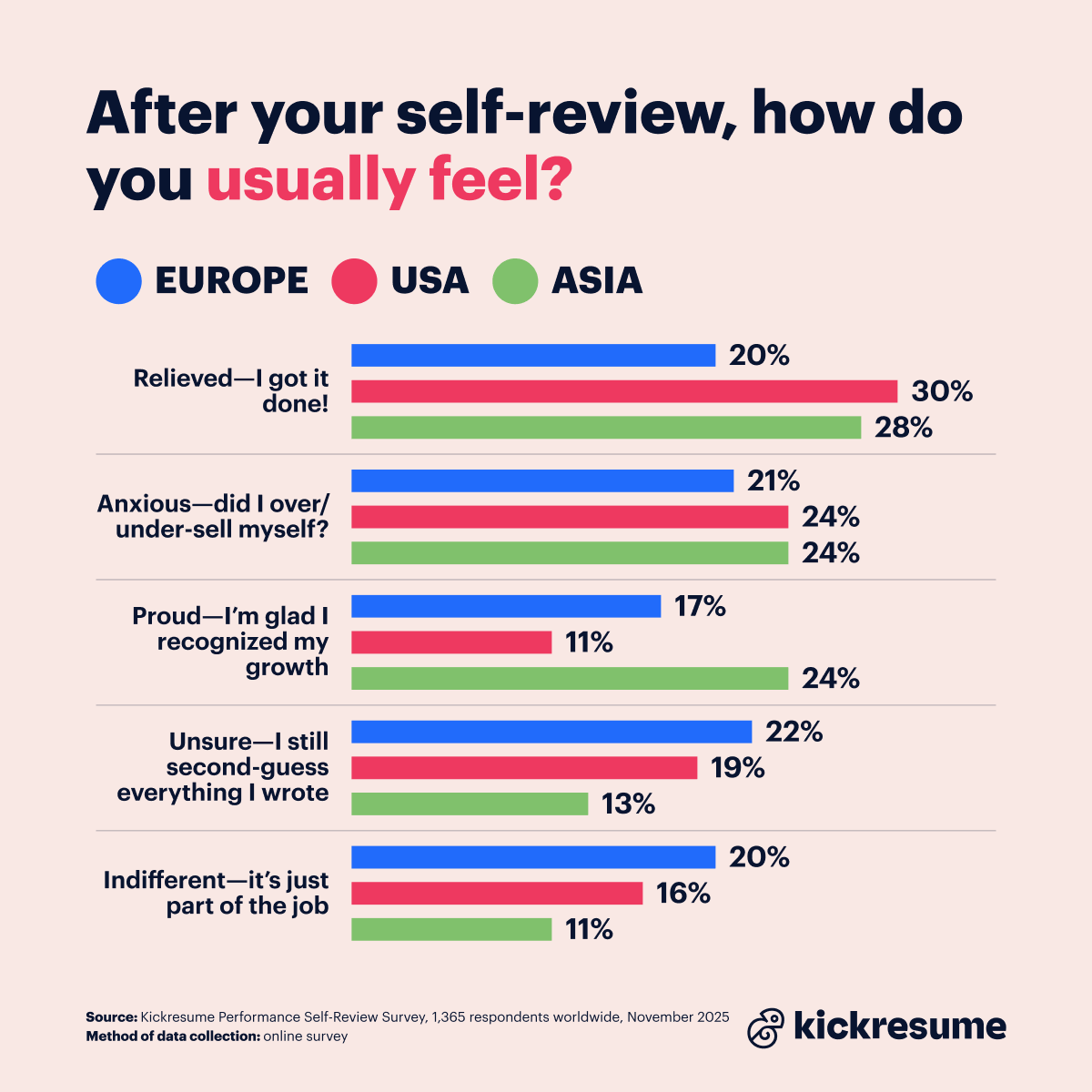
Regional results show another layer of variation.
- In Europe, feelings were spread more evenly. Higher levels of uncertainty and indifference suggest that self-reviews might not carry the same emotional weight as they do elsewhere.
- In the United States, relief was much more common, and anxiety remained high. This could reflect workplaces where reviews play a bigger role in decisions, which can make the process feel more serious.
- Asia showed strong levels of both pride and relief. Anxiety was present but not as dominant as in the United States or among Gen Z.
The top self-review fear? Not giving yourself enough credit
Given how much stress and anxiety a performance self-review brings to some employees, what is the thing they worry about the most? What fears does the process bring up?
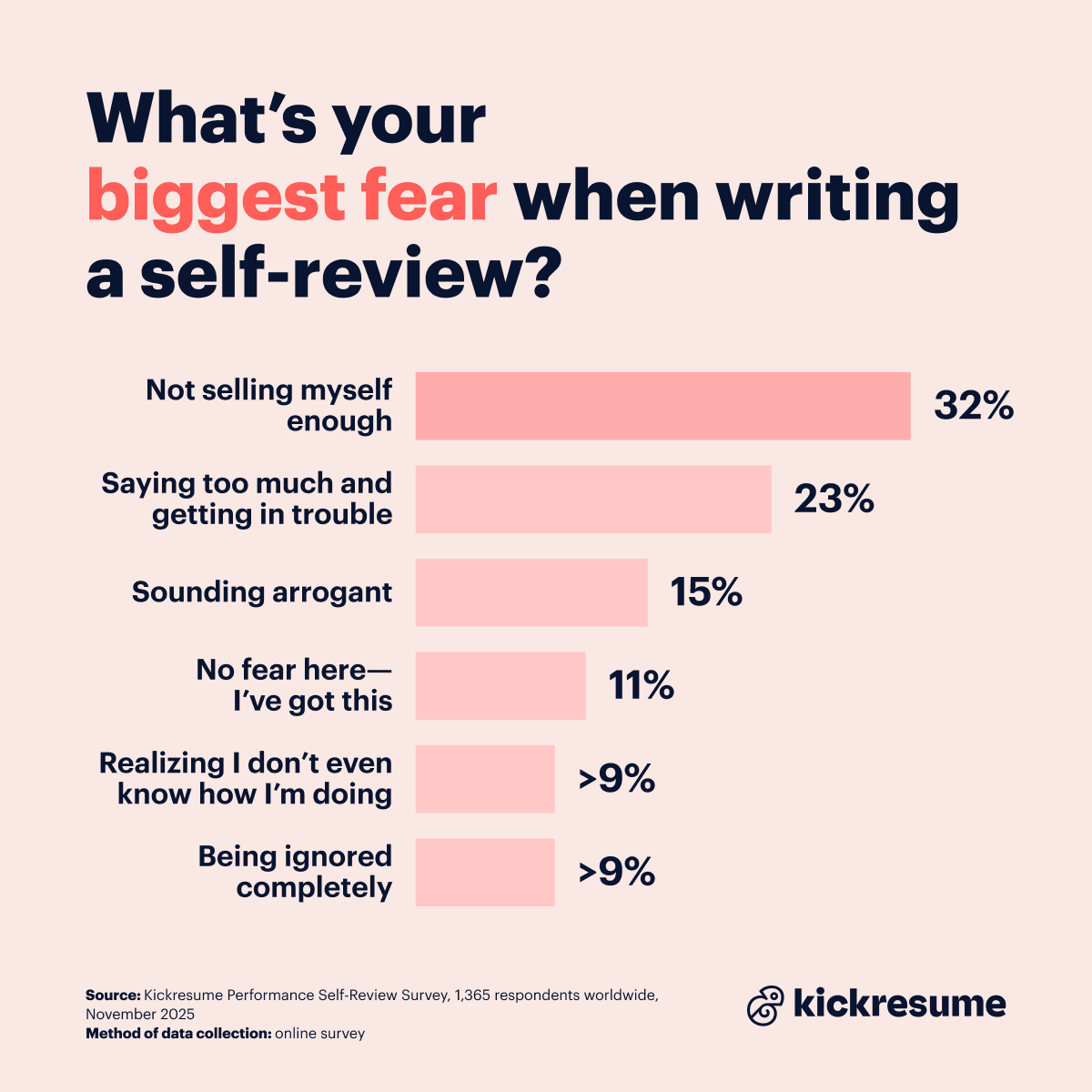
Only 11% of people told us they feel no fear at all when writing their self-review. So almost everyone else starts the process with at least some level of concern:
- The most common worry is not selling themselves enough. This was the case for 32% of respondents*. They are afraid they'll miss an achievement or describe their work too modestly.
- Right behind that is the fear of saying too much and getting in trouble. This applies to 23% of people.
- Another 15% worry about sounding arrogant. They want to highlight their work, but they also want to avoid overdoing it. Many feel they have to walk a narrow line.
Then there are two smaller groups.
- About 9% fear realizing they don't actually know how they are doing.
- And another 9% worry that no one will pay attention to their review at all.
Our results reveal that most people carry some kind of fear into their self-review. These worries vary, but they all tell us something about how employees see the process. For many, writing a self-review feels uncertain, delicate, and easy to get wrong.
- The fear of selling themselves too short is most common among Gen X respondents (24% for Gen Z, 34% for MIllenials, 39% for Gen X).
One possible reason is that Gen X workers may feel more pressure to stand out, especially as they work alongside younger colleagues with similar skills and ambitions.
- On the other hand, the fear of saying something that could get them in trouble is most pronounced among Gen Z workers (29% for Gen Z, 23% for Millennials, 18% for Gen X).
Younger workers may simply be more aware of how their words can be interpreted, both online and offline. Social media culture and the emphasis on public perception could make them more cautious when writing anything that will be read and evaluated.
12% don't feel safe at all to share their struggles
Earlier, we saw how many people worry about saying too much in their review. So it makes sense to look at how safe they actually feel when they try to be honest about their struggles.
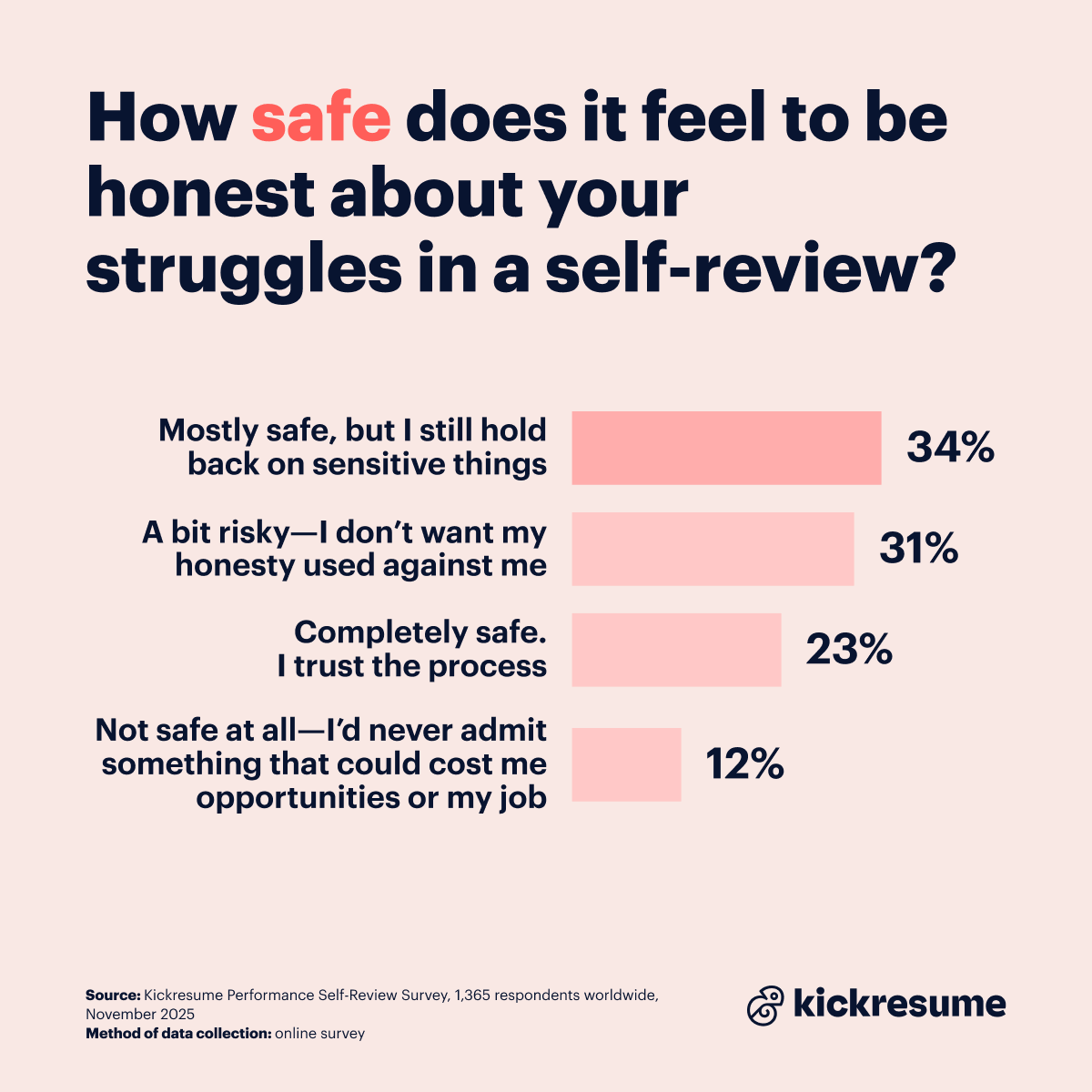
Most respondents fall somewhere in the middle.
- About 34% said the process feels mostly safe, but they still hold back on sensitive details. They're willing to share, just not everything.
- Another 31% said honesty feels a bit risky. They worry their words could be used against them, so they choose them carefully.
- On the other end, 23% feel completely safe. They trust the process and don't see a need to filter themselves.
- And 12% don't feel safe at all. They avoid saying anything that could harm their opportunities or job.
These results show that trust in the self-review process is uneven. Many people participate with caution. Only a small share feels fully open, while others worry about potential consequences. The system asks for honesty, but for a lot of workers, that honesty comes with conditions.
41% turn weaknesses into “growth,” while 7% avoid them entirely
If honesty in self-reviews comes with conditions, then talking about weaknesses is even more delicate. It's the part of the process where people feel most exposed. Admitting where you struggle asks for a sense of safety, and not everyone feels they have that. So the way people choose to approach their weaknesses tells us a lot about how they navigate the process.
Most people try to keep some control over how their weaknesses come across:
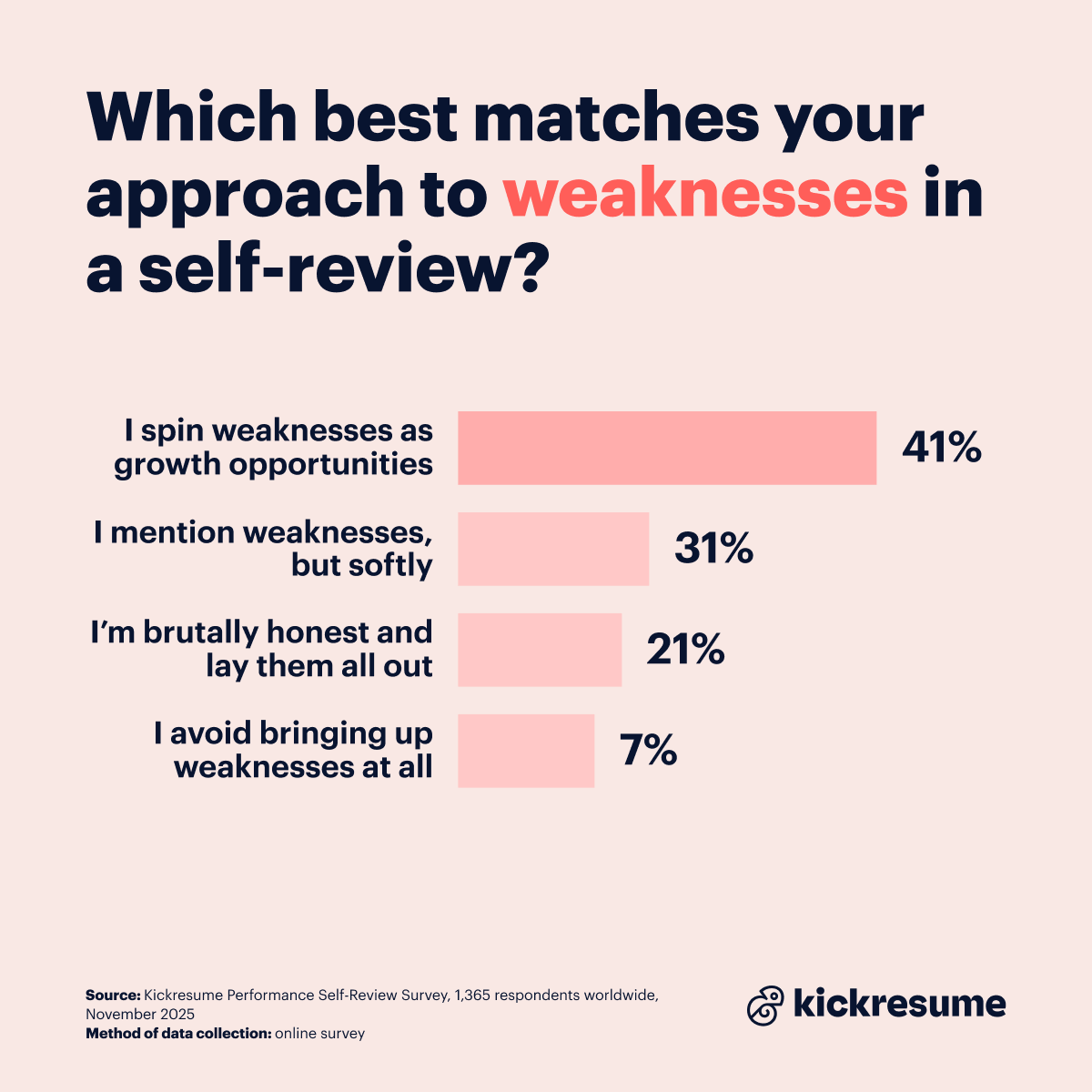
- The largest group, 41%, said they frame their weaknesses as growth opportunities.
This fits the pattern we have seen throughout the survey. People want to be honest, but they also want that honesty to feel safe. Reframing a weakness as a step toward improvement helps them stay open without feeling too vulnerable.
- Another 31% mention weaknesses, but softly. This lines up with earlier results about partial honesty and the instinct to avoid saying something that could be misunderstood.
- Then we have 21% who are brutally honest and put everything on the table.
This group breaks from the overall trend of caution. It may reflect more trust in their environment or simply a personal preference for straightforward communication. Either way, they represent a smaller share.
- And 7% avoid weaknesses entirely.
When we look at all these responses together, the common thread becomes pretty obvious. Most employees are participating but in a way that manages risk. They share what they feel comfortable sharing and adjust the rest.
And in the context of a manager–employee relationship, this hesitant approach makes sense. It reflects the reality that vulnerability at work is rarely simple, and people naturally protect themselves when the stakes feel even a little uncertain.
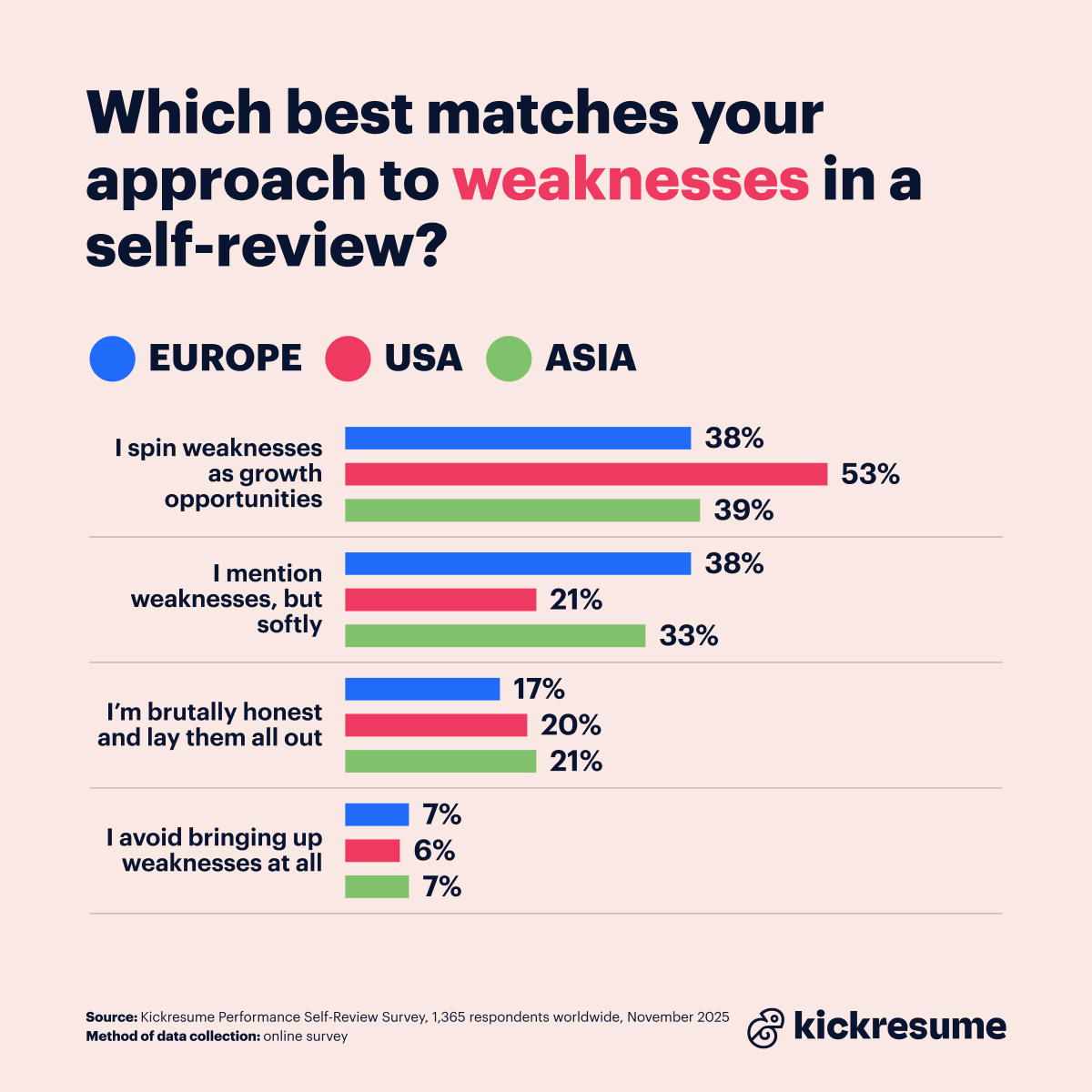
There's a strong U.S. preference for spinning weaknesses as growth opportunities (53%), which could point to a workplace culture where framing matters. People may feel that how they present themselves carries weight, so they choose the safest, most positive version of the truth.
Europeans, on the other hand, seem less focused on strong self-positioning, splitting almost evenly between reframing a weakness (38%) and mentioning it softly (38%).
Their answers lean toward understatement and balance. It may reflect a workplace culture where being overly positive or overly critical feels out of place, so people stay somewhere in the middle.
Up to 69% have disagreed with a manager’s review
All the hesitation we've seen so far doesn't happen in a vacuum. It lives inside a relationship where one person evaluates their own work and another person judges it from the outside.
And whenever vulnerability feels complicated, that relationship feels it too. So it makes sense to look at what happens when employees compare their own view of their performance with their manager’s.
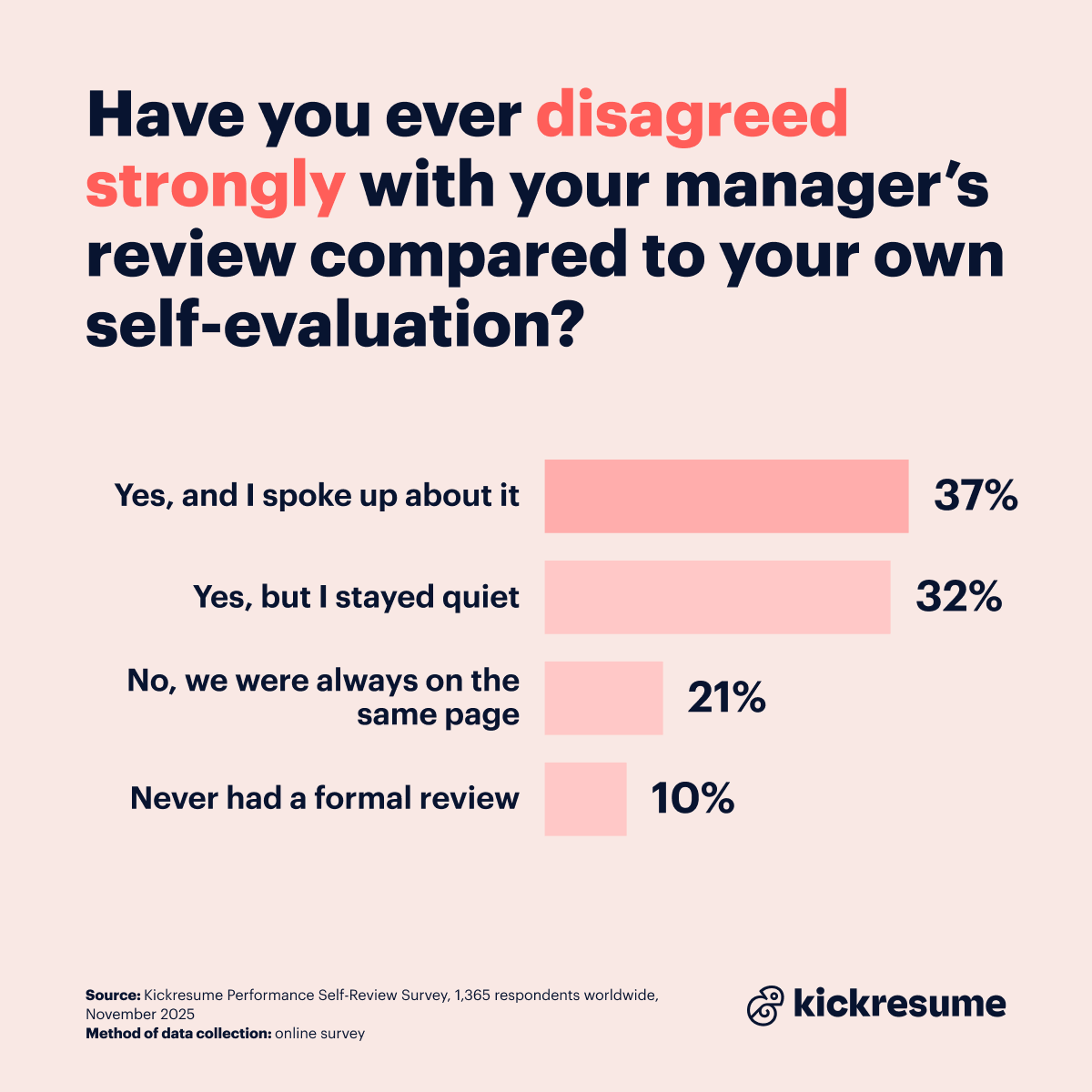
In 69% of cases, people told us they've strongly disagreed with their manager’s review at some point. That alone shows how common these disconnects are. But how people handle those moments varies a lot:
- About 37% said they disagreed and felt confident to speak up about it.
- Close behind them is another group of 32% who also disagreed, but stayed quiet.
- Only 21% said they've always been on the same page as their manager, which is also a fairly big share.
- And 10% said they've never had a formal review at all, so this kind of comparison simply doesn't come up for them.
What we see here is pretty straightforward. Strong disagreements happen a lot, and people deal with them in different ways. Some bring it up. Some hold it in.
The way people respond to these disagreements ends up saying a lot about the relationship itself. If the trust is solid, talking about a mismatch feels normal. If the trust is shaky, even a small disagreement can feel like something best left unsaid.
Review season strengthens the manager relationship for 38% of employees
Despite the fact that disagreements between managers and employees are high (69%), they rarely damage the relationship. In many cases, the relationship stays steady or even gets stronger after review season:
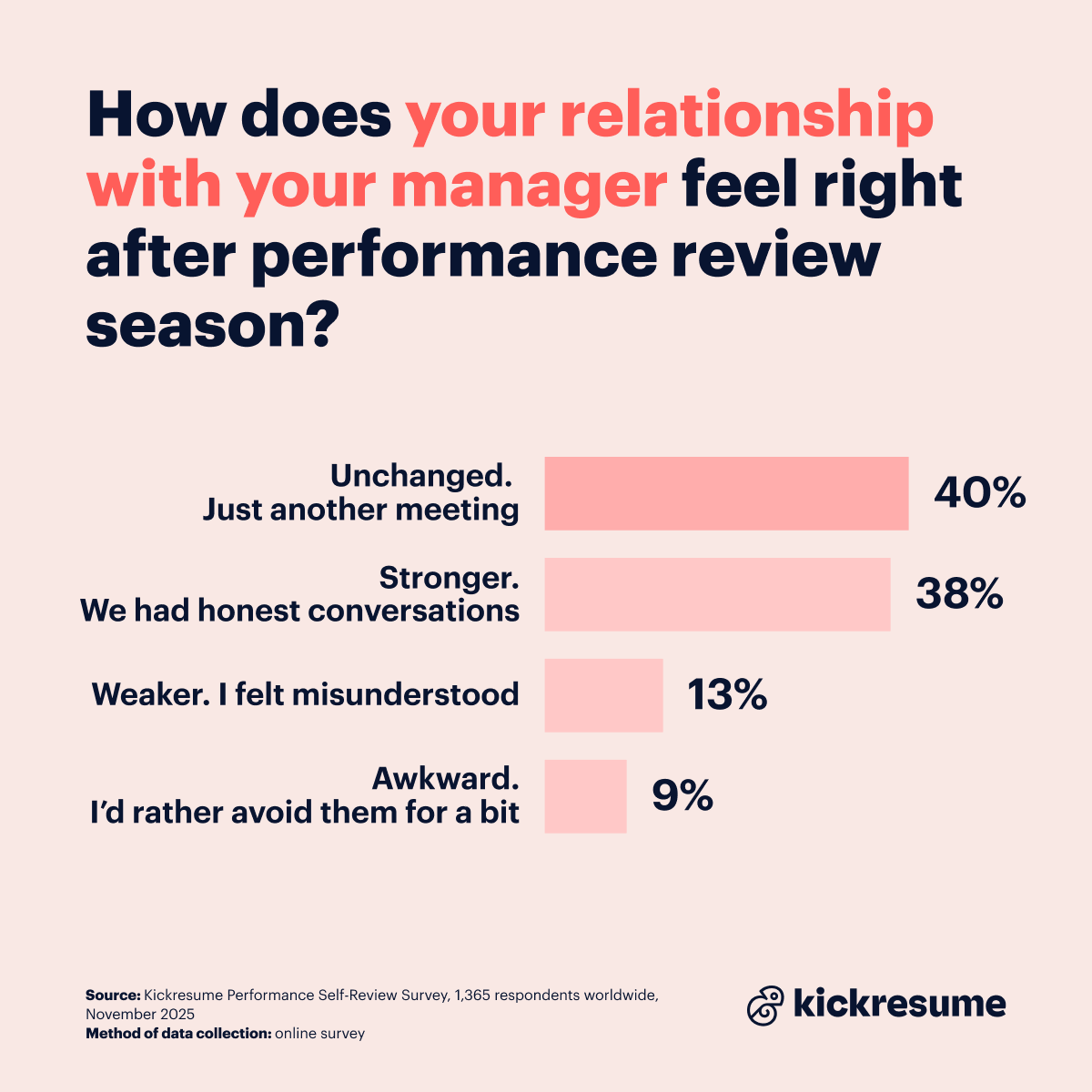
- 40% said their relationship with their manager feels unchanged afterward.
- Another 38% said the relationship actually feels stronger.
Not everyone has a positive experience, of course.
- 13% said the relationship feels weaker because they walked away feeling misunderstood.
- And 9% said things feel awkward for a while.
Even so, the outlook is encouraging. Most people come out of their review discussions feeling either stable or better off. And for many, the chance to talk openly with their manager helps resolve tension rather than create it.
Workers want more conversation (20%) and clarity (18%)
In the last chapter, we saw that open conversations with managers often make the working relationship feel stronger. And that same idea pops up again here.
When we asked people what they would change about the self-review process, the top answer was: 20% said they want it to feel more conversational.
After all the careful phrasing and second-guessing we saw earlier, people are asking for something more natural and human. They want to talk things through instead of writing everything down in a format that can feel stiff or easy to misinterpret.
And this is where things get interesting!
In our previous article, we mentioned that 72% of respondents believe their managers use AI to write performance reviews. So while employees are asking for more conversation and more human contact, many feel the process is moving the other way.
It’s easy to see how that creates tension. People want a real exchange, but they worry they’re responding to something written by a tool, not a person. That makes it harder to trust the process or feel open during it.
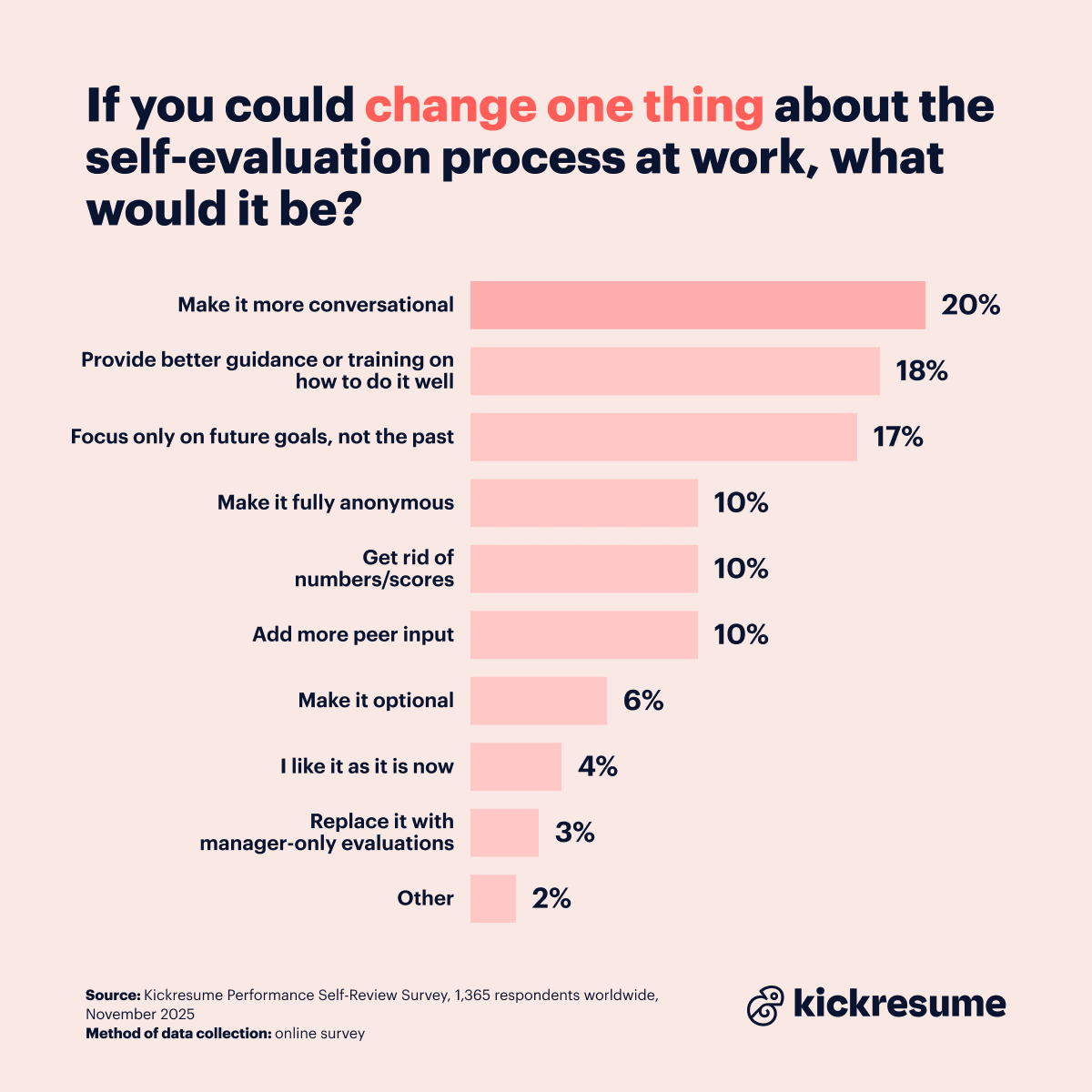
- Right behind that, 18% want better guidance or training on how to do a self-review well.
This one suggests that many employees don't receive clear instructions from their organizations. They're left to figure out the process on their own, which only adds to the uncertainty we saw throughout this report.
- Another 17% want the process to focus more on future goals rather than revisiting the past.
This shows a desire for a more forward-looking approach that supports growth instead of dwelling on old missteps or unclear expectations.
Several smaller groups highlight other areas for improvement:
- About 10% want the process to be anonymous.
- Another 10% would remove numbers and scores.
- And 10% want more peer input.
The remaining answers are even smaller:
- 6% want the review to be optional.
- Only 4% like the process as it is.
- And 3% would prefer manager-only evaluations.
What stands out most is what employees don’t put at the top. Even though trust and vulnerability are ongoing themes in this survey, anonymity isn't a leading request. Instead, people prioritize conversation, clarity, and a process that helps them move forward.
Self-reviews aren’t really “self” for 54% of respondents
The uncertainty and haziness around what self-reviews are actually probing, combined with the lack of guidance from employers, are responsible for one intriguing outcome.
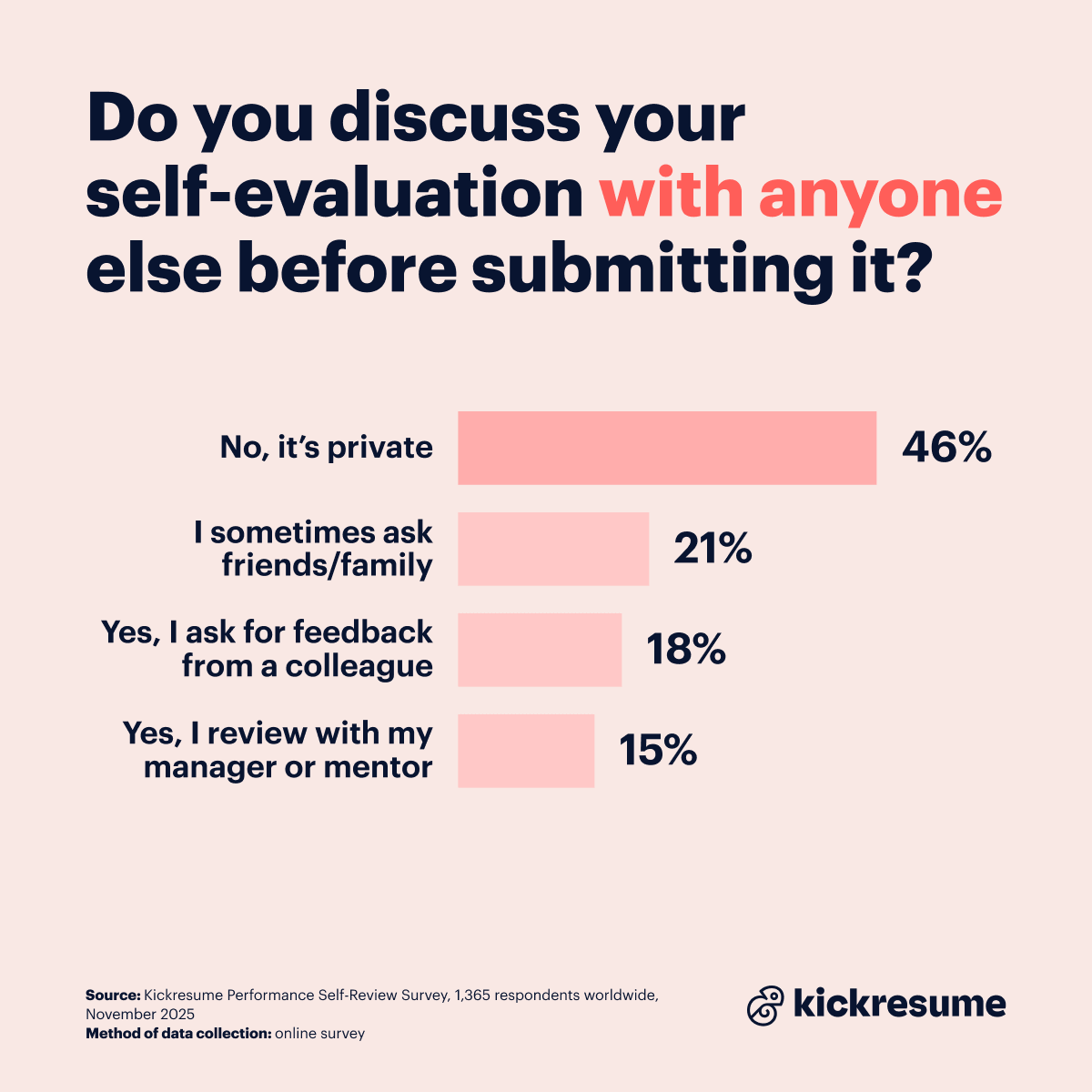
These forms are supposed to be self-reviews, yet the majority of our respondents (54%) admit they talk to someone else before submitting them.
In a way, this goes against the whole idea of a self-assessment.
Here’s how people answered:
- 46% said no, it’s private.
- 21% sometimes ask friends or family.
- 18% ask a colleague for feedback.
- 15% review it with their manager or mentor.
Why could this be?
- Firstly, it points to a lack of clear direction from employers. When people are unsure what is expected, they look for help elsewhere. A simple conversation with a friend or colleague can help them figure out what the review is really asking for, because they aren’t getting that clarity from the organization itself.
- Secondly, it connects back to the fears we saw earlier. Many workers worry about not selling themselves enough or saying something that could hurt them. Checking with someone else becomes a way to make sure they get it right.
In the end, the fact that people feel the need to get outside help says more about the system than about the employees. If a “self” review requires this much guesswork, the process itself may be the part that needs a closer look.
Final thoughts
People are trying their best to be honest and thoughtful in their self-reviews, but the process doesn't always make that easy. There's stress, there's second-guessing, and there's a lot of careful framing. Most employees want to speak openly about their work, yet many still feel they need to protect themselves while doing it.
At the same time, the results show that people don't want less involvement. They want better involvement. They want clearer instructions, more guidance, and space for real conversation. They want a process they can trust, not one they have to navigate with caution.
If employers can meet them halfway with guidance, openness, and a bit more trust, self-reviews could become less of a chore and more of a meaningful part of working life.
Demographics
Gender
- Male: 69%
- Female: 30%
- Non-binary or other: 1%
Age
- Under 18: 2%
- 18–28: 28%
- 29–43: 44%
- 45–60: 23%
- 61–79: 2%
- 79 or older: <1%
Location
- Africa: 12%
- Asia: 24%
- Australia/Oceania: 2%
- Europe: 27%
- Latin America: 10%
- North America: 25% (90% based in the USA)
Note
This anonymous online survey by Kickresume, conducted in November 2025, gathered insights from 1,365 respondents globally. All participants were reached via Kickresume's internal database.
About Kickresume
Kickresume is an AI-based career tool that helps candidates source jobs and raise salary with powerful resume and cover letter tools, skills analytics, and automated job search assistance. It has already helped more than 8 million job seekers worldwide.