For years, the CV has been the standard way to present professional experience. Today, expectations around it are changing.
Candidates are expected to tailor their resumes more closely to each role, while recruiters look for clearer signals of real ability. At the same time, other ways of presenting experience — from portfolios to skills-based profiles and professional platforms — are becoming more visible in hiring.
To understand how people actually feel about CVs today — and where they think things are headed — Kickresume surveyed 1,004 respondents globally, including both job seekers and HR professionals.
The survey focused on where people struggle most when writing a CV, which formats they trust to represent ability, and how they see the future of CVs.
The results suggest that CVs aren’t disappearing — but the way people use and evaluate them is evolving, often alongside other ways of showing skills and experience.
Here’s a quick snapshot of the key findings:
- 38% of HR professionals say candidates struggle most with describing responsibilities and achievements, while 29% of job seekers say tailoring a CV to each role is hardest.
- Nearly three quarters of job seekers say they tailor their CV for each role, either significantly (28%) or with minor tweaks (46%).
- The traditional CV remains the top single format for showing ability, but at the same time, only 31% of HR professionals and 29% of job seekers chose it.
- Gen Z, the youngest generation of job seekers, is the only group where the traditional CV no longer ranks first: 29% say portfolios or project examples best represent ability, 28% favour skills-based profiles, and 23% choose a traditional CV.
- Nearly 8 in 10 respondents expect CVs to either change significantly or be replaced within the next 10 years.
- If CVs disappeared, social or professional profiles like LinkedIn would be the most commonly chosen alternative (27%) — though without majority support.
Job seekers’ top CV struggle? Tailoring it to the role
Writing a resume isn’t just about listing experience. It’s about deciding what matters, how to frame it, and how much detail is enough. And that’s where things start to fall apart.
When we asked HR professionals which part of a CV they think candidates struggle with most, the answer was clear. 38% pointed to describing responsibilities and achievements — far ahead of:
- choosing and describing skills (20%)
- tailoring the CV to each role (20%)
- writing a personal summary (12%)
- formatting and design (9%)
Only 1% of HR respondents said they don’t think any part of the CV writing feels particularly hard for candidates.
.png)
Job seekers see the problem slightly differently.
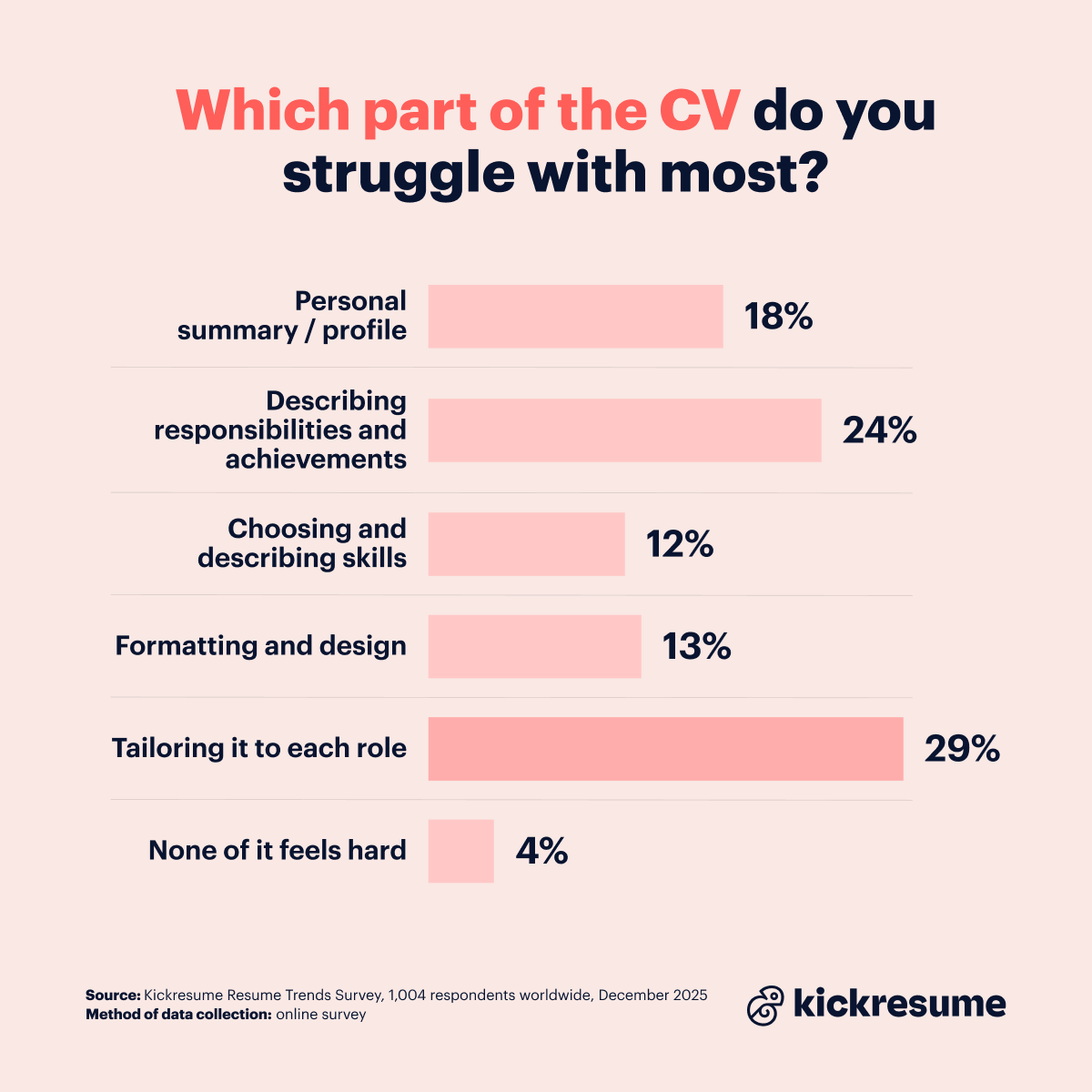
For them, the biggest difficulty isn’t the wording itself, but tailoring the CV to each role — 29% selected tailoring as the hardest part of the process, followed by:
- describing responsibilities and achievements (24%)
- writing a personal summary (18%)
- formatting and design (13%)
- choosing and describing skills (12%)
Only 4% say none of it feels hard.
Put together, the results highlight a disconnect.
Candidates focus on the effort required to adapt their CVs for each application, while recruiters more often notice the outcome — CVs where responsibilities and achievements aren’t clearly explained.
According to HR expert Marta Říhová, this gap isn’t accidental. Most candidates are comfortable describing factual aspects of their work, especially technical or project-based details. The difficulty starts when they have to interpret those facts for a specific role:
“Most candidates don’t struggle with describing factual parts of their work, especially technical or project-based details. They can usually easily explain what they did, where they worked, or which technologies they used.
Where things get much harder is self-evaluation. Choosing and naming their own competencies, talking about strengths, achievements, or explaining how they work doesn’t come naturally to many people — especially when it comes to soft skills and personal strengths.”
In other words, tailoring isn’t just about editing a resume for a different job title. It requires deciding which experiences matter most, how to frame them, and how to translate past work into relevant skills — exactly the areas where candidates report the most uncertainty.
Overall, the data suggests that the hardest parts of resume writing aren’t about layout or design. They’re about deciding how to present real experience in a way that feels relevant, specific, and convincing.
Where you apply shapes what feels hardest about writing a CV
The same challenges don’t show up everywhere in the same way. The data shows that different job markets emphasise different pain points.
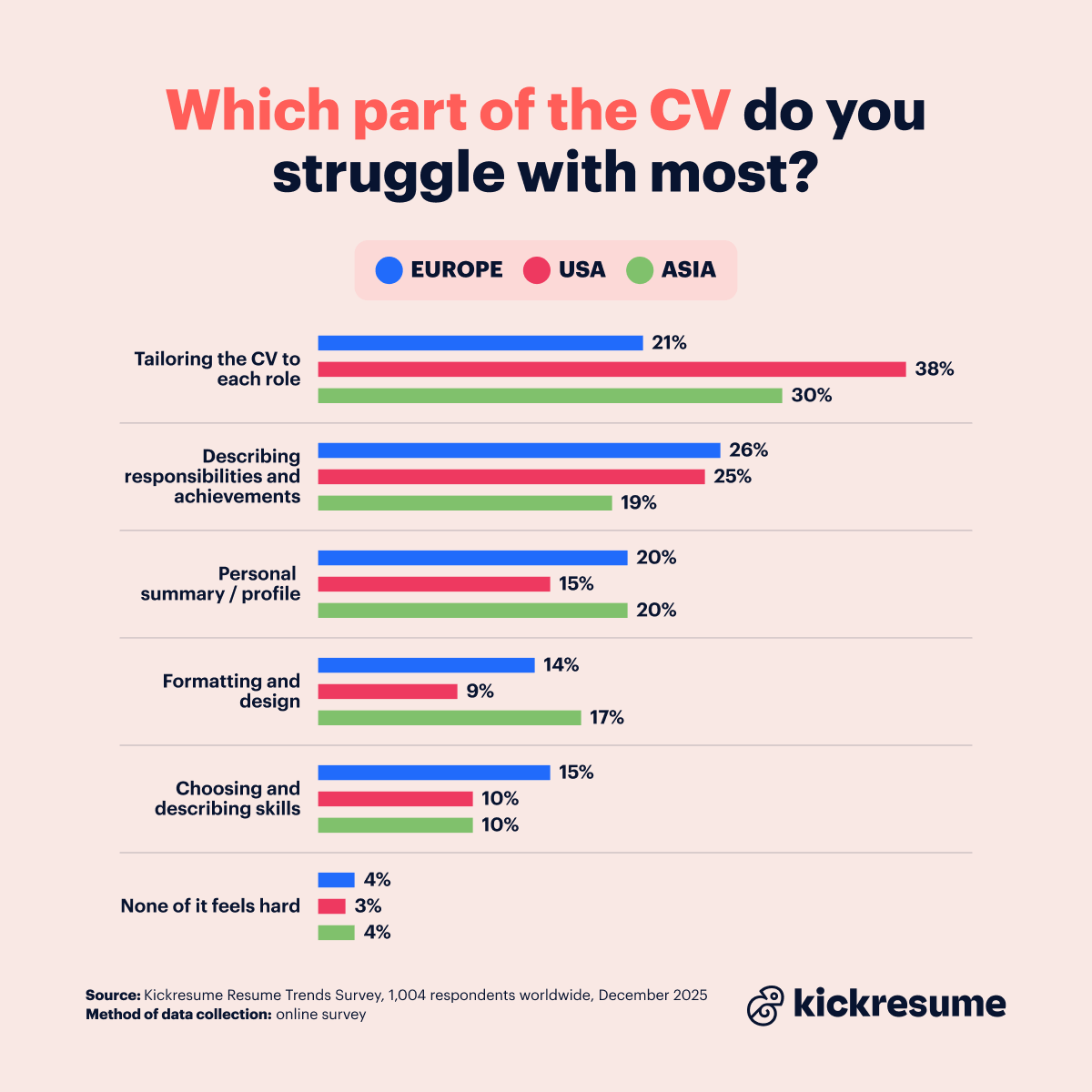
Across all respondents, 29% of job seekers say tailoring their CV to each role is the hardest part of the process. But this average hides clear regional differences.
In the United States, tailoring stands out as the dominant challenge. 38% of US-based respondents say adapting their CV for each role is the hardest part of CV writing — significantly more than those who struggle with describing responsibilities and achievements (25%) or writing a personal summary (15%).
In Europe, the picture shifts. Tailoring is still a challenge, but it’s not the top one. Instead, 26% of European respondents say the hardest part of CV writing is describing responsibilities and achievements, while 21% struggle with tailoring and 20% with writing a personal summary.
In Asia, tailoring again ranks highest. 30% of respondents say it’s the hardest part of the process, followed by writing a personal summary (20%) and describing responsibilities and achievements (19%).
Seen side by side, the regional pattern is clear:
- USA: Tailoring is the most common struggle (38%)
- Europe: Describing responsibilities and achievements ranks first (26%)
- Asia: Tailoring again leads (30%)
Taken together, these struggles help explain why conversations around the traditional CV often extend beyond the document itself. When candidates find it difficult to interpret their experience, prioritize what matters, and tailor it clearly for each role, many look for additional ways to support what’s already in their CV.
CVs rank first for showing ability, but they don’t win a majority
Despite growing interest in new formats, the traditional CV still ranks first when it comes to representing ability. But that first place comes without majority support.
Among HR professionals, 31% choose the traditional CV as the best format for representing a candidate's ability. That makes it the most common answer — but it also means 69% believe another format does a better job.
LinkedIn profiles (23%) and skills-based profiles or assessments (22%) follow closely, with portfolios and project examples at 16%. Video or recorded pitches remain a fringe option at 8%.
Job seekers also place the traditional CV first, but the ranking that follows looks different.
29% job seekers say a traditional CV best represents their ability. Almost the same number, 28%, point to skills-based profiles or assessments instead. Portfolios and project examples (20%) and LinkedIn profiles (20%) sit just behind. Video formats trail far back at 3%.
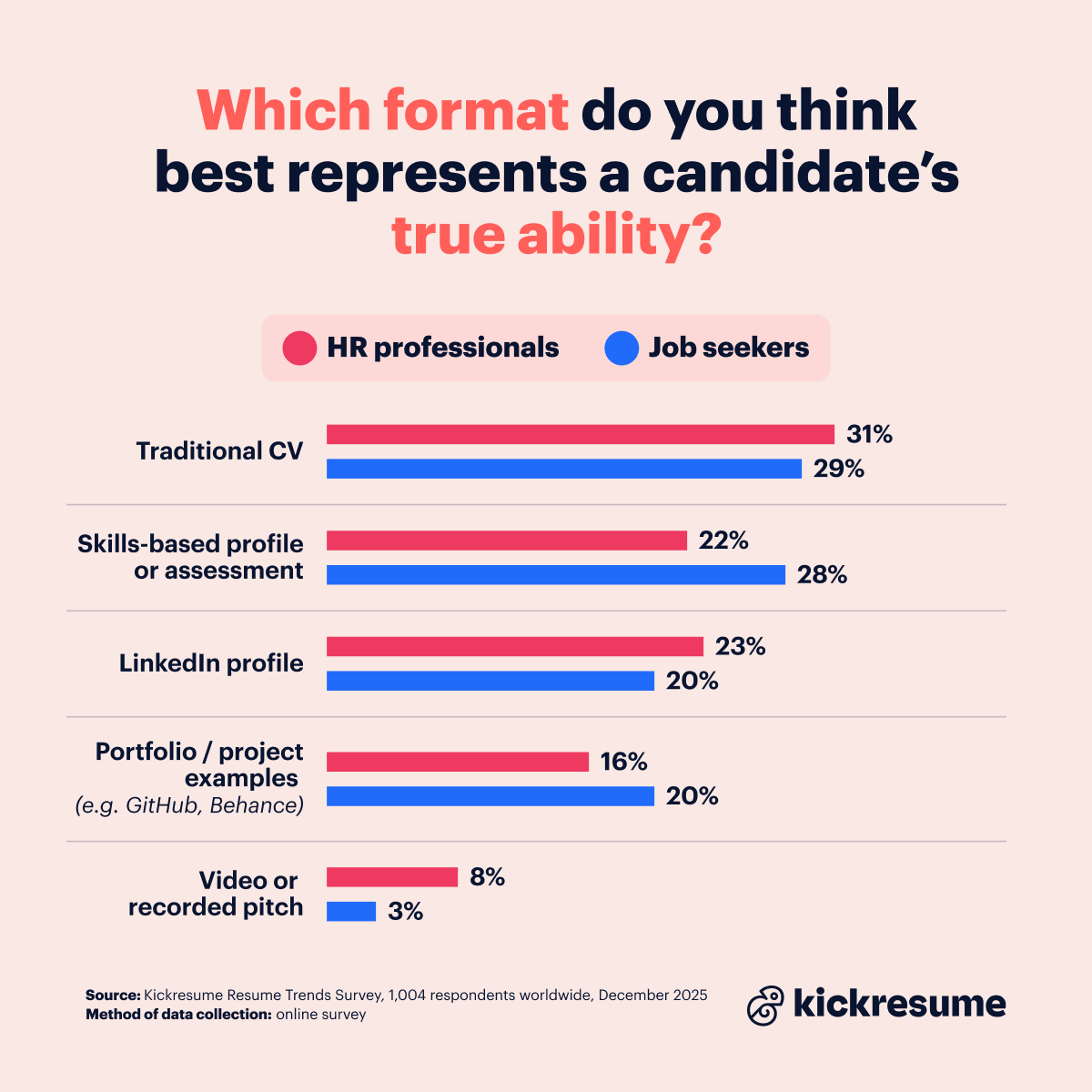
The pattern is clear. The CV still leads as a single format, but most people don’t put their trust in it alone. Ability is increasingly associated with extra proof — portfolios, projects, or profiles that show more than a list of past roles.
That shift is strongest among younger respondents, as Gen Z is the only generation where the CV no longer ranks first as the best way to show ability:
- Gen Z: Portfolios and project examples lead at 29%, closely followed by skills-based profiles (28%). Only 23% say a traditional CV best represents ability.
- Millennials: The traditional CV still ranks first at 30%, but skills-based formats follow closely at 28%.
- Gen X: The traditional CV remains the clear top choice at 37%, with skills-based profiles second at 27%.
The takeaway isn’t that the CV has lost all relevance — but that its role is no longer universally agreed on. While it still ranks first overall, it does so without majority support, and younger candidates are already placing more trust in alternative formats.
Nearly 8 in 10 expect CVs to change or be replaced in the next decade
When asked about the future of CVs, both HR professionals and job seekers point in the same direction: most don’t expect things to stay as they are.
Only a small minority believe traditional CVs will remain mostly unchanged over the next decade.
Among HR professionals, just 12% say CVs will stay mostly the same as they are today. The largest share, 39%, expect CVs to remain relevant but in a very different format, such as a more skills-based or AI-driven approach. A similar number, 38%, believe that something else will replace traditional CVs altogether. The remaining 11% are unsure.
Job seekers show almost identical expectations.
Only 10% believe CVs will stay mostly the same. 38% expect CVs to evolve into a very different format, while 40% think they will be replaced entirely. Another 12% say they’re not sure.
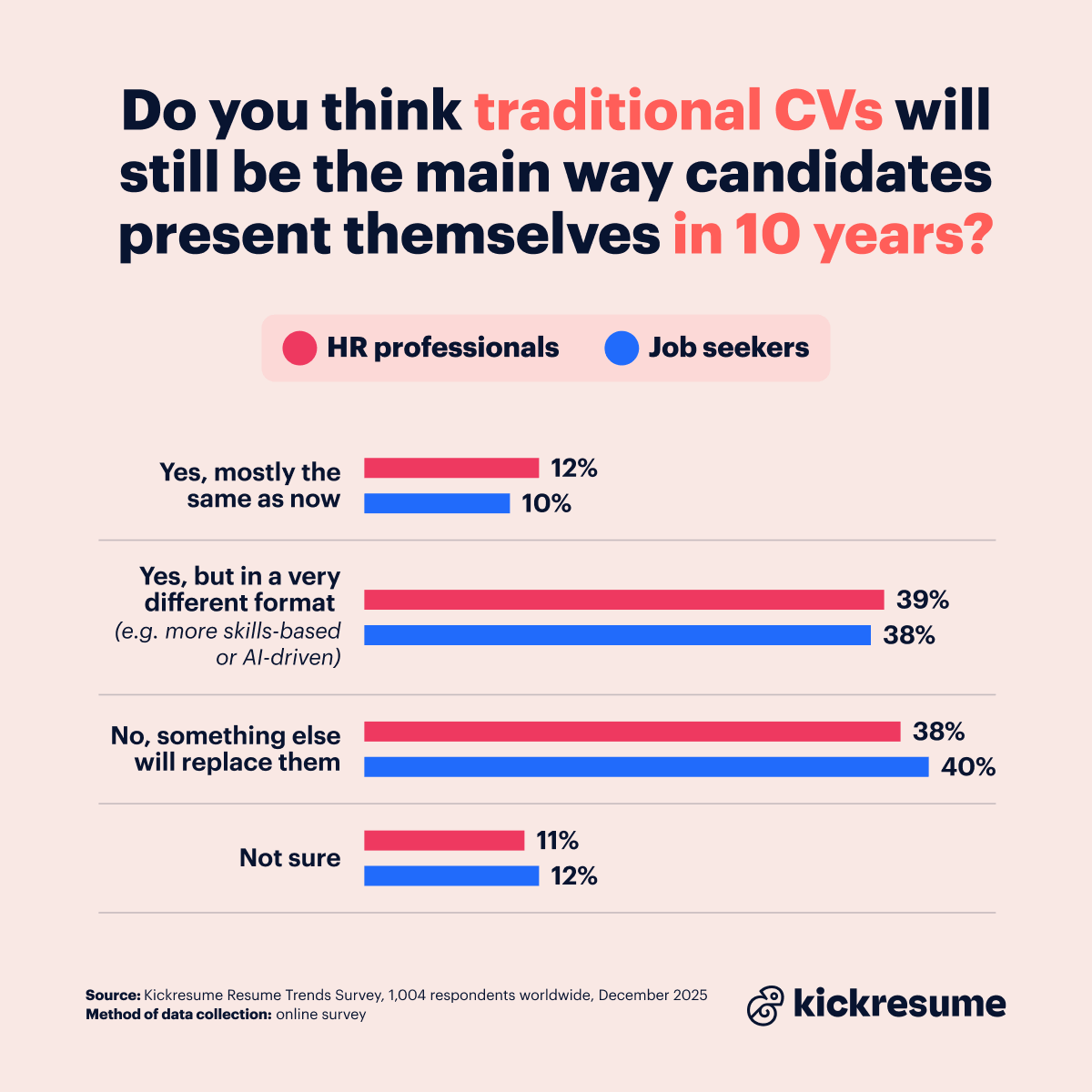
Taken together, the message is clear. Around 8 in 10 respondents expect either a major transformation of the CV or its replacement within the next 10 years. Very few believe the CV of today will still exist in its current form.
The split isn’t about whether change will happen, but about how far it will go. Some see the CV evolving into a new format, others expect it to be replaced — but only a small minority expect no change at all.
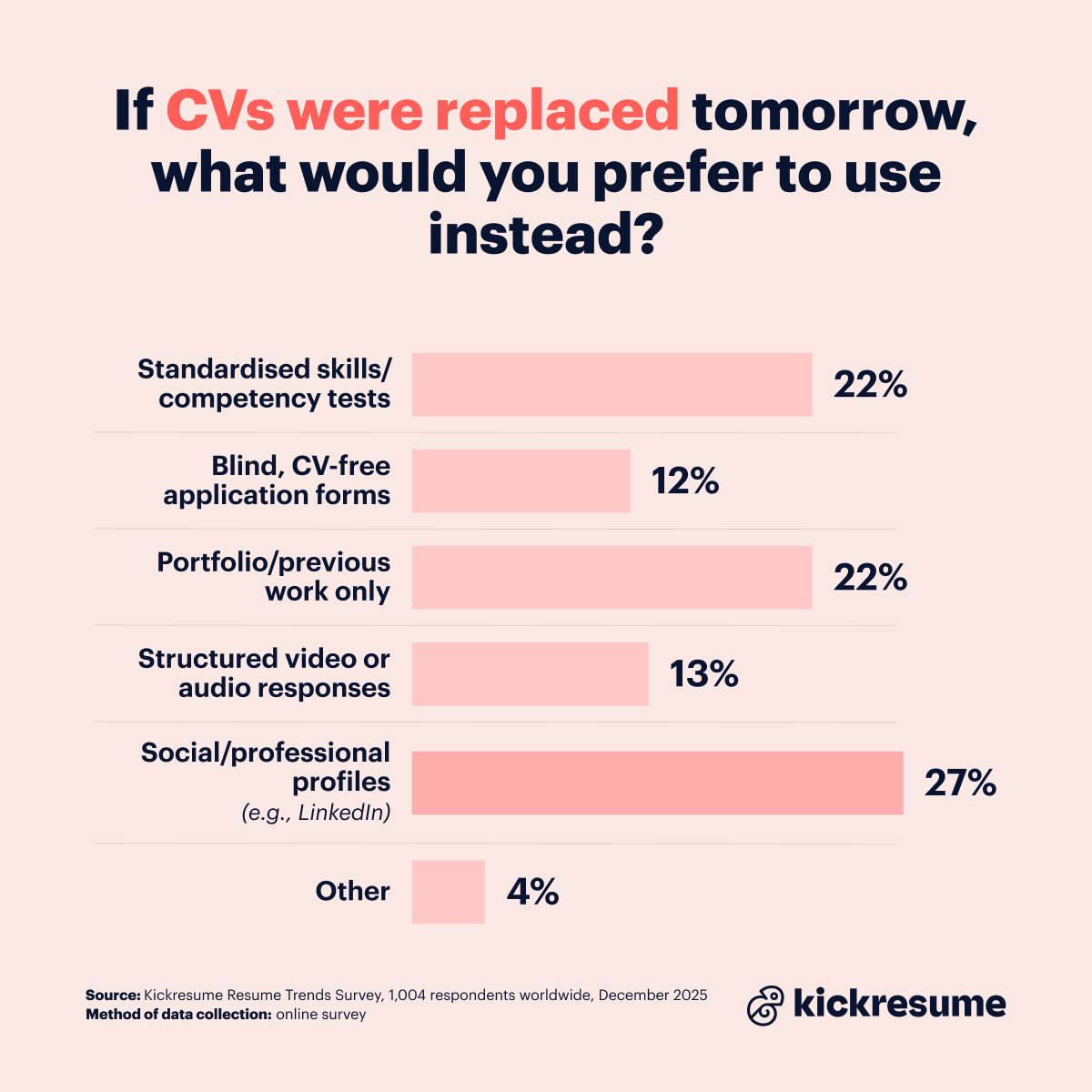
If CVs were replaced tomorrow, professional profiles would rank first
When asked respondents what they would prefer if traditional CVs disappeared overnight, the most popular alternative is social or professional profiles, such as LinkedIn, chosen by 27% of respondents.
Close behind are options that focus on measurable ability and real output:
- Standardised skills or competency tests: 22%
- Portfolio or previous work only: 22%
- Structured video or audio responses: 13%
- Blind, CV-free application forms: 12%
- Other: 4%
At the same time, the results show no clear replacement for the resume. While professional profiles are the most frequently chosen option, they fall well short of majority support. Preferences are split across several formats, each offering a different way to show ability.
Preferences also vary by age, pointing to different ideas of what “proof” looks like:
- Gen Z is most likely to choose portfolios (27%) and skills tests (26%), signalling a stronger preference for tangible output.
- Millennials lean most toward social or professional profiles (30%).
- Gen X also shows the strongest preference for social or professional profiles (33%).
Final thoughts
Taken together, the survey results point in a clear direction. Resumes are still part of the hiring process, but they no longer stand alone. As a single format, they rank first — yet without majority support, with only 31% of HR professionals and 29% of job seekers saying a traditional CV best represents ability.
At the same time, expectations around CVs are clearly shifting. Nearly 8 in 10 respondents believe CVs will either change significantly or be replaced within the next decade. Among younger candidates, that shift is already visible: Gen Z is the only generation where the traditional CV no longer ranks first, with portfolios and skills-based formats taking the lead.
Put simply, the role of the CV is changing. It still opens doors, but it’s increasingly evaluated alongside other signals — skills, projects, and professional profiles that offer a more complete picture of ability.
The CV still matters — just not on its own.
Demographics
Role
- HR-related: 12%
- Non-HR: 79%
- Others: 9%
Gender
- Male: 67%
- Female: 31%
- Non-binary or other: 2%
Age
- Under 18: 1%
- 18–28: 29%
- 29–43: 42%
- 45–60: 24%
- 61–79: 4%
- 79 or older: <1%
Location
- Africa: 9%
- Asia: 21%
- Australia/Oceania: 2%
- Europe: 28%
- Latin America: 9%
- North America: 31% (84% based in the USA)
Note
This anonymous online survey by Kickresume, conducted in December 2025, gathered insights from 1,004 respondents globally. All participants were reached via Kickresume's internal database.
About Kickresume
Kickresume is an AI-based career tool that helps candidates source jobs and raise salary with powerful resume and cover letter tools, skills analytics, and automated job search assistance. It has already helped more than 8 million job seekers worldwide.