A CV used to be a fairly static document. Today, it changes fast. Expectations shift, templates spread, and AI can rewrite everything in seconds. But the goal stays the same: convince someone you're worth a conversation.
To see how people think about CV writing today, Kickresume surveyed 1,004 respondents.
This is the first article in a series of three. In this part, we looked at how workers feel about AI in resumes, how common they think exaggeration is, and where they draw the line between polishing and lying. We also asked about omission, including whether people remove personal details to reduce bias.
We split the respondents into two groups: workers/job seekers and HR professionals. For specific questions, we show both sets of answers side by side, so you can see where they agree and where they don’t.
We also interviewed HR expert, Marta Říhová, whose comments are cited throughout the article to add detail and context to the survey findings.
Here's a quick rundown on the most intriguing results:
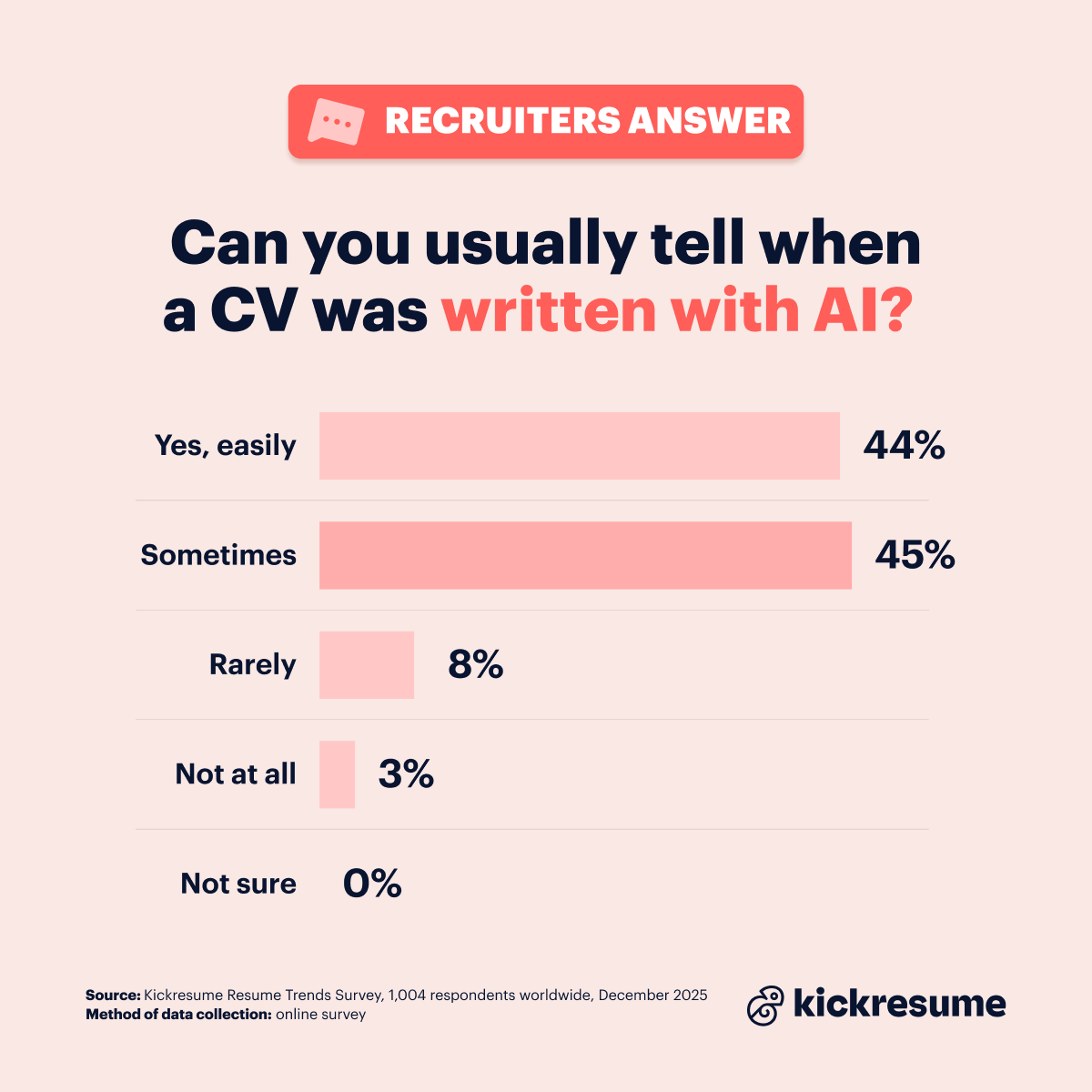
- 44% of HR professionals say it’s easy to detect AI use in CVs.
- AI is already treated like a real advantage because 78% rate it at least moderately helpful and 52% rate it very helpful or essential.
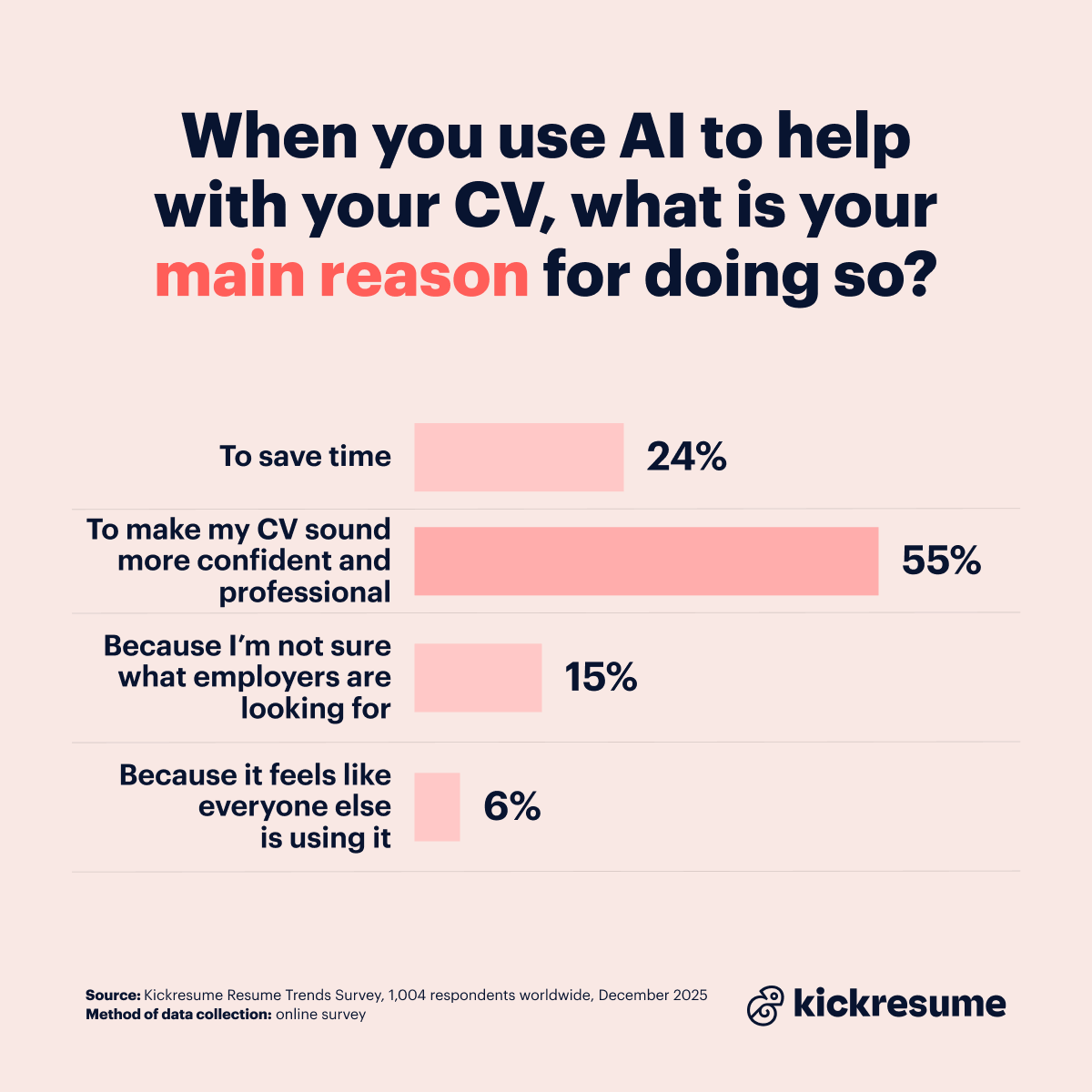
- People use AI more for confidence than convenience with 55% using it mainly to sound more professional, while 24% use it primarily to save time.
- 39% would use a “tiny lie” invented by AI to boost their competitiveness if it’s technically justifiable and 11% would do it without hesitation.
- Only 38% say they've never exaggerated or omitted anything from their CV.
- HR sees exaggeration as common on CVs: 39% say it shows up in 26–50% of CVs, and 31% say 51–75% of resumes.
- 41% of respondents said they’ve removed elements like a photo, address, dates, or school names to prevent bias.
Most people believe recruiters can detect AI use in CVs
A good CV is meant to sound polished. That’s the point. The issue is that AI can polish it in a very specific way. The same clean tone, the same neat phrasing, the same “confident but vague” bullets. Read enough of them and they start to blend together.
So can hiring managers actually tell when a CV was “niced up” with AI?
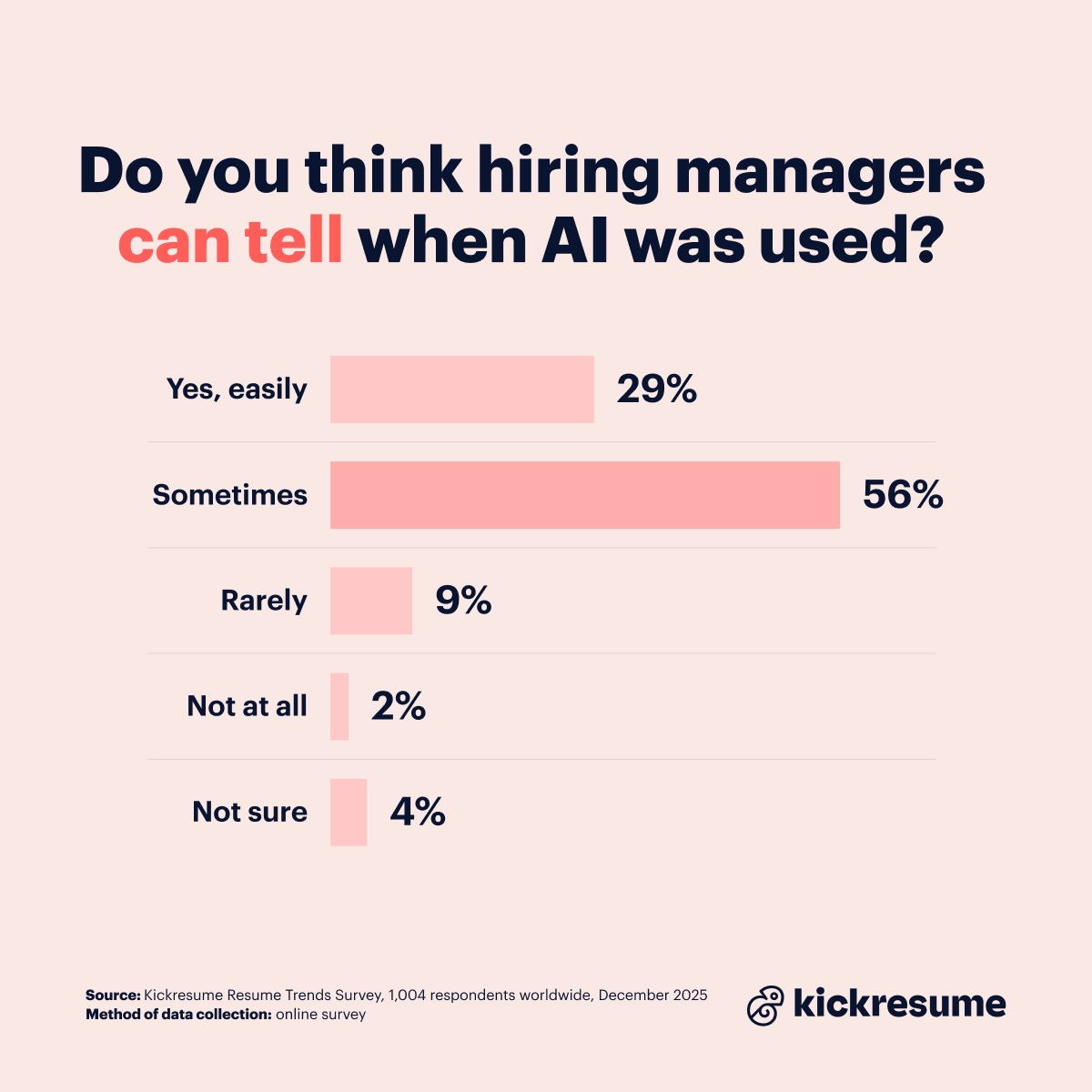
Most of our respondents (85%) think they can:
- In our survey, 29% said hiring managers can spot AI use easily.
- Another 56% said they can tell sometimes.
A significantly smaller group is more sceptical:
- 9% said recruiters can tell rarely.
- 2% said not at all.
- And 4% weren’t sure.
This suggests people assume recruiters have a trained ear because they read a lot of CVs. They expect HR to notice patterns like vague achievements or “perfect” phrasing that doesn’t match the role.
Still, “sometimes” is the top answer, not “yes, easily”. So there seems to be a sense that AI isn’t always obvious.
Looking at the regions, the pattern stays pretty consistent. “Sometimes” is the top answer everywhere, and “yes, easily” comes second.
- USA: 27% said “yes, easily” and 59% said “sometimes.” That’s 86% who think AI is detectable at least some of the time.
- Europe: 28% “yes, easily” and 56% “sometimes.” That’s 84%.
- Asia: 30% “yes, easily” and 49% “sometimes.” That’s 79%.
So overall, US respondents are the most confident that hiring managers can detect AI use, even if it’s not always obvious. But Asia has the highest share of “yes, easily” at 30%.
Still, HR is more confident about spotting AI than candidates are
Although job seekers and regular workers seem pretty confident that recruiters can tell when AI was used in a CV, their perception only comes close to how confident HR actually is.
Here’s the comparison side by side:
- Yes, easily: HR 44% vs. non-HR 27%
- Sometimes: HR 45% vs. non-HR 57%
- Rarely: HR 8% vs. non-HR 9%
- Not at all: HR 3% vs. non-HR 2%
- Not sure: HR 0% vs. non-HR 5%
In other words, both groups land in a similar place overall. Most people think AI can be spotted at least sometimes. But HR respondents are much more likely to say it’s obvious. Nearly half of HR (44%) chose “yes, easily,” compared to just 27% among everyone else.
This difference suggests that candidates may underestimate just how quickly AI-style phrasing can stand out to people who read CVs every day.
Still, HR expert Marta Říhová points out that spotting AI isn’t always that simple:
So what happens when a CV does feel clearly AI-made? Is that enough to disqualify someone?
Říhová’s answer is measured:
78% say AI is at least moderately helpful for CV writing
Given how many people think recruiters can recognize AI in a CV, is the risk worth it? How helpful do people actually find AI when writing or editing their resume?
For most respondents, it seems to be:
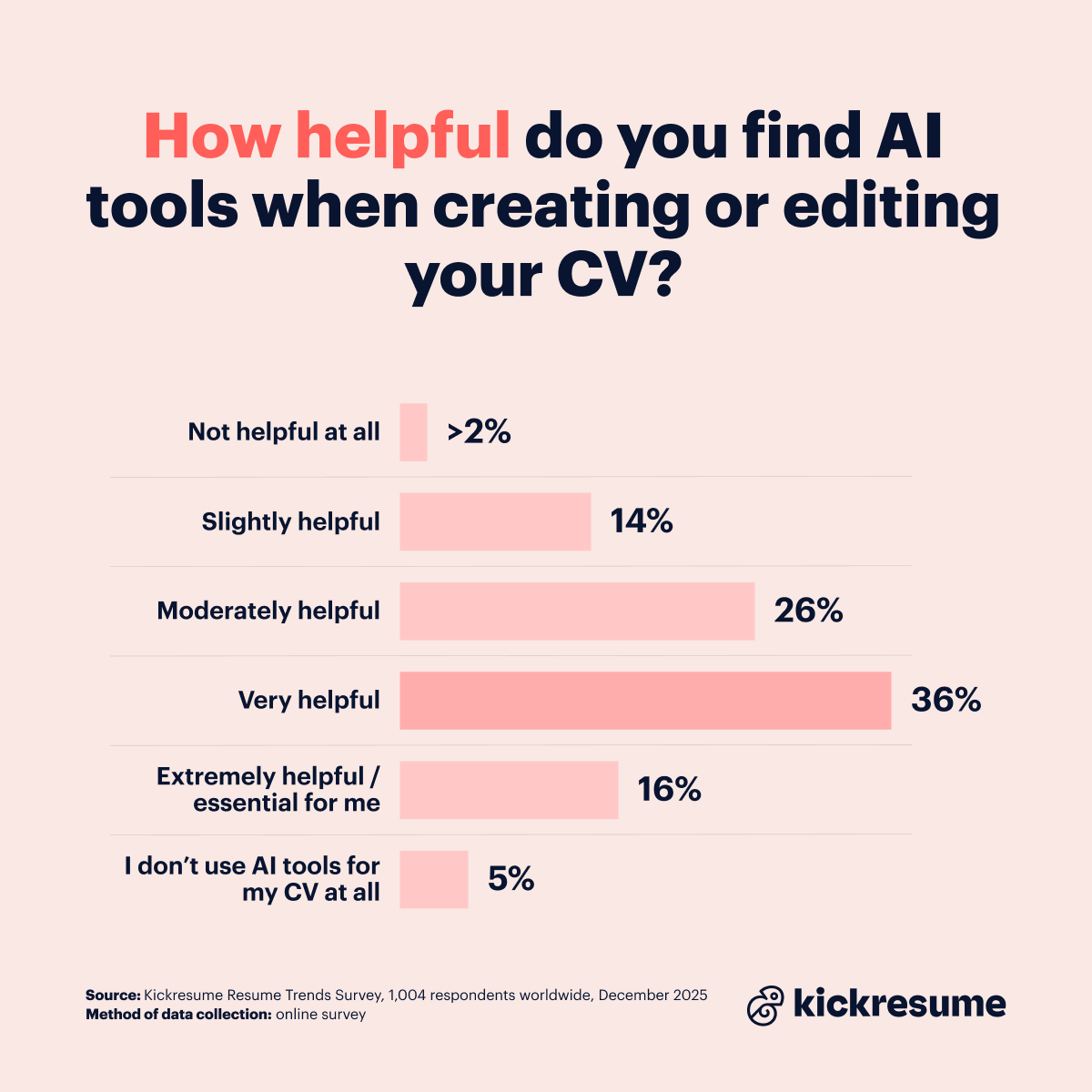
- Only just over 2% said AI tools aren't helpful at all, and 14% found them slightly helpful.
- The rest rated the impact much higher with 26% calling AI moderately helpful.
- 36% said it was very helpful, and 16% described it as extremely helpful or even essential.
Altogether, 78% of respondents see AI as at least moderately helpful for CV writing. And more than half, 52%, rate it as very helpful or essential.
Not everyone is using it, though. 5% said they don’t use AI tools for their CV at all. So while AI isn’t universal, most respondents who do engage with it see it as a meaningful help.*
How does this perception change when we move around the globe?
Europe looks the most consistently positive. Over half of European respondents rate AI as very helpful or essential (38% + 15% = 53%). They’re also less likely to avoid AI completely, with 4% saying they don’t use it at all.
Asia has the strongest “power user” group. It has the highest share calling AI extremely helpful or essential at 20% (compared to 15% in the USA and Europe). And almost no one in Asia says AI is not helpful at all (less than 1%). So the scepticism is low, and the enthusiasm at the top end is higher.
The USA is where AI feels most optional. The share saying they don’t use AI tools for their CV at all is highest there at 7% (vs. 4% in Europe and Asia). And the USA also has a slightly larger “not helpful” segment, with 4% saying not helpful at all, compared to under 1% in Asia.
There are a few practical factors might explain these gaps:
- In Europe, AI may be especially useful simply because many people apply across languages.
- In Asia, the higher “essential” rating may reflect the same thing, but more intensely. If you’re competing in high-volume markets or writing in a second language, AI can feel less like a nice extra and more like a real advantage.
55% turn to AI for confidence rather than saving time
“Helpful” can mean very different things depending on who’s writing the CV. For one person, it’s speed. For another, it’s confidence. For someone else, it’s simply trying to figure out what employers want to see.
For our respondents, the most common reason for using AI wasn’t to save time. It was to improve how the CV sounds.
- Just above half of respondents (55%) said they use AI to make their CV sound more confident and professional.
- 24% use it mainly to save time.
- Another 15% turn to AI because they’re not sure what employers are looking for.
- Only 6% said they use it because it feels like everyone else is using it.
That 55% is the most intriguing part. Anyone who’s used generative AI knows one of its weak spots is tone. It can sound generic, vague, and formulaic. So it’s a bit paradoxical that the main goal is to sound more professional.
One explanation may be that “professional” often means “safe.” Clear structure, tidy phrasing, fewer mistakes, and less awkward wording. If you’re worried your CV reads too casual or uneven, AI can quickly push it closer to the style people associate with a “proper” resume.
It also ties in with the 15% who use AI because they’re not sure what employers want. In that situation, AI becomes a shortcut to the expected format, even if the result risks sounding less personal.
Only 29% reject an AI suggested lie outright
Many people use AI because they want their CV to sound more confident and professional. But confidence can slide into something else if the tool starts “helping” with the facts.
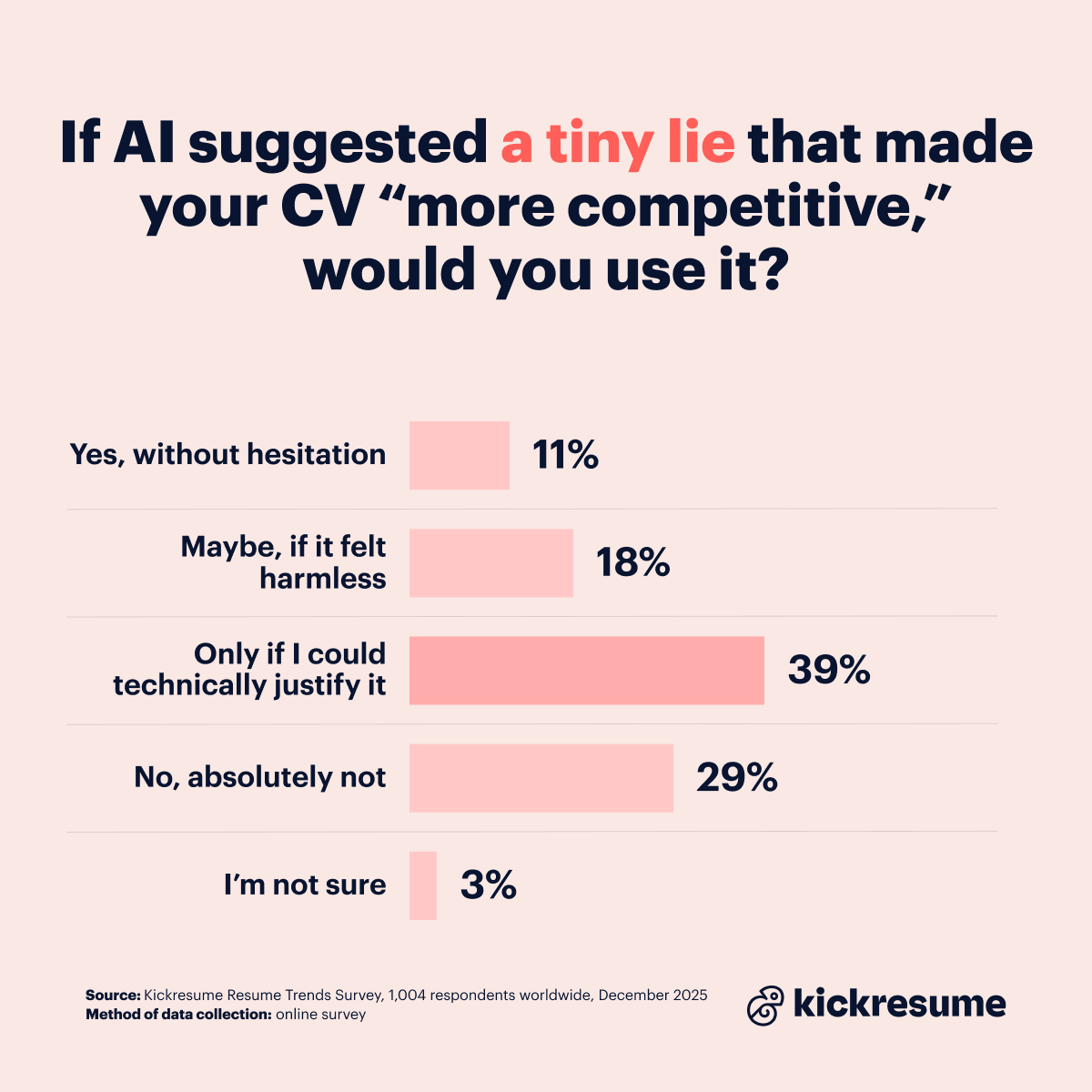
If AI suggested a tiny lie that made your CV more competitive, would our respondents use it?
Most people didn’t give a simple yes or no. Instead, they drew conditions:
- The largest group, 39%, said they’d only use the suggestion if they could technically justify it.
- Another 18% said maybe, as long as it felt harmless.
- On the other side, 29% rejected the idea completely, saying no, absolutely not.
- And 11% said yes, without hesitation.
- The remaining 3% weren’t sure.
What stands out is how many people try to keep a foot planted on both sides.
That 39% suggests that for many people, the boundary isn’t “truth vs lie.” It’s whether the claim can survive a follow-up question. If it can be explained, defended, or backed up in some way, it starts to feel acceptable.
At the same time, nearly a third draw a hard line. For them, AI can help with wording, structure, and clarity, but it can’t invent or stretch facts.
Taken together, the results suggest that the real boundary isn’t AI itself. It’s whether the final CV still feels explainable and honest under scrutiny.
Looking at the results by region, the “line” sits in different places:
- US respondents are the strictest. 38% said “no, absolutely not,” and only 18% said yes or maybe (9% “yes, without hesitation” and 9% “maybe, if it felt harmless”).
- Europe is more open to the idea of a “harmless” stretch. The share saying yes or maybe rises to 34% (13% yes, 21% maybe), while the outright “no” drops to 24%.
- Asia is the most flexible overall. Only 20% reject it completely, and the dominant answer is still “only if I could technically justify it” at 45%.
Over 6 in 10 have tweaked the truth on their CV
A lot of CV writing comes down to judgement calls. You choose what to include, what to skip, and how strongly to frame your impact. Most people wouldn’t call that lying. But it can get close.
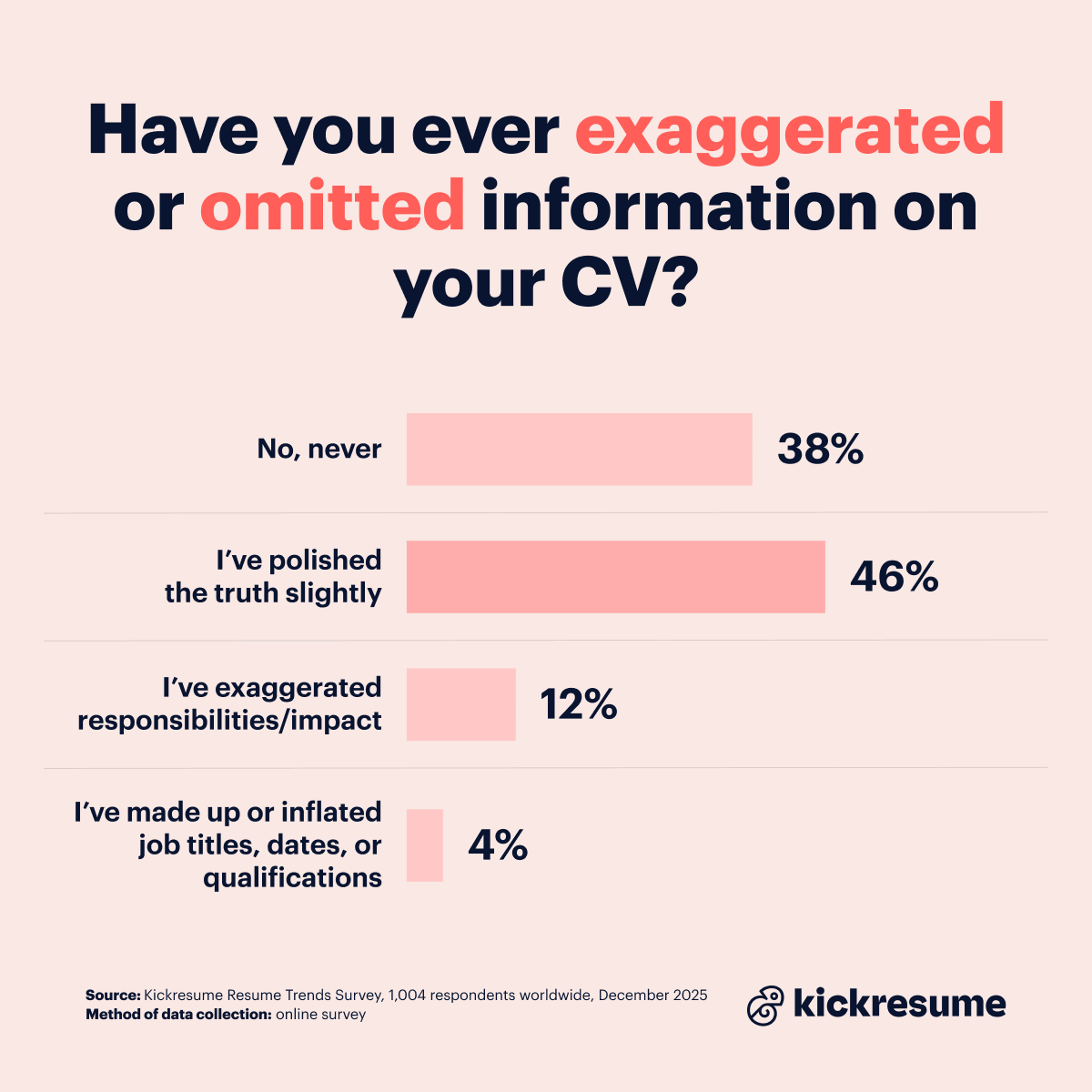
When we asked respondents if they’ve ever exaggerated or omitted information on their CV, only 38% said no, never.
Everyone else admitted to some level of adjustment:
- Nearly half, 46%, said they’ve polished the truth slightly.
- 12% said they’ve exaggerated responsibilities or impact.
- And 4% went further, saying they’ve made up or inflated job titles, dates, or qualifications.
These numbers help explain the earlier responses about a “tiny lie” suggested by AI. A big chunk of people are already comfortable with small tweaks, as long as they still feel defensible. In that light, “only if I could technically justify it” makes sense.
But there’s still a clear boundary. The share who admit to making things up is small, and the share who said they’d use an AI-generated lie without hesitation is also relatively small. So even if polishing is common, outright fabrication still looks like a step most people try to avoid.
Attitudes toward “tweaking” a CV aren’t evenly spread across generations. They seem to track with experience, risk tolerance, and how long someone has been in the job market.
Gen X is the most resistant to stretching the truth.
- Half of Gen X respondents (50%) said they’ve never exaggerated or omitted anything on their CV.
- They’re also the least likely to exaggerate responsibilities (8%) or make things up entirely (4%).
That caution likely comes from experience. With longer careers and more exposure to interviews, reference checks, and follow-up questions, Gen X candidates are more aware of how easily inconsistencies surface. They also tend to have enough professional experience that they don’t need aggressive embellishment to compete.
Gen Z is the most open to pushing boundaries.
- Only 33% say they’ve never adjusted the truth, while 16% admit to exaggerating impact.
- 6% admit to inflating titles, dates, or qualifications, which is the highest share of outright fabrication among all age groups.
For early-career candidates, this somewhat makes sense. With limited experience and high competition, the pressure to appear qualified is stronger.
Millennials sit in the middle.
- Millennials show the highest rate of “polishing the truth slightly” at 50%, but lower rates of outright exaggeration (12%) and fabrication (3%).
Recruiters expect exaggeration and they see a lot of it
The fact that people tweak, reframe, and occasionally stretch their experience isn’t lost on those who read CVs for a living.
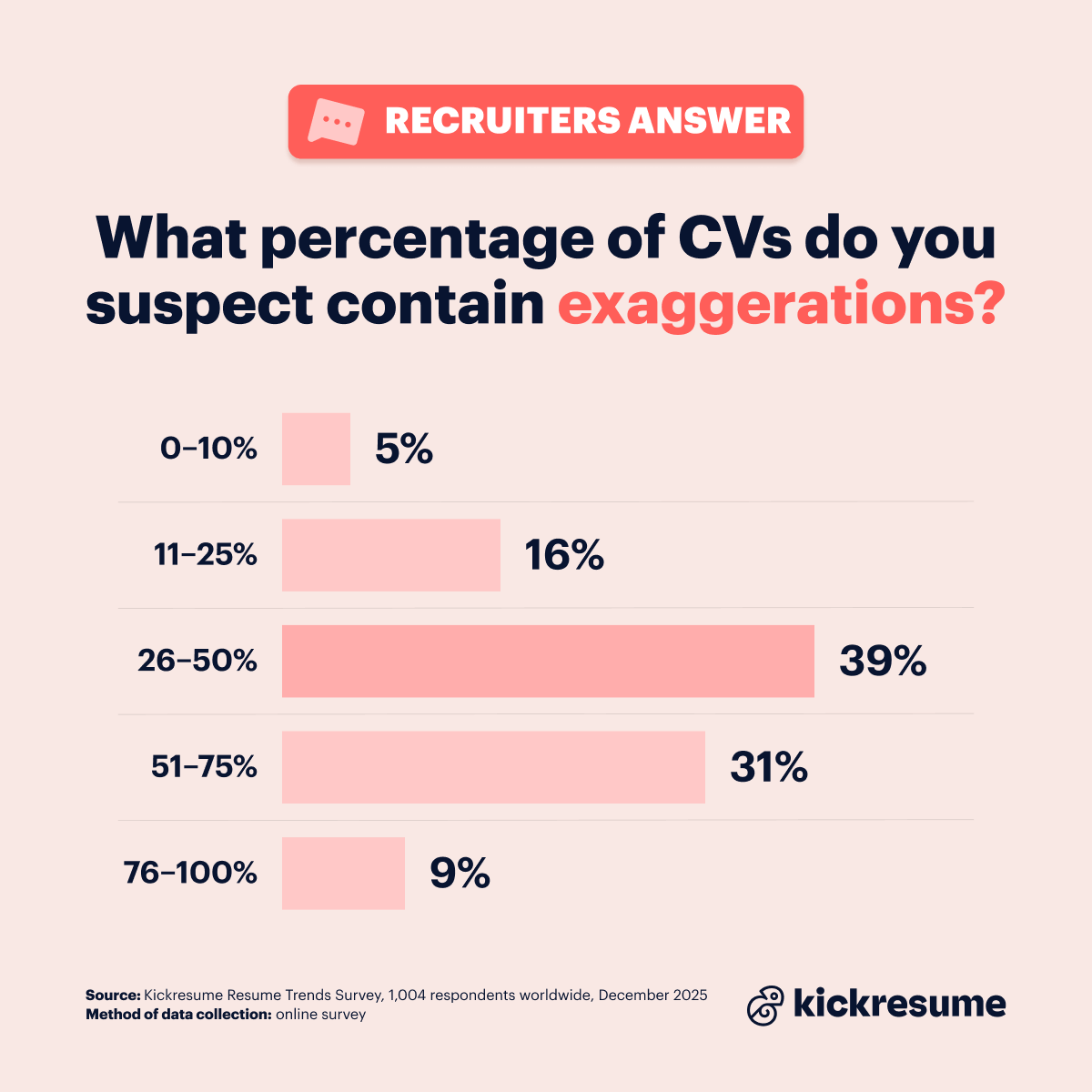
When we asked HR professionals, recruiters, and hiring managers what share of CVs they suspect contain exaggerations, their estimates were somewhat predictable:
- The largest group, 39%, estimate that exaggerations appear in 26–50% of CVs.
- Another 31% believe it’s even more common, affecting 51–75% of applications.
- And 9% go further still, suspecting exaggerations in nearly all CVs they review.
- 16% put the figure at 11–25%.
- Only 5% believe exaggerations appear in 10% or fewer of the CVs they see.
Taken together, nearly 4 in 5 HR respondents believe that at least 25% of CVs they read contain some form of exaggeration. And a striking 40% think it shows up in the majority of applications.
Marta Říhová also leans towards the 25-50% range. However, she maintains that “it’s usually not outright dishonesty. More often, people just misjudge themselves and give themselves strengths or skill levels they don’t really have.”
As she proceeds to clarify:
“In the more technical parts of a resume, like what someone studied, what roles they’ve had, and which technical skills they list, candidates tend to either oversell or undersell themselves. Most often, they’ll include a hard skill they don’t actually have at the level they’re implying. It’s rarely total cluelessness. It’s more like they’re decent at it, but they’re not “advanced” the way the resume makes it sound.”
Říhová continues:
41% have removed personal details from their CV to reduce bias
Not all CV decisions are about what to add. Some are about what to leave out.
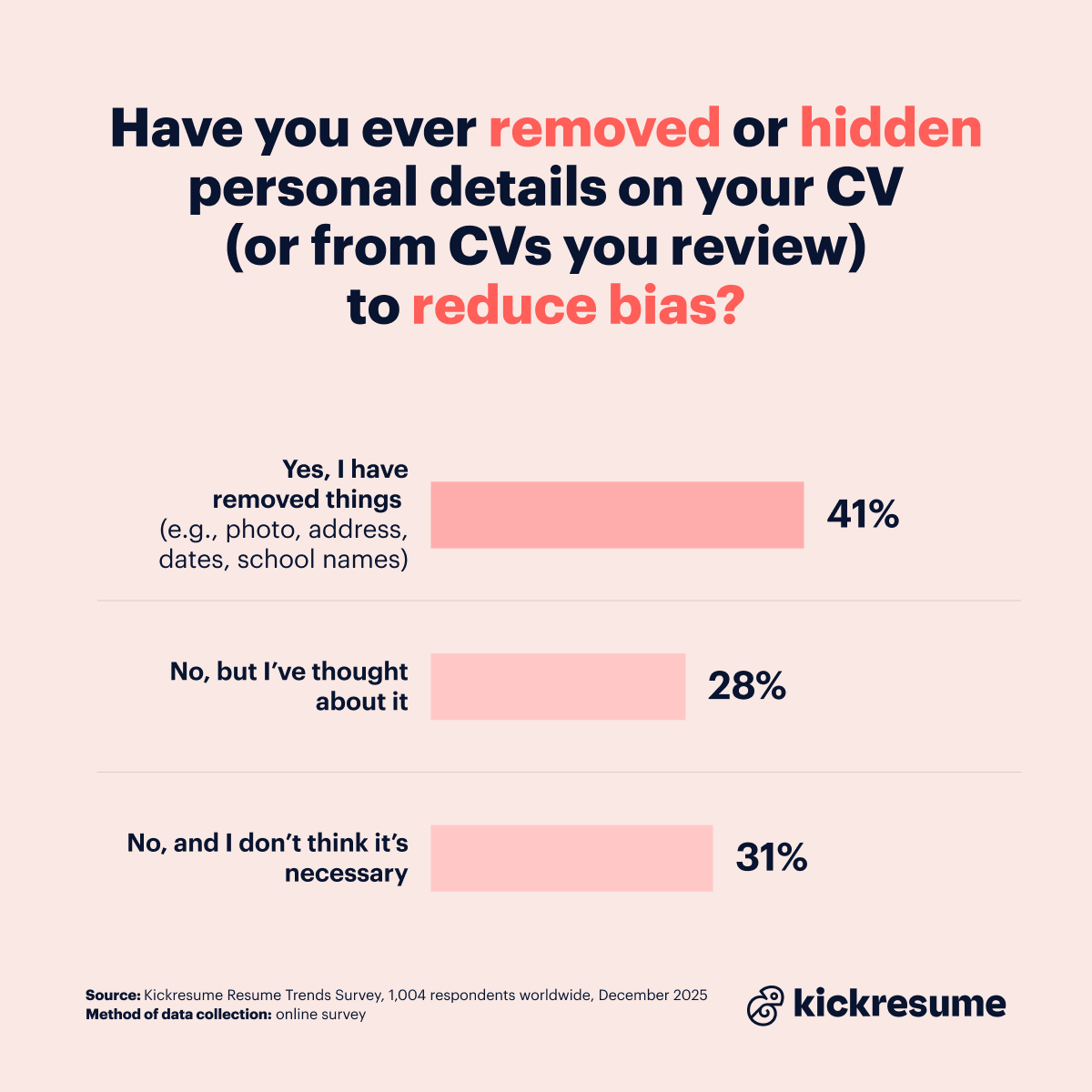
After talking about exaggeration and embellishment, we looked at the other side of the same judgement call: omission. Specifically, whether people remove or hide personal details on their CV to reduce bias.
A significant share responded in the affirmative:
- 41% of respondents said they’ve removed elements like a photo, address, dates, or school names for this reason.
- Another 28% haven’t done it yet, but have considered it, which suggests a large group of candidates who are at least aware that certain details might work against them.
- Only 31% say they don’t think it’s necessary at all.
This means that nearly 7 in 10 respondents either actively adjust their CV to reduce potential bias or seriously think about doing so. That makes omission almost as common a strategy as polishing language or reframing achievements.
Perhaps unexpectedly, men and women are basically on the same page when it comes to bias awareness:
- 41% of men and 43% of women say they’ve removed personal details from their CVs to reduce bias.
- The numbers for those who’ve only thought about it (28% vs. 27%) or don’t think it’s necessary (31% vs. 30%) are also nearly identical.
Age introduces slightly more variation.
- Gen X (44%) and Gen Z (43%) are the most likely to say they’ve removed personal details, while Millennials follow closely at 39%.
- Millennials are the most likely to say omission isn’t necessary (35%), compared to 30% of Gen Z and 27% of Gen X.
- Gen X also has the share of those who haven't removed anything but thought about it (29% vs. 27% for Gen Z and 26% for Millennials).
For younger candidates, removing personal details may often be about avoiding assumptions related to inexperience. For older candidates, it's more likely connected to steering clear of age-related bias.
As Marta Říhová explains, this can sometimes reflect the expectations of the hiring team:
"We also often work with teams that have a specific age range — for example, a younger team where an older candidate simply wouldn’t fit, or, on the other hand, positions where we expect significant seniority, managerial experience, and many years of professional practice."
Final thoughts
At the start, we wanted to understand three things: how people feel about AI in CV writing, how common exaggeration is, and where the line sits between improving a CV and crossing into dishonesty.
The answers point in the same direction. AI is widely seen as useful, but only when it supports real content. People like it for sharpening tone and making a CV read more professionally, but they also expect recruiters to notice when the writing feels generic or detached.
That same rule applies to honesty. Most respondents accept that CVs involve framing and selective detail, but they still want the final version to hold up when someone asks follow-up questions.
And the survey shows that CV editing isn't only about what gets added. Many people also remove personal details like photographs and dates of birth to reduce bias.
A simple takeaway: use AI for wording, not facts. Keep every strong claim tied to an example you can explain, and make sure your CV still sounds like you.
Demographics
Role
- HR-related: 12%
- Non-HR: 79%
- Others: 9%
Gender
- Male: 67%
- Female: 31%
- Non-binary or other: 2%
Age
- Under 18: 1%
- 18–28: 29%
- 29–43: 42%
- 45–60: 24%
- 61–79: 4%
- 79 or older: <1%
Location
- Africa: 9%
- Asia: 21%
- Australia/Oceania: 2%
- Europe: 28%
- Latin America: 9%
- North America: 31% (84% based in the USA)
Note
This anonymous online survey by Kickresume, conducted in December 2025, gathered insights from 1,004 respondents globally. All participants were reached via Kickresume's internal database.
About Kickresume
Kickresume is an AI-based career tool that helps candidates source jobs and raise salary with powerful resume and cover letter tools, skills analytics, and automated job search assistance. It has already helped more than 8 million job seekers worldwide.