As the year comes to a close, a lot of people start asking themselves what’s next for their career. Even if improving your professional life isn’t on your New Year’s resolution list this year, it likely has been before.
Maybe you're looking to climb the career ladder, switch gears completely, or simply feel happier at work in 2026. We spoke to Laura Tipping, a career coach who has over 10 years experience in executive recruitment, talent strategy, and career consultancy. Laura shared her expert advice on what to do if the New Year has got you itching for a change.
Here’s what we’ll cover:
- Before you leave your current job, take time to consider whether you truly want a new employer or simply need things to improve where you are.
- Pay, flexibility, and values are the top three reasons people want to change jobs.
- Younger workers look for a new job in January to get their foot in the door—more established workers are looking for a career upgrade.
- Learning new skills can help you advance on your current career path, or make a bigger change.
- Following a career-coach-approved 30-day action plan can help keep you on track.
We don’t necessarily want a new job, just a better day at work
Career coach Laura Tipping notes that many of the people she advises don't want to quit their job. They are often simply unhappy with a specific aspect of their current situation. The expert warned that before jumping ship, people should examine exactly what they don’t like about their current position, and see whether it’s possible to change it.
One reason for this is that the job market is currently highly competitive, which can make finding a new job very difficult. In the UK, where the career coach is based, the most recent Office for National Statistics data shows there are 2.5 unemployed people per vacancy. But this issue goes further than the UK—in the US, the unemployment rate and the number of unemployed people have both risen since last year.
On top of that, without fully analyzing what made you unhappy in your last role, you might experience similar issues in a new position. If you don’t know what you want at work or how to get it, it could lead to a pattern of serial job-hopping. And while changing roles frequently is now fairly common, a long list of short stints can still raise questions for hiring managers about your commitment and fit.
The top three reasons people want a change
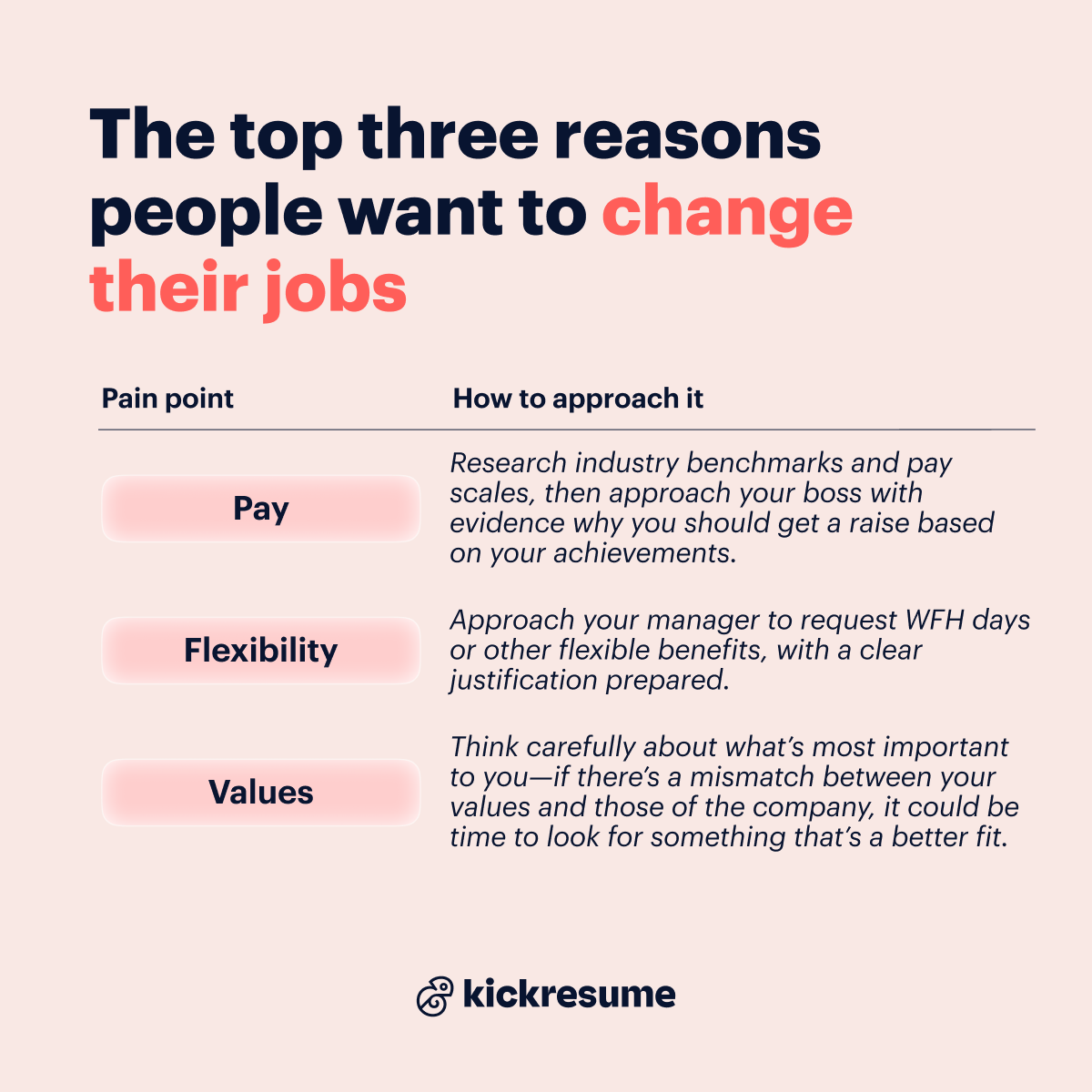
So in Laura Tipping’s experience, what are the top three reasons people consider looking for a new job?
Pay
The first major pain point that affects a lot of people is pay. Many countries are experiencing a rise in the cost of living and around the world people are dissatisfied with their salaries, as our recent research explored.
The career coach had some advice for people who are thinking about leaving their job because of this reason—compare your salary to industry benchmarks or pay scales in your country. If you earn less than what’s typical, you can share this with your boss and explain the value you bring to the company.
Flexibility and hybrid work
If pay isn’t the problem, the issue is often flexibility, the career coach observed. As our analysis of data from LinkedIn shows, it’s one of the most highly desired benefits—but access isn’t equal. For instance, in the UK, degree-educated people are 10 times more likely to do hybrid work, according to 2025 data from the Office for National Statistics. In the US, 52% of workers say they prefer hybrid work, but many big companies, including Amazon, now want employees in the office 5 days a week.
For people who are considering leaving their job because of a lack of flexibility, Laura Tipping advised finding out if changing this would be possible. You can approach your employer with a clear justification such as lowering your commuting time or costs, and suggest how many in-office days per week you can do. The career coach suggested that you could even request a “trial period”, which could be extended if you and your manager are happy.
Values
Finally, one more factor that can have a big impact on how much you enjoy your job is whether it aligns with your values. Laura explained that a clash between your values and those of your employer can be demoralising. The expert recommended thinking carefully about what’s important to you, from diversity, equity, and inclusion to sustainability. If your values don’t match, the career coach warned that it’s unlikely you’ll find a compromise. In this case, it’s often best to start looking for a new role elsewhere.
Different life stages and situations drive different New Year job searches
The New Year can get people reflecting on whether their current job still makes them happy—but their motivation to look for something new might vary based on factors like their life stage.
At the turn of the New Year, young people might set resolutions like getting their first graduate job or moving into their dream industry. Laura Tipping explained that many young people are either looking for their first role or switching careers as they figure out exactly what they want to do—and they’re facing a tough job market. Our 2025 survey found that recent graduates were three times less likely to have secured full-time employment pre-graduation than those in previous years.
Laura suggested that mid-career employees may set work-related New Year’s resolutions focused on specific goals or benefits. For example, finding a new job that has better parental leave if they’re planning to start a family soon. They might also be looking to break through a career ceiling, achieve better work-life balance, or leave poor working conditions in their current job.
Another factor that could play a role in January job searches is where you live. Laura suggested that the changing of the year might inspire people in areas with fewer opportunities to plan a move to a place with more jobs, like major cities, in a ‘New Year New Me’ total lifestyle overhaul. This is especially the case if they want to enter an industry that’s concentrated in a particular area, such as their country’s capital. On the other hand, people who already live in these cities might be searching for a new role in order to level up their careers in 2026.
Take this simple self audit to help make a strategic decision
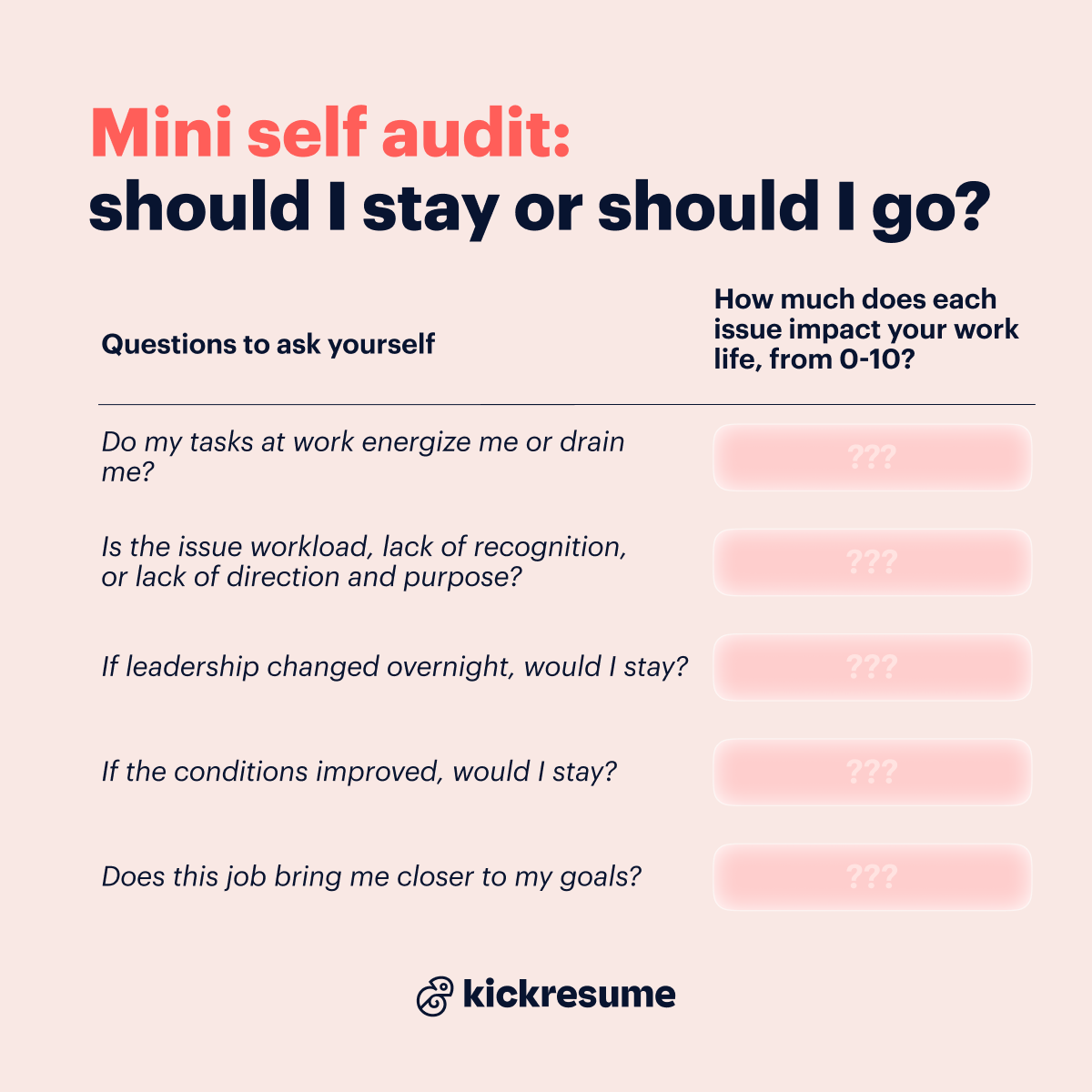
Do you feel like you’re at a crossroads at the moment? Laura Tipping shared five simple questions you can ask yourself in a self audit. It will help you identify whether you want to make your current job better, look for a new role, or switch industry entirely. The career coach advised, “To get a real and clear picture, you should answer them like a strategist gathering evidence rather than based on emotion.”
When you answer these questions, give each answer a score from 0-10 based on how much it impacts your day-to-day working life. The highest scores usually reveal the most urgent bottlenecks that need solving.
- The first question is: Where is my energy consistently gained versus drained? Track a week at work, noting down which tasks give you momentum and which leave you feeling exhausted. This should help you figure out whether it’s the work itself that’s the issue or something else.
- Next up, ask yourself: What’s missing—capacity, credit, or compass? Is the problem to do with workload and not having enough resources? Or do you feel like you’re not recognized for your work? Lastly, do you feel like you have enough direction or purpose in your job?
- Laura recommended that people considering a change should then ask: If leadership changed overnight, would my answer change too? If you’d stay, then it’s a management problem—if you’d still leave, the issue goes deeper.
- The next question is: If the conditions improved, would the role still feel wrong? If upgrades like better pay, flexible work, or more support would make you stay, perhaps you need a change of role doing similar work at another company. But if not, switching to a different career path might bring you more fulfillment.
- Finally, ask yourself: Is this job investing in the person I’m trying to become? Where do you see yourself in a year? If this job won’t help you meet those goals—or even takes you further away from them—then it might be time to start looking for a job that will.
How to boost your profile at your current job
Decided to stay but need more recognition? Laura Tipping has advice. The career coach asks all her clients to answer this question: “If you want to feel more visible in your company, what does that mean to you?” It could be a pay rise, a promotion, or developing your reputation as an expert in your field.
If you want an increase in pay, the career coach advises “building a case” about the value you add to the company. While the answer may be ‘no’ when you speak to your manager, Laura suggests taking the opportunity to ask what would need to happen for you to be eligible for a salary increase. Our recent article about negotiating for what you want at work has tips on how to raise the issue.
For those who are seeking promotion, put together a portfolio that demonstrates your abilities and some of the projects you’ve worked on. Arrange a meeting with your manager and let them know that you believe you’re well-suited for a more senior position.
Laura also had advice for people who’d like to boost their positioning in the company or develop their reputation as an expert. Post thought leadership pieces on LinkedIn to put yourself on the radar of industry peers as well as senior managers in your own company. You can even ask the company’s marketing department if you can guest post for them, which benefits them as well by providing interesting content.
What about if you just want to feel like your work is appreciated? “If you feel like the work you do goes unnoticed and you would just love to feel a little more “seen”, raise this in a 1-1 with your manager,” Laura advised. This might lead to more frequent catch ups with your boss, or even to them putting you forward for interesting projects—all paving the way for your future career development.
Upskill in tech for new opportunities
For those who decide they do want to look for something new, we also asked Laura Tipping to suggest some growing industries that might offer exciting opportunities. Learning a new skill can open doors, whether you want to stay in the same field or switch paths entirely. The career coach said that while the tech industry might not be booming as much as it was a few years ago, there is still a wide range of niches that job seekers could explore.
- Cybersecurity: This growing sector was valued at $193.73 billion in 2024 and $ 218.98 billion in 2025—it’s projected to reach $562.77 billion by 2032. Data from ICS2’s most recent annual report, shows a workforce gap of 4.8 million cybersecurity professionals in Europe. With cyber attacks often hitting the news, you can see why companies are investing in cybersecurity. This can be a high-paying field, and might be a great choice for those exploring a career in tech to specialize in.
- Healthtech: People with experience in healthcare who would like to get into tech could look for opportunities in patient pathways, compliance, service design, and data quality. The current trends in healthtech are all about solving business problems and streamlining administration rather than clinical care.
- Fintech: For those with a background in finance, there’s a lot happening in fintech right now. Learning about risk, governance, customer trust, and processes which are primed for automation could be the key to a new role in this field. In recent years, fintech’s development as an industry was accelerated by COVID-19, which drove a surge in digital transactions.
- Edtech: People who have worked in or studied education in some capacity could transfer their current skills into edtech. Laura suggested useful avenues to explore could include design, user behaviour, curriculum translation, and community growth. This industry is predicted to grow to a global market size of $395.19 billion in 2029, from $169.2 billion in 2024.
These fields are just a quick example of how you could level up your skills. By understanding how to apply tech skills to your industry, you could potentially get a bigger paycheck, a better title, or a brand new job.
Your 30-day career action plan for January 2026
If you’re unhappy or unfulfilled at work, deciding what to do can feel overwhelming—and creating a long term plan might be even more difficult. Laura Tipping has put together a simple 30-day action plan to help you go from the first inkling that something needs to change to setting goals for 6 months’ time.
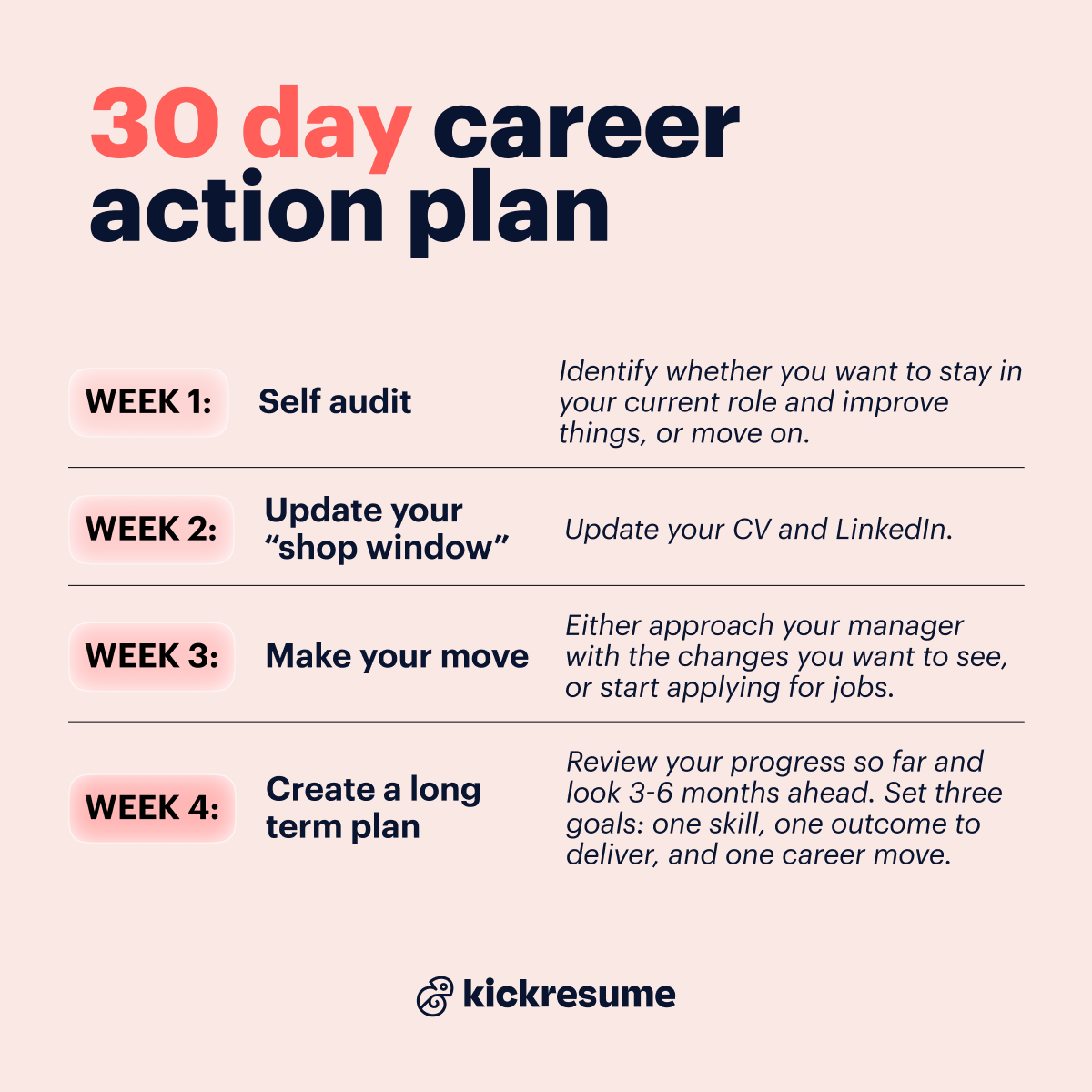
- Week 1: First, the career coach says, “Start with diagnosis, not action”. Conduct a self audit using Laura’s helpful template to find out what you need most at work, and whether you’re more likely to find it by talking to your manager or moving on. The coach recommends, “If your issue is conditional like workload visibility or manager fit, it may be best to commit to stay and grow (whatever that looks like for you) for 30 days. If it’s structural, like values mismatch or career path misfit, then you should commit to moving and start to identify your end goal.”
- Week 2: Next, update your resume and LinkedIn so they reflect your skills, achievements, and ambitions. Laura advises, “Your objective is to create a single clear story of what you do well and what you are moving toward.” Whether you’ve decided to progress in your current role or look for something new, your professional “shop window” should make it clear that you’re a great candidate and why. Your resume should focus on what you achieved, not just what you did. There’s more information on how to share impressive, quantifiable results on your resume in our guide.
- Week 3: Now’s the time to make your move—whether that’s having a conversation with your manager about the pay, benefits, or changes you’d like to see, or starting to apply for new jobs. If you’re applying for new jobs, quality’s better than quantity, so sending a few highly relevant applications that align with your priorities will be better than a scattergun approach. Laura’s advice is “apply deliberately with your top three strengths mapped to their top three needs”.
- Week 4: If you’re starting this journey in January as part of a New Year’s resolution, you need to find a way to keep that momentum going. Review your progress, and ask yourself what’s working so far and what’s not. Then, make a 3-6 month plan with three goals—one skill to build, one outcome to deliver, and one career move to aim for. This might look like developing your ability to use AI, growing your confidence, and finding your new role.
Final thoughts
As Laura Tipping’s advice shows, the key to making the best decisions for yourself is developing a clear understanding of what you need. Once you know that, you can figure out the best way to move forward. A simple self-audit can help you see whether your current job fits your needs. If it doesn’t, learning new skills—especially in tech, which is in demand across industries—can give you an edge and even open the door to a whole new career path.
If you’re unsure how you feel about your current position, take some time to reflect. The issue could be temporary and fixable, or it could point to a deeper mismatch in values with your employer. Either way, identifying the problem is the first step to solving it—and setting yourself up for a strong, fulfilling 2026 at work.
Note
Kickresume spoke to Laura Tipping, a career coach with 10+ years experience in executive recruitment, talent strategy, and career consultancy, in November 2025. The expert shared her practical advice for people who want to make a change in their career in the New Year. The career coach also linked this advice to the latest job market and industry trends.
About Kickresume
Kickresume is an AI-based career tool that helps candidates land jobs and raise their salary with powerful resume and cover letter tools, skills analytics, and automated job search assistance. It already helped more than 8 million job seekers worldwide.