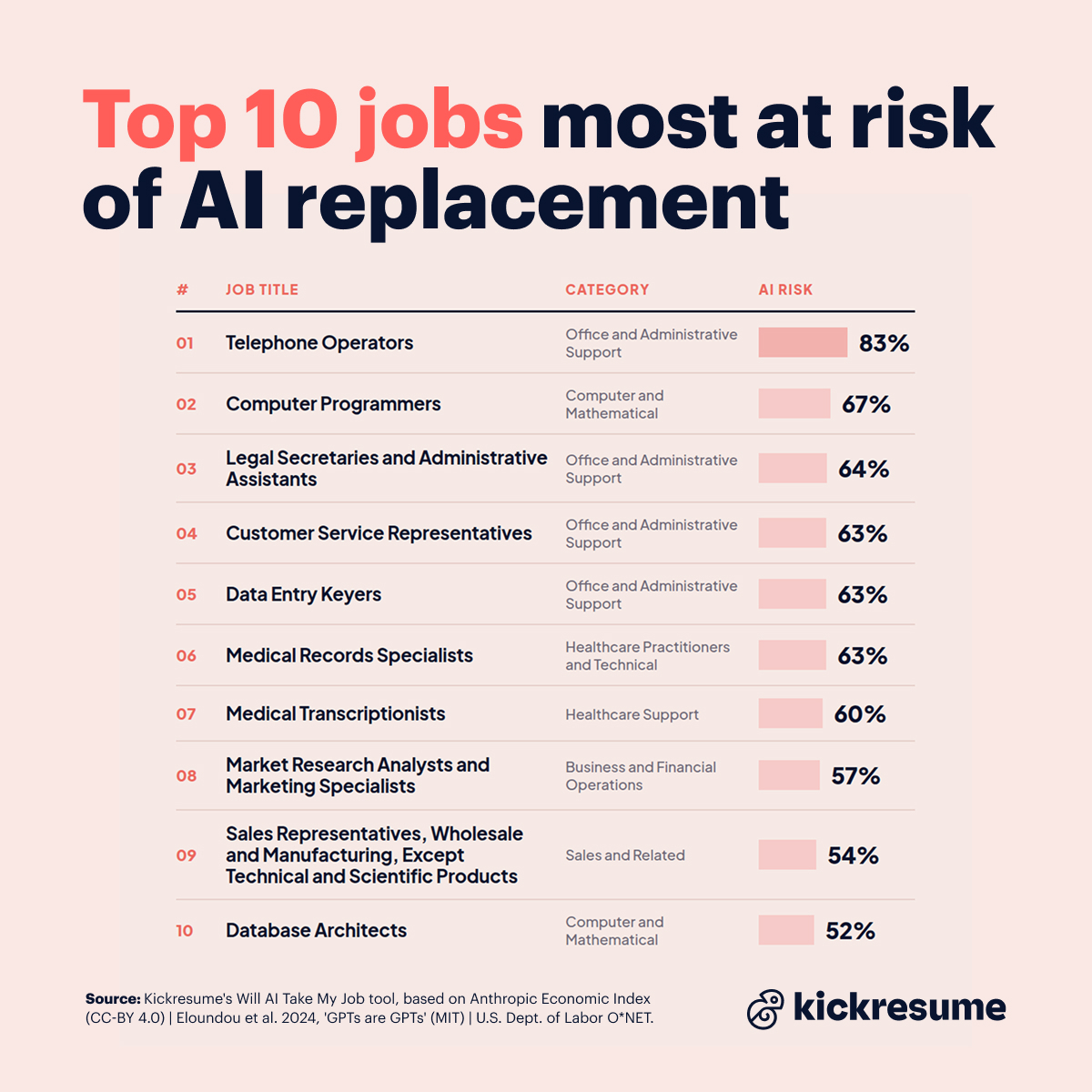
Ask someone which job AI is coming for first, and most people will say a call center rep. They're not wrong—Telephone Operators top our entire risk dataset at 83%, the single highest score of any job we tracked. But scroll down the list and the story gets a lot less predictable.
We went through the full dataset behind Kickresume's Will AI Take My Job tool—756 U.S. occupations, each with an AI exposure score built from Claude usage data or, where that wasn't available, a modeled estimate—to see where AI could hit hardest.
What we found is that the pattern can’t be fully explained by white collar versus blue collar, or by degrees. Even within the same type of work, the day-to-day tasks can make a huge difference.
Here are some of the key findings:
- Telephone Operators (83%) score the highest AI risk of any of the 756 occupations we tracked.
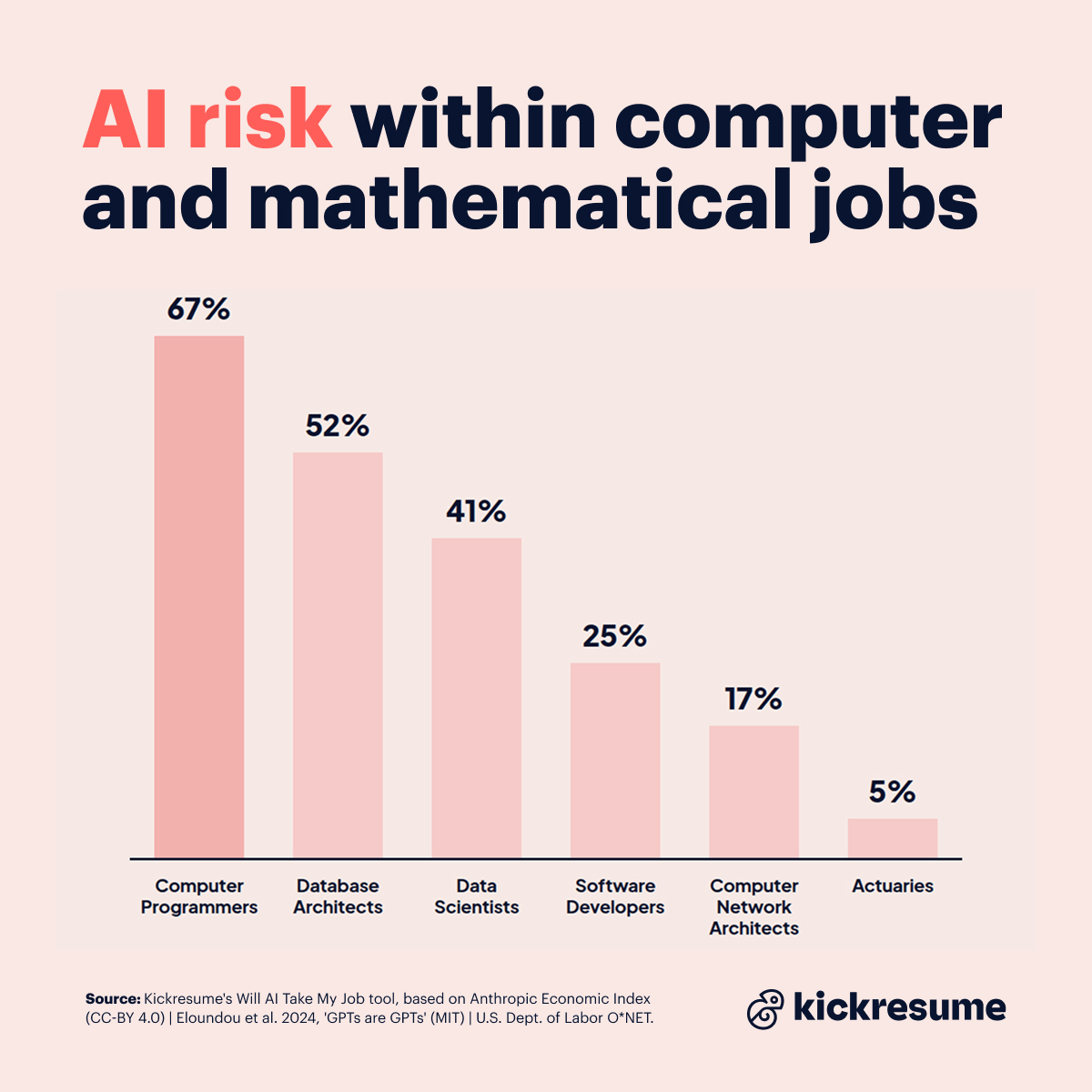
- Computer Programmers (67%) and Actuaries (5%) have a striking 62-point gap, despite both being highly quantitative, degree-based professions.
- Paralegals (26%) score nearly double the Lawyers (14%) they work for.
- Software Developers (25%) vs. Computer Programmers (67%) differ by more than double, inside what most people would call the same job.
- Across all 756 occupations, the average risk score is 16.4%, and 1 in 8 jobs lands in the "very high" risk band.
- Computer and Mathematical is the single highest-risk category overall—not Office and Administrative Support, the category most people would guess first.
You can look up any of the 756 job scores yourself:
The obvious fear checks out—and it's bigger than "call centers"
The obvious assumption holds up: jobs built around phone calls, scripts, and repetitive tasks are the most exposed to AI. Telephone Operators lead the entire dataset at 83%. Legal Secretaries and Administrative Assistants sit at 64%. Customer Service Representatives and Data Entry Keyers are tied at 63%.
What links these jobs together isn't the phone itself—it's the shape of the work. Someone calls or writes in, there's a script or a database lookup to follow, and the answer gets typed somewhere.
That’s the kind of task you can hand over to an AI almost entirely, which is why these roles end up at the very top of the list rather than merely scoring "high."
This isn't hypothetical anymore, either. It's already showing up in headcount decisions being made this year. Salesforce cut around 4,000 customer support roles in 2026 after its CEO said publicly that the company needed "less heads" following a steep drop in support ticket volume it attributed to AI.
Cloudflare cut a fifth of its workforce the same year, citing AI as the reason it no longer needed as many people in operations and middle management.
Outplacement firm Challenger, Gray & Christmas found AI was cited in roughly 40% of all U.S. layoffs announced in May 2026 alone—the highest share it has ever recorded.
But there are exceptions. Receptionists (39%) and HR Assistants (38%) do plenty of the same desk work and lookup tasks—yet neither comes close to the 83% ceiling, because both still spend real time face-to-face with people. The phone and the script aren't what's exposed. The lack of a human in the room is.
Same field, same degree, a 62-point gap
Actuaries score 5%. Software Developers score 25%. Computer Programmers score 67%. All three come from similarly quantitative, degree-required backgrounds, yet Programmers land in "very high" risk while the others don't come close.
"The gap isn't about how smart the work is—it's about whether the output can be checked in five seconds or needs to hold up in front of a client," says Peter Duris, CEO and Co-Founder of Kickresume. "A programmer's code either runs or it doesn't. An actuary's model has to survive a room full of regulators asking hard questions. A developer's day looks similar on paper, but it's usually about designing systems and talking to stakeholders, not just writing code to someone else's spec."
Same story, twice: a 62-point gap and a 42-point gap, all inside jobs with similarly quantitative training. The title on a resume doesn't show that. The daily task list does.
This gap isn't a one-off. It shows up everywhere.
- In Legal: Paralegals (26%) score nearly double their Lawyers (14%). Judges score 28%, twice the Lawyers arguing in front of them. Title Examiners, whose whole job is document search, score just 2%. Prestige runs backwards here.
- In Healthcare: Psychiatrists sit at 41%. Physical Therapists sit at 1%. One turns a conversation into a written report. The other has to be in the room, hands-on.
- In Office and Administrative Support: you saw the top—Telephone Operators at 83%, the highest score in the dataset. Here's the bottom: Tellers score 2%. A Teller and a Data Entry Keyer wear the same category label and land on opposite ends of the scale.
We can't say with certainty why each gap within the same job category exists—the dataset gives us the scores, not the reasoning behind them.
However, what these comparisons do suggest is that the type of task matters more than the job title or level of seniority. Repetitive information processing can be highly exposed, but document-heavy work isn't automatically high-risk.
The bigger question is whether the work can be reduced to a clear, repeatable task—or whether it still depends on judgment, context, and responsibility.
The trades really do look safe—but say so carefully
The Construction and Extraction job category has an average risk of 3.9% of being replaced by AI. Building and Grounds Cleaning and Maintenance averages 3.6%, the two lowest-scoring categories overall.
Plumbers, Pipefitters, and Steamfitters score 1%. Roofers score 1%. A long list of specialized helper and mining-support roles—Helpers to Carpenters, Helpers to Roofers, Terrazzo Workers, Rail-Track Laying Equipment Operators—score a flat 0%, as low as this dataset goes.
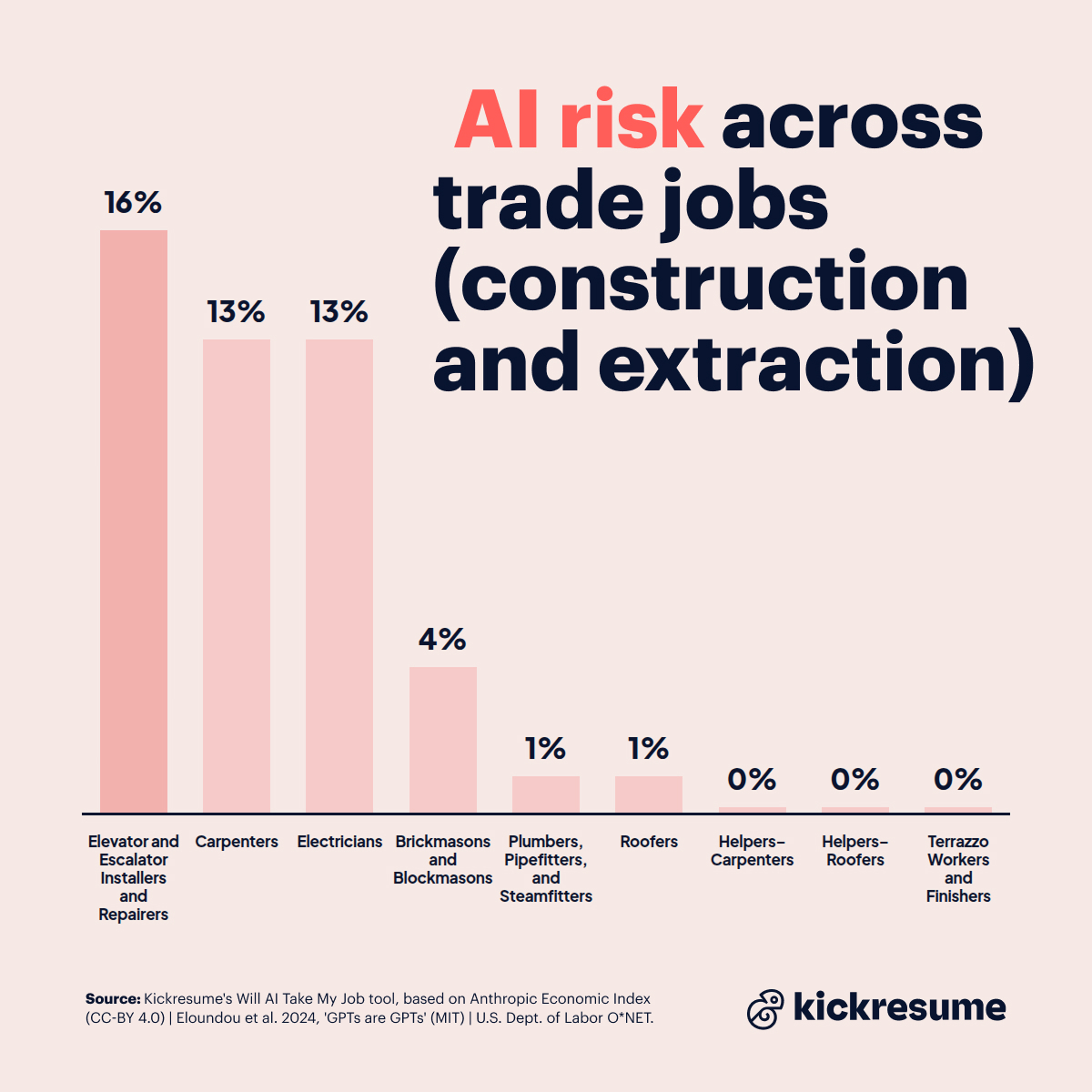
Even among the trades, the risk isn’t the same across the board. Carpenters and Electricians both score 13%, while Elevator and Escalator Installers and Repairers score 16%. That’s significantly higher than the 0–3% scores for bricklayers, roofers, and drywall installers.
One reason may be that the higher-scoring trades involve more diagnosis and troubleshooting alongside the physical work—for example, figuring out why a circuit isn’t working or why an elevator keeps jamming.
The lowest-scoring trades, on the other hand, tend to involve more straightforward physical work once the plan is set.
So the trades aren’t necessarily all equally safe from AI. Just like in the other categories, the jobs that involve less judgment tend to have the lowest AI risk.
People in these jobs simply aren't using AI day-to-day yet, so the model estimates risk instead, based on how physical, unpredictable, and hands-on the work is.
That doesn't make the numbers less useful—someone who has to climb inside a wall to fix something is still a hard job to automate. Just know these scores come from the nature of the work, not from millions of logged AI interactions like the Computer Programmer score.
Final thoughts
The comfortable story is that "AI is coming for the obvious jobs." Telephone Operators prove that story right at the very top. But underneath it is a less comfortable one: AI exposure follows the tasks inside a job more closely than its title, degree, or prestige.
The lesson isn't that some jobs are simply "safe" and others are "doomed." It's that some parts of almost every job are easier for AI to take over than others—the note, the lookup, the standardized analysis, the repetitive code, the routine response—even when the overall profession requires judgment, responsibility, or human interaction.
Collar color, degree, and prestige were never really measuring the thing that mattered most. The better question is much simpler: what does this job actually ask a person to do, day after day?
Methodology
The primary input behind each score is real AI usage data from the Anthropic Economic Index—an ongoing research project tracking how people actually use Claude at work, mapped to O*NET occupation codes.
Each job's score is sorted into one of four risk bands: low (0–10%), medium (10–20%), high (20–35%), and very high (35% and up).
That usage signal gets a reality check: government task data on how much a job depends on creativity, people skills, and physical dexterity can shift the score by up to 25%.
So a job with heavy AI usage can still land lower if it also demands a lot of hands-on work—and a job with light AI usage can still land higher if it involves little face-to-face contact or physical skill.
For the roughly 30% of workers in occupations without enough measured usage data yet—mostly production, construction, skilled trades, and transportation, where AI simply isn't used much on the job today—the score instead comes from a peer-reviewed exposure estimate (Eloundou et al., 2024, published in Science), which models exposure from task descriptions rather than observed behavior.
About Kickresume
Kickresume is an AI-based career tool that helps candidates find jobs and raise their salary with resume and cover letter builders, skills analytics, and automated job search assistance. It has helped more than 8 million job seekers worldwide.