After clicking “Apply,” candidates are often left guessing what happens to their CV next. Some assume recruiters carefully read every resume. Others expect their application to be skimmed in seconds. But perceptions don’t always match reality.
To understand what really happens after candidates apply — and how both sides of the hiring process see it — Kickresume surveyed 1,004 respondents worldwide, including job seekers and HR professionals, as part of its Resume Trends Survey.
The survey explored how recruiters review CVs, how much attention candidates believe their applications receive, and how people adapt their resumes in response — from tailoring and frequent updates to decisions about tone.
Here’s a snapshot of the key findings:
- 62% of HR professionals say they have rejected a candidate without fully reading their CV, either often (29%) or occasionally (33%).
- 76% of recruiters report spending at least 30 seconds reviewing a CV, with nearly half spending a minute or more.
- 56% of job seekers believe recruiters spend 30 seconds or less on their resume, highlighting a perception gap.
- 74% of job seekers tailor their CV for each role, either significantly (28%) or with minor tweaks (46%).
- 37% update their CV every time they apply for a new role, while another 21% do so a few times a year.
- 58% of candidates prefer to keep their CV strictly formal, avoiding humour or playful language.
Most recruiters admit rejecting candidates without fully reading their CV
In early-stage screening, decisions aren’t always made after a full read. Survey results suggest that, in many cases, recruiters make a call before reaching the end of a CV.
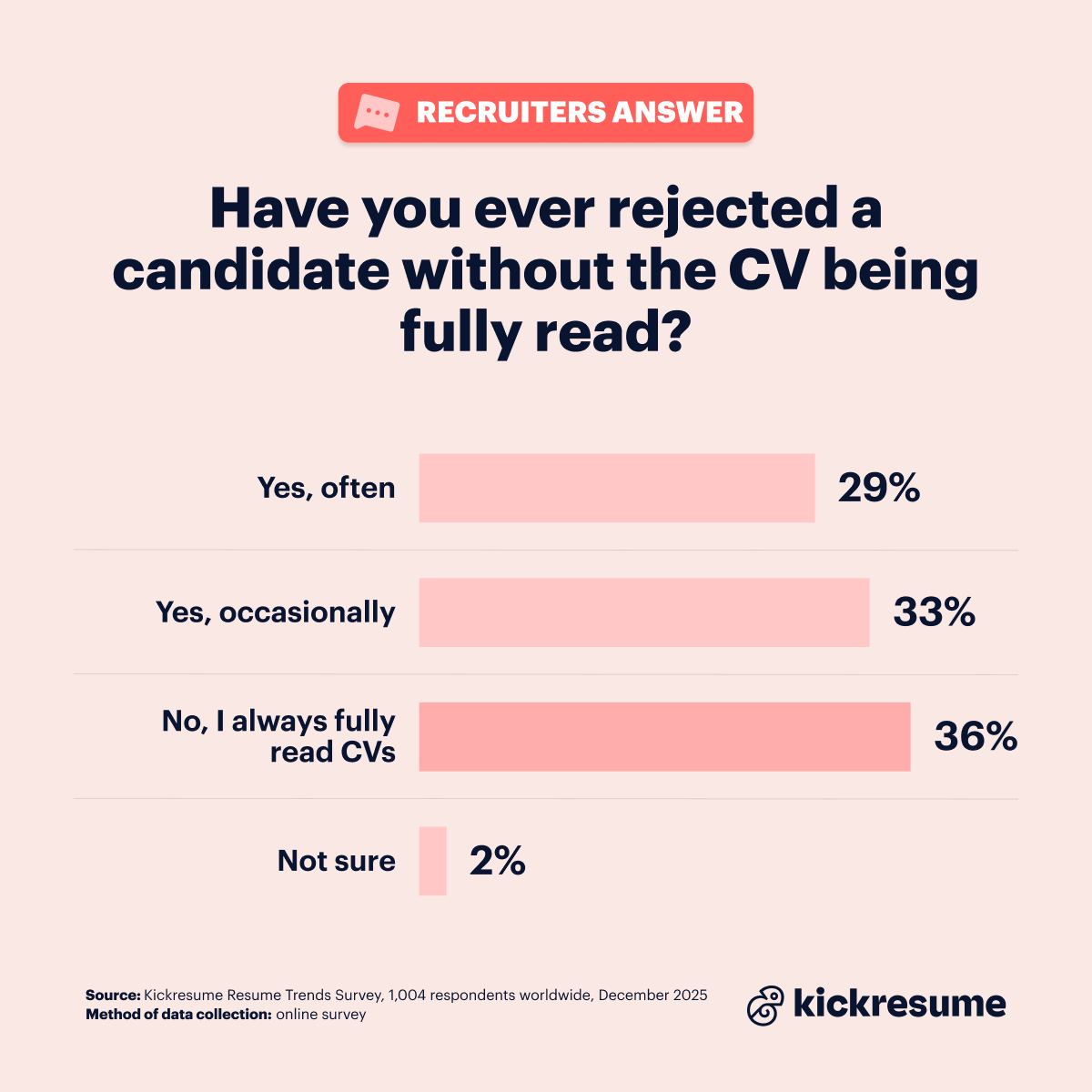
When asked whether they have ever rejected a candidate without fully reading their resume, nearly two thirds of HR professionals said yes:
- 29% say they do this often
- 33% say they do it occasionally
- 36% say they always fully read CVs
- 2% aren’t sure
Taken together, this means that 62% of recruiters admit to rejecting candidates without reading their CVs from start to finish.
However, this doesn’t necessarily mean recruiters skim CVs at random or ignore them entirely. As HR expert Marta Říhová explains, early decisions are often based on clearly defined criteria that can be identified very quickly:
Říhová adds that this kind of early screening is especially common when expectations around seniority or experience are clear:
In practice, this means that recruiters scan resumes for key requirements first — often in the resume summary, experience, or skills sections — before deciding how deeply to read the rest. If those essentials are missing or unclear, the review may stop early, even if the CV contains more detail later on.
Most recruiters decide within minutes — candidates expect seconds
Time is one of the biggest unknowns in the application process. Candidates know recruiters are busy — but how much time do they actually believe their CV gets?
According to job seekers — not much.
When asked how long they believe a recruiter spends reviewing their CV, 38% assume it’s only 10–30 seconds. Another:
- 18% believe recruiters spend under 10 seconds
- 22% estimate 31–60 seconds
- 17% think it’s 1–3 minutes
- 5% believe it’s more than 3 minutes
Taken together, 56% of job seekers believe recruiters spend 30 seconds or less on their CV.
Recruiters paint a different picture.
They report spending significantly more time. 76% say they spend at least 30 seconds reviewing a CV, and nearly half say they spend a minute or more:
- 6% say under 10 seconds
- 18% spend 10–30 seconds
- 28% spend 31–60 seconds
- 30% spend 1–3 minutes
- 18% spend more than 3 minutes
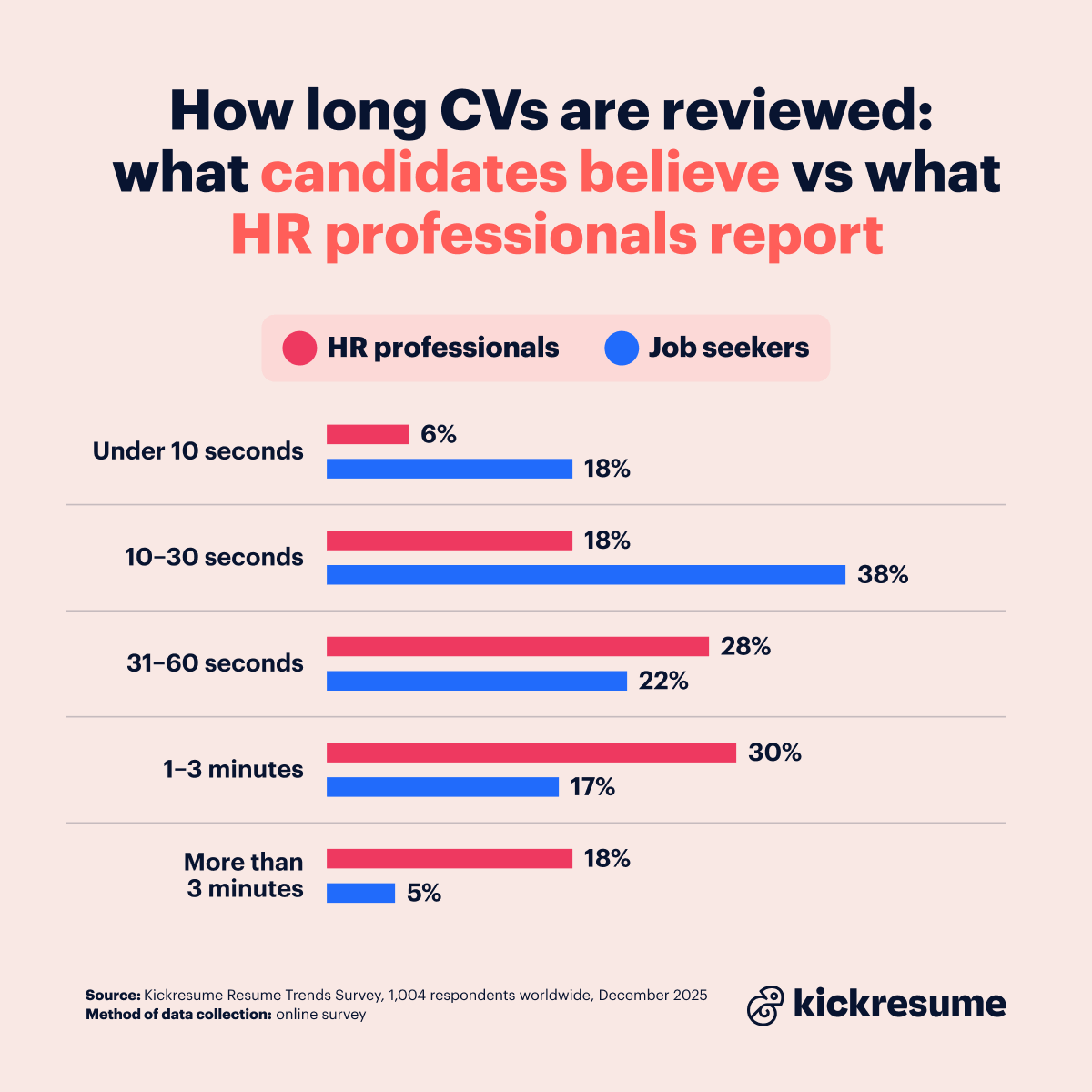
The gap between perception and reality is striking. While most candidates assume their CV gets only a quick glance, recruiters report spending more time — especially once a CV passes initial screening criteria.
As HR expert Marta Říhová explains, this aligns with how early-stage screening typically works in practice:
This suggests that time spent on a resume isn’t evenly distributed. Candidates who meet the basic requirements often receive significantly more attention, while those who don’t may be filtered out quickly.
“Clarity matters early — because the first minute determines whether there will be a second one.”
From a candidate’s perspective, the takeaway isn’t that recruiters only skim. It’s that clarity matters early — because the first minute determines whether there will be a second one.
Tailoring is the norm: nearly 3 in 4 adjust their CV for each role
Earlier results show that recruiters don’t approach CVs line by line. In early-stage screening, they typically scan for key requirements — such as education, experience level, or specific skills — before deciding how deeply to read.
That reading pattern helps explain why most candidates tailor their CVs, even when they expect limited attention.
When asked whether they tailor their CV to each job they apply for, 74% of job seekers say they do so at least to some degree — meaning nearly 3 in 4 candidates adjust their CV for each role.
Breaking that down:
- 28% say they tailor their CV significantly
- 46% make minor tweaks depending on the role
- 18% tailor their CV only rarely
- 8% say they send the same CV to all roles
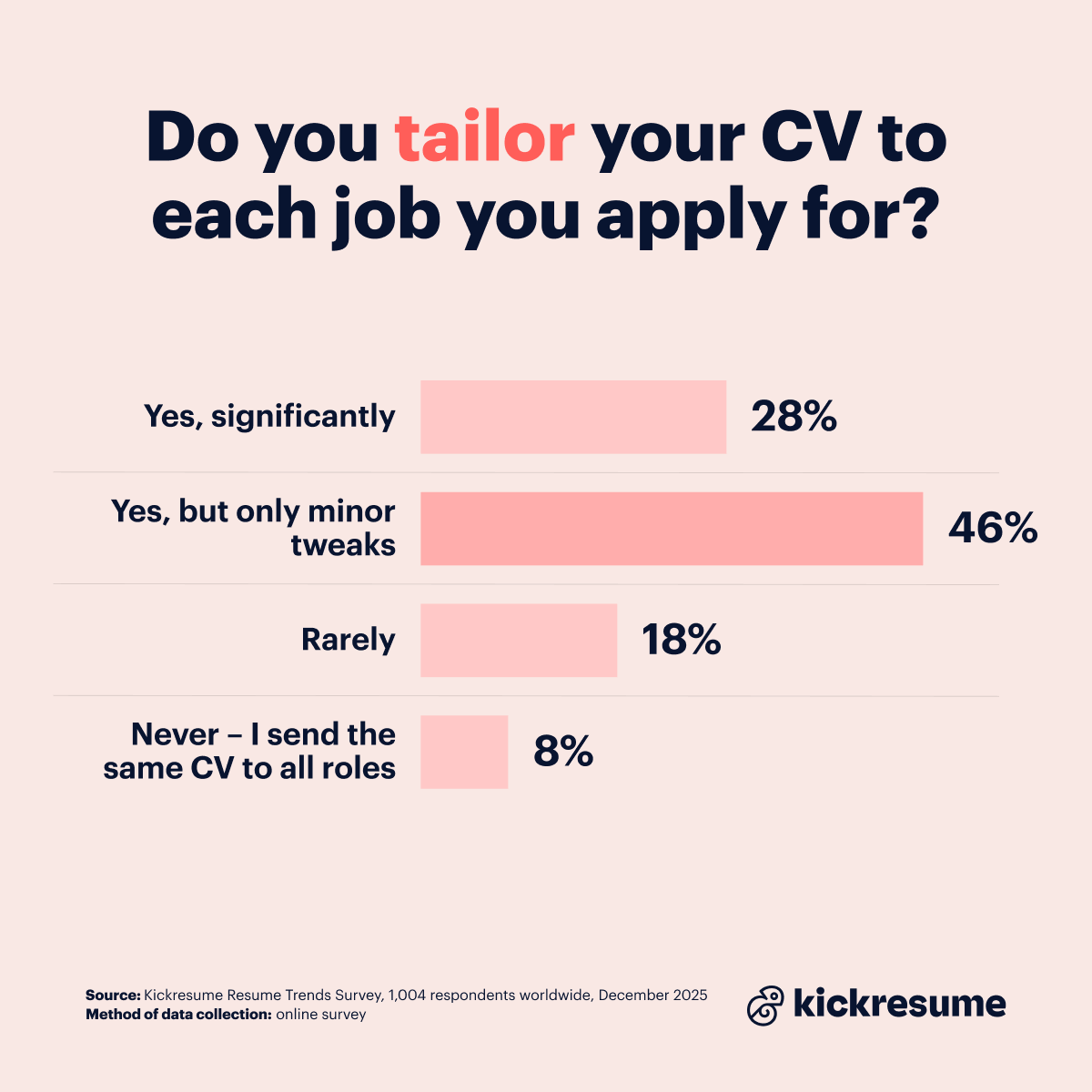
Rather than trying to make their resume longer or more detailed, candidates appear to be optimising what recruiters see first. Tailoring allows them to prioritise relevant experience, reorder content, or adjust wording so key requirements are easier to spot during an initial scan.
This also helps explain why CVs are updated so frequently. 37% update their CV every time they apply for a new role, and another 21% do so a few times a year:
- 37% update their CV every time they apply for a new role
- 21% update it a few times a year
- 28% update it only when actively job hunting
- 11% update it once a year
- Just 3% say they can’t remember the last time they updated it
In practice, this means that nearly 6 in 10 job seekers update their CV at least several times a year, and more than a third do so for every application.
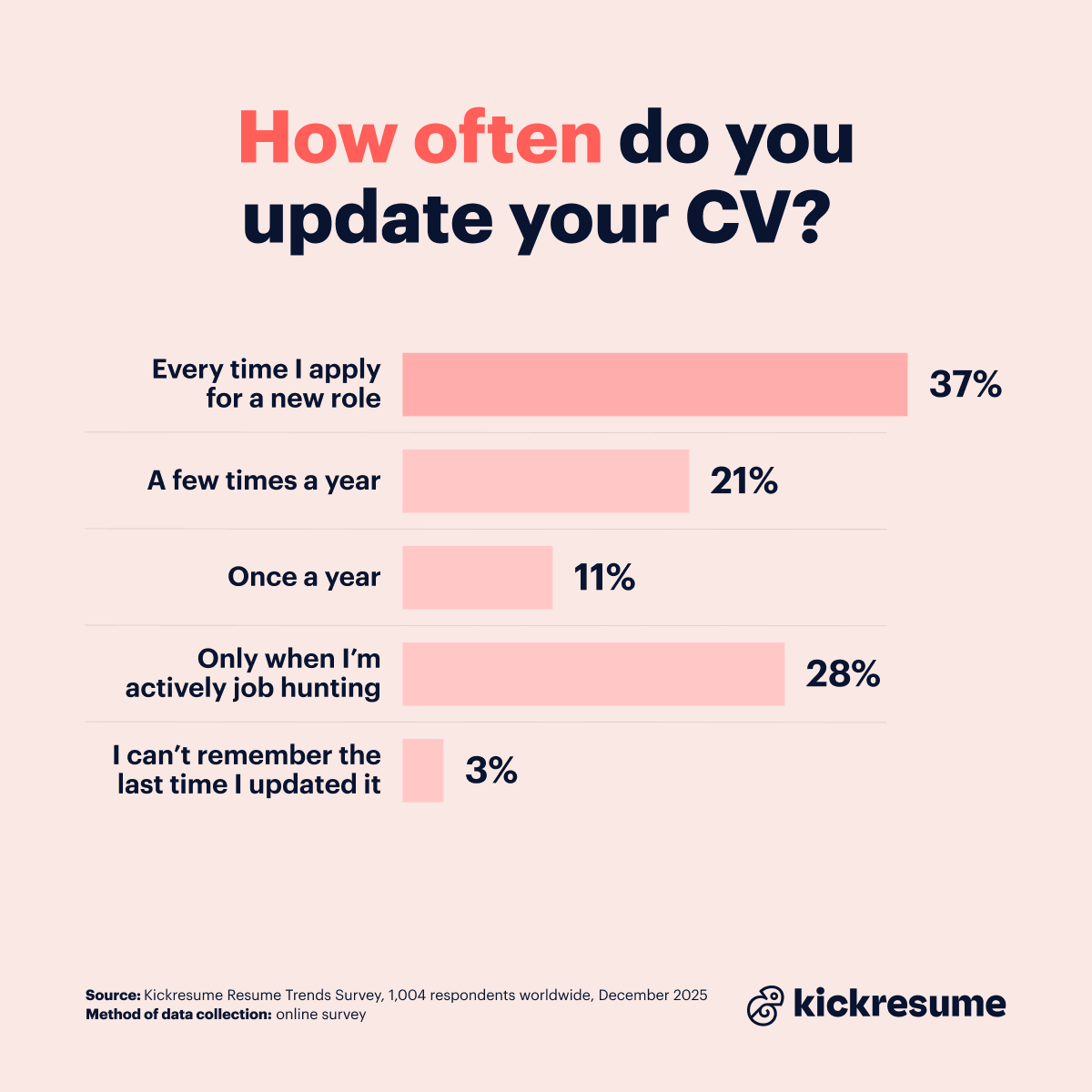
Taken together, the data suggests that tailoring and frequent updates aren’t about perfection — they’re about relevance. When recruiters scan CVs for fit early on, candidates respond by shaping their CVs so the most relevant information is immediately visible.
Humour on CVs is rare: 58% keep things strictly formal
As candidates tailor and update their CVs to surface relevant information faster, there’s one area where most still hold back: tone.
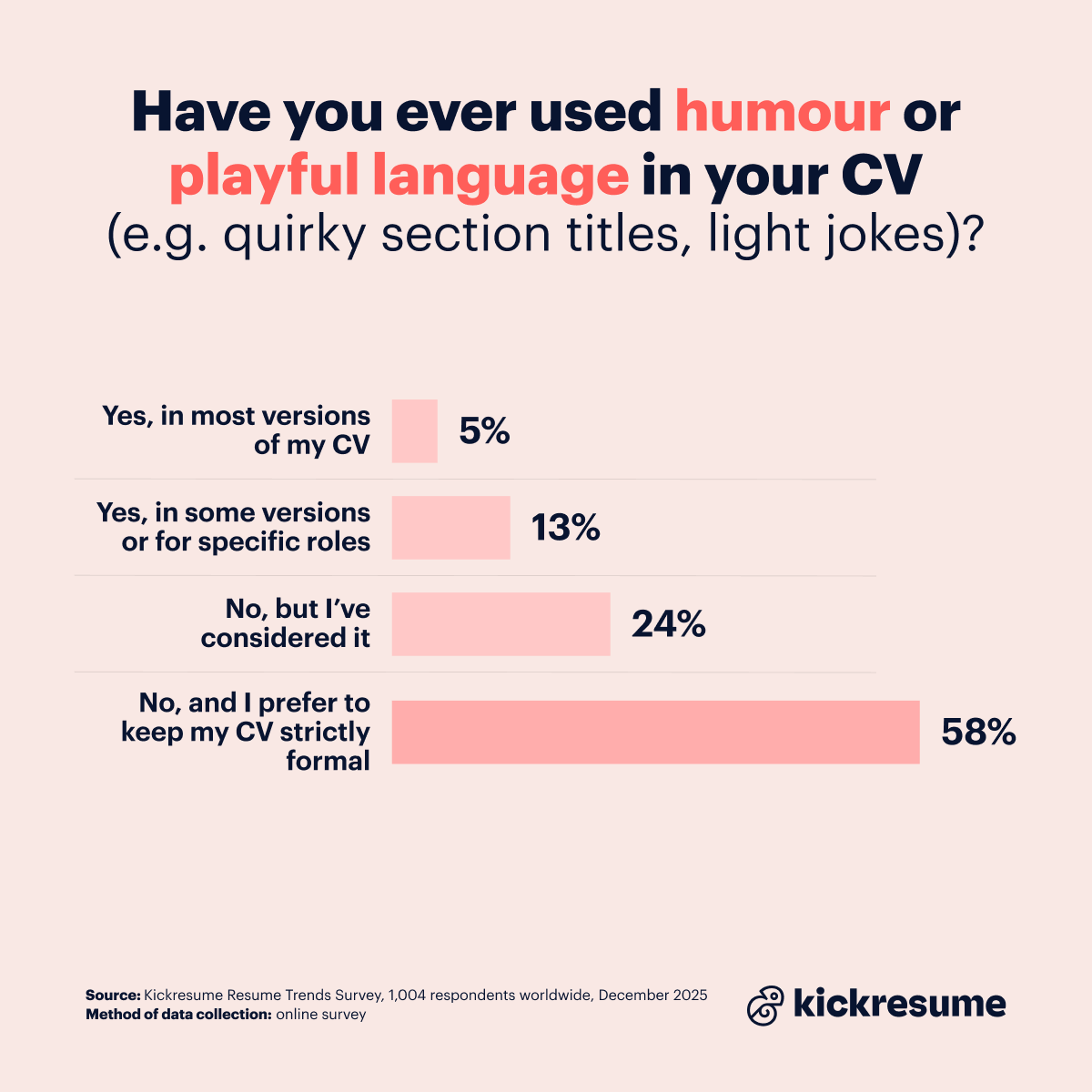
When asked whether they’ve ever used humour or playful language in their resume — such as quirky section titles or light jokes — the majority say they prefer to keep things formal:
- 58% say they’ve never used humour and prefer a strictly formal CV
- 24% say they haven’t used it, but have considered it
- 13% say they’ve used humour in some versions or for specific roles
- Just 5% say they use humour in most versions of their CV
In other words, nearly 6 in 10 candidates actively avoid humour, while only a small minority consistently experiment with it.
The pattern is remarkably consistent across age groups, genders, and regions. Even among Gen Z — often seen as more informal in online communication — 57% say they prefer to keep their CV strictly formal, and only 18% say they’ve used humour in any form.
This caution likely reflects how candidates interpret the early screening process. When recruiters scan CVs quickly for fit, playful language can feel like a risk — something that may distract from key information or be misread in a high-stakes context.
“Relevance feels necessary. Humour still feels optional — and potentially costly if it backfires.”
The results suggest that while candidates are willing to invest time in tailoring content, they are far less willing to experiment with tone. Relevance feels necessary. Humour still feels optional — and potentially costly if it backfires.
Same process, slightly different expectations across regions
While the overall patterns are consistent globally, a few regional differences stand out in how candidates approach their CVs and how they imagine the screening process works.
In the United States, job seekers are more likely to expect extremely fast CV reviews. Nearly one in four US respondents (24%) believe recruiters spend under 10 seconds reviewing their CV, compared to 16% in Europe. Despite similar overall expectations that CVs are reviewed quickly, US candidates appear more pessimistic about how little time their application receives.
US candidates are also slightly more likely to update their CV for every application. 40% say they revise their CV each time they apply, compared to 32% in Europe, suggesting a higher perceived need to continuously adjust application materials.
Attitudes toward tone show small but noticeable differences as well. European candidates are more open to experimenting with humour or playful language, with 24% saying they’ve used it in at least some versions of their CV, compared to 14% in the US. Still, in both regions, the majority prefer to keep their CV strictly formal.
Taken together, these differences don’t point to fundamentally different hiring processes, but rather to variations in how candidates respond to the same pressures — speed, relevance, and early screening — across job markets.
Final thoughts: What really happens after you click “Apply”
The survey results paint a clearer picture of what happens once a CV lands in a recruiter’s inbox.
Most CVs are not read line by line from start to finish. 62% of recruiters admit they’ve rejected candidates without fully reading the CV, usually because key requirements weren’t met early on. At the same time, recruiters report spending more time on CVs than job seekers expect them to — often one to three minutes, and sometimes longer.
Candidates seem well aware of this reality. Even though 56% believe recruiters spend 30 seconds or less on their CV, nearly three quarters still tailor their CVs for each role, and 37% update their CV every time they apply. The effort is clearly there — not to say more, but to say the right things faster.
What’s striking is where candidates don’t experiment. Despite constant tailoring and frequent updates, 58% keep their CV strictly formal, avoiding humour or playful language altogether. In a process they perceive as fast and high-stakes, clarity and professionalism still outweigh originality.
Put simply, the data suggests that candidates optimize for relevance and recruiters scan for fit. And the space in between is where most hiring decisions begin.
Demographics
Role
- HR-related: 12%
- Non-HR: 79%
- Others: 9%
Gender
- Male: 67%
- Female: 31%
- Non-binary or other: 2%
Age
- Under 18: 1%
- 18–28: 29%
- 29–43: 42%
- 45–60: 24%
- 61–79: 4%
- 79 or older: <1%
Location
- Africa: 9%
- Asia: 21%
- Australia/Oceania: 2%
- Europe: 28%
- Latin America: 9%
- North America: 31% (84% based in the USA)
Note
This anonymous online survey by Kickresume, conducted in December 2025, gathered insights from 1,004 respondents globally. All participants were reached via Kickresume's internal database.
About Kickresume
Kickresume is an AI-based career tool that helps candidates source jobs and raise salary with powerful resume and cover letter tools, skills analytics, and automated job search assistance. It has already helped more than 8 million job seekers worldwide.