Flexible schedules, time off for childcare, leaving early for school pickup — workplace accommodations for parents are common. But how do coworkers without children actually see them?
To better understand this perspective, Kickresume surveyed 1,022 respondents worldwide as part of its Parenthood & Productivity Survey.
In this part of the survey, we focused on how non-parents perceive workplace support for parents — from flexibility requests and workload adjustments to broader questions of fairness. To provide additional context, we also compared these perceptions with how parents themselves say they are treated at work.
In a nutshell, the results show that workplace tensions around parenting may be less about parents themselves — and more about how flexibility and workload are managed.
Here are some of the key findings:
- 64% of non-parents believe parents receive at least some special treatment at work.
- 71% believe parents are equally or more productive than non-parents. Among Gen X, only 7% believe parents are more productive.
- 86% react positively or neutrally to flexibility requests from parents.
- 87% support workplace help for parents, but most (62%) say workloads must remain balanced.
- 46% say nothing about parents at work frustrates them.
- 39% think equal flexibility for all employees is the best way to support parents without creating resentment.
- 73% say better workplace support could influence their decision to have children — including 56% of Gen Z who say it definitely would, the highest share across generations.
- Nearly half of parents (47%) say coworkers treat them the same after becoming parents.
- Fathers report more positive reactions from coworkers than mothers (28% vs 17%).
- 75% of parents say they feel at least somewhat supported by their workplace — though men are more likely to report full support than women (36% vs 24%).
- Gen Z consistently appears as the most supportive generation — including 55% who react positively to flexibility requests and 30% who unconditionally support additional help regardless of workload impact for others.
64% of non-parents say parents get special treatment — yet nearly half say nothing frustrates them
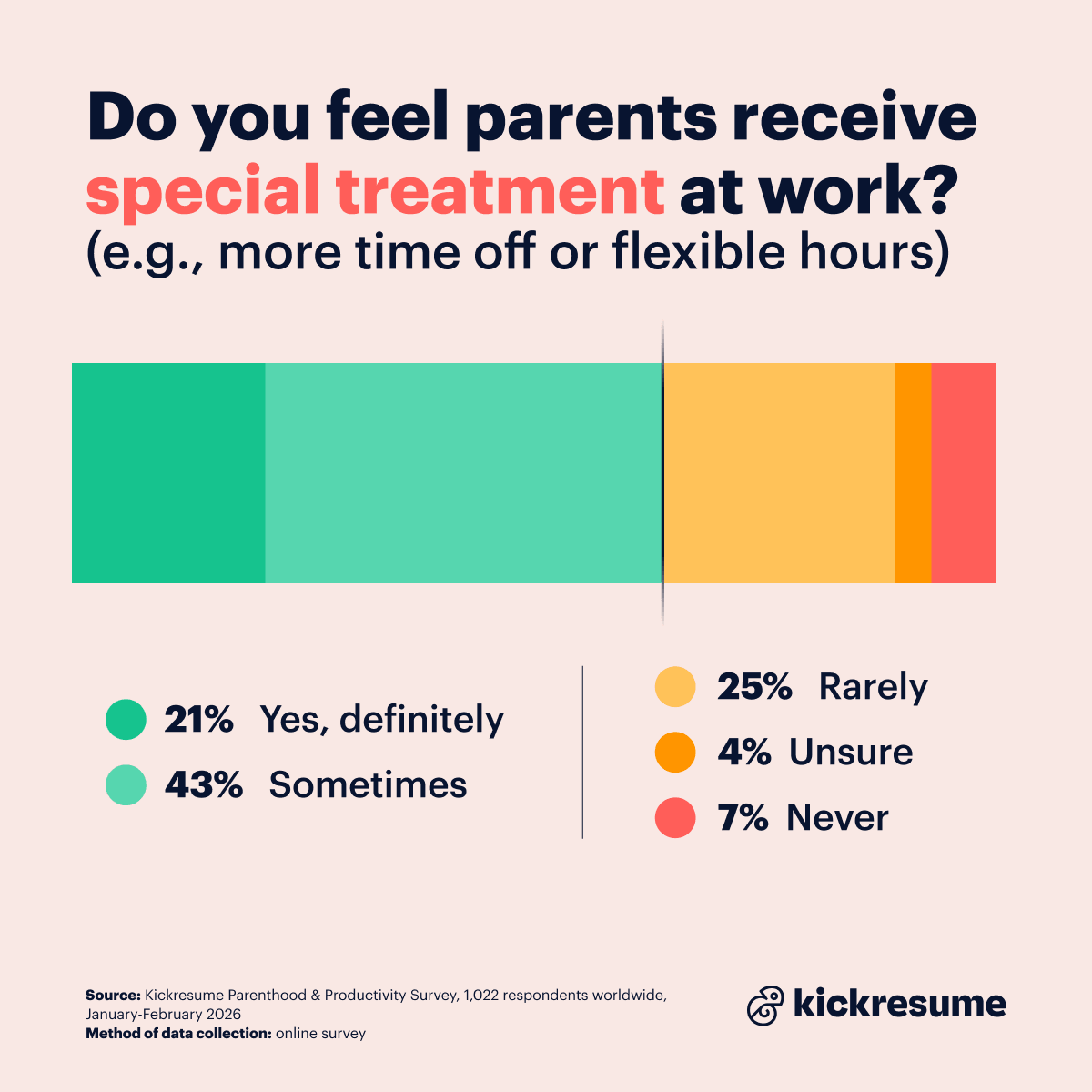
Questions about fairness often come up when parents receive flexibility at work. When asked whether parents receive special treatment at work — such as more time off or flexible hours — most non-parents say they believe some level of preferential treatment exists.
Overall, 64% of respondents say parents receive special treatment at least occasionally, including 21% who say it definitely happens and 43% who say it sometimes occurs. Only 7% say parents never receive special treatment.
Here’s the full breakdown:
- Yes, definitely: 21%
- Sometimes: 43%
- Rarely: 25%
- Never: 7%
- Unsure: 4%
But at the same time, frustration toward parents remains relatively low. When asked about the biggest frustration with parents at work, 46% of non-parents say nothing frustrates them.
Among those who do report frustrations, the most common issues are:
- Frequent schedule changes: 18%
- Flexibility expectations: 15%
- Talking about family too much: 9%
- Taking extra time off: 8%
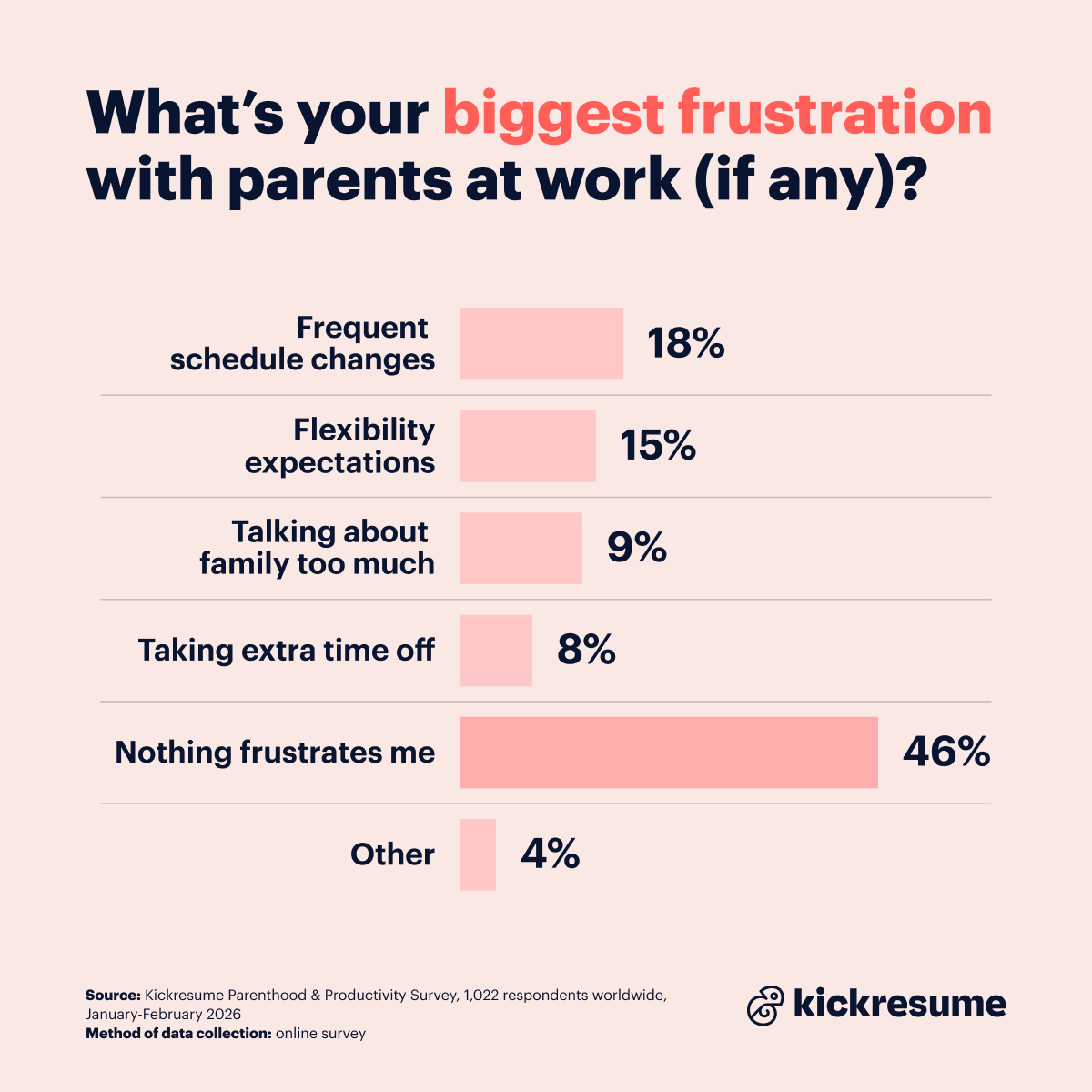
In other words, many coworkers recognize that parents may receive certain accommodations — but that doesn’t necessarily translate into resentment. When frustrations do appear, they are more often tied to scheduling or workload coordination than to negative attitudes toward parents themselves.
Perceptions of special treatment are fairly similar across generations, though they increase slightly among older workers.
Among Gen Z, 57% say parents receive special treatment at least occasionally. This rises to 70% among Millennials and 74% among Gen X, suggesting that older employees may simply notice workplace adjustments for parents more often.
Gen X also appears slightly more critical overall: only 36% say nothing about parents at work frustrates them, compared to nearly half of Gen Z (47%) and Millennials (48%).
This may partly reflect experience. Employees who have spent longer in the workforce may notice parenting-related adjustments more often, while younger workers may be more used to flexible schedules in general.
Still, the overall pattern remains consistent: in every generation, a majority believes parents receive at least some preferential treatment at work.
Regional differences are particularly noticeable.
In Europe (73%) and the US (72%), large majorities believe parents receive special treatment at work at least sometimes. In Asia, the share drops to 53%, and the region also records the highest share of respondents who say parents never receive special treatment (15%) — compared to 6% in Europe and only 2% in the US.
.png)
This may partly reflect stronger family support networks in many Asian societies, where childcare is more often shared with extended family members such as grandparents. When parents rely less on workplace flexibility, these adjustments may simply be less visible to coworkers.
Taken together, the data shows that while perceptions of special treatment are common, strong resentment toward parents remains relatively rare.
71% believe parents are just as productive — or even more
If coworkers notice special treatment for parents, the next question is often productivity. But when asked whether parents are more or less productive than non-parents, most respondents do not see a drop in performance.
Overall, 53% of respondents say parents are about as productive as non-parents, while another 18% believe parents are actually more productive.
Together, this means 71% see parents as at least equally productive in the workplace.
Here’s the full breakdown:
- More productive: 18%
- About the same: 53%
- Slightly less productive: 25%
- Much less productive: 4%
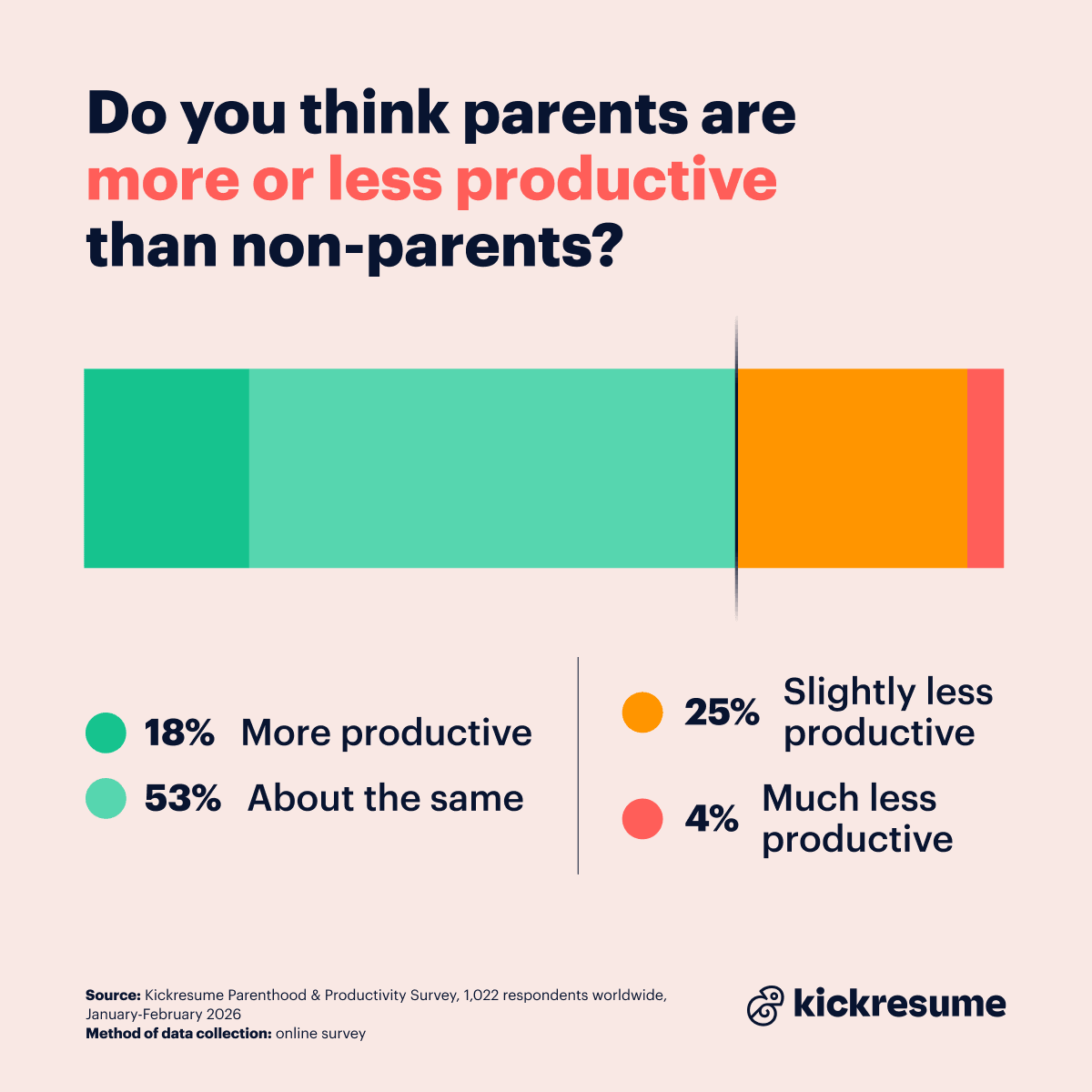
Some skepticism does exist, but it remains limited. Roughly 1 in 4 respondents (25%) say parents are slightly less productive, while a small minority (4%) believe they are much less productive.
In other words, even though many coworkers think parents receive certain accommodations, most do not associate parenthood with lower productivity.
Generational differences are relatively modest but still visible.
Among Gen Z, 22% say parents are more productive than non-parents, while 51% say productivity is about the same. Millennials show a similar pattern, with 14% saying parents are more productive and 55% saying productivity is roughly equal.
Gen X stands out as the most skeptical generation: only 7% believe parents are more productive, the lowest share in the survey, though two-thirds (66%) still believe productivity is about the same.
Overall, the results suggest that while workplace accommodations for parents may be visible, most coworkers do not interpret them as a sign of lower performance.
Nearly 9 in 10 coworkers react positively or neutrally when parents request flexibility — with Gen Z the most supportive
Requests for flexibility — such as leaving early, working remotely, or adjusting schedules — are one of the most visible workplace accommodations for parents. And the data suggests that most coworkers respond to these requests with understanding rather than frustration.
According to the survey, 86% of coworkers react either positively or neutrally when parents request flexibility.
Here’s how the responses break down:
- Supportive: 51%
- Neutral: 35%
- Slightly annoyed: 12%
- Very annoyed: 2%
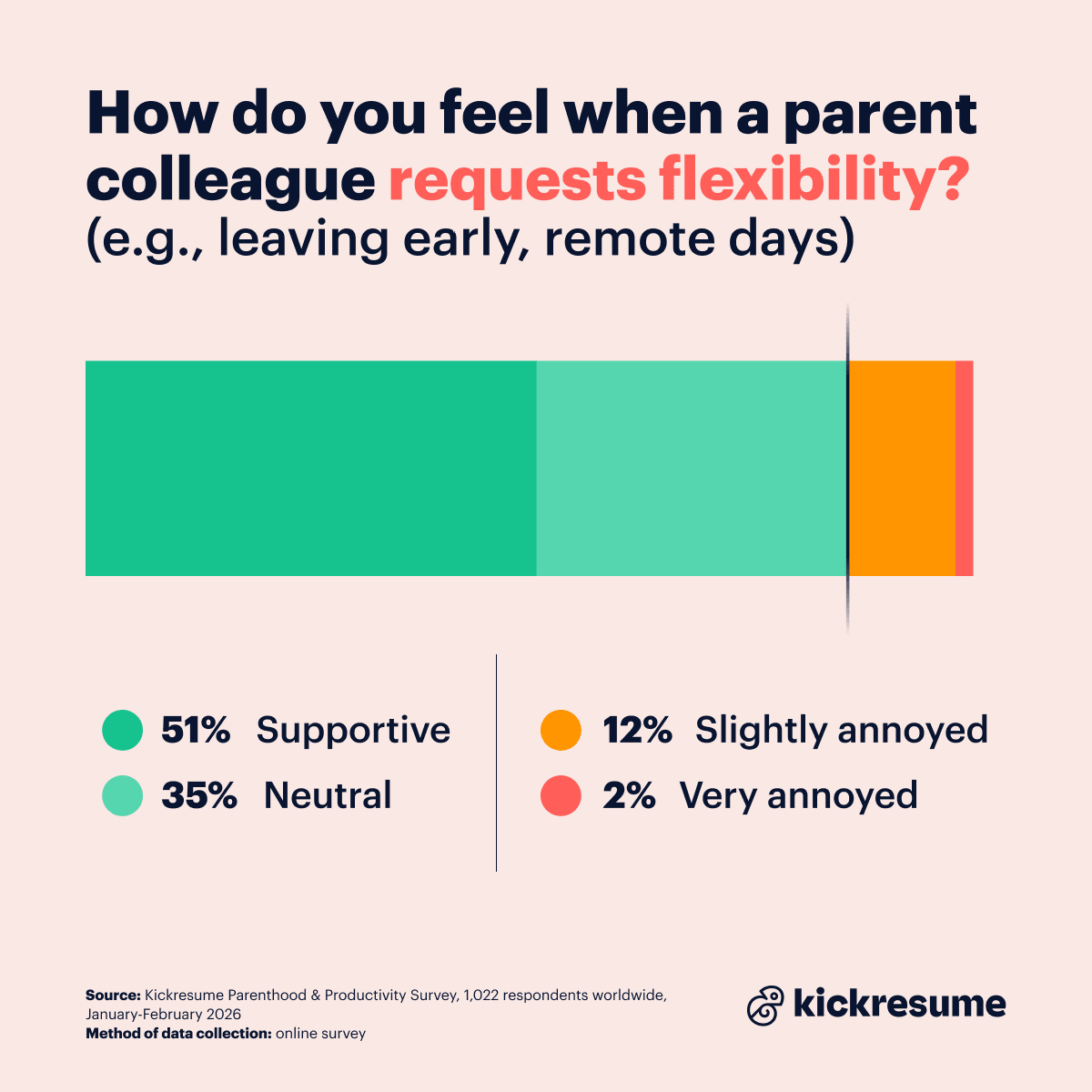
In other words, only about 1 in 7 coworkers (14%) feel annoyed when parents request flexibility at work.
Generational differences stand out more in this question.
Among Gen Z, 55% say they feel supportive when parents request flexibility, and only 9% report feeling annoyed. Millennials show a similar pattern, with 50% supportive and 16% annoyed.
Among Gen X, however, reactions are more mixed. Only 39% say they feel supportive, while 23% report feeling annoyed — the highest share among all generations.
.png)
The generational contrast is clear: Gen Z are the most supportive of parental flexibility, while Gen X are the most likely to feel annoyed by it.
One possible reason is how different generations view workplace flexibility in general. Younger employees often see flexible schedules or remote work as a normal part of modern workplaces, while older generations may be more used to traditional work structures.
Taken together, the results show that flexibility for parents is widely accepted by coworkers — especially among younger employees — even if perceptions of special treatment still exist.
87% support workplace help for parents — but most say that workload must stay fair
Support for parents at work is widespread — but many employees say it should not come at the expense of their colleagues.
When asked whether workplaces should offer more support to parents, even if it impacts workload for others, most said yes — at least to some extent.
Overall, 87% say they support additional help for parents in the workplace.
However, only 25% support it unconditionally. Most respondents (62%) added an important condition: the workload must remain fair across the team.
Here’s the full breakdown:
- Yes, definitely: 25%
- Yes, but only if workload is balanced: 62%
- No: 10%
- Unsure: 3%
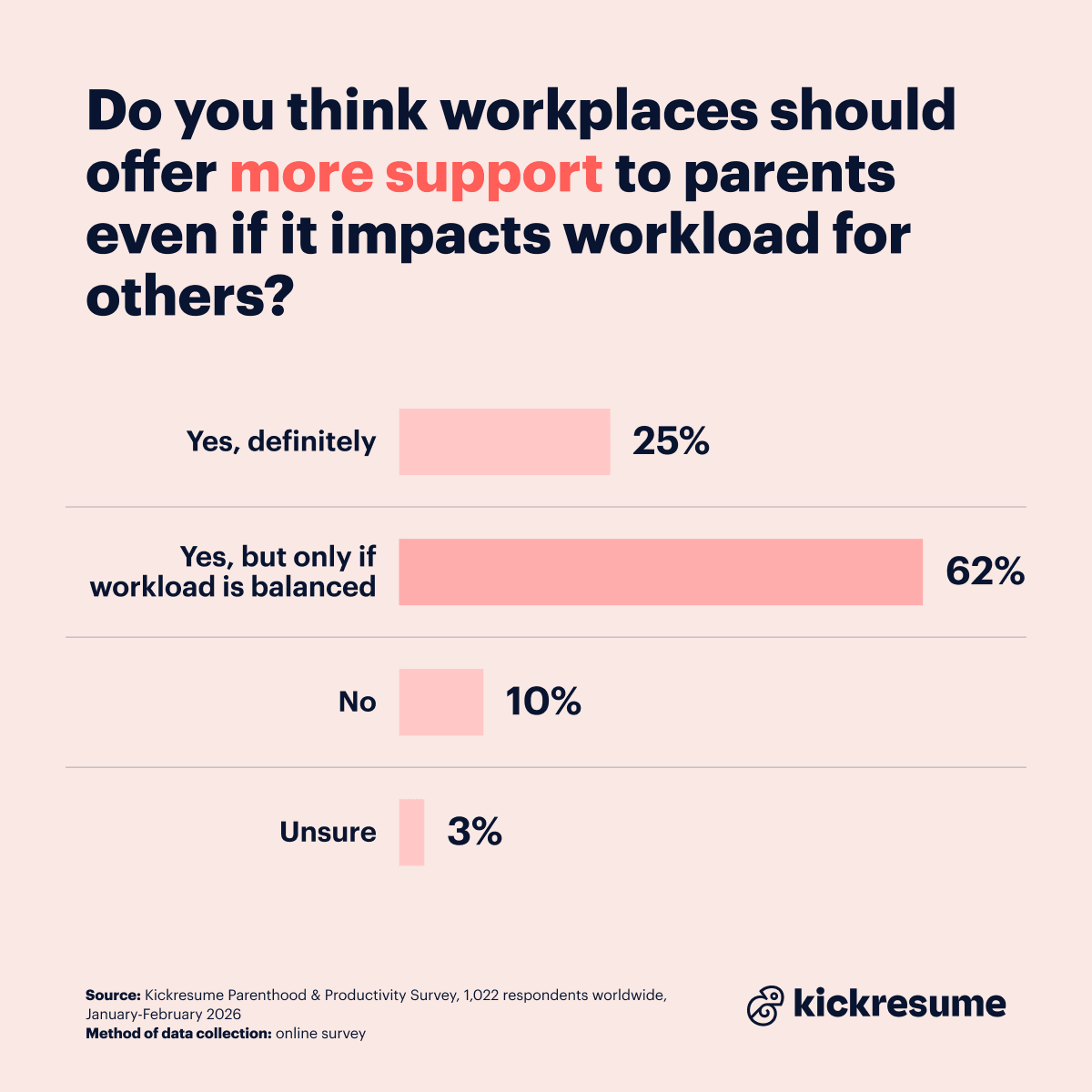
In other words, coworkers generally support workplace accommodations for parents — but many emphasize that these policies should not create uneven responsibilities within teams.
Generational differences follow a similar pattern. In every age group, the largest share of respondents say they support additional help for parents only if workloads remain balanced.
Among Gen Z, 60% express conditional support for additional help, compared to 67% of Millennials and 65% of Gen X.
Unconditional support is somewhat more common among younger respondents. About 30% of Gen Z say they support additional help for parents regardless of workload impact, compared to 21% of Millennials and 17% of Gen X.
Across several questions in the survey, Gen Z respondents consistently appear the most supportive of parenting-related flexibility at work.
Gen X respondents show slightly higher skepticism: 15% say workplaces should not offer additional support for parents, the highest share among all generations (compared to 10% of Millennials and 8% of Gen Z).
Overall, the results show that support for parents at work is strong — but fairness in how work is shared still matters to employees.
Equal flexibility matters more than special policies
While most coworkers say they support parents at work, many also stress that fairness across the team matters. So we asked what would actually help reduce tension between parents and non-parents at work.
The most common answer: equal flexibility for everyone — not special policies for specific groups.
39% of respondents say offering equal flexibility for all employees would be the most effective way to reduce resentment.
Other frequently mentioned solutions focus on clearer expectations around workload and communication:
- Clear workload redistribution: 20%
- Transparent policies: 18%
- Regular communication: 12%
- Better staffing: 10%
- Other: 1%
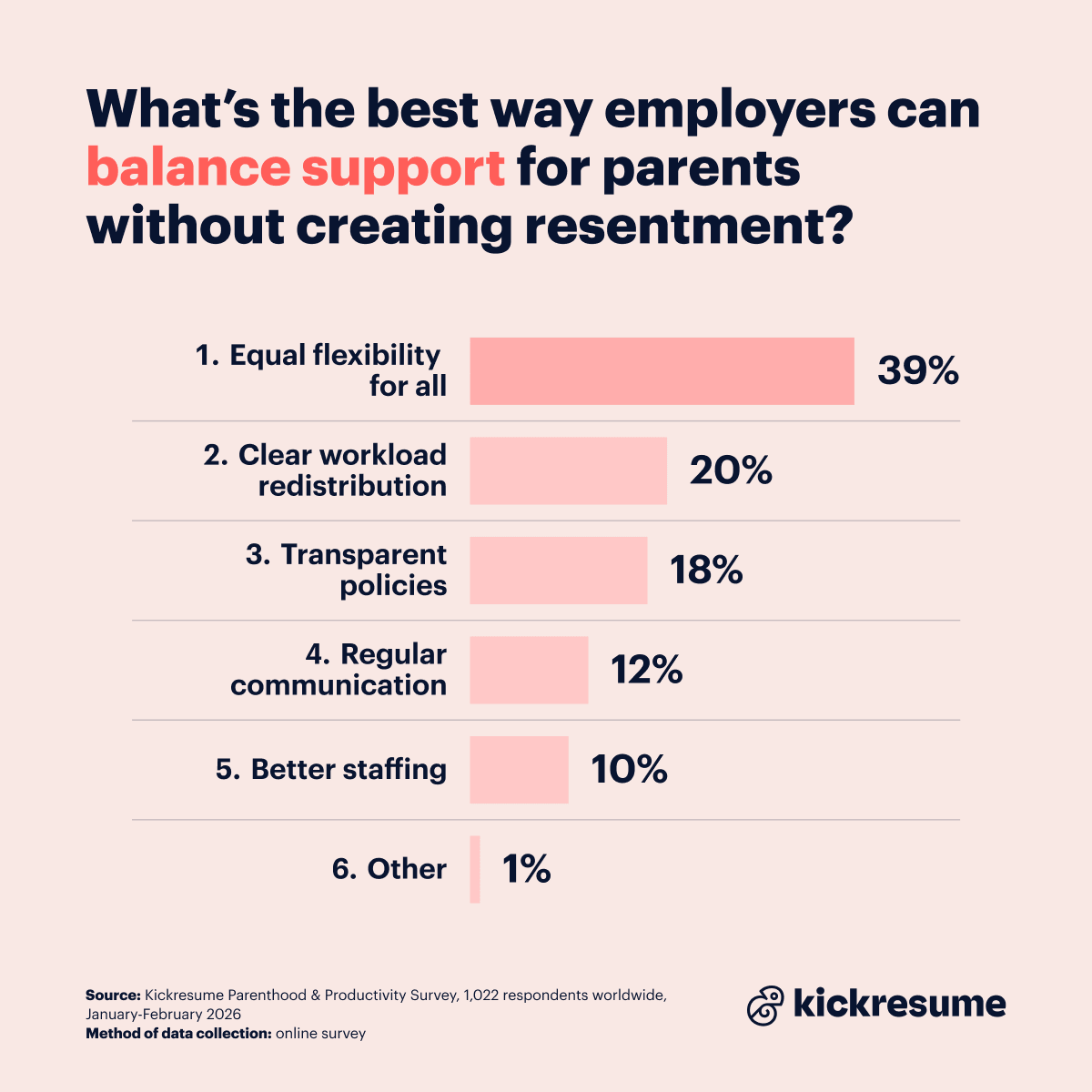
In other words, the issue isn’t flexibility itself. It’s whether that flexibility feels fair.
Resentment is far less likely when flexibility is seen as a shared workplace norm rather than a special accommodation.
This suggests that coworkers are not necessarily asking for fewer accommodations for parents. Instead, they want those accommodations to be structured in a way that feels fair to everyone.
That distinction may matter not only for day-to-day workplace dynamics, but also for how people think about starting a family in the future.
47% say workplace support could influence decisions to have children — with Gen Z leading the trend
Across the survey, one theme appears again and again: support for parents matters — but fairness matters too. That raises another question: could better workplace support influence whether people choose to have children at all?
When non-parents were asked whether better parental support at work would make them more likely to have children, nearly three-quarters said it could influence their decision.
Overall, 48% say it definitely would, while another 25% say maybe. Together, that means 73% say better workplace support could influence their decision to some extent. Meanwhile, 18% say no and 9% are not sure.
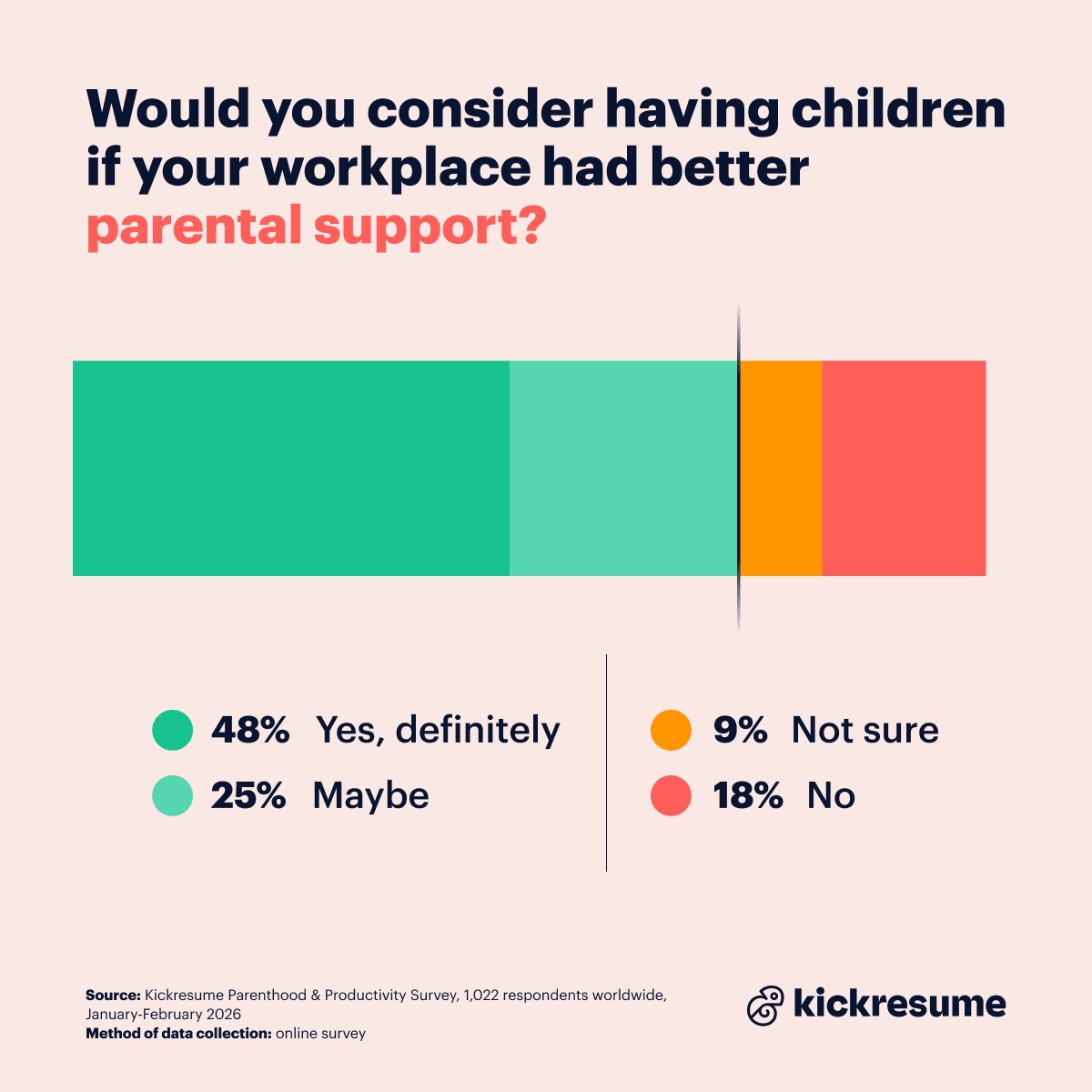
The effect is strongest among younger employees.
Among Gen Z, 56% say better workplace support would definitely make them more likely to have children, while another 24% say maybe. Among Millennials, 49% say definitely and 23% say maybe. Gen X stands apart: only 19% say definitely, while 45% say better support would not influence their decision.
This likely reflects life stage. Younger employees are more likely to be actively thinking about whether or when to start a family, making workplace conditions a more immediate factor in that decision.
Importantly, this doesn’t contradict earlier findings in the survey. While many respondents emphasize fairness and equal flexibility rather than special policies for parents, broader workplace conditions — such as flexible schedules or supportive management — can still shape how people think about starting a family.
Put simply, employees may not be asking for special treatment for parents — but better workplaces could still make parenthood easier to consider.
But outside perceptions are only one side of the story. To understand whether support is actually felt in practice, it also helps to look at how parents themselves say they are treated by coworkers.
Nearly half of parents say coworkers treat them the same — though some notice differences
Much of the survey questions focused on how non-parents perceive parents at work — from flexibility to fairness. But how do parents themselves experience these dynamics?
To find out, we asked parents whether becoming a parent changed how colleagues treat their work or availability.
For many, the answer is simple: 47% of parents say they notice no difference in how coworkers treat them after becoming parents.
At the same time, positive reactions are a bit more common than negative ones. Overall, 24% say colleagues treat them more positively, while 19% say they have experienced somewhat or very negative treatment.
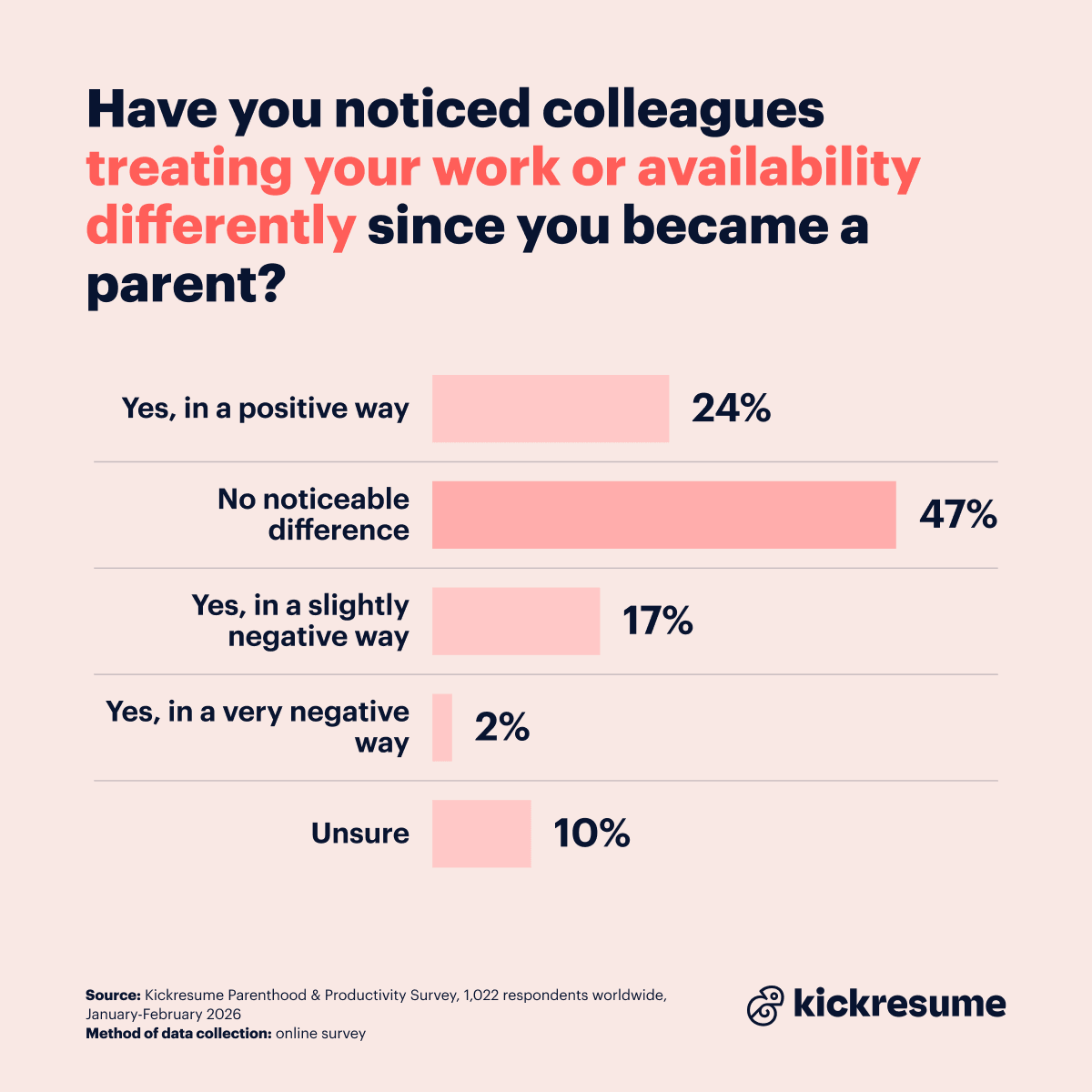
Generational differences stand out in this question.
More than half of Gen Z parents (52%) say coworkers treat them more positively after becoming parents — far higher than among older generations. Only 24% report no noticeable difference.
Among Millennials, responses closely mirror the overall results: 46% say they see no difference, while 24% report more positive treatment.
Gen X parents are the most likely to report no change, with 55% saying coworkers treat them the same as before.
.png)
Gender differences also appear.
Men are more likely to report positive reactions, with 28% saying coworkers treat them more positively after becoming parents, while 49% say they notice no difference. Among women, only 17% report positive treatment, while 42% say they notice no change.
At the same time, women are more likely to report negative experiences: 22% say coworkers treat them slightly worse and 3% report very negative treatment, compared to 15% and 1% among men.
Regional differences are visible as well:
- Positive reactions from coworkers are most common in Asia, where 35% of parents say colleagues treat them more positively after becoming parents.
- In Europe, the share is 25%, while in the US, it drops to 16%.
- Meanwhile, parents in the US are the most likely to report no noticeable difference (52%), compared to 51% in Europe and 43% in Asia.
After becoming parents, many employees also say they feel supported by their workplaces overall.
According to the survey, 75% of parents say their workplace supports parents at least somewhat, including 32% who say they feel fully supported and 43% who say they feel somewhat supported.
However, that experience is not identical for everyone. Men are more likely to say they feel fully supported (36%) than women (24%), suggesting that workplace support may still be experienced differently depending on gender.
Interestingly, fathers in the survey report more positive reactions from coworkers and are more likely to say they feel fully supported at work than mothers. One possible explanation may lie in how parenthood is perceived at work. Previous research often points to a “motherhood penalty” and a “fatherhood bonus,” where fathers are sometimes viewed more positively after having children, while mothers may face greater expectations around caregiving.
Overall, the results show that while many parents do not notice major changes in how coworkers treat them, experiences are not identical across groups. Positive reactions appear somewhat more common than negative ones — though they vary by generation, gender, and region.
Final thoughts: fairness matters more than parenthood itself
Overall, the findings point to a simple theme: tensions between parents and non-parents at work are often less about parenthood itself and more about how flexibility and workload are handled.
While 64% of non-parents believe parents receive special treatment, frustration toward parents remains relatively low. In fact, 46% say nothing about parents at work frustrates them, and most coworkers say they react positively or neutrally when parents request flexibility.
At the same time, support for parents comes with a clear condition. 62% of employees say workplace support should exist only if workloads remain balanced across teams, highlighting how strongly fairness shapes workplace attitudes.
The survey also suggests that workplace culture can influence decisions beyond the office. 73% of non-parents say better workplace support could make them more likely to consider having children, with the strongest effect among younger employees.
Across several questions in the survey, Gen Z respondents consistently appear the most supportive of workplace flexibility for parents, suggesting that younger workers may be shaping a more parent-friendly workplace culture.
In the end, the question for employers may not be whether to support parents — but how to do it in a way that feels fair to everyone.
Demographics
Role
- Parent: 55%
- Non-parent: 45%
Gender
- Male: 70%
- Female: 30%
- Non-binary or other: <1%
Age
- Under 18: 2%
- 18–28: 25%
- 29–44: 48%
- 45–60: 24%
- 61–79: 1%
- 79 or older: <1%
Location
- Africa: 12%
- Asia: 24%
- Australia/Oceania: 1%
- Europe: 29%
- Latin America: 10%
- North America: 24% (87% based in the USA)
Note
This anonymous online survey by Kickresume, conducted in January-February 2026, gathered insights from 1,022 respondents globally. All participants were reached via Kickresume's internal database.
About Kickresume
Kickresume is an AI-based career tool that helps candidates source jobs and raise salary with powerful resume and cover letter tools, skills analytics, and automated job search assistance. It has already helped more than 8 million job seekers worldwide.