Have you ever scrolled LinkedIn and wondered if the posts you’re seeing were written by a person or a robot? It can be hard to tell whether a post was written from scratch, lightly polished with AI, or generated entirely by it.
To find out who’s actually leaning on AI, Kickresume analyzed 275 LinkedIn posts using GPTZero, an AI detection tool, and compared AI probability scores across seniority levels, industries, and regions.
Here’s a snapshot of our key findings:
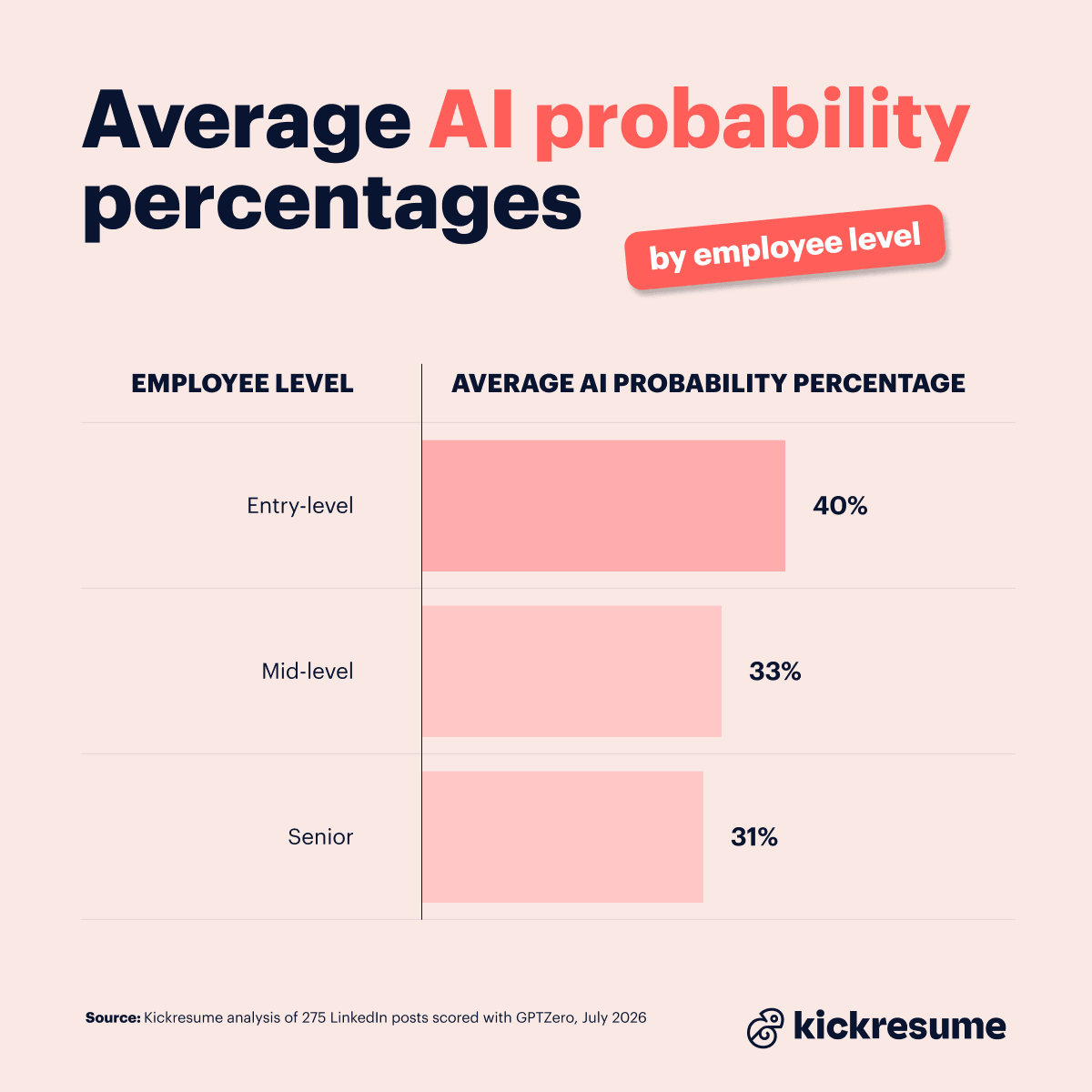
- Entry-level employees score the highest of any seniority level, at 40%.
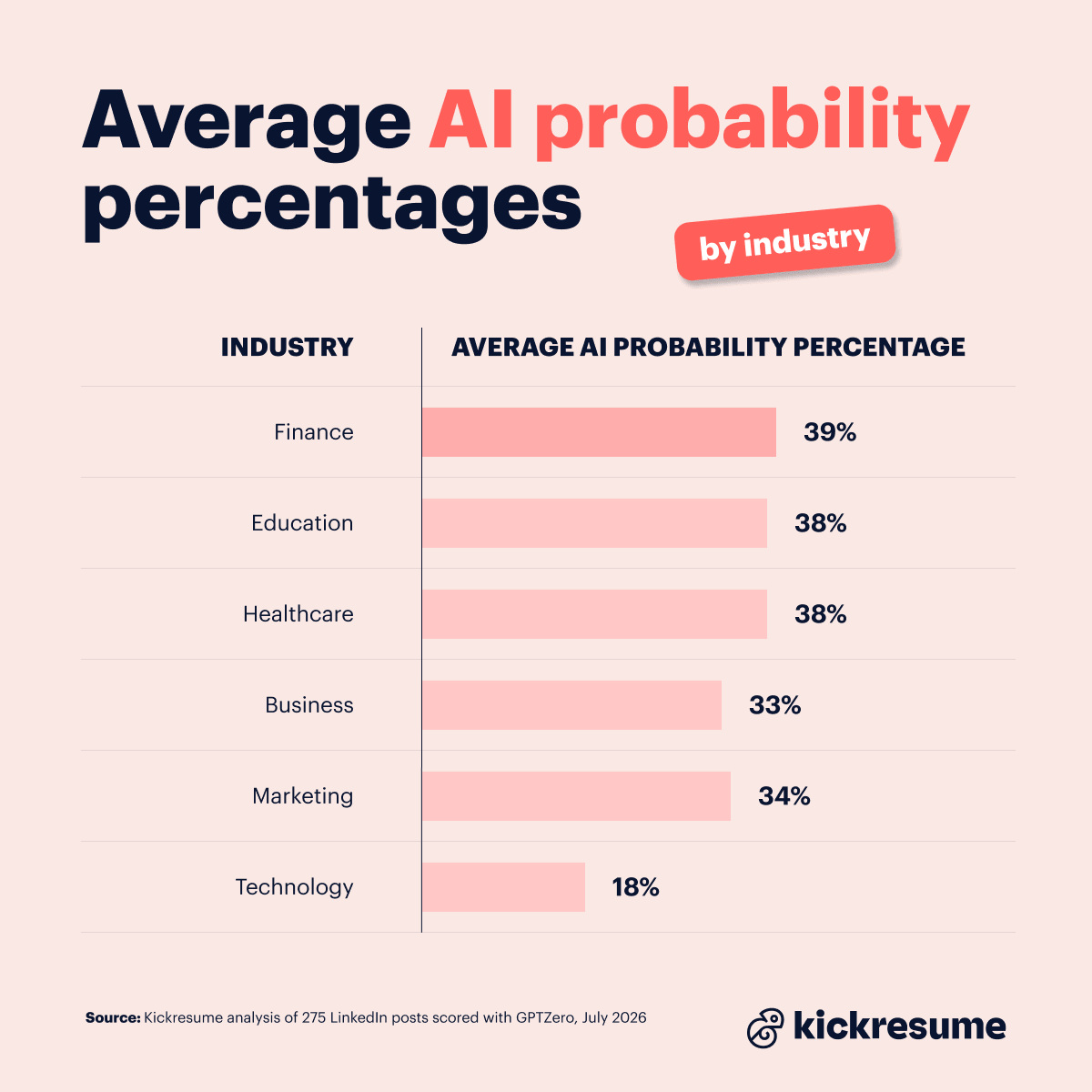
- Finance is the industry with the highest average AI probability score at 39%.
- Entry-level healthcare workers are the demographic with the highest score, at 62%.
- The technology sector has an average score of 18%, making it the lowest-scoring industry.
- Senior employees have the lowest probability scores out of every level, at 31%.
Junior employees score highest of any level, at 40%
Our research revealed that junior workers are overall the most likely to use AI to write their LinkedIn posts. We found the average AI probability score for entry-level employees is 40%, compared to 33% for mid-level workers and 31% for senior executives. Just 20% of entry-level posts scored a clean 0%.
Getting a foot in the door is hard enough already. Professionals early in their careers may also feel more pressure to establish their voice and build credibility on LinkedIn. This may be one reason their posts show higher AI probability scores.
There’s likely a language gap driving this, too. In a previous study, we found that Gen Z workers hate corporate jargon, as 85% of LinkedIn posts about this topic were negative — many saying it sounds like a different language. If corporate language feels unnatural but is still necessary to sound credible, AI is an easy way to bridge the gap between the two.
Junior healthcare professionals stand out within this group: they post the highest AI probability score of any group in the entire study, at 62%. With demanding schedules and little time left for social media, these workers may be turning to AI simply to keep posting consistently without the extra time cost.
At the other end of the ladder, high-level senior employees like CEOs, directors, and professors scored lowest, with an average AI probability score of 31%. It tracks: after years in the role, most have tons of experience and clear opinions to draw on, so writing a quick LinkedIn post in their own words comes easily.
Mid-level crisis: Why middle management may use AI to manage their workload
Junior workers aren’t the only ones reaching for AI out of necessity. Our research found that mid-level business employees f are the second-most AI-reliant group, at 57%, just behind junior healthcare workers.
Middle management can be a demanding level to sit at. Professionals at this level often manage teams and are tasked with critical deliverables — in short — they’re busy. LinkedIn Premium’s built-in AI writing suggestions may be part of the story — mid-level managers may be more likely to invest in Premium as they build their careers — while those with a free account are more likely reaching for third-party AI tools like ChatGPT, Gemini, or Claude instead.
The industry with the highest probability of using AI? Finance comes out on top, at 39%
Moving on from seniority levels to specific industries, we found that workers in finance are the most likely to use AI for LinkedIn posts, with a 39% average AI probability score.
A likely driver here is simple time economics: in a field that prizes speed, spending 20 minutes crafting a LinkedIn post is a hard sell when a tool can draft one in seconds.
Senior finance executives stand out here, at 46% — the third-highest of the level-industry groups, behind entry-level healthcare and mid-level business workers. That's notable because senior employees in every other field scored low — suggesting the pressure to post consistently may outweigh seniority in finance specifically.
Tech pros build AI—but their posts are the least likely to show it
Despite working alongside technology like AI, the tech industry was found to have the lowest AI probability scores out of all. The average AI probability percentage is just 18%, significantly lower than the second-lowest industry (business, at 33%) and the average across all industries, which is also 33%.
One possible explanation: technology experts know exactly how to spot AI-generated content, and want to avoid being caught out by their peers. A low score here may mean "edited well," not "didn't use AI." Since tech experts understand AI inside out, they may still be generating a first draft using AI and then editing out any telltale signs.
While AI is a great tool that can help craft a compelling post, using it to create an online persona without adding any human insight can be seen as inauthentic.
This may be why the demographic least likely to use AI, according to our research, are entry-level technology workers. These employees may be cautious of using AI to write their LinkedIn posts, in case it looks obvious. This category has an AI probability score of just 4%, the lowest out of every industry and seniority level combination.
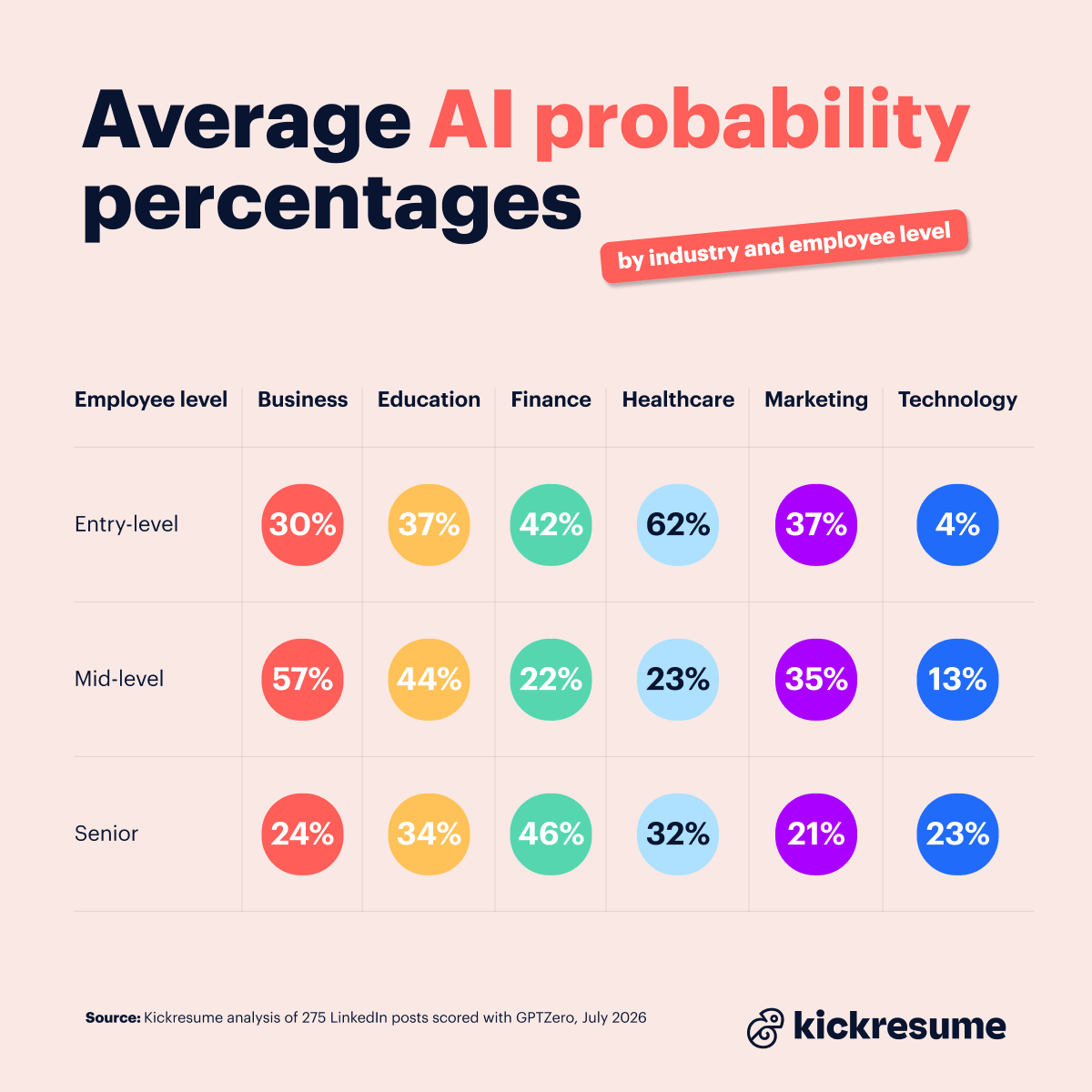
Following entry-level workers, mid-level technology employees were found to have the second-lowest AI probability percentage at 13%. High-level technology workers were also found to have one of the lowest percentages, at just 23%. Across every level, technology comes out as the industry most likely to stay visibly human on LinkedIn.
U.S. vs. Europe: America out-scores Europe on AI in most industries
Breaking it down by region, we found that the U.S. has a higher AI probability score than European workers — 35% vs. 31%. And in almost every industry, posts by U.S. workers were more likely to have been created using AI. When looking at specific industries, finance workers in the U.S. were found to have an average score of 50%, the highest of any single industry-and-region group.
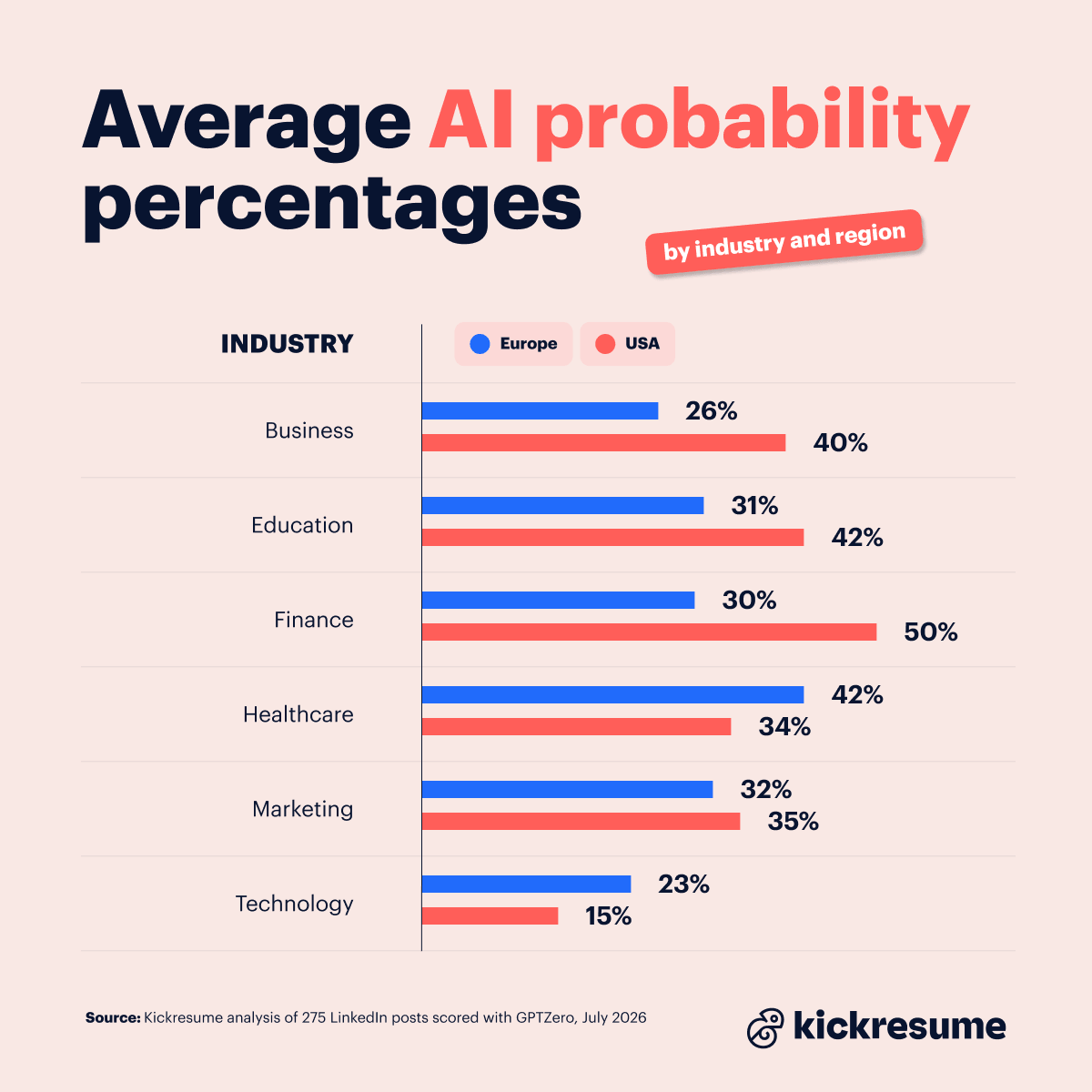
In Europe, healthcare is the top-scoring industry at 42%. In both Europe and the States, the technology industry had the lowest percentages, at 15% in the U.S. and 23% in Europe.
Working hours may help explain this gap. In a previous study, we found that employees in the U.S. work more hours than those in Europe. We found that 26% of European employees work between 41 and 50 hours per week, compared to 40% of American workers. Longer hours likely mean less time and energy left for writing a LinkedIn post from scratch — making AI the easier trade-off. Studies have also suggested that the U.S. is adopting AI technology faster than Europe.
Final thoughts
Turning to AI to build your LinkedIn persona is a practical response to having little time and a lot to keep up with. Entry-level employees across the board have the highest AI probability scores, suggesting a need to contribute to discussions online with confidence. The same can be said for U.S. employees working longer hours, and for middle managers in business who are stretched for time.
AI can make a post cleaner and more confident, but it can't come up with something worth saying. That's what the tech numbers really show: the people who know these tools best score lowest — either because they lean on them least, or because they're good enough to edit out the signs. Knowing when to use AI, and how to make it sound like you, is its own skill — and most of LinkedIn isn't there yet.
Note
Kickresume analyzed 275 LinkedIn posts in July 2026 and categorized the authors into senior, mid-level, and entry-level job titles, and by industry and region. Kickresume found LinkedIn posts and added them to a spreadsheet, along with the industry of the author. Posts were copied and pasted into GPTZero, an AI detector. Kickresume then added the AI probability percentage for each post to the spreadsheet. While this software can’t conclusively confirm that AI was used to write text, it looks for clues and patterns, including how predictable the writing is, and how much the sentence structure varies throughout. AI-generated text is usually more predictable because LLMs work word-by-word, choosing the most probable word to appear next in the sentence. Text created using LLMs also features less variation between sentence length and structure. Kickresume found the average AI probability percentages for each employee level, industry, and region to find out which demographics are the most likely to use AI on LinkedIn.
About Kickresume
Kickresume is an AI-based career tool that helps candidates source jobs and raise salary with powerful resume and cover letter tools, skills analytics, and automated job search assistance. It has already helped more than 8 million job seekers worldwide.